SAFETY FIRST
★★★★★
Very safety and detail oriented. Pre-flight briefing explained everything there was. To my knowledge, this flight school is exceptional in their ability.

Runway markings are white. Taxiway and holding position markings are yellow. Airport signs come in six types, and the one that matters most is red with white letters: the runway hold position sign, which means stop here unless you are cleared. This guide covers every marking and sign a student pilot meets, from the FAA’s own standards, and how they work on the two parallel runways at Van Nuys.
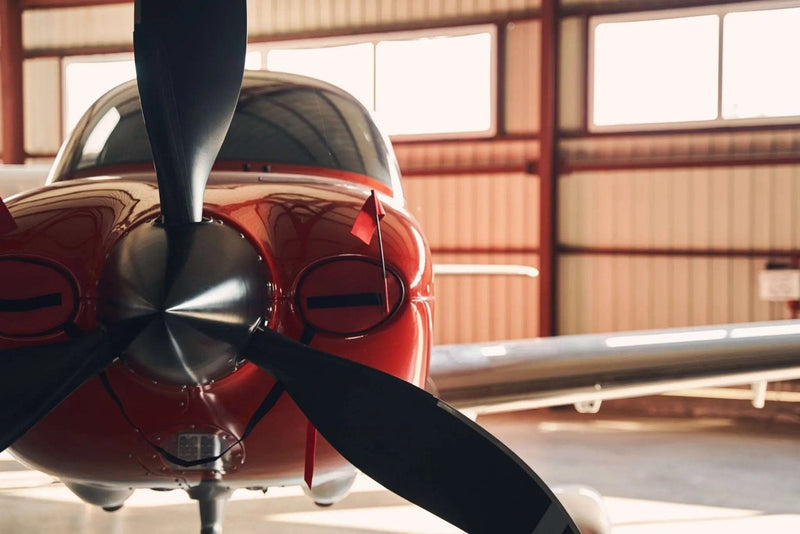
Training aircraft on the Van Nuys ramp, the start of every taxi to the runway.
The color tells you most of what you need. White paint belongs to the runway. Yellow paint belongs to taxiways, holding positions and hazards. Red signs give orders. Black signs tell you where you are. Yellow signs tell you where to go.
The FAA sets out what pilots need to know in the Aeronautical Information Manual, Chapter 2, Section 3, “Airport Marking Aids and Signs.” The airport operator builds to two advisory circulars: AC 150/5340-1M, Standards for Airport Markings (May 2019, with Change 1 of December 2020), and AC 150/5340-18H, Standards for Airport Sign Systems (September 2024). Both were the current editions when we checked the FAA advisory circular library in October 2026.
AIM 2-3-2 groups pavement markings into four kinds: runway, taxiway, holding position and other. Runway markings are white. Taxiway markings, holding position markings and markings for closed or hazardous areas are yellow, even where they are painted on a runway. That one rule lets you tell at a glance whether a painted line is yours to cross.
AIM 2-3-7 lists six types of airport sign. Learn the colors and you can read a sign you have never seen before.
| Sign Type | Colors | What It Tells You | Example |
|---|---|---|---|
| Mandatory Instruction | White inscription on a red background | You must not proceed without a clearance: a runway entrance, critical area or no-entry area | Runway hold position sign 16R-34L, ILS, no entry |
| Location | Yellow inscription and border on a black background | The taxiway or runway you are on | A black sign reading B |
| Direction | Black inscription on a yellow background, always with arrows | Taxiways that leave the intersection ahead, and which way they go | A yellow sign with an arrow and C |
| Destination | Black inscription on a yellow background, always with an arrow | The route to a place on the airport | Runway 16R, FBO, fuel, ramp |
| Information | Black inscription on a yellow background | Frequencies, noise abatement, areas not visible from the tower | A frequency or a noise procedure |
| Runway Distance Remaining | White numerals on a black background | Landing distance left, in thousands of feet | A black sign reading 3 |
| Runway Boundary And ILS Critical Area Boundary | Black inscription on a yellow background | Faces a pilot leaving the runway or critical area; once past it, you are clear | A yellow sign showing the hold line pattern |
Two signs often stand together at an intersection: a black location sign showing where you are, beside yellow direction signs showing where the other taxiways go. AIM 2-3-10 notes that direction signs are normally on the left before the intersection. A taxiway ending marker, a low barrier rather than a sign, tells you the pavement does not continue.
A runway hold position sign is a red sign with white runway numbers. It stands beside a yellow marking of four lines across the taxiway. At a towered airport you do not cross either without an ATC clearance.
AIM 2-3-5 describes the marking: four yellow lines, two solid and two dashed, across the full width of the taxiway. The solid lines are always on the side where you hold. Approaching on the taxiway you see the solid lines first, and you stop with no part of the airplane beyond them. Leaving the runway you meet the dashed side first, and you are not clear until every part of the airplane has crossed the whole marking.
The sign shows the runway designation in the direction each end lies. A sign reading 16R-34L means runway 16R is to your left and 34L to your right. At Van Nuys you will read signs like that every lesson, because the field has two parallel runways, 16R-34L and 16L-34R, and the taxiways cross between them.
Under 14 CFR 91.129(i), at an airport with an operating control tower you may not operate on a runway or taxiway, take off or land without an appropriate clearance. AIM 4-3-18 adds that a taxi clearance must state each runway you are cleared to cross, and that pilots must read back all runway hold short instructions. “Hold short of runway one six left” gets read back with your call sign, every time.

A red sign reading ILS, with a ladder-shaped yellow marking: two solid lines two feet apart joined by pairs of lines ten feet apart. Hold here when the tower tells you to, so your airplane does not bend the localizer signal.
A red sign such as 16R-APCH, on a taxiway that crosses below the approach path to a runway end. You hold there if instructed, so you do not taxi under a landing airplane.
A red sign with a white circle and horizontal bar. It marks paved areas aircraft must not enter, such as a one-way taxiway or a vehicle road.
Runway markings are white and they scale with the runway. A visual runway may carry only numbers and a centerline; a precision instrument runway carries the full set.
| Marking | What It Looks Like | What It Means |
|---|---|---|
| Runway Designator | Large white numbers, with L, C or R on parallel runways | Magnetic direction to the nearest ten degrees, divided by ten: 160 degrees becomes 16 |
| Centerline | A dashed white line down the middle | Alignment on takeoff and landing |
| Threshold | White longitudinal stripes across the runway start | The beginning of the runway available for landing |
| Aiming Point | Two broad white rectangles about 1,000 ft from the threshold | A visual aiming point on approach |
| Touchdown Zone | Pairs of white bars in groups of one, two and three | Distance from the threshold in 500 ft steps, on precision runways |
| Side Stripes | Continuous white lines along each edge | The edge of the full-strength runway pavement |
| Displaced Threshold | White arrows along the centerline, arrowheads and a white threshold bar | Pavement before the bar is usable for takeoff and rollout, not for touchdown |
| Chevrons | Yellow chevrons pointing toward the runway | Blast pad or stopway, not usable for taxi, takeoff or landing |
| Closed Runway | Yellow crosses | Closed; at each end if temporary, and every 1,000 ft as well if permanent |
The threshold stripes tell you the runway’s width. AC 150/5340-1M sets the count. AIM 2-3-3 describes either eight stripes or a number tied to width, which is the table below.
| Runway Width | Number Of Stripes |
|---|---|
| 60 ft | 4 |
| 75 ft | 6 |
| 100 ft | 8 |
| 150 ft | 12 |
| 200 ft | 16 |
The aiming point is the one to fly to. AC 150/5340-1M places it 1,020 feet from the threshold on most runways, and AIM 2-3-3 rounds that to about 1,000 feet. On a stabilized approach the aiming point should hold still in the windshield. Everything before a displaced threshold is runway you can use for takeoff and to roll out after landing, but you may not touch down on it, often because of an obstacle or noise rule under the approach. A yellow demarcation bar three feet wide separates a displaced threshold from a blast pad or taxiway in front of it.
Every taxiway marking is yellow. Each one either keeps you on the pavement, warns you that a runway is coming, or tells you whose area you are in.
A continuous yellow line keeps the nosewheel on the centerline. Where a runway is ahead, dashed yellow lines may appear on each side of it for up to 150 feet before the hold line. AIM 2-3-4 says they are there to warn you to stop.
A continuous double yellow line marks an edge you must not cross onto non-aircraft pavement. A dashed double yellow line marks an edge where the paved area beside it is also for aircraft, such as an apron.
Location signs (yellow on black) and direction signs (black on yellow) painted on the pavement, used where a standing sign cannot be seen or placed, often just before a hold line.
A solid and a dashed yellow line side by side. The solid side is the non-movement area, such as a ramp; the dashed side is the movement area, where you need ATC clearance at a towered field.
A single dashed yellow line across a taxiway. You hold there only if ATC tells you to hold short of that taxiway.
Circular markings with a number, used along low-visibility taxi routes when the runway visual range is below 1,200 feet. You are unlikely to need them in a light trainer.
This is the routine our instructors teach at Van Nuys, built on AIM 4-3-18 and the FAA’s runway safety guidance. It works at any towered field.
Listen to the ATIS, then open the airport diagram and find the runway in use, your likely route and any marked hot spots before you call for taxi.
Ground control gives the runway, the route and every runway to cross or hold short of. Write it, read it back with your call sign, and ask if any part is unclear.
At each intersection, read the black location sign and the yellow direction signs. Compare them with the diagram and the clearance before you turn.
When the dashes appear beside the centerline, a hold line is within 150 feet. Slow down, look for the red sign and get ready to stop.
Stop with the whole airplane behind the solid yellow lines. Do your run-up at the run-up area, not at the hold line, unless the tower directs otherwise.
Cleared to cross or take off, look both ways down the runway and up the approach path, confirm the runway number on the sign matches your clearance, then go.

Van Nuys gives a student a full set of signs and markings from the first lesson: two parallel runways, a busy tower and taxiways that cross between the runways.
Parallel runways are where pilots line up on the wrong one. At Van Nuys the tower may clear you to cross 16L to reach 16R, or the reverse, and the only things telling the two apart from the cockpit are the L or R on the sign and the painted designator. Saying the full runway number in your readback, and checking it against the sign before the wheels roll onto white paint, is the habit that prevents a runway incursion. The airspace that sits over the field is set out on the Van Nuys Airspace page and the rules for entering it on the Class D Airspace page, both part of our Airspace Classes Explained series.
Taxi clearances use the Pilot Phonetic Alphabet for every taxiway: B is Bravo, C is Charlie. Markings and signs are tested on the FAA Written Exam, usually with a picture, and an examiner on the Private Pilot Checkride will watch how you handle the hold short line. Before you taxi at all you will have done the walkaround in our Preflight Inspection Checklist, and the next step after the runway is Flying Out Of Van Nuys Airport itself.
Airport lighting follows the same logic as the paint. AIM Chapter 2, Section 1 describes white runway edge lights, blue taxiway edge lights and green taxiway centerline lights, with green at the threshold and red at the runway end as seen from the approach. Night flying from Van Nuys is part of every Private Pilot Program, so you will see the lit version too.
On a $229 discovery flight you taxi out at Van Nuys reading the same signs and markings on this page, with an instructor talking you through every hold short line, then you fly the airplane yourself.
7900 Balboa Blvd. Suite 108A, Van Nuys, CA 91406 · (818) 290-8249 · Open 9am–9pm, seven days · 5.0 from 120+ Google reviews
Runway markings are white. That includes the runway numbers, the centerline, threshold stripes, aiming point, touchdown zone bars and side stripes. Taxiway markings, holding position markings and markings for closed or hazardous areas are yellow, even when they are painted on a runway, according to AIM 2-3-2. Chevrons on a blast pad and the crosses on a closed runway are yellow for that reason: they mark pavement you must not use.
A runway hold position sign has white numbers on a red background, outlined in black, and shows the designations of the runway ahead, such as 16R-34L. The number on the left is the runway end to your left. It stands beside the holding position marking of four yellow lines across the taxiway. At a towered airport you must not cross it without an ATC clearance, and you must stop if told to hold short.
Four yellow lines across a taxiway, two solid and two dashed, are a runway holding position marking. The solid lines face the side where you must hold, so when you approach a runway you see them first and stop before them. When you leave a runway, you cross the dashed lines first, and you are not clear of the runway until the whole aircraft has passed the marking, according to AIM 2-3-5.
A runway number is its magnetic direction rounded to the nearest ten degrees, with the last zero dropped. A runway pointing 163 degrees magnetic becomes runway 16, and the opposite end, about 343 degrees, becomes runway 34. Parallel runways add L, C or R for left, center and right. Because the magnetic field slowly shifts, airports occasionally repaint runway numbers so they still match the current magnetic heading.
A displaced threshold is a runway threshold set further down the pavement than the physical start of the runway. It is marked by a white bar across the runway, with white arrows along the centerline and arrowheads before it. You may use the pavement before the bar for taxi, takeoff and the landing rollout from the opposite direction, but you may not touch down on it, usually because of obstacles or noise under the approach.
A location sign is black with a yellow inscription and border, and it tells you which taxiway or runway you are on now. A direction sign is yellow with a black inscription and arrows, and it tells you which taxiways leave the intersection ahead and in which direction. They are often mounted together so that, at a glance, you can see where you are and where each option goes.
A runway distance remaining sign has a white number on a black background beside the runway edge, showing how many thousand feet of runway are left. A sign reading 3 means about 3,000 feet remain. AIM 2-3-13 says the last sign is at least 950 feet from the runway end. They are most common on longer runways used by jets, and they help a pilot decide early whether to abort a takeoff.
A hot spot is a location on an airport with a history of, or a higher risk of, runway incursions or collisions, where pilots and drivers need extra attention. Hot spots are circled on the FAA airport diagram and described in the Chart Supplement. Brief them before you taxi. At airports with parallel runways and crossing taxiways, the hot spots are often where a taxi route crosses one runway to reach another.
Every rule on this page traces to Title 14 of the Code of Federal Regulations, the Aeronautical Information Manual or an FAA handbook or advisory circular. These links open the primary source.
Marking and sign descriptions are from AIM Chapter 2, Section 3, checked in October 2026, and from AC 150/5340-1M (10 May 2019, Change 1 of 23 December 2020) and AC 150/5340-18H (30 September 2024). Always use the current FAA airport diagram and Chart Supplement for the airport you are flying from.
The three private pilot packages, what each one includes, the financing options and a realistic timeline built around how often you can actually fly. Sent to you in one email. Nobody will pressure you.
Loved On Google
Every review below is real and shown verbatim, in the reviewer’s own words — written by the people who learned to fly here, not by us.
SAFETY FIRST
Very safety and detail oriented. Pre-flight briefing explained everything there was. To my knowledge, this flight school is exceptional in their ability.
 DISCOVERY FLIGHT
I recently had the chance to take my first-ever discovery flight, and it was nothing short of amazing! From the moment I stepped into the cockpit, the...
 SUNSET CIRRUS
It was a great flight! I did a sunset flight and Alex let us fly an awesome. Website was easy to book, and the plane itself was really fun to fly...
 FLYING LESSON
We had a great flying lesson with Ralph and came away with a much better understanding of both the aircraft and the principles of flight. Ralph is a...
 KIDS LUXURY FLIGHT
I got 2 luxury discovery flights for my kids. I wanted them to have the experience of flying. Our instructor Alex was amazing he made sure they feel...
 HONEYMOON SURPRISE
Last minute booking to surprise my wife on our honeymoon. She had no experience with flying and was scared of flying, but Alex was very easygoing and knew...
 FULL-MOTION SIM
Amazing flight school in van nuys airport. I have been a student here for the past few months and i could not be happier. I started doing a lot of...
 DISCOVERY FOR TWO
I booked a Discovery Flight for Two for my girlfriend's birthday and it was the perfect gift for her. She couldn't have been more excited to get to...
 SIMULATORS
Very professional and great airplanes. I love the flight simulators. The pricing is very fair compared to any other flight school
 TEEN FIRST LESSON
We gifted our teenage son his first flying lesson. He was so excited! Alex greeted us and gave a reassuring brief that made us all feel comfortable and at...
 FIRST-TIME FLYER
Flying is my husband's hobby and I was incredibly anxious and apprehensive about the discovery flight. However, I felt completely safe and at ease once we...
SAFETY FIRST
Very safety and detail oriented. Pre-flight briefing explained everything there was. To my knowledge, this flight school is exceptional in their ability.
DISCOVERY FLIGHT
I recently had the chance to take my first-ever discovery flight, and it was nothing short of amazing! From the moment I stepped into the cockpit, the...
SUNSET CIRRUS
It was a great flight! I did a sunset flight and Alex let us fly an awesome. Website was easy to book, and the plane itself was really fun to fly...
FLYING LESSON
We had a great flying lesson with Ralph and came away with a much better understanding of both the aircraft and the principles of flight. Ralph is a...
KIDS LUXURY FLIGHT
I got 2 luxury discovery flights for my kids. I wanted them to have the experience of flying. Our instructor Alex was amazing he made sure they feel...
HONEYMOON SURPRISE
Last minute booking to surprise my wife on our honeymoon. She had no experience with flying and was scared of flying, but Alex was very easygoing and knew...
FULL-MOTION SIM
Amazing flight school in van nuys airport. I have been a student here for the past few months and i could not be happier. I started doing a lot of...
DISCOVERY FOR TWO
I booked a Discovery Flight for Two for my girlfriend's birthday and it was the perfect gift for her. She couldn't have been more excited to get to...
SIMULATORS
Very professional and great airplanes. I love the flight simulators. The pricing is very fair compared to any other flight school
TEEN FIRST LESSON
We gifted our teenage son his first flying lesson. He was so excited! Alex greeted us and gave a reassuring brief that made us all feel comfortable and at...
FIRST-TIME FLYER
Flying is my husband's hobby and I was incredibly anxious and apprehensive about the discovery flight. However, I felt completely safe and at ease once we...
Reviews shown verbatim, exactly as each reviewer published them.
Aviation News
Notes from the flight line at Van Nuys — weather, regulation changes, checkride questions and the cost of training, written up as they come.
Open 7 days · 9:00 AM – 9:00 PM
Los Angeles Flight School