SAFETY FIRST
★★★★★
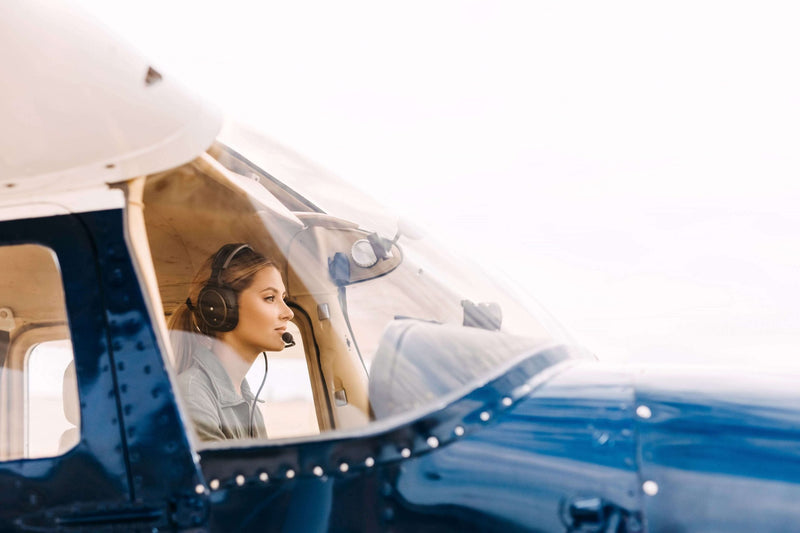
Very safety and detail oriented. Pre-flight briefing explained everything there was. To my knowledge, this flight school is exceptional in their ability.
$500 off every Private Pilot Program and $5,000 off the Airline Pilot Course — applied automatically at checkout.
See Back to School Prices →
Every stage between never having touched a control yoke and holding a certificate, in the order it happens, with the real timings and the real costs attached.
Becoming a pilot is a sequence of ordinary steps rather than a leap. You take an introductory flight to find out whether you enjoy it. You get a medical certificate and a student pilot certificate. You start lessons, mixing flying with ground study. Somewhere around fifteen to twenty-five hours your instructor gets out of the aircraft and you fly a circuit alone. Then come cross-country flights, night flying, a written exam, and finally a checkride with a designated examiner.
None of those steps is intellectually out of reach for a normal adult. What they demand is consistency. The single biggest predictor of how long training takes is how often you fly, and the difference is dramatic: twice a week and most people finish a private certificate inside four to six months, once a fortnight and it can drag past a year because each lesson is spent recovering ground lost since the last one. Frequency matters far more than natural talent.
Van Nuys is a strong place to do it. The weather cooperates on 355 days a year by our own count of NOAA observations, which removes the stop-start rhythm that plagues training in wetter parts of the country. The airfield has an active control tower and a genuinely mixed traffic pattern, so radio work and situational awareness become second nature rather than something you bolt on afterwards. And the terrain within twenty minutes includes coast, mountains, desert and city.
The cost is real and worth facing squarely at the start. Our standard private pilot package is $10,900, sport pilot is $8,400 and a solo certificate is $5,500. Outside those figures sit the FAA medical, the examiner fee for the checkride, books and a headset. Financing runs through Stratus Financial or an in-house payment plan, and a free consultation at 7900 Balboa Blvd will get you a monthly figure rather than a lump sum.

Courses & Pricing
Course prices are packages, not hourly rates - the aircraft, your instructor, ground school and simulator time are all in the figure. Van Nuys Airport, KVNY. Financing Available Through Stratus & In-House Plans.

Start Here
The First Hour At The Controls. Credited Toward Your Training If You Enroll Within 24 Hours Of Landing.
All Prices In USD. 7900 Balboa Blvd, Suite 108A, Van Nuys, CA 91406 · Open 9 AM–9 PM, Seven Days. Free In-Person Tour Of The School
Book It Or Gift It
Every discovery flight below can be booked for yourself in the next few minutes, or bought as a gift certificate that is emailed within minutes and never expires. Same flight, same price, either way.
 Most Given
 Two Seats
 The Nice One
 Twin Engine
One person, one instructor, and no audience. Hands on the controls from the left seat, briefed before you go and debriefed after you land.
Hands-On Stick TimePre-Flight BriefingLoggable Flight Time
Flight Length
$229Book It Or Gift It
Same Price Either Way
The same flight with a passenger in the back seat, briefed and on the intercom. Couples book it; so do parents who would rather watch than hear about it.
One Passenger SeatPiper Warrior Or ArcherHeadsets For Both
Flight Length
$299Book It Or Gift It
Same Price Either Way
The nicest airplane we put a first-time flyer in. Glass cockpit, air conditioning, leather seats, and a parachute built into the airframe rather than strapped to the person.
Turbocharged Cirrus SR22Air ConditioningWhole-Airframe Parachute
Flight Length
$499Book It Or Gift It
Same Price Either Way
Two engines, and the airplane instrument-rated pilots move into when they start thinking about a career. Flown from the left seat with a multi-engine instructor.
Piper Seminole TwinMulti-Engine DepartureCareer-Track Instructor
Flight Length
$499Book It Or Gift It
Same Price Either Way
Gift It issues a real gift certificate, emailed within minutes, which never expires and credits in full toward training. Flights are limited to 180 lb per person, 360 lb combined. Questions: (818) 290-8249, 9 AM–9 PM, seven days.
First come the two pieces of paper. You need a student pilot certificate, applied for through the FAA IACRA system with your instructor's help, and a medical certificate from an Aviation Medical Examiner. Several examiners sit within a few miles of the airfield, on Vanowen Street and Noble Avenue in Van Nuys and on Wilbur Avenue in Tarzana. Do both early. You cannot solo without them, and solo arrives sooner than most students expect it to.
Then comes the flying, which splits into three phases. Pre-solo work is circuits, slow flight, stalls and emergency procedures until landings are consistent, typically fifteen to twenty-five hours. After solo the syllabus moves to navigation: cross-country flights to airports like Camarillo, Santa Barbara or Bakersfield, night flying, and instrument reference under the hood. The final phase is polish, flying the checkride profile until each maneuvere is repeatable to standard rather than lucky.
Alongside all of it runs ground study, ending in the FAA knowledge test, a sixty-question written exam you should sit before the final phase rather than after. The checkride itself is an oral examination followed by a flight with a designated pilot examiner, who charges separately from us. Pass it and you leave with a temporary certificate the same day. Start the whole process with a call to (818) 290-8249 or a free consultation at Suite 108A.

Van Nuys is one of the busiest general aviation airports in the country, with a control tower and traffic ranging from trainers to business jets. You learn to talk on the radio properly because you have to, from your first lesson. Pilots trained at quiet uncontrolled fields often find that skill is the hardest one to acquire afterwards.
Rain is concentrated into a handful of winter weeks and most days give clear skies and workable visibility. That means lessons happen when they are booked, and the consistency is what actually shortens training. The one local variable is the marine layer pushing inland overnight in late spring, which usually shifts a flight east rather than canceling it.
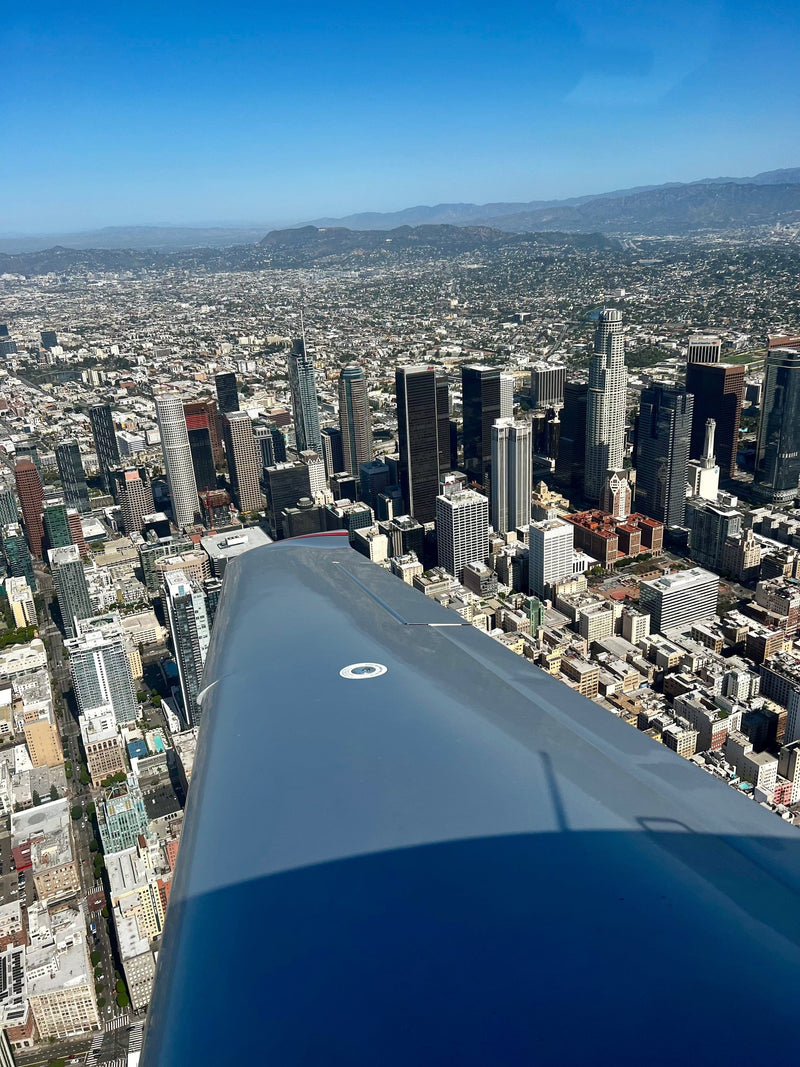
Mountains to the north and south, the Pacific beyond Malibu, desert past the Antelope Valley, and the largest metropolitan airspace in the western United States. You will fly mountain passes, coastal routes and busy corridors during training rather than reading about them. Few fields anywhere give a student that range on a single tank of fuel.
Sport, private, instrument, complex and multi-engine can all be flown from the same ramp with the same instructors reading the same logbook. Students who have to move schools to progress lose time to repetition and paperwork. Here the progression is continuous and your training record follows you up the ladder without interruption.
Early lessons happen in the Cessna 162 Skycatcher or the Diamond DA20. Both are light, forgiving two-seaters, and both come with the instructor and the ground work already inside your package price, so the first twenty hours cost you nothing you did not agree at the start. The DA20 has a bubble canopy that gives excellent visibility for circuit work. When you move on to navigation, the four-seat Piper Warrior takes over, cruising above 143 mph with the fuel and payload for genuine cross-country flights from Van Nuys out to Camarillo, Santa Barbara or over the mountains toward Bakersfield.
Beyond the private certificate the fleet keeps going. The Piper Arrow II covers complex training with its retractable gear and constant-speed propeller. The Cirrus SR22 Turbo brings a full glass panel, an autopilot and a whole-airframe parachute. The twin-engine Piper Seminole is where multi-engine ratings are flown, as a $5,100 package. The Redbird MCX full-motion simulator sits alongside all of it, included in every program and $189 to book on its own, absorbing the repetition that is expensive in an aircraft.

Training has a rhythm, and these are the points where it visibly changes.
Usually somewhere between hours eight and fifteen, when your instructor stops touching the controls on final approach and you realize the landing was yours. It rarely feels tidy, and it is the moment most people commit.
Fifteen to twenty-five hours in, the instructor climbs out on the ramp and sends you round the circuit alone. The aircraft climbs noticeably better without them, which surprises everybody. Traditionally the back of your shirt does not survive the day.
Planning a route, calculating fuel and wind, then flying to an airfield you have never seen and finding it exactly where the plan said it would be. Camarillo and Santa Barbara are the usual first destinations out of Van Nuys.
An oral examination followed by a flight with a designated pilot examiner, who is paid separately from your course. Pass and you walk out with a temporary certificate the same afternoon and can carry passengers immediately.
The FAA minimum for a private certificate is 40 hours, but the realistic national figure sits higher, commonly in the sixty to seventy range. Sport pilot requires fewer. How close you land to the minimum depends almost entirely on how frequently you fly, not on how quickly you learn. Twice a week is the rate that keeps hours down.
There is no minimum age to take lessons, and children fly with instructors regularly. You must be 16 to fly solo and 17 to hold a private pilot certificate. Our teen flight training package is $4,200 and is structured around school terms. At the upper end there is no age limit at all provided you can hold a medical.
No. The standard is 20/20 or better in each eye with or without correction, so glasses and contact lenses are entirely normal among pilots. Color vision must be good enough to distinguish aviation signal colors. If either is a concern, mention it before you start rather than discovering it at the examiner's office.
Sixty multiple-choice questions covering regulations, weather, navigation, aerodynamics, aircraft systems and human factors, sat at a testing center. You need 70 percent to pass and the result is valid for 24 calendar months. Most students study alongside flying and sit it before the final phase of training, which makes the checkride oral much easier.
Yes, and a large share of our students do. We fly from 9 AM to 9 PM seven days a week, so early morning slots before work and evening slots afterwards are both available. The honest warning is that flying less than once a week stretches everything out and costs more overall, because relearning eats into every lesson.
The FAA medical exam, paid to the examiner directly, the designated pilot examiner's fee for the checkride, the FAA knowledge test fee, books and charts, and a headset if you want your own. Ask us to itemise all of it at a consultation. It is a meaningful sum and it is better seen at the start than met in installments.
No. There are headsets at the desk to borrow and most students use those for the first several lessons while they work out what they like. Buying your own becomes worthwhile once you are flying regularly, mainly for comfort and fit.
Most graduates keep flying with us from the same ramp at Van Nuys, and we will go through what that costs with you in person. The instrument rating at $11,700 is the usual next step and the one that genuinely expands what you can do. Some carry on into commercial work, and the multi-engine add-on at $5,100 fits into that path.
A $229 discovery flight or a $189 simulator session answers the only question that actually matters, which is whether you like it. We are at Van Nuys Airport, 7900 Balboa Blvd, Suite 108A: come off the 101 at Balboa Boulevard and turn north, or take the 405 to Victory or Roscoe and run west to Balboa. Parking outside the door is free and ungated. Call (818) 290-8249 between 9 AM and 9 PM to book either.
The three private pilot packages, what each one includes, the financing options and a realistic timeline built around how often you can actually fly. Sent to you in one email. Nobody will pressure you.
Loved On Google
Every review below is real and shown verbatim, in the reviewer’s own words — written by the people who learned to fly here, not by us.
SAFETY FIRST
Very safety and detail oriented. Pre-flight briefing explained everything there was. To my knowledge, this flight school is exceptional in their ability.
 DISCOVERY FLIGHT
I recently had the chance to take my first-ever discovery flight, and it was nothing short of amazing! From the moment I stepped into the cockpit, the...
 SUNSET CIRRUS
It was a great flight! I did a sunset flight and Alex let us fly an awesome. Website was easy to book, and the plane itself was really fun to fly...
 FLYING LESSON
We had a great flying lesson with Ralph and came away with a much better understanding of both the aircraft and the principles of flight. Ralph is a...
 KIDS LUXURY FLIGHT
I got 2 luxury discovery flights for my kids. I wanted them to have the experience of flying. Our instructor Alex was amazing he made sure they feel...
 HONEYMOON SURPRISE
Last minute booking to surprise my wife on our honeymoon. She had no experience with flying and was scared of flying, but Alex was very easygoing and knew...
 FULL-MOTION SIM
Amazing flight school in van nuys airport. I have been a student here for the past few months and i could not be happier. I started doing a lot of...
 DISCOVERY FOR TWO
I booked a Discovery Flight for Two for my girlfriend's birthday and it was the perfect gift for her. She couldn't have been more excited to get to...
 SIMULATORS
Very professional and great airplanes. I love the flight simulators. The pricing is very fair compared to any other flight school
 TEEN FIRST LESSON
We gifted our teenage son his first flying lesson. He was so excited! Alex greeted us and gave a reassuring brief that made us all feel comfortable and at...
 FIRST-TIME FLYER
Flying is my husband's hobby and I was incredibly anxious and apprehensive about the discovery flight. However, I felt completely safe and at ease once we...
SAFETY FIRST
Very safety and detail oriented. Pre-flight briefing explained everything there was. To my knowledge, this flight school is exceptional in their ability.
DISCOVERY FLIGHT
I recently had the chance to take my first-ever discovery flight, and it was nothing short of amazing! From the moment I stepped into the cockpit, the...
SUNSET CIRRUS
It was a great flight! I did a sunset flight and Alex let us fly an awesome. Website was easy to book, and the plane itself was really fun to fly...
FLYING LESSON
We had a great flying lesson with Ralph and came away with a much better understanding of both the aircraft and the principles of flight. Ralph is a...
KIDS LUXURY FLIGHT
I got 2 luxury discovery flights for my kids. I wanted them to have the experience of flying. Our instructor Alex was amazing he made sure they feel...
HONEYMOON SURPRISE
Last minute booking to surprise my wife on our honeymoon. She had no experience with flying and was scared of flying, but Alex was very easygoing and knew...
FULL-MOTION SIM
Amazing flight school in van nuys airport. I have been a student here for the past few months and i could not be happier. I started doing a lot of...
DISCOVERY FOR TWO
I booked a Discovery Flight for Two for my girlfriend's birthday and it was the perfect gift for her. She couldn't have been more excited to get to...
SIMULATORS
Very professional and great airplanes. I love the flight simulators. The pricing is very fair compared to any other flight school
TEEN FIRST LESSON
We gifted our teenage son his first flying lesson. He was so excited! Alex greeted us and gave a reassuring brief that made us all feel comfortable and at...
FIRST-TIME FLYER
Flying is my husband's hobby and I was incredibly anxious and apprehensive about the discovery flight. However, I felt completely safe and at ease once we...
Reviews shown verbatim, exactly as each reviewer published them.
Aviation News
Notes from the flight line at Van Nuys — weather, regulation changes, checkride questions and the cost of training, written up as they come.
Open 7 days · 9:00 AM – 9:00 PM
Los Angeles Flight School