SAFETY FIRST
★★★★★
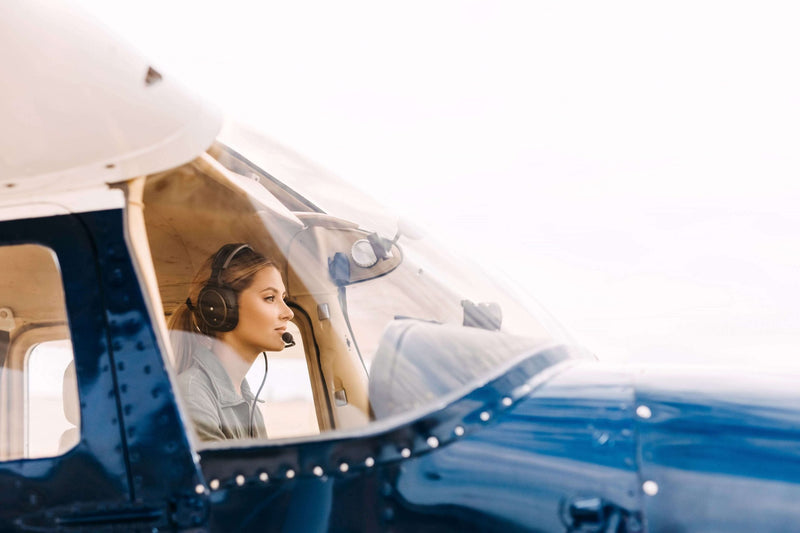
Very safety and detail oriented. Pre-flight briefing explained everything there was. To my knowledge, this flight school is exceptional in their ability.

One is quicker, cheaper and needs no FAA medical certificate. The other carries three passengers, climbs above 10,000 ft and flies at night without a medical question attached. Here is how to tell which one you want.
Two licenses, one airfield, and a choice most people make on the wrong grounds. The sport pilot certificate and the private pilot certificate both let you fly an airplane yourself with a passenger beside you. What separates them is not prestige or difficulty; it is the size of the box you fly inside afterwards. Choose on the flying you actually intend to do over the next five years and the answer usually becomes obvious within a single conversation.
The sport pilot certificate is the shorter road. The FAA sets its minimum at twenty flight hours under 14 CFR 61.313 against forty for the private under 61.109, and no FAA medical certificate is required for daytime flying: a valid US driver's license stands in its place under 14 CFR 61.23(c)(1)(ii). Our program runs at $8,400 and is flown in the Cessna 162 Skycatcher. In exchange you accept one passenger, at least 3 statute miles of visibility, a 10,000 ft ceiling, and only aircraft that meet the performance limits in 14 CFR 61.316. For a great many recreational pilots that is not a compromise at all.
The private pilot certificate opens the rest of aviation. Unrestricted night flying, longer cross-country trips, four seats filled rather than two, heavier and faster aircraft, instrument training later if you want it, and every professional rating beyond. It requires at least a third-class FAA medical from a designated examiner and more training time, which is why the Standard program is $10,900 rather than $8,400. It is also the only one of the two that leads anywhere if a career ever crosses your mind.
There is a third option people forget: start, and decide later. Every hour flown toward a sport pilot certificate counts toward a private certificate if you upgrade, and the first twenty hours of both syllabi are nearly identical. Our $5,500 Solo Certificate exists partly for this reason. Fly to solo, see how the medical and the money feel, then commit. Nobody at Van Nuys will make you declare a destination before you have been in the air.

The FAA rewrote the sport pilot rules in 2025 and most of what is written about them online has not caught up. The Modernization of Special Airworthiness Certification final rule was published at 90 FR 35034 on 24 July 2025. Most of the rule took effect on 22 October 2025; a second set of amendments — including removal of the § 1.1 light-sport aircraft definition and the new light-sport airworthiness requirements in 14 CFR part 22 — took effect on 24 July 2026. Both sets are in force now.
The single biggest change: the definition of a light-sport aircraft, and the 1,320 lb maximum takeoff weight that sat inside it, was deleted from 14 CFR 1.1. What a sport pilot may fly is now set by 14 CFR 61.316 — a stall speed (VS1) of no more than 59 knots CAS for airplanes at maximum certificated takeoff weight, a maximum of four seats, an unpressurised cabin, fixed landing gear and a fixed, ground-adjustable or automated controllable-pitch propeller. There is no weight limit at all any more. An aircraft with retractable landing gear, or an airplane with a manual controllable-pitch propeller, is available once you hold the training and endorsement required by 14 CFR 61.331.
Night flying is no longer banned outright. 14 CFR 61.329 allows it after 3 hours of night flight training, a night cross-country landing at an airport at least 25 nautical miles away, 10 night takeoffs and landings to a full stop, and an instructor endorsement — but that section also requires an FAA medical certificate under part 67 or BasicMed. If avoiding the medical was your reason for choosing sport, night is still closed to you. Retractable gear and manual controllable-pitch propellers opened up too, with the endorsements in 14 CFR 61.331.
What did not change is the passenger limit. 14 CFR 61.315(c)(4) still allows a sport pilot one passenger, so a four-seat airplane flies with two of its seats empty. The 10,000 ft ceiling, the 3-statute-mile visibility requirement and the ban on flying for compensation or hire all survived intact, and 14 CFR 61.23(c)(1)(ii) still accepts a driver's license in place of a medical for daytime flying.
One honest caveat. Whether a specific airplane now qualifies turns on its published VS1 at maximum certificated takeoff weight, the FAA has not issued a list of eligible types, and 14 CFR 61.316(a) requires an aircraft to have met the criteria since its original certification. The figure is in the aircraft's FAA-approved flight manual and on its type certificate data sheet. Ask us and we will look it up with you rather than guess.
Full detail is on our MOSAIC rule and what it changed page, with the airframe-by-airframe check on MOSAIC aircraft eligibility and the night rules on sport pilot night flying under 14 CFR 61.329.

Courses & Pricing
Course prices are packages, not hourly rates - the aircraft, your instructor, ground school and simulator time are all in the figure. Van Nuys Airport, KVNY. Financing Available Through Stratus & In-House Plans.

Start Here
The First Hour At The Controls. Credited Toward Your Training If You Enroll Within 24 Hours Of Landing.
All Prices In USD. 7900 Balboa Blvd, Suite 108A, Van Nuys, CA 91406 · Open 9 AM–9 PM, Seven Days. Free In-Person Tour Of The School
Book It Or Gift It
Every discovery flight below can be booked for yourself in the next few minutes, or bought as a gift certificate that is emailed within minutes and never expires. Same flight, same price, either way.
 Most Given
 Two Seats
 The Nice One
 Twin Engine
One person, one instructor, and no audience. Hands on the controls from the left seat, briefed before you go and debriefed after you land.
Hands-On Stick TimePre-Flight BriefingLoggable Flight Time
Flight Length
$229Book It Or Gift It
Same Price Either Way
The same flight with a passenger in the back seat, briefed and on the intercom. Couples book it; so do parents who would rather watch than hear about it.
One Passenger SeatPiper Warrior Or ArcherHeadsets For Both
Flight Length
$299Book It Or Gift It
Same Price Either Way
The nicest airplane we put a first-time flyer in. Glass cockpit, air conditioning, leather seats, and a parachute built into the airframe rather than strapped to the person.
Turbocharged Cirrus SR22Air ConditioningWhole-Airframe Parachute
Flight Length
$399Book It Or Gift It
Same Price Either Way
Two engines, and the airplane instrument-rated pilots move into when they start thinking about a career. Flown from the left seat with a multi-engine instructor.
Piper Seminole TwinMulti-Engine DepartureCareer-Track Instructor
Flight Length
$499Book It Or Gift It
Same Price Either Way
Gift It issues a real gift certificate, emailed within minutes, which never expires and credits in full toward training. Flights are limited to 180 lb per person, 370 lb combined. Questions: (818) 290-8249, 9 AM–9 PM, seven days.
Start with the medical question, because it is the only part of this that can be decided for you. If you have a medical history that might complicate an FAA third-class certificate, the sport route sidesteps the issue entirely by accepting a valid driver's license. Speak to an aviation medical examiner before you spend anything if you are unsure. What you should not do is apply for a medical, get deferred, and only then look at sport flying, because a denied application closes the sport door as well.
Then write down the four flights you most want to make. If the list is a Sunday morning over the Santa Monica Mountains with one friend aboard, sport is enough and you will have saved money and months. If the list includes taking three people to Big Bear, coming home after sunset, or flying to Las Vegas in weather, you need the private certificate and buying the cheaper one first would be a detour. Be honest rather than modest here.
Finally, come and sit in the aircraft. The free in-person consultation at Suite 108A takes about thirty minutes and settles more arguments than a comparison table can. You will see the Cessna 162 that sport students fly, the Warrior and the DA20 used for private training, and the Redbird MCX simulator both groups use. We are at 7900 Balboa Boulevard, Suite 108A, on the west boundary of Van Nuys Airport. Come north on Balboa from the 101 at Encino, or south on Balboa from the 118 above Granada Hills, and turn in at the 7900 block; parking is free in our own lot outside the door. Call (818) 290-8249 to arrange it, any day between 9 AM and 9 PM.

Schools that only run private pilot programs will always find a reason why sport is not for you. We fly both syllabi weekly in our own aircraft, which means the recommendation you get is about your flying rather than about our schedule. Sometimes the honest answer is the cheaper program.
Sport to private is a well-worn path rather than an admission of error. Your logged hours carry over, your aircraft handling carries over, and what remains is the additional training, the night work and the medical. Knowing that the door stays open takes most of the pressure out of the initial decision.
Van Nuys has a control tower and a genuinely busy circuit. A sport pilot may not operate at a towered airport, or in Class B, C or D airspace, without the instructor endorsement in 14 CFR 61.325 — so here you earn it as a matter of course rather than discovering later that half of Southern California is closed to you.
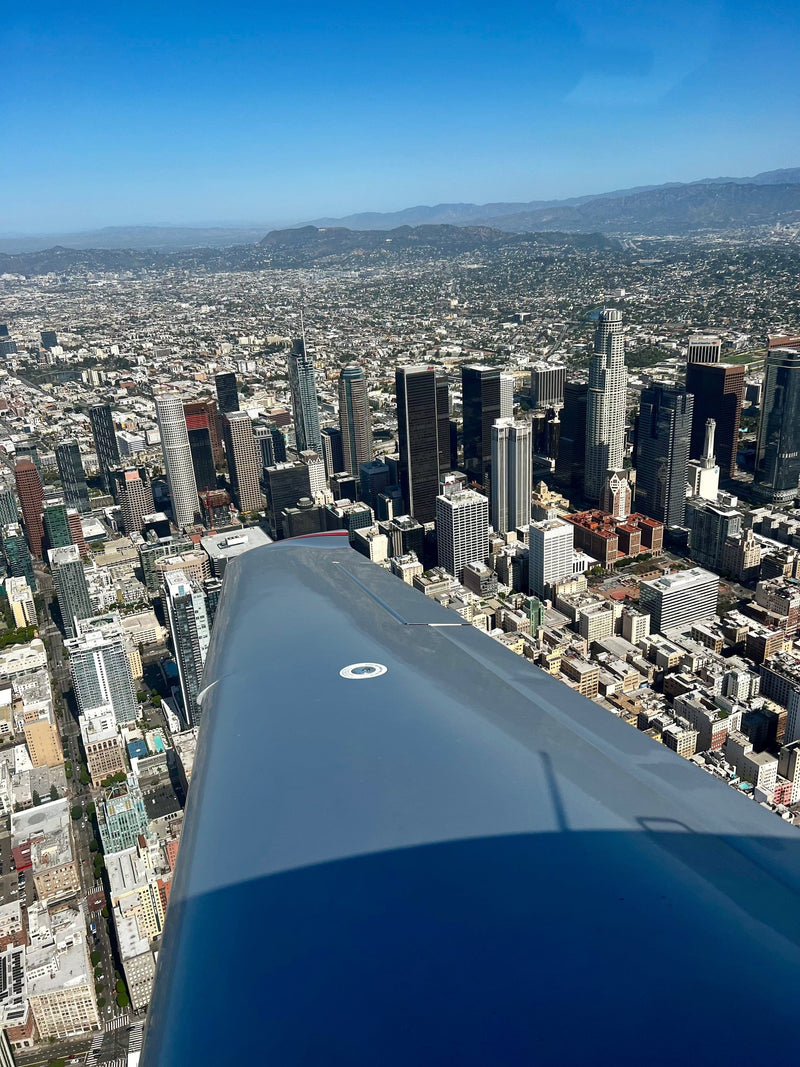
Mountains to the north and west, ocean to the south, and one of the most complex pieces of airspace in America overhead. Whichever license you take, you learn density altitude, terrain avoidance and airspace discipline as ordinary parts of training rather than as topics for a written exam.
Sport pilot training happens in the Cessna 162 Skycatcher: two seats, fixed gear, and a glass panel far more modern than its size suggests. It was certificated as a special light-sport aircraft, a category that required a VS1 of not more than 45 knots CAS under the light-sport definition then in 14 CFR 1.1, which is inside the 59 knots CAS that 14 CFR 61.316(a)(1) allows for airplanes; read the figure in the flight manual before you rely on it. It is also the aircraft you will fly after certification, which is a real advantage of the sport route. What you train in is what you rent, so there is no awkward gap between passing a checkride and being signed off in something unfamiliar.
Private pilot students have more of the fleet available. The Diamond DA20 and the Piper Warrior cover primary training, the Warrior being the low-wing four-seater to learn in if carrying passengers is the point. Afterwards the Piper Arrow II adds retractable gear and a constant-speed propeller, the Cirrus SR22 Turbo brings a glass cockpit and an airframe parachute, and the Piper Seminole waits for a multi-engine rating. Both groups use the Redbird MCX full-motion simulator throughout.
Since MOSAIC the sport certificate is no longer tied to two-seat aircraft, so the honest answer on the rest of the ramp is that it depends on the number in each flight manual. The twin-engine Piper Seminole is outside 14 CFR 61.316, because 61.316(a)(5) requires an aircraft on which the loss of partial power would not adversely affect directional control. For the Cirrus SR22 Turbo and the Piper Arrow II we have not verified a VS1 figure to publication standard and do not print one; the Arrow's retractable gear and manual controllable-pitch propeller engage both 14 CFR 61.331 endorsements before 61.316 is reached, and neither airplane is offered here on the sport route. For anything else, ask and we will open the book with you.

Each of these is an ordinary day out from Van Nuys, and each one lands on a different side of the line.
The airport in the sky, a short hop across the water from the coast. It is a private pilot trip in practice, given the overwater leg, the elevated runway and the aircraft most people would want under them.
Sixty minutes out over the ridgeline and back down the coast with one passenger aboard, in daylight and good visibility. This is exactly what a sport pilot certificate is designed for, and it is the flight most recreational pilots make most often.
Los Angeles at night from three thousand feet is one of the great sights in American flying. Since MOSAIC a sport pilot can legally do it under 14 CFR 61.329, but only with the night training, the endorsement, and an FAA medical certificate or BasicMed. On a driver's license alone it is still a private pilot flight.
A high-altitude mountain airport that demands real density altitude planning and an aircraft with seats to spare. 14 CFR 61.315(c)(4) caps a sport pilot at one passenger no matter how many seats the airplane has, so three friends puts this firmly on the private side of the line.
Yes, since 22 October 2025, but with a condition that catches people out. 14 CFR 61.329 allows sport pilot night flying after 3 hours of night training, a night cross-country landing at least 25 nautical miles away, 10 night takeoffs and landings to a full stop and an instructor endorsement — and it also requires either an FAA medical certificate under part 67 or BasicMed. A driver's license alone still means daylight only, so if avoiding the medical was the point, take the private route for night flying.
Correct for daytime flying. 14 CFR 61.23(c)(1)(ii) accepts a valid US driver's license in place of an FAA medical certificate, and 14 CFR 61.303(b) sets four conditions: you must comply with every restriction and limitation on your driver's license and with any judicial or administrative order about driving; you must have been found eligible for at least a third-class medical at your most recent application; your most recent medical must not have been suspended or revoked and no Special Issuance authorization withdrawn; and you must not know, or have reason to know, of any medical condition that would make you unable to operate an aircraft in a safe manner. If you have any doubt about passing a medical, talk to an aviation medical examiner before you submit an application, because a denial removes the driver's license route as well.
The FAA minimum is twenty flight hours for sport and forty for private. Very few people finish at the minimum. Flying twice a week, a realistic sport pilot timeline is a couple of months and a private certificate is six to nine. Flying once a fortnight, both take considerably longer because each lesson spends time recovering the last one.
Yes, and it is common. Your logged flight time carries across, so nothing is wasted. What you add is the extra training hours, the night and cross-country requirements, the instrument-reference work and an FAA medical certificate. It costs more in total than going straight for the private certificate, but it spreads the spending over a longer period.
Since MOSAIC, any aircraft meeting 14 CFR 61.316: a stall speed (VS1) of 59 knots CAS or less for airplanes, four seats at most, unpressurised, with fixed gear and a fixed, ground-adjustable or automated controllable-pitch propeller. Retractable landing gear, or a manual controllable-pitch propeller, needs the training and endorsement in 14 CFR 61.331. The old 1,320 lb weight limit is gone. In our fleet sport students fly the Cessna 162 Skycatcher. The twin-engine Piper Seminole is outside 61.316 on the directional-control criterion in 61.316(a)(5); for the Cirrus SR22 Turbo and the Piper Arrow II we have not verified a VS1 figure to publication standard, and the Arrow's retractable gear and manual controllable-pitch propeller engage the 61.331 endorsements in any case. Private pilots fly all of them subject to the usual checkouts.
Yes, substantially. The MOSAIC final rule was published at 90 FR 35034 on 24 July 2025. Most of the rule took effect on 22 October 2025; a second set of amendments, including removal of the § 1.1 light-sport aircraft definition and the 1,320 lb weight limit inside it, took effect on 24 July 2026. Since 22 October 2025 what a sport pilot may fly has been set by a stall-speed and design test in 14 CFR 61.316. The rule also opened night flying under 14 CFR 61.329, allowed four-seat airplanes, and made retractable landing gear and manual controllable-pitch propellers available with the 14 CFR 61.331 endorsements. An automated controllable-pitch propeller is permitted by 14 CFR 61.316(a)(9) with no endorsement at all. The one-passenger limit, the 10,000 ft ceiling and the driver's-license medical rule were left unchanged.
Sport costs $8,400 and private starts at $10,900, so the gap is smaller than most people expect for what it buys. If there is any chance you will want night flying, four seats or an instrument rating, the private certificate is better value even though it costs more today. If you are certain about local daylight flying, sport wins clearly.
Yes, on both, but 14 CFR 61.315(c)(4) limits a sport pilot to one passenger — MOSAIC opened four-seat airplanes to sport pilots and left that limit exactly where it was. Private pilots are limited only by the seats in the airplane. Neither certificate allows you to be paid for carrying people or property; that requires a commercial certificate, which is only reachable from the private route.
A private pilot may use Class B, C, D and E airspace with the normal training. A sport pilot may not operate in Class B, C or D airspace, or to, from, through or at any airport with an operating control tower, without the endorsement in 14 CFR 61.325 — and that includes Van Nuys itself. Class A above 18,000 ft is closed to sport pilots outright under 61.315(c)(6). Because we are a Class D field under the LAX Class B shelf, the 61.325 endorsement is part of ordinary training here.
A free half-hour consultation at Suite 108A, with the Cessna 162 and the Warrior parked outside, settles this faster than any amount of reading. Call (818) 290-8249 between 9 AM and 9 PM to book one.
Every regulation and rulemaking cited on this page, at its primary source. Links open in a new tab.
Federal Register — MOSAIC Final Rule, 90 FR 35034, 24 July 2025
eCFR — 14 CFR Part 61 Subpart J, Sport Pilot Rules
eCFR — 14 CFR 61.303, Operating Limits And The Driver License Conditions
eCFR — 14 CFR 61.315, Sport Pilot Privileges And Limits
eCFR — 14 CFR 61.316, Aircraft Performance Limits And Design Requirements
eCFR — 14 CFR 61.325, Towered Airports And Class B, C And D Airspace
eCFR — 14 CFR 61.329, Night Privileges
eCFR — 14 CFR 61.331, Retractable Gear And Manual Controllable-Pitch Propellers
eCFR — 14 CFR 61.23, Medical Certificates: Requirement And Duration
eCFR — 14 CFR 61.113, Private Pilot Privileges And Limitations
The three private pilot packages, what each one includes, the financing options and a realistic timeline built around how often you can actually fly. Sent to you in one email. Nobody will pressure you.
Loved On Google
Every review below is real and shown verbatim, in the reviewer’s own words — written by the people who learned to fly here, not by us.
SAFETY FIRST
Very safety and detail oriented. Pre-flight briefing explained everything there was. To my knowledge, this flight school is exceptional in their ability.
 DISCOVERY FLIGHT
I recently had the chance to take my first-ever discovery flight, and it was nothing short of amazing! From the moment I stepped into the cockpit, the...
 SUNSET CIRRUS
It was a great flight! I did a sunset flight and Alex let us fly an awesome. Website was easy to book, and the plane itself was really fun to fly...
 FLYING LESSON
We had a great flying lesson with Ralph and came away with a much better understanding of both the aircraft and the principles of flight. Ralph is a...
 KIDS LUXURY FLIGHT
I got 2 luxury discovery flights for my kids. I wanted them to have the experience of flying. Our instructor Alex was amazing he made sure they feel...
 HONEYMOON SURPRISE
Last minute booking to surprise my wife on our honeymoon. She had no experience with flying and was scared of flying, but Alex was very easygoing and knew...
 FULL-MOTION SIM
Amazing flight school in van nuys airport. I have been a student here for the past few months and i could not be happier. I started doing a lot of...
 DISCOVERY FOR TWO
I booked a Discovery Flight for Two for my girlfriend's birthday and it was the perfect gift for her. She couldn't have been more excited to get to...
 SIMULATORS
Very professional and great airplanes. I love the flight simulators. The pricing is very fair compared to any other flight school
 TEEN FIRST LESSON
We gifted our teenage son his first flying lesson. He was so excited! Alex greeted us and gave a reassuring brief that made us all feel comfortable and at...
 FIRST-TIME FLYER
Flying is my husband's hobby and I was incredibly anxious and apprehensive about the discovery flight. However, I felt completely safe and at ease once we...
SAFETY FIRST
Very safety and detail oriented. Pre-flight briefing explained everything there was. To my knowledge, this flight school is exceptional in their ability.
DISCOVERY FLIGHT
I recently had the chance to take my first-ever discovery flight, and it was nothing short of amazing! From the moment I stepped into the cockpit, the...
SUNSET CIRRUS
It was a great flight! I did a sunset flight and Alex let us fly an awesome. Website was easy to book, and the plane itself was really fun to fly...
FLYING LESSON
We had a great flying lesson with Ralph and came away with a much better understanding of both the aircraft and the principles of flight. Ralph is a...
KIDS LUXURY FLIGHT
I got 2 luxury discovery flights for my kids. I wanted them to have the experience of flying. Our instructor Alex was amazing he made sure they feel...
HONEYMOON SURPRISE
Last minute booking to surprise my wife on our honeymoon. She had no experience with flying and was scared of flying, but Alex was very easygoing and knew...
FULL-MOTION SIM
Amazing flight school in van nuys airport. I have been a student here for the past few months and i could not be happier. I started doing a lot of...
DISCOVERY FOR TWO
I booked a Discovery Flight for Two for my girlfriend's birthday and it was the perfect gift for her. She couldn't have been more excited to get to...
SIMULATORS
Very professional and great airplanes. I love the flight simulators. The pricing is very fair compared to any other flight school
TEEN FIRST LESSON
We gifted our teenage son his first flying lesson. He was so excited! Alex greeted us and gave a reassuring brief that made us all feel comfortable and at...
FIRST-TIME FLYER
Flying is my husband's hobby and I was incredibly anxious and apprehensive about the discovery flight. However, I felt completely safe and at ease once we...
Reviews shown verbatim, exactly as each reviewer published them.
Aviation News
Notes from the flight line at Van Nuys — weather, regulation changes, checkride questions and the cost of training, written up as they come.
Open 7 days · 9:00 AM – 9:00 PM
Los Angeles Flight School