

The private pilot knowledge test is the exam students put off. It sits in the middle of training, it can be taken any time before the checkride, and there is always a flight lesson that seems more urgent. Then the checkride comes into view, the instructor asks about the written, and a month of ground study has to happen alongside the last of the flying. It works better the other way round: get the test done early, in a block, while the flying is still in the pattern, and arrive at the cross-country phase with the theory already in your head.
Here is the thirty-day plan we give students who want the test done in one block, and what to do on the day.

What You Are Studying For
The test is sixty multiple-choice questions, drawn from a bank the FAA does not publish, with two and a half hours to answer them. Seventy per cent passes, which is forty-two questions. You take it on a computer at an approved testing centre, and you need an instructor's endorsement to sit it, which means either finishing a ground school course or showing the instructor what you studied on your own. The result is valid for twenty-four calendar months, and the checkride has to happen inside that window. All of the mechanics are on our FAA written exam guide; this post is about the studying.
The questions come from the areas in the private pilot Airman Certification Standards: regulations, airspace and charts, weather and weather services, aerodynamics and aircraft systems, performance and weight and balance, navigation, airport operations and radio procedures, human factors and aeronautical decision making. When you get your score report it will list the ACS codes for the questions you got wrong, and your instructor has to go over those areas with you before the checkride. So a pass with a lot of wrong answers costs you a longer oral exam later; it is worth studying to score well, not just to pass.
Days One To Seven: Build The Frame
Pick one course and stay with it. Sporty's, Gleim, King Schools and the ASA books all cover the same material, and switching between them wastes the first week. In the first seven days, watch or read the whole course once at a steady pace, an hour to ninety minutes a day, without trying to memorise anything. The point of the first pass is to know what the subjects are and how they connect, so that when you meet a question about a Class E floor you know it belongs with airspace and not with weather. Take no practice tests yet. Practice tests in week one measure nothing except how much you have not studied.
Days Eight To Fourteen: The Three Hard Subjects
Most of the questions students get wrong fall into three areas, and the second week goes to them.
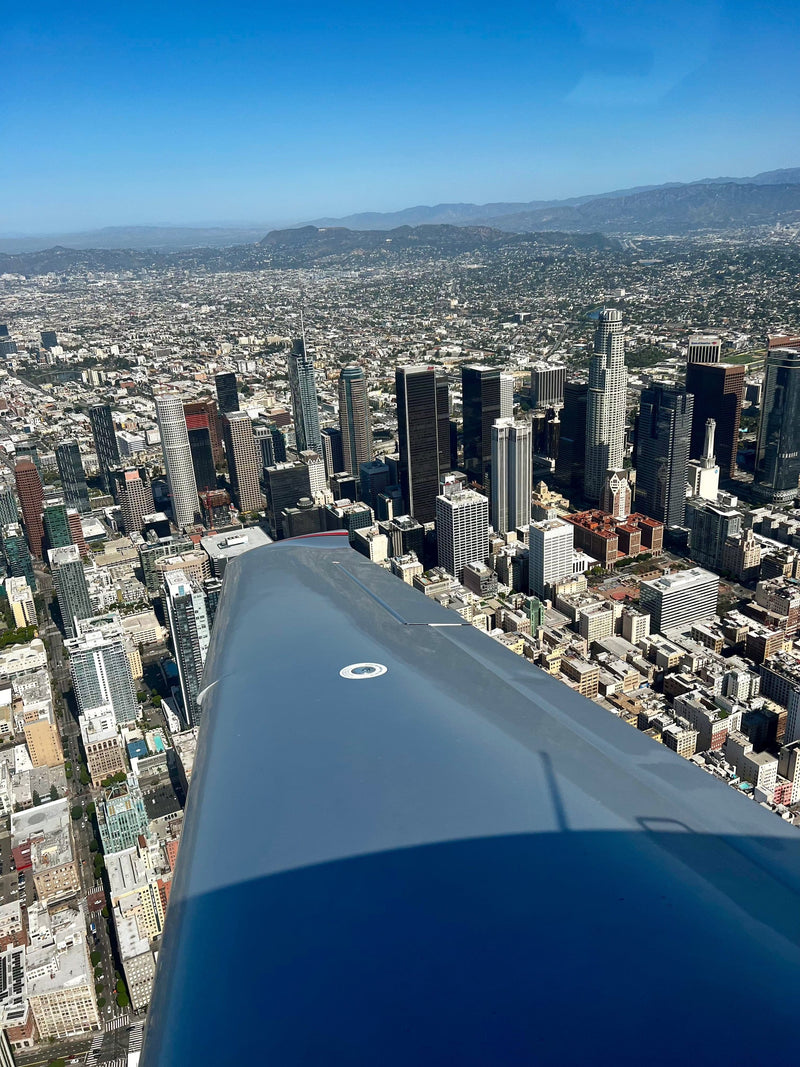
Airspace and sectional charts first. Get a current Los Angeles sectional, paper or in an app, and learn to read it around Van Nuys, because the airspace here is the most complicated a private pilot student sees: Class D at Van Nuys and Whiteman, Class C at Burbank next door, the LAX Class B shelves layered over the Valley at different floors, and the special flight rules area through the middle of it. Every airspace question on the test is easier when you have traced a real one. Our page on airspace classes and the LAX SFRA post both use the local chart.
Weather second, and specifically decoding. The test gives you METARs, TAFs, and winds aloft in their raw form and asks what they mean. Learn to read them without the decoder until it is automatic; then the questions become simple. Learn the difference between a stable and an unstable atmosphere, what a temperature and dew point spread tells you, and how fronts move, because those are the conceptual questions that catch people.
Performance and weight and balance third. These are arithmetic, using charts from the test supplement, and the errors are almost always reading the chart wrong rather than the maths. Practise the interpolation, practise reading a density altitude chart, and practise a weight and balance problem until you can do one in under five minutes. If you learn the E6B in this week you will also have covered most of the navigation questions, which use it.
Days Fifteen To Twenty-One: Practice Tests, With A Rule
Now the practice tests start, and the rule is that every wrong answer gets written down with the reason it was wrong, in your own words, before you move on. A wrong answer you understand is a question you will get right next time. A wrong answer you shrug at will come back. Take a full sixty-question test every second day, and on the days between, work only the areas the last test found weak. By the end of the third week most students are scoring in the eighties on practice tests, and the pattern of what they get wrong has narrowed to two or three subjects.
Regulations belong in this week too, because they are memorisation and memorisation is best done late. The ones that appear most: currency for carrying passengers, day and night; the medical certificate classes and durations; the required documents in the aircraft; VFR weather minimums by airspace; the fuel reserves; the right-of-way rules; and what a private pilot may and may not be paid for. Our practice test is a good place to find out which of these you actually know.
Days Twenty-Two To Thirty: Sharpen And Sit
The last week is short sessions, not long ones. A practice test every day, a review of the written-down wrong answers, and nothing new. Book the test for the last few days of the plan, so the date is fixed and the studying has a finish line. Get the endorsement from your instructor a few days before, not the night before, in case they want to go over something first. On the day, bring your government ID, the endorsement, and nothing else you do not need; the testing centre provides the figures and the supplement, and a mechanical or electronic E6B is allowed as long as its memory is clear, which is another reason to have learned one.
Read every question twice. The FAA writes distractors that are true statements answering a different question, and the students who miss questions they knew are almost always the ones who answered the question they expected instead of the one on the screen. Flag anything you are unsure of and come back to it; two and a half hours is plenty.
Why Early Is Better
Students who take the written before their solo cross-country phase fly those cross-countries with the airspace, weather and navigation theory fresh, and the flights teach them more because of it. Students who leave it until the end study it in the two weeks before the checkride, when they should be flying the maneuvers, and arrive at the oral exam with the weakest possible memory of the material. The examiner will ask about whatever you got wrong on the written; you would rather that conversation be about two questions than about twelve.
If you would rather do the ground study with an instructor in the room, our ground school covers the same material with an instructor in front of you, and the oral exam guide shows what the same knowledge looks like when the examiner is asking.

Comments (0)
There are no comments for this article. Be the first one to leave a message!