The syllabusWhat Private Pilot Ground School Covers
Nine subject areas, drawn from the aeronautical knowledge requirements in 14 CFR 61.105. This is the order we teach them in, because it is roughly the order they become useful to you in the aircraft.
1
Airspace And Regulations
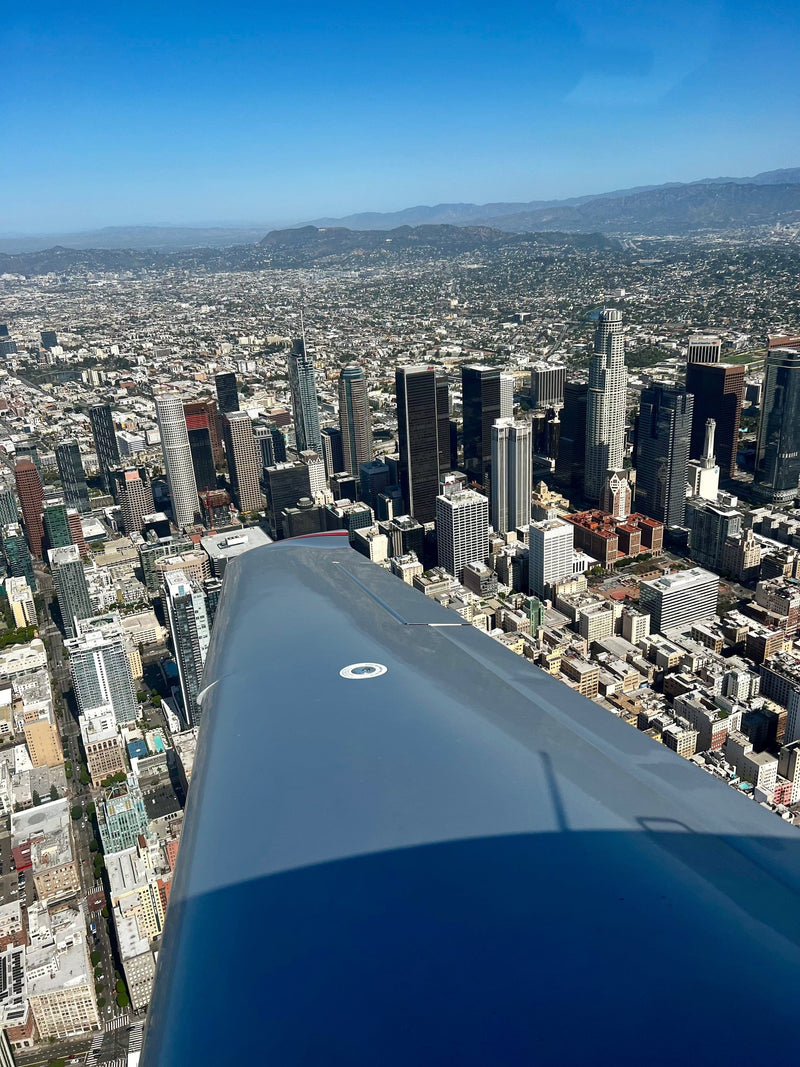
Class B, C, D, E and G, and exactly what each demands of you before you enter it. Locally that means the Van Nuys Class D, the Burbank Class C two miles east and the LAX Class B shelf over the coastal route — taught on a current sectional, not a diagram in a book.
2
Weather Theory And Real Forecasts
Fronts, stability, icing and fog is one half. Reading an actual TAF for KVNY and deciding whether the marine layer burns off by ten is the other. We spend more time on the second — it is the half that gets pilots killed.
3
Aerodynamics
Why the airplane flies, why it stops, and why a stall has nothing to do with the engine. Load factor matters more than it looks: a 60-degree bank doubles effective weight and raises stall speed by about 41%.
4
Aircraft Systems And The Engine
Carburetor versus fuel injection, magnetos, the electrical bus, and what the oil pressure gauge is really telling you. You will preflight better for knowing it, and diagnose faster when something reads wrong.
5
Performance, Weight And Balance
Density altitude on a 100-degree afternoon in the San Fernando Valley is not an abstraction; it can add hundreds of feet to your takeoff roll. You run the numbers for the exact aircraft you fly, not a textbook example.
6
Navigation And Cross-Country Planning
Pilotage, dead reckoning, VOR and GPS, wind triangles and fuel planning. You plan a full cross-country on paper before you fly one, including the 30-minute day VFR reserve in 14 CFR 91.151.
7
Radio Work And ATC
Phraseology, clearances, and the flight following request most students are quietly frightened of for about three weeks. Rehearsed on the ground and in the simulator, so the first time you say it for real is not the first time you say it.
8
Aeromedical Factors
Hypoxia, spatial disorientation, night vision, the IMSAFE checklist and the eight-hour bottle-to-throttle rule in 14 CFR 91.17. A short section, disproportionately represented in accident reports.
9
Aeronautical Decision Making
The subject that appears in almost every accident report ever written. Risk assessment, the five hazardous attitudes, and how to say “not today” after you have already driven to the airport.


 Most Given