SAFETY FIRST
★★★★★
Very safety and detail oriented. Pre-flight briefing explained everything there was. To my knowledge, this flight school is exceptional in their ability.

IFR stands for Instrument Flight Rules: the set of federal rules under which a pilot flies by reference to the instruments, on a flight plan and an air traffic control clearance, and may legally fly inside cloud. Flying IFR takes an instrument rating, an IFR-equipped aircraft and more fuel than a VFR flight. Here is what the term means, what the rules require, and how it works in the Los Angeles marine layer.
IFR means Instrument Flight Rules. Pilots use the three letters in three different ways, and most confusion about IFR comes from mixing them up.
1. The rules. Instrument Flight Rules are the operating rules in 14 CFR Part 91, sections 91.167 through 91.193 — fuel, flight plans, alternates, minimum altitudes, approaches, lost communications. Under them, ATC separates you from other IFR traffic and you navigate by instruments.
2. The kind of flight. An “IFR flight” is one flown on an IFR flight plan and clearance. It can happen on a cloudless day. Every flight in Class A airspace, from 18,000 feet MSL up, must be flown IFR (14 CFR 91.135).
3. The weather. “IFR conditions” are defined in 14 CFR 1.1 as “weather conditions below the minimum for flight under visual flight rules.” Forecasters also use IFR as a flight category: a ceiling of 500 to below 1,000 feet or visibility of 1 to below 3 miles.
| Term | What It Means |
|---|---|
| IFR | Instrument Flight Rules: the rules, 14 CFR 91.167–91.193 |
| IFR flight | A flight on an IFR flight plan and ATC clearance |
| IFR conditions | Weather below VFR minimums (14 CFR 1.1) |
| IMC | Instrument meteorological conditions: the same weather, the term ATC and the AIM use |
| Instrument rating | The pilot qualification that allows IFR (14 CFR 61.3(e)) |
| VFR | The other set: Visual Flight Rules |
An IFR flight needs four things to be legal. Each comes from a specific section of Title 14, quoted or summarized below.
| Requirement | Rule | What It Says |
|---|---|---|
| Instrument rating | 14 CFR 61.3(e) | No person may act as pilot in command under IFR, or in weather below VFR minimums, without an instrument rating (or an ATP certificate) for the aircraft flown. |
| Earning the rating | 14 CFR 61.65(d) | 50 hours cross-country PIC (10 in airplanes); 40 hours actual or simulated instrument time, 15 from an instrument instructor; a 250 nm IFR cross-country with three kinds of approach; 3 hours of instrument training in the 2 calendar months before the test. |
| Currency | 14 CFR 61.57(c) | Within the preceding 6 calendar months: six instrument approaches, holding procedures and tasks, and intercepting and tracking courses. |
| Aircraft equipment | 14 CFR 91.205(d) | VFR equipment plus: two-way radio and navigation equipment suitable for the route, rate-of-turn indicator, slip-skid indicator, sensitive altimeter adjustable for pressure, a clock with seconds, adequate generator or alternator, attitude indicator and heading indicator. |
| Flight plan and clearance | 14 CFR 91.173 | No IFR flight in controlled airspace without a filed IFR flight plan and an ATC clearance. |
| Fuel | 14 CFR 91.167 | Enough fuel to reach the destination, then the alternate (if one is required), then fly 45 more minutes at normal cruise. |
| Alternate airport | 14 CFR 91.169 | Required unless the destination has an instrument approach and, from 1 hour before to 1 hour after arrival, the forecast is at least a 2,000-foot ceiling and 3 miles — the “1-2-3 rule.” |
| Alternate weather | 14 CFR 91.169(c) | Unless the approach chart says otherwise: 600-foot ceiling and 2 miles for a precision approach, 800 and 2 for a nonprecision approach. |
| Minimum altitudes | 14 CFR 91.177 | Published minimums; where none exist, 1,000 feet above the highest obstacle within 4 nm of course, or 2,000 feet in designated mountainous areas. |
| Approaches | 14 CFR 91.175 | No descent below the decision altitude or minimum descent altitude unless the runway environment is in sight and the flight visibility meets the approach minimum. |
| Lost communications | 14 CFR 91.185 | In VFR conditions, continue VFR and land as soon as practicable; in IFR conditions, fly the assigned, vectored, expected or filed route at the highest of the assigned, minimum or expected altitude. |
Compare the fuel rule with VFR: a VFR flight by day needs only 30 minutes of reserve, at night 45 (14 CFR 91.151). An IFR flight needs 45 minutes after flying to an alternate, which on a typical training flight can mean an extra hour of fuel on board.
An IFR clearance is ATC’s permission to fly a route at an altitude. Pilots copy it with the five-letter memory aid CRAFT, then read it back word for word.
Usually the destination airport. It can be a fix short of it, in which case you expect further clearance before you reach it.
A departure procedure, radar vectors, airways or “as filed.” If the route differs from what you filed, ATC reads the change.
An initial altitude, and often an altitude to expect a set time after departure. That expected altitude matters if you lose radio contact (91.185).
The departure control frequency. Around Los Angeles that is a Southern California TRACON sector.
A four-digit code unique to your flight. It ties your radar return to your flight plan on the controller’s screen.
You repeat the clearance in the same order. Under 14 CFR 91.123 you must comply with it once received, so an error caught at readback is an error that never flies.
A clearance read at the Van Nuys clearance delivery position has this shape (all values illustrative): “Warrior five two zero eight Victor, cleared to the Santa Barbara Airport via radar vectors, then as filed. Climb and maintain five thousand, expect seven thousand ten minutes after departure. Departure frequency one two zero point four. Squawk four three two one.” Five items, in the order CRAFT predicts. The letters in the call sign come from the pilot phonetic alphabet.
IMC describes the weather. IFR describes the rules you are flying under. A pilot can be IFR in clear sky, and a VFR pilot can blunder into IMC. The four flight categories below are how weather reports and charts sort the weather.
| Category | Ceiling | Visibility | What It Means For A Flight |
|---|---|---|---|
| VFR | Above 3,000 ft | Above 5 statute miles | Good visual flying; IFR flights fly it too |
| MVFR | 1,000 to 3,000 ft | 3 to 5 statute miles | Legal VFR in most airspace, but marginal |
| IFR | 500 to below 1,000 ft | 1 to below 3 statute miles | Below basic VFR minimums in a surface area; an instrument flight |
| LIFR | Below 500 ft | Below 1 statute mile | Near or below many approach minimums |
An IFR flight in clear weather is still an IFR flight. ATC still separates you from other IFR traffic, but under 14 CFR 91.113(b) you must still see and avoid other aircraft whenever the weather allows it.
A VFR pilot who enters cloud has broken 14 CFR 91.155 and, without an instrument rating, 61.3(e). It is also one of the most dangerous situations in general aviation, which is why private pilot training includes 3 hours of instrument flight under 61.109(a)(3).
IFR does not mean you can always land. Every instrument approach has published minimums, and 91.175 forbids descending below them without the runway environment in sight. The skill the rating teaches is flying to those numbers precisely.
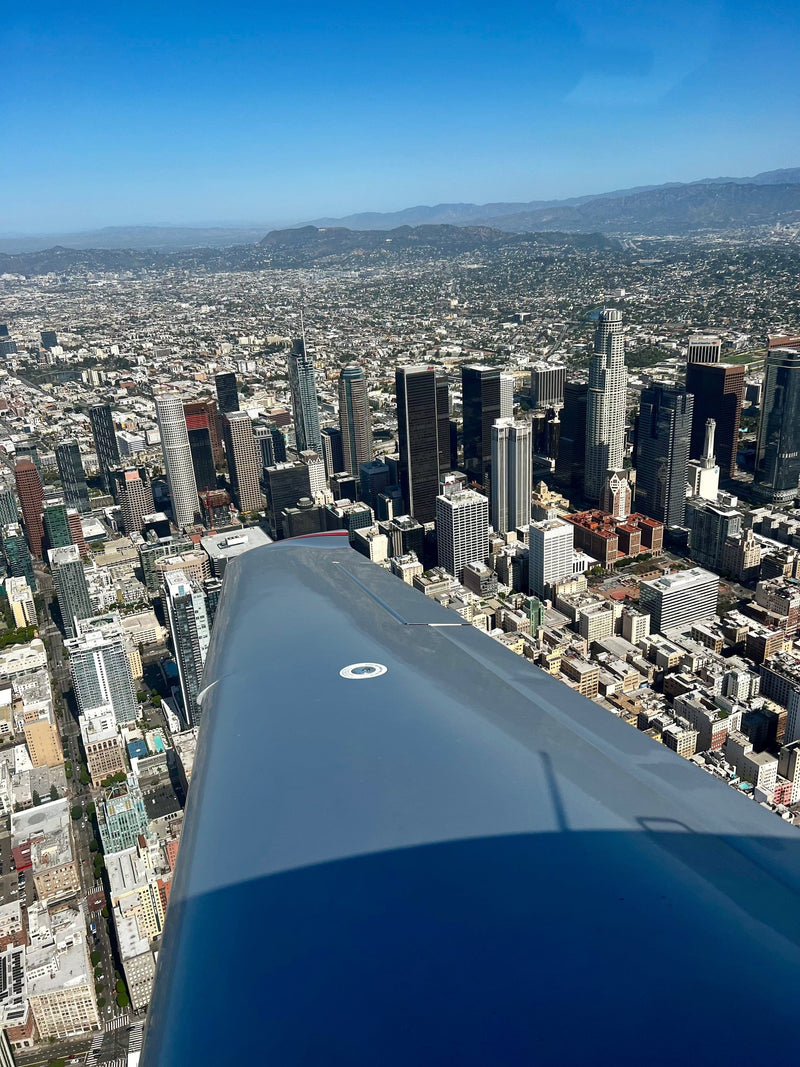
Los Angeles is one of the most useful places in the country to fly IFR, and one of the busiest. Between Van Nuys and the coast sits the LAX Class B airspace, layered with Burbank’s Class C and a ring of towered airports. Southern California TRACON handles IFR traffic for all of them.
An IFR clearance simplifies that airspace. VFR pilots need a separate clearance to enter Class B (14 CFR 91.131) and must work out the boundaries themselves. An IFR flight is already cleared along its route and altitudes, through every class of airspace on the way.
The weather case is the marine layer. From roughly May through August a thin stratus deck sits over the basin each morning. In our year of Van Nuys observations, only 40% of 07:00 June observations met training minima; by 11:00 it was 93%. A VFR pilot waits. An instrument-rated pilot files, climbs through a few minutes of gray and flies in sunshine above it.
For short hops between Southern California airports, controllers commonly use Tower Enroute Control routings, published in the FAA Chart Supplement, which keep the flight inside approach control airspace the whole way. Your instructor will teach you to file and fly them.

You need at least a private pilot certificate first. After that, the instrument rating is the next rating most pilots add, and in Los Angeles it is the one that changes how often you fly.
14 CFR 61.65(d)(1) asks for 50 hours of cross-country pilot in command time, 10 of it in airplanes. Most new private pilots need to build some of this first.
Regulations, charts, weather and procedures, then the FAA instrument knowledge test with an instructor endorsement.
Holds, intercepts and approaches flown in our full-motion simulator. Depending on the device’s approval, up to 20 of the 40 instrument hours can be credited in simulators and training devices under 61.65(h) to (j).
Instrument training in our single-engine fleet, with clearances and vectors from Southern California controllers and approaches at local airports.
A filed IFR flight of at least 250 nautical miles with an instructor, an approach at each airport and three different kinds of approach, per 61.65(d)(2)(ii).
Three hours of instrument training in the 2 calendar months before the test, an endorsement, then the practical test with an examiner.
| Program | Rule | Published Price |
|---|---|---|
| Private Pilot (Standard, 40 hours) | 14 CFR 61.109 | $10,900 |
| Instrument Rating | 14 CFR 61.65 | $11,700 |
| Multi-Engine Add-On | 14 CFR 61.63 | $5,100 |
| Zero To Airline (commercial, instrument, multi, CFI) | 14 CFR Part 61 | $89,000 |
The $11,700 instrument program includes the aircraft, the instructor, ground instruction and Redbird MCX simulator time. FAA test and examiner fees are paid to those providers. The full breakdown is on our instrument rating in Los Angeles page and the instrument rating cost page. For how the two rule sets compare side by side, read VFR vs IFR.
A free consultation covers where you are now — cross-country hours, currency, schedule — and what the $11,700 program looks like from there. If you are not yet a pilot, start with a discovery flight instead.
7900 Balboa Blvd. Suite 108A, Van Nuys, CA 91406 · (818) 290-8249 · Open 9am–9pm, seven days · 5.0 from 120+ Google reviews
IFR stands for Instrument Flight Rules, the regulations in 14 CFR Part 91 that govern flight by reference to instruments under an air traffic control clearance. The same letters describe weather: IFR conditions are conditions below VFR minimums, and on weather charts the IFR category means a ceiling of 500 to below 1,000 feet or visibility of 1 to below 3 miles.
An IFR flight is one flown on a filed IFR flight plan and an ATC clearance, as 14 CFR 91.173 requires in controlled airspace. ATC assigns the route and altitudes and separates the flight from other IFR traffic. An IFR flight can take place in cloud or in clear sky; the rules, not the weather, make it IFR.
No. Under 14 CFR 61.3(e), you may not act as pilot in command under IFR, or in weather below VFR minimums, unless you hold an instrument rating for that category and class of aircraft, or an airline transport pilot certificate. A student or private pilot without the rating may fly IFR only with an appropriately rated instructor or pilot in command.
IFR conditions are weather conditions below the minimum for flight under visual flight rules, as defined in 14 CFR 1.1. In practice that is often a ceiling below 1,000 feet or visibility below 3 statute miles at an airport in a controlled surface area. Pilots also call these instrument meteorological conditions, or IMC.
It is more demanding in a different way. IFR flying removes the outside view and asks you to hold altitude, heading and airspeed precisely by instruments while copying clearances and flying published procedures. Most pilots find the instrument rating the most intensive rating to earn, and 14 CFR 61.57(c) requires regular practice to stay current.
In practice, yes. All flight in Class A airspace, from 18,000 feet MSL up to FL600, must be conducted under IFR (14 CFR 91.135), and airliners cruise there. Airline flights file IFR from gate to gate, though a crew may accept a visual approach at the end of the flight while still on an IFR flight plan.
Under 14 CFR 91.205(d), an IFR airplane needs its VFR equipment plus a two-way radio and navigation equipment for the route, a rate-of-turn indicator, slip-skid indicator, sensitive altimeter, a clock with seconds, an adequate alternator or generator, an attitude indicator and a heading indicator. Inspections such as the 24-month altimeter check also apply.
Most pilots finish in a few months flying two or three times a week, once they hold a private pilot certificate and have 50 hours of cross-country PIC time. The FAA minimum is 40 hours of instrument time under 14 CFR 61.65. At Van Nuys the instrument rating program is $11,700, including simulator time.
Every rule on this page is traceable to Title 14 of the Code of Federal Regulations, the FAA or the National Weather Service.
Regulatory text checked against the current eCFR on 15 October 2026. The sample clearance is illustrative; frequencies, altitudes and squawk codes are not for navigation. Van Nuys marine-layer figures are from our flyable days study. Prices current at 15 October 2026.
The three private pilot packages, what each one includes, the financing options and a realistic timeline built around how often you can actually fly. Sent to you in one email. Nobody will pressure you.
Loved On Google
Every review below is real and shown verbatim, in the reviewer’s own words — written by the people who learned to fly here, not by us.
SAFETY FIRST
Very safety and detail oriented. Pre-flight briefing explained everything there was. To my knowledge, this flight school is exceptional in their ability.
 DISCOVERY FLIGHT
I recently had the chance to take my first-ever discovery flight, and it was nothing short of amazing! From the moment I stepped into the cockpit, the...
 SUNSET CIRRUS
It was a great flight! I did a sunset flight and Alex let us fly an awesome. Website was easy to book, and the plane itself was really fun to fly...
 FLYING LESSON
We had a great flying lesson with Ralph and came away with a much better understanding of both the aircraft and the principles of flight. Ralph is a...
 KIDS LUXURY FLIGHT
I got 2 luxury discovery flights for my kids. I wanted them to have the experience of flying. Our instructor Alex was amazing he made sure they feel...
 HONEYMOON SURPRISE
Last minute booking to surprise my wife on our honeymoon. She had no experience with flying and was scared of flying, but Alex was very easygoing and knew...
 FULL-MOTION SIM
Amazing flight school in van nuys airport. I have been a student here for the past few months and i could not be happier. I started doing a lot of...
 DISCOVERY FOR TWO
I booked a Discovery Flight for Two for my girlfriend's birthday and it was the perfect gift for her. She couldn't have been more excited to get to...
 SIMULATORS
Very professional and great airplanes. I love the flight simulators. The pricing is very fair compared to any other flight school
 TEEN FIRST LESSON
We gifted our teenage son his first flying lesson. He was so excited! Alex greeted us and gave a reassuring brief that made us all feel comfortable and at...
 FIRST-TIME FLYER
Flying is my husband's hobby and I was incredibly anxious and apprehensive about the discovery flight. However, I felt completely safe and at ease once we...
SAFETY FIRST
Very safety and detail oriented. Pre-flight briefing explained everything there was. To my knowledge, this flight school is exceptional in their ability.
DISCOVERY FLIGHT
I recently had the chance to take my first-ever discovery flight, and it was nothing short of amazing! From the moment I stepped into the cockpit, the...
SUNSET CIRRUS
It was a great flight! I did a sunset flight and Alex let us fly an awesome. Website was easy to book, and the plane itself was really fun to fly...
FLYING LESSON
We had a great flying lesson with Ralph and came away with a much better understanding of both the aircraft and the principles of flight. Ralph is a...
KIDS LUXURY FLIGHT
I got 2 luxury discovery flights for my kids. I wanted them to have the experience of flying. Our instructor Alex was amazing he made sure they feel...
HONEYMOON SURPRISE
Last minute booking to surprise my wife on our honeymoon. She had no experience with flying and was scared of flying, but Alex was very easygoing and knew...
FULL-MOTION SIM
Amazing flight school in van nuys airport. I have been a student here for the past few months and i could not be happier. I started doing a lot of...
DISCOVERY FOR TWO
I booked a Discovery Flight for Two for my girlfriend's birthday and it was the perfect gift for her. She couldn't have been more excited to get to...
SIMULATORS
Very professional and great airplanes. I love the flight simulators. The pricing is very fair compared to any other flight school
TEEN FIRST LESSON
We gifted our teenage son his first flying lesson. He was so excited! Alex greeted us and gave a reassuring brief that made us all feel comfortable and at...
FIRST-TIME FLYER
Flying is my husband's hobby and I was incredibly anxious and apprehensive about the discovery flight. However, I felt completely safe and at ease once we...
Reviews shown verbatim, exactly as each reviewer published them.
Aviation News
Notes from the flight line at Van Nuys — weather, regulation changes, checkride questions and the cost of training, written up as they come.
Open 7 days · 9:00 AM – 9:00 PM
Los Angeles Flight School