SAFETY FIRST
★★★★★
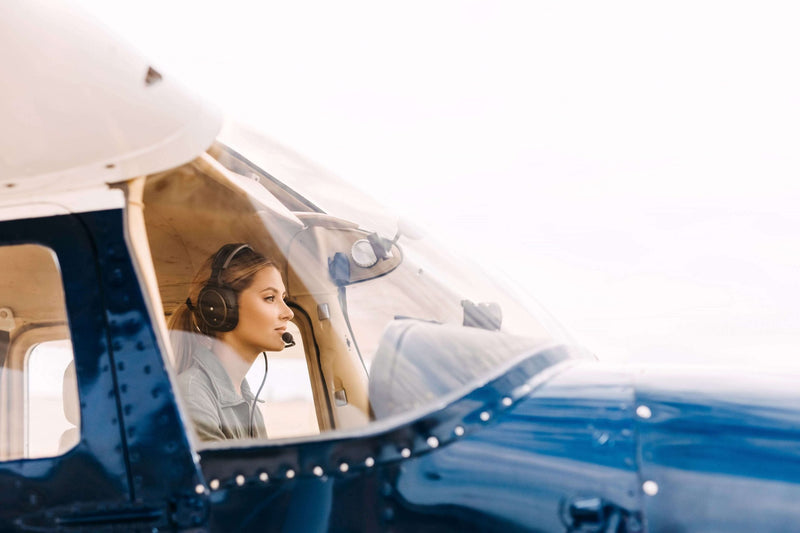
Very safety and detail oriented. Pre-flight briefing explained everything there was. To my knowledge, this flight school is exceptional in their ability.

The aviation alphabet is a set of 26 code words — Alfa, Bravo, Charlie through Zulu — that pilots and controllers use to spell letters over the radio, plus ten numbers spoken the ICAO way, including “tree,” “fife” and “niner.” It is the same alphabet NATO and the military use. Below is the full chart with the official pronunciation and Morse code, and how it actually sounds on frequency at Van Nuys.
Spelling and pronunciation exactly as the FAA prints them in the Aeronautical Information Manual, table 4-2-7, which follows ICAO. Capitals show the syllables; the official spellings are Alfa and Juliett.
| Letter | Code Word | Pronunciation | Morse Code |
|---|---|---|---|
| A | Alfa | AL-FAH | · – |
| B | Bravo | BRAH-VOH | – · · · |
| C | Charlie | CHAR-LEE or SHAR-LEE | – · – · |
| D | Delta | DELL-TAH | – · · |
| E | Echo | ECK-OH | · |
| F | Foxtrot | FOKS-TROT | · · – · |
| G | Golf | GOLF | – – · |
| H | Hotel | HOH-TEL | · · · · |
| I | India | IN-DEE-AH | · · |
| J | Juliett | JEW-LEE-ETT | · – – – |
| K | Kilo | KEY-LOH | – · – |
| L | Lima | LEE-MAH | · – · · |
| M | Mike | MIKE | – – |
| N | November | NO-VEM-BER | – · |
| O | Oscar | OSS-CAH | – – – |
| P | Papa | PAH-PAH | · – – · |
| Q | Quebec | KEH-BECK | – – · – |
| R | Romeo | ROW-ME-OH | · – · |
| S | Sierra | SEE-AIR-RAH | · · · |
| T | Tango | TANG-GO | – |
| U | Uniform | YOU-NEE-FORM or OO-NEE-FORM | · · – |
| V | Victor | VIK-TAH | · · · – |
| W | Whiskey | WISS-KEY | · – – |
| X | Xray | ECKS-RAY | – · · – |
| Y | Yankee | YANG-KEY | – · – – |
| Z | Zulu | ZOO-LOO | – – · · |
Three notes on the table. First, the pronunciation column is the official one, not a guess: the AIM gives both CHAR-LEE and SHAR-LEE for Charlie and both YOU-NEE-FORM and OO-NEE-FORM for Uniform, and either is correct. Second, FAA Order JO 7110.65, the controllers’ handbook, prints X as “X-ray” and puts the stress on the second syllable of Hotel (HOH TELL); the word is the same. Third, nothing here is decorative. The table is kept plain so it prints cleanly on one or two sheets from your browser.
Digits get the same treatment as letters. Three of them sound wrong to a new student, and every one of the three exists for a reason.
| Digit | Word | Say It | Morse |
|---|---|---|---|
| 0 | Zero | ZEE-RO | – – – – – |
| 1 | One | WUN | · – – – – |
| 2 | Two | TOO | · · – – – |
| 3 | Three | TREE | · · · – – |
| 4 | Four | FOW-ER | · · · · – |
| 5 | Five | FIFE | · · · · · |
| 6 | Six | SIX | – · · · · |
| 7 | Seven | SEV-EN | – – · · · |
| 8 | Eight | AIT | – – – · · |
| 9 | Nine | NIN-ER | – – – – · |
“Niner” keeps nine from being heard as the German nein, and from blurring into five on a scratchy radio. “Tree” drops the “th” sound that many of the world’s pilots do not have in their first language. “Fife” gives five a hard ending so it cannot be mistaken for nine.
Most numbers are read one digit at a time: a heading of 090 is “heading zero niner zero,” and 10 is “one zero,” never “ten” (AIM 4-2-8 and 4-2-10). The exceptions are round hundreds and thousands, which keep the words “hundred” and “thousand.” Zero is always “zero,” never “oh.”
In the United States the decimal point in a frequency is spoken as “point.” ICAO procedures use “decimal,” and the AIM notes the FAA accepts either.
| What You See | What You Say | Rule |
|---|---|---|
| Altitude 4,500 ft | “Four thousand five hundred” | AIM 4-2-8 |
| Altitude 12,500 ft | “One two thousand five hundred” | AIM 4-2-9 |
| Flight level 190 | “Flight level one niner zero” | AIM 4-2-9 |
| Heading 090 | “Heading zero niner zero” | AIM 4-2-10 |
| Wind 220 at 8 | “Wind two two zero at eight” | AIM 4-2-10 |
| Frequency 122.1 | “One two two point one” | AIM 4-2-8 |
| Speed 190 knots | “One niner zero knots” | AIM 4-2-11 |
| Time 0920 UTC | “Zero niner two zero Zulu” | AIM 4-2-12 |
| Altimeter 29.92 | “Altimeter two niner niner two” | JO 7110.65, 2-4-17 |
| Airway V12 | “Victor twelve” | AIM 4-2-8 |
Pilots do not spell words for fun. The alphabet earns its keep in four places, and you will use all four on your first lesson out of Van Nuys.
Every US aircraft is registered with an N-number, and that number is its call sign. A tail of N5208V is spoken “November five two zero eight Victor” — each character separately, never “fifty-two oh eight.” If you lead with the make or model, the N is dropped: “Skycatcher five two zero eight Victor” (AIM 4-2-4).
The recorded airport information — wind, visibility, ceiling, altimeter, runway in use — is broadcast as “information Alfa,” then Bravo, and so on as it is updated (AIM 4-1-13). Your first call to the tower or ground tells them you have it: “with Bravo.”
Taxiways are lettered, so a taxi clearance is a string of code words: “taxi to runway one six right via Alfa.” Navigation fixes and airport identifiers are spelled the same way — Van Nuys, KVNY, is “Kilo Victor November Yankee.”
A runway number is its magnetic direction with the last zero dropped, read digit by digit. Van Nuys has two parallel runways, 16 Right/34 Left and 16 Left/34 Right, so you will hear “runway one six right” and “three four left,” never “sixteen.”
A transponder code is four digits from 0 to 7, read separately: “squawk one two zero zero.” One wrong digit puts your aircraft on someone else’s data tag, which is why you read it back.
Once ATC has shortened your call sign, you may too. The short form is the prefix plus the last three characters: “November zero eight Victor.” Never shorten it first, and never when another aircraft on frequency has a similar number (AIM 4-2-4).
Here is the shape of a first call on the ground at Van Nuys, with an illustrative tail number. The taxi route and the ATIS letter change daily; the structure does not.
| Who | What Is Said | What It Means |
|---|---|---|
| Pilot | “Van Nuys Ground, Skycatcher five two zero eight Victor, on the ramp, VFR to the north, with Bravo.” | Who you are calling, who you are, where you are, what you want, and that you have ATIS information Bravo. |
| Ground | “Skycatcher zero eight Victor, runway one six right, taxi via Alfa.” | The controller has shortened the call sign, so now you may too. |
| Pilot | “Runway one six right, taxi via Alfa, Skycatcher zero eight Victor.” | Readback: the runway, the route, then your call sign. |
None of these will fail a checkride on its own. All of them make a busy frequency harder for everyone on it, and Los Angeles frequencies are busy.
“B as in boy” or “N as in Nancy” defeats the purpose. The value of the list is that every listener already knows it.
“November fifty-two oh-eight Victor” is how people say phone numbers. Each digit is spoken alone. Group form is for airline flight numbers like “American Fifty-two” (JO 7110.65, 2-4-20).
“Zero” is unambiguous; “oh” can be heard as the letter O or as nothing at all.
Ordinary “nine” slips back in under workload. It is the digit most often misheard, so it is the one worth drilling.
Under AIM 4-2-4 the controller abbreviates first. Until then, use the full call sign every time.
Papa is pah-PAH, Hotel is hoh-TEL, Quebec is keh-BECK. The stress is part of what makes a word recognizable through static.
4,500 is “four thousand five hundred,” not “four five zero zero.” Thousands and hundreds keep their words below 18,000 feet.
The AIM tells pilots to use the alphabet for call signs, single letters and difficult words. Spelling the whole message wastes the frequency.
Speed is not fluency. A controller would rather hear a call sign once, clearly, than three times quickly.
Before 1956 there was no single alphabet. After the Second World War, international aviation used the US “Able Baker” alphabet, built for English speakers. ICAO wanted words that a pilot from any country could say and hear reliably.
The work began with a draft from IATA in 1947. Professor Jean-Paul Vinay, a linguist at the Université de Montréal, worked with ICAO’s Language Section on it in 1948 and 1949, and a new alphabet came into use for civil aviation in 1952.
Pilots complained about several of the words, so ICAO tested them again, with speakers from 31 countries. Only five words changed — those for C, M, N, U and X — and the final version was implemented by ICAO on 1 March 1956. NATO adopted the same alphabet that year, which is why the “NATO phonetic alphabet” and the “military alphabet” are the same 26 words pilots use.
The odd spellings are deliberate. ICAO writes Alfa with an F because “alpha” would not be pronounced correctly by some speakers, and Juliett with two Ts because French speakers might treat a single final T as silent.

People search for this list under a dozen names. They all point to the same thing.
| Name You Hear | Who Uses The Term | Same Words? |
|---|---|---|
| ICAO radiotelephony spelling alphabet | The official name, in ICAO Annex 10 | Yes |
| Aviation alphabet, pilot alphabet, airplane alphabet | Pilots, student pilots, the public | Yes |
| Aviation phonetic alphabet, airline phonetic alphabet | Flight schools and airline crews | Yes |
| NATO phonetic alphabet | NATO forces, adopted 1956 | Yes |
| Military alphabet | US armed forces | Yes |
| International radiotelephony spelling alphabet | ITU, maritime and amateur radio | Yes |
One thing it is not: the two-letter and three-letter airline codes (AA, UAL) printed on tickets. Those are IATA and ICAO designators, a separate system. When an airline crew speaks to ATC, its call sign is a word such as “American” or “United” followed by the flight number in group form — “United Twenty-Five Heavy” in the AIM’s own example.
Most students know the letters within a few days. Saying them fluently while flying an airplane is the part that takes practice.
License plates, street signs, your own name. Ten minutes a day for three days covers the 26 words.
Once you know which aircraft you fly, say its full call sign until it comes out without thought. It is the phrase you will say most.
Listening to Van Nuys tower and ground shows you the rhythm: who speaks first, what gets read back, and how short good calls are.
Early on, jot the call on your kneeboard: who, who you are, where, what. The words come from the alphabet; the order comes from habit.
Our Redbird MCX full-motion simulator is a quiet place to rehearse calls without a real controller waiting on you.
Radio work is part of every lesson from the first one. On a discovery flight you hear it live from the right seat, at one of the busier general aviation airports in the country.
A discovery flight from Van Nuys puts a headset on you and an instructor beside you. You will hear “information Bravo” and “runway one six right” in their natural setting, and you fly the airplane yourself. The time logs toward a pilot certificate.
7900 Balboa Blvd. Suite 108A, Van Nuys, CA 91406 · (818) 290-8249 · Open 9am–9pm, seven days · 5.0 from 120+ Google reviews
The aviation alphabet is the ICAO radiotelephony spelling alphabet: 26 code words, Alfa, Bravo, Charlie through Zulu, used by pilots and air traffic controllers to say letters clearly over the radio. It also sets how the ten digits are spoken, including tree, fife and niner. The FAA publishes it in the Aeronautical Information Manual, paragraph 4-2-7.
Yes. ICAO implemented the final version on 1 March 1956 and NATO adopted the same words that year, so the pilot alphabet, the NATO phonetic alphabet and the military alphabet are identical: Alfa, Bravo, Charlie, Delta, Echo, Foxtrot, Golf, Hotel, India, Juliett, Kilo, Lima, Mike, November, Oscar, Papa, Quebec, Romeo, Sierra, Tango, Uniform, Victor, Whiskey, Xray, Yankee, Zulu.
Niner keeps nine from being confused with five on a weak radio signal, and from being heard as the German word nein. The FAA and ICAO both list the pronunciation as NIN-ER. Pilots also say tree for three and fife for five, so that each digit has a distinct sound for speakers of any language.
The official ICAO and FAA spelling is Alfa, with an F, and Juliett with two Ts. ICAO chose the spellings so that speakers of other languages pronounce the words correctly. The spoken word is the same either way, AL-FAH, and you will see Alpha in many English-language publications.
US aircraft use their N-number as a call sign, with every character spoken separately in the phonetic alphabet. N5208V becomes November five two zero eight Victor, or Skycatcher five two zero eight Victor if you lead with the aircraft type. After ATC shortens it, you may use the prefix and last three characters, such as November zero eight Victor.
The military alphabet is the same 26-word NATO phonetic alphabet that pilots use, from Alfa to Zulu. The US armed forces, NATO, ICAO and the International Telecommunication Union all use the same code words, which is why a civilian pilot and a military controller can spell a call sign to each other without any confusion.
Yes, airline pilots use the same aviation phonetic alphabet for taxiways, fixes, ATIS letters and any letter that must be spelled. Their call sign is different: an airline uses its authorized name and the flight number in group form, such as United Twenty-Five Heavy, rather than spelling a registration.
Most people memorize all 26 letters in two or three days of short practice, such as spelling license plates aloud. Fluency on the radio takes longer, typically the first several flight lessons, because you are using it while flying the airplane, listening to the controller and reading back instructions at the same time.
The alphabet, pronunciation and Morse code are taken from the FAA Aeronautical Information Manual, which follows ICAO Annex 10, Volume II. History is from ICAO’s own account.
Pronunciation is shown as published in AIM table 4-2-7. Tail number N5208V is an illustrative example. Taxi routes and ATIS letters at Van Nuys change daily; always use the current ATIS and ATC instructions. Checked 15 October 2026.
Teachers, students and writers may link to this page, print the chart or reproduce it with credit to LA Flight School. Suggested credit: Pilot Phonetic Alphabet Chart, LA Flight School, after FAA AIM 4-2-7 and ICAO.

The three private pilot packages, what each one includes, the financing options and a realistic timeline built around how often you can actually fly. Sent to you in one email. Nobody will pressure you.
Loved On Google
Every review below is real and shown verbatim, in the reviewer’s own words — written by the people who learned to fly here, not by us.
SAFETY FIRST
Very safety and detail oriented. Pre-flight briefing explained everything there was. To my knowledge, this flight school is exceptional in their ability.
 DISCOVERY FLIGHT
I recently had the chance to take my first-ever discovery flight, and it was nothing short of amazing! From the moment I stepped into the cockpit, the...
 SUNSET CIRRUS
It was a great flight! I did a sunset flight and Alex let us fly an awesome. Website was easy to book, and the plane itself was really fun to fly...
 FLYING LESSON
We had a great flying lesson with Ralph and came away with a much better understanding of both the aircraft and the principles of flight. Ralph is a...
 KIDS LUXURY FLIGHT
I got 2 luxury discovery flights for my kids. I wanted them to have the experience of flying. Our instructor Alex was amazing he made sure they feel...
 HONEYMOON SURPRISE
Last minute booking to surprise my wife on our honeymoon. She had no experience with flying and was scared of flying, but Alex was very easygoing and knew...
 FULL-MOTION SIM
Amazing flight school in van nuys airport. I have been a student here for the past few months and i could not be happier. I started doing a lot of...
 DISCOVERY FOR TWO
I booked a Discovery Flight for Two for my girlfriend's birthday and it was the perfect gift for her. She couldn't have been more excited to get to...
 SIMULATORS
Very professional and great airplanes. I love the flight simulators. The pricing is very fair compared to any other flight school
 TEEN FIRST LESSON
We gifted our teenage son his first flying lesson. He was so excited! Alex greeted us and gave a reassuring brief that made us all feel comfortable and at...
 FIRST-TIME FLYER
Flying is my husband's hobby and I was incredibly anxious and apprehensive about the discovery flight. However, I felt completely safe and at ease once we...
SAFETY FIRST
Very safety and detail oriented. Pre-flight briefing explained everything there was. To my knowledge, this flight school is exceptional in their ability.
DISCOVERY FLIGHT
I recently had the chance to take my first-ever discovery flight, and it was nothing short of amazing! From the moment I stepped into the cockpit, the...
SUNSET CIRRUS
It was a great flight! I did a sunset flight and Alex let us fly an awesome. Website was easy to book, and the plane itself was really fun to fly...
FLYING LESSON
We had a great flying lesson with Ralph and came away with a much better understanding of both the aircraft and the principles of flight. Ralph is a...
KIDS LUXURY FLIGHT
I got 2 luxury discovery flights for my kids. I wanted them to have the experience of flying. Our instructor Alex was amazing he made sure they feel...
HONEYMOON SURPRISE
Last minute booking to surprise my wife on our honeymoon. She had no experience with flying and was scared of flying, but Alex was very easygoing and knew...
FULL-MOTION SIM
Amazing flight school in van nuys airport. I have been a student here for the past few months and i could not be happier. I started doing a lot of...
DISCOVERY FOR TWO
I booked a Discovery Flight for Two for my girlfriend's birthday and it was the perfect gift for her. She couldn't have been more excited to get to...
SIMULATORS
Very professional and great airplanes. I love the flight simulators. The pricing is very fair compared to any other flight school
TEEN FIRST LESSON
We gifted our teenage son his first flying lesson. He was so excited! Alex greeted us and gave a reassuring brief that made us all feel comfortable and at...
FIRST-TIME FLYER
Flying is my husband's hobby and I was incredibly anxious and apprehensive about the discovery flight. However, I felt completely safe and at ease once we...
Reviews shown verbatim, exactly as each reviewer published them.
Aviation News
Notes from the flight line at Van Nuys — weather, regulation changes, checkride questions and the cost of training, written up as they come.
Open 7 days · 9:00 AM – 9:00 PM
Los Angeles Flight School