Start with the layout. KVNY has two parallel strips, 16L/34R and 16R/34L, running roughly north-south down the length of the field. The longer of the two takes the jet traffic and the arrivals that need the distance. The shorter parallel is where most of the training happens, which means you are not queueing behind a departing business jet every time you want to shoot a landing.
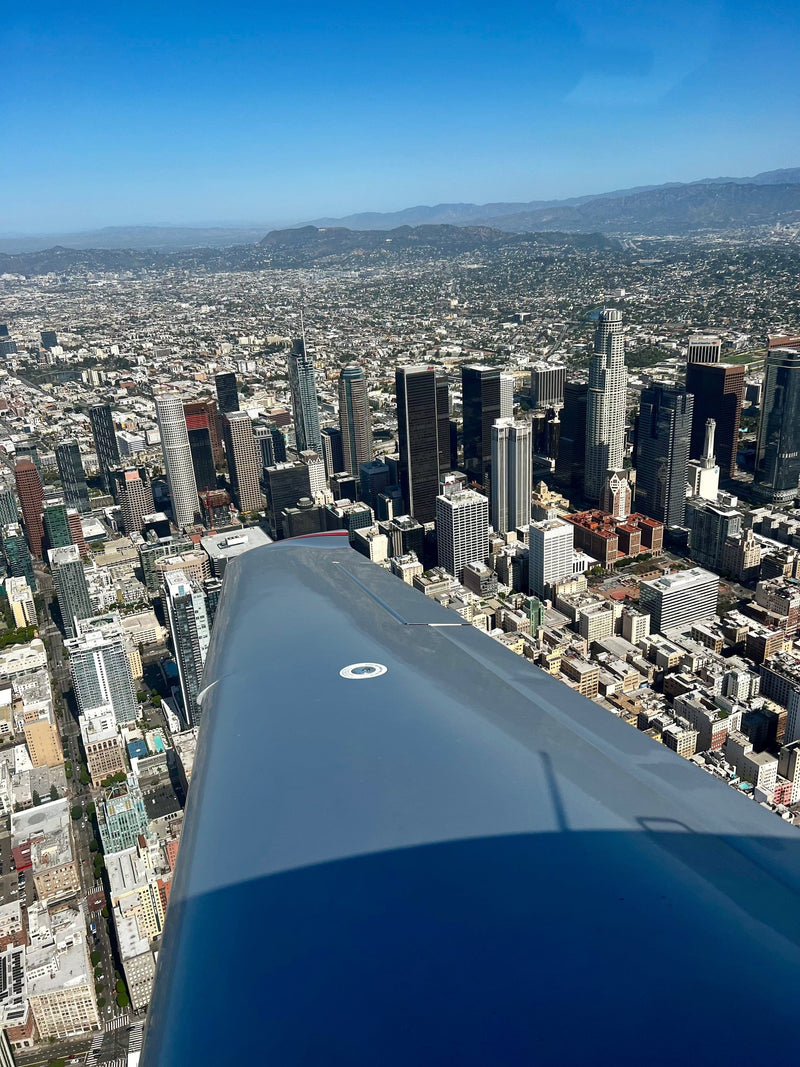
Now the airspace. The Class B shelf that protects arrivals into LAX sits over the top of the valley, and Van Nuys tucks in underneath it. You learn, from the first lesson, that altitude is not optional and that a clearance means something. Students who train at quiet uncontrolled fields often meet that idea for the first time on a cross-country, alone, with a controller talking quickly. Ours meet it on day one with an instructor in the right seat.
Then the radio. This is the part people underestimate and the part that makes Van Nuys graduates comfortable anywhere. Before you have flown a circuit you have pulled the ATIS, called ground, read back a taxi clearance, switched to tower, been sequenced behind traffic you had to find visually, and been told to make a short approach because something faster is on a three-mile final. By your solo it is automatic. Pilots who learned somewhere quiet spend their first year being nervous on the frequency. That is a real cost and nobody bills you for it.
The flying itself is good. A typical lesson from Van Nuys puts you over the Sepulveda Basin and Lake Balboa within a minute of the departure end, and the Santa Monica Mountains sit right there on the south side as your reference for everything. Ground reference maneuvers over the basin, steep turns and stalls out over the hills to the north, then back into the pattern. The visual landmarks are unmistakable, which matters more than it sounds when you are a student trying to hold a heading and think at the same time.
Here is the trade-off, and it is real. Van Nuys is busy. Some mornings you will sit at the hold short line behind four aircraft while a departure sequence clears, and a 1.2-hour lesson costs you 1.4. A quiet field would give you those minutes back. What it would not give you is the traffic scan, the sequencing, or a controller who expects a competent read-back. We think that trade is worth making, and after two hundred hours in the LA basin most of our graduates say the same. If you disagree, that is a fair position and you should train somewhere quieter.
One more thing that only applies here. Because we are based on the field rather than driving to it, a lesson that gets scrubbed for weather at 8am can often be rebuilt into a simulator hour or a ground session the same morning without anyone going home. That is a scheduling advantage, not a marketing line.


 Most Given