SAFETY FIRST
★★★★★
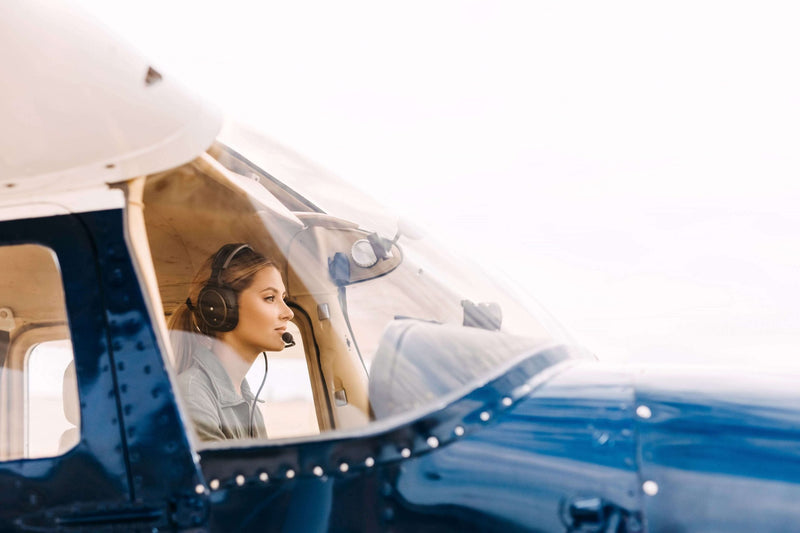
Very safety and detail oriented. Pre-flight briefing explained everything there was. To my knowledge, this flight school is exceptional in their ability.

Flight training has its own language, and most of it gets thrown at you in the first three lessons with no translation. This is the translation. Every term you will actually hear at a flight school, in plain English, written by the instructors who teach it.
Every student pilot has the same experience in the first week: an instructor says something completely ordinary like squawk VFR and stay below the shelf, and you nod as though that meant anything. It is not a sign you are behind. Aviation compresses a lot of meaning into very few words because radio time is expensive, and the vocabulary is learned the same way any vocabulary is — by hearing it used.
This page exists so you can look things up without pretending. It is organized by subject rather than strictly alphabetically, because terms make more sense next to their neighbors. If you are looking for one specific word, use your browser's find function.

Aviation distinguishes between a certificate (the license itself), a rating (an addition that expands what you may do) and an endorsement (a logbook signature from an instructor permitting something specific). People say license in conversation; the FAA says certificate.
Issued by an Aviation Medical Examiner (AME), not an ordinary doctor. Applied for through MedXpress, the FAA's online system, before the appointment.
The FARs (Federal Aviation Regulations) live in Title 14 of the Code of Federal Regulations. Instructors cite them constantly and by number.
The vocabulary below stops being abstract about ten minutes into your first lesson, because you will hear all of it on the radio at one of the busiest general aviation airports in the world. Students trained here learn radio discipline quickly because there is no alternative.

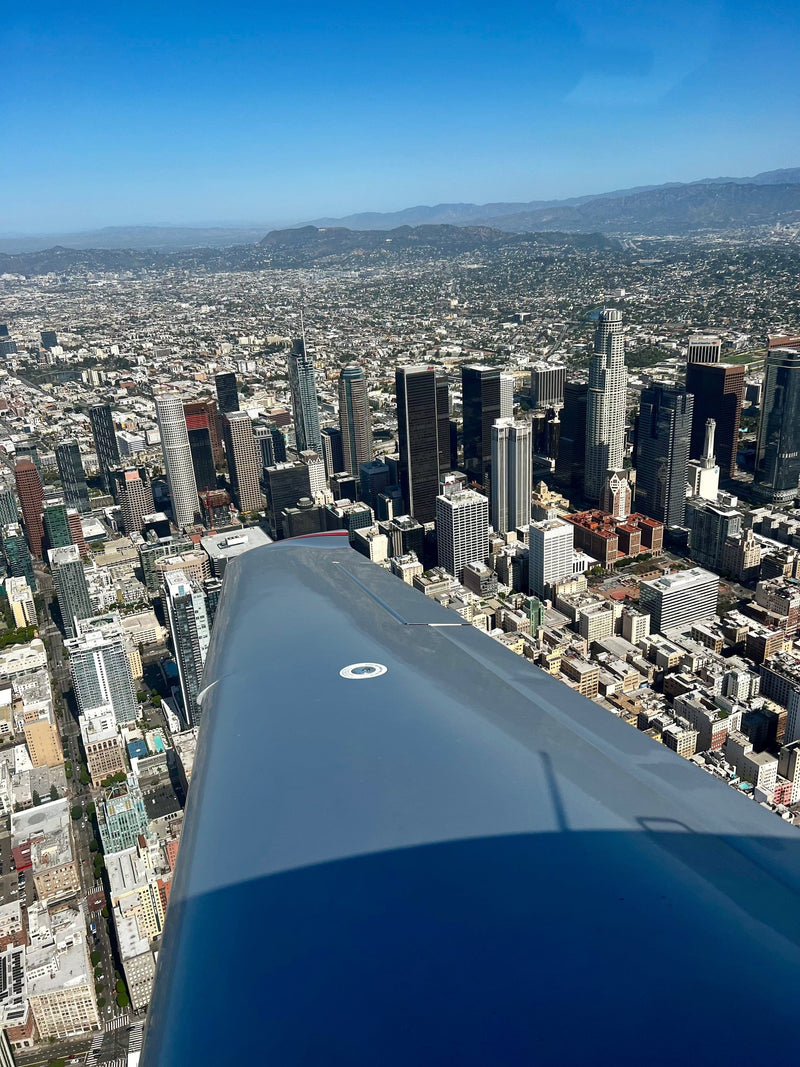
US airspace is layered like an upside-down wedding cake around busy airports. Van Nuys sits in Class D beneath the Class B shelf belonging to LAX — which is exactly why students trained here learn radio discipline quickly.
Book It Or Gift It
Every discovery flight below can be booked for yourself in the next few minutes, or bought as a gift certificate that is emailed within minutes and never expires. Same flight, same price, either way.
 Most Given
 Two Seats
 The Nice One
 Twin Engine
One person, one instructor, and no audience. Hands on the controls from the left seat, briefed before you go and debriefed after you land.
Hands-On Stick TimePre-Flight BriefingLoggable Flight Time
Flight Length
$229Book It Or Gift It
Same Price Either Way
The same flight with a passenger in the back seat, briefed and on the intercom. Couples book it; so do parents who would rather watch than hear about it.
One Passenger SeatPiper Warrior Or ArcherHeadsets For Both
Flight Length
$299Book It Or Gift It
Same Price Either Way
The nicest airplane we put a first-time flyer in. Glass cockpit, air conditioning, leather seats, and a parachute built into the airframe rather than strapped to the person.
Turbocharged Cirrus SR22Air ConditioningWhole-Airframe Parachute
Flight Length
$499Book It Or Gift It
Same Price Either Way
Two engines, and the airplane instrument-rated pilots move into when they start thinking about a career. Flown from the left seat with a multi-engine instructor.
Piper Seminole TwinMulti-Engine DepartureCareer-Track Instructor
Flight Length
$499Book It Or Gift It
Same Price Either Way
Gift It issues a real gift certificate, emailed within minutes, which never expires and credits in full toward training. Flights are limited to 180 lb per person, 370 lb combined. Questions: (818) 290-8249, 9 AM–9 PM, seven days.
Courses & Pricing
Course prices are packages, not hourly rates - the aircraft, your instructor, ground school and simulator time are all in the figure. Van Nuys Airport, KVNY. Financing Available Through Stratus & In-House Plans.

Start Here
The First Hour At The Controls. Credited Toward Your Training If You Enroll Within 24 Hours Of Landing.
All Prices In USD. 7900 Balboa Blvd, Suite 108A, Van Nuys, CA 91406 · Open 9 AM–9 PM, Seven Days. Free In-Person Tour Of The School
Loved On Google
Every review below is real and shown verbatim, in the reviewer’s own words — written by the people who learned to fly here, not by us.
SAFETY FIRST
Very safety and detail oriented. Pre-flight briefing explained everything there was. To my knowledge, this flight school is exceptional in their ability.
 DISCOVERY FLIGHT
I recently had the chance to take my first-ever discovery flight, and it was nothing short of amazing! From the moment I stepped into the cockpit, the...
 SUNSET CIRRUS
It was a great flight! I did a sunset flight and Alex let us fly an awesome. Website was easy to book, and the plane itself was really fun to fly...
 FLYING LESSON
We had a great flying lesson with Ralph and came away with a much better understanding of both the aircraft and the principles of flight. Ralph is a...
 KIDS LUXURY FLIGHT
I got 2 luxury discovery flights for my kids. I wanted them to have the experience of flying. Our instructor Alex was amazing he made sure they feel...
 HONEYMOON SURPRISE
Last minute booking to surprise my wife on our honeymoon. She had no experience with flying and was scared of flying, but Alex was very easygoing and knew...
 FULL-MOTION SIM
Amazing flight school in van nuys airport. I have been a student here for the past few months and i could not be happier. I started doing a lot of...
 DISCOVERY FOR TWO
I booked a Discovery Flight for Two for my girlfriend's birthday and it was the perfect gift for her. She couldn't have been more excited to get to...
 SIMULATORS
Very professional and great airplanes. I love the flight simulators. The pricing is very fair compared to any other flight school
 TEEN FIRST LESSON
We gifted our teenage son his first flying lesson. He was so excited! Alex greeted us and gave a reassuring brief that made us all feel comfortable and at...
 FIRST-TIME FLYER
Flying is my husband's hobby and I was incredibly anxious and apprehensive about the discovery flight. However, I felt completely safe and at ease once we...
SAFETY FIRST
Very safety and detail oriented. Pre-flight briefing explained everything there was. To my knowledge, this flight school is exceptional in their ability.
DISCOVERY FLIGHT
I recently had the chance to take my first-ever discovery flight, and it was nothing short of amazing! From the moment I stepped into the cockpit, the...
SUNSET CIRRUS
It was a great flight! I did a sunset flight and Alex let us fly an awesome. Website was easy to book, and the plane itself was really fun to fly...
FLYING LESSON
We had a great flying lesson with Ralph and came away with a much better understanding of both the aircraft and the principles of flight. Ralph is a...
KIDS LUXURY FLIGHT
I got 2 luxury discovery flights for my kids. I wanted them to have the experience of flying. Our instructor Alex was amazing he made sure they feel...
HONEYMOON SURPRISE
Last minute booking to surprise my wife on our honeymoon. She had no experience with flying and was scared of flying, but Alex was very easygoing and knew...
FULL-MOTION SIM
Amazing flight school in van nuys airport. I have been a student here for the past few months and i could not be happier. I started doing a lot of...
DISCOVERY FOR TWO
I booked a Discovery Flight for Two for my girlfriend's birthday and it was the perfect gift for her. She couldn't have been more excited to get to...
SIMULATORS
Very professional and great airplanes. I love the flight simulators. The pricing is very fair compared to any other flight school
TEEN FIRST LESSON
We gifted our teenage son his first flying lesson. He was so excited! Alex greeted us and gave a reassuring brief that made us all feel comfortable and at...
FIRST-TIME FLYER
Flying is my husband's hobby and I was incredibly anxious and apprehensive about the discovery flight. However, I felt completely safe and at ease once we...
Reviews shown verbatim, exactly as each reviewer published them.
Angle of attack, trim, complex, glass cockpit, multi-engine — every one of those terms points at a specific airplane on our ramp. We own all of them, inspect them on our own schedule, and fly them every day.


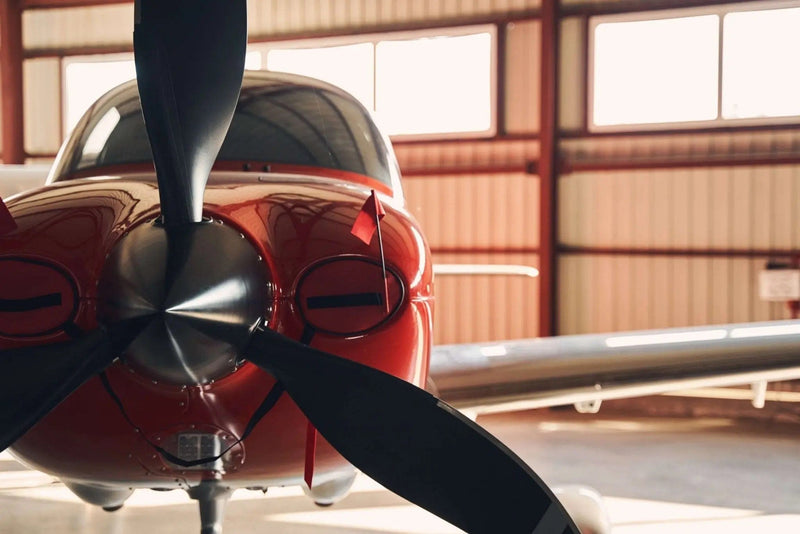
Single-engine training on the Standard and Comprehensive programs is flown in the Cessna, Piper and Diamond aircraft. The Premium program is flown in the Cirrus SR22 Turbo with its full glass cockpit.
A full-motion, FAA-approved, fully enclosed simulator, and it moves. Half the vocabulary on this page is easier to learn here than in the aircraft, because the instructor can freeze the world and explain it. And it is never canceled for weather.
Simulator hours are built into every private pilot program — 2 hours on Standard and Premium, 5 hours on Comprehensive. A standalone session is $189.
Every instructor here holds a commercial or ATP certificate plus a CFI and a current medical, and the instructor is legally pilot in command on every flight. Which means you can use a term wrongly on the radio in your third week and nothing bad happens — which is exactly how the vocabulary gets learned.
There are eleven of them, so your lessons are not hostage to one person's calendar. You are matched to an instructor when you enroll and you can change if the fit is wrong, without a conversation about loyalty.
They fly here as a career rather than treating the school as a waiting room for an airline class date. It shows up in the debrief, which is where most of the words on this page actually get explained.

A discovery flight is a real lesson — you fly the aircraft, your instructor talks you through the radio calls, and it goes in a logbook as dual instruction. The full price is credited against any program if you enroll within 24 hours.
Full-motion and FAA-approved. Foggles, approaches and radio work, with the ability to pause and ask what a word means.
You fly it. Logged as dual instruction. 90 min $299, 120 min $399. Credited in full against any program within 24 hours.
Half an hour on your calendar, your budget and which certificate actually fits. No obligation.
Programs: Sport Pilot $8,400 · Private Pilot $10,900 Standard, $15,900 Comprehensive, $22,500 Premium · Instrument Rating $11,700 · Multi-engine add-on $5,100 · Solo Certificate $5,500 · Teens 10–15 $4,200 · Zero-to-airline $89,000. Enrolled students train at $179 an hour wet, single-engine, fixed at enrollment. Financing from $2,500 down.
An hour in the aircraft will teach you more vocabulary than an evening on this page. You fly it, your instructor talks you through the radio calls, and it goes in a logbook as real instruction. Call (818) 290-8249 or book online.
They are the same thing. The FAA issues 'certificates' and that is the correct legal term in the United States; most of the world and most conversation says 'license'. Nobody will correct you either way, and the private pilot certificate you earn in our $10,900 Standard program is the document people mean when they say license.
A rating is added to your certificate by the FAA after a checkride — an instrument rating or a multi-engine rating, for example. An endorsement is a signature an instructor writes in your logbook permitting a specific activity, such as flying a high-performance or tailwheel aircraft. Ratings require a test; endorsements require an instructor to be satisfied you are competent. Our instrument rating is $11,700 and the multi-engine add-on is $5,100.
Visual Flight Rules — flying by looking out of the window, in weather good enough to see and avoid other aircraft and terrain. In Class D airspace such as Van Nuys that means 3 statute miles visibility and cloud clearance of 500 feet below, 1,000 above and 2,000 horizontally. The alternative is IFR, which requires an instrument rating and permits flight in cloud under air traffic control.
An hourly aircraft rate with fuel included. A dry rate excludes fuel, which you then buy separately, so a dry number always looks cheaper than it is. At LA Flight School enrolled students train at $179 an hour, wet, single-engine — the package rate, already inside the program price and fixed at enrollment.
Hobbs time runs in real time from engine start to shutdown. Tach time is driven by engine RPM and runs slower at lower power settings, so an hour of one is not an hour of the other. Where a school bills by the hour it changes what a lesson costs; on our packages it does not, because you buy a stated number of logged hours — 40 on the $10,900 Standard program, 60 on the $15,900 Comprehensive.
Set your transponder to code 1200, the standard code for VFR flight in the United States. Air traffic control assigns you a discrete four-digit code when you are receiving radar service; 1200 is what you use otherwise. 7700 is the emergency code, 7600 signals lost communications and 7500 signals a hijacking.
No. You will absorb almost all of it in the first 20 hours simply by using it. This page exists so you can look things up in the evening without feeling behind. Every pilot flying today started out not knowing any of it, and a $229 discovery flight will teach you more of it in an hour than a week of reading.
Our Cessna, Piper and Diamond single-engine trainers, which is what the $10,900 Standard and $15,900 Comprehensive private pilot programs are flown in. The $22,500 Premium program is flown in a glass-cockpit Cirrus SR22 Turbo, and multi-engine terms such as AMEL and critical engine belong to the Piper Seminole. We own and maintain every one of them.
The three private pilot packages, what each one includes, the financing options and a realistic timeline built around how often you can actually fly. Sent to you in one email. Nobody will pressure you.
Aviation News
Notes from the flight line at Van Nuys — weather, regulation changes, checkride questions and the cost of training, written up as they come.
Open 7 days · 9:00 AM – 9:00 PM
Los Angeles Flight School