SAFETY FIRST
★★★★★
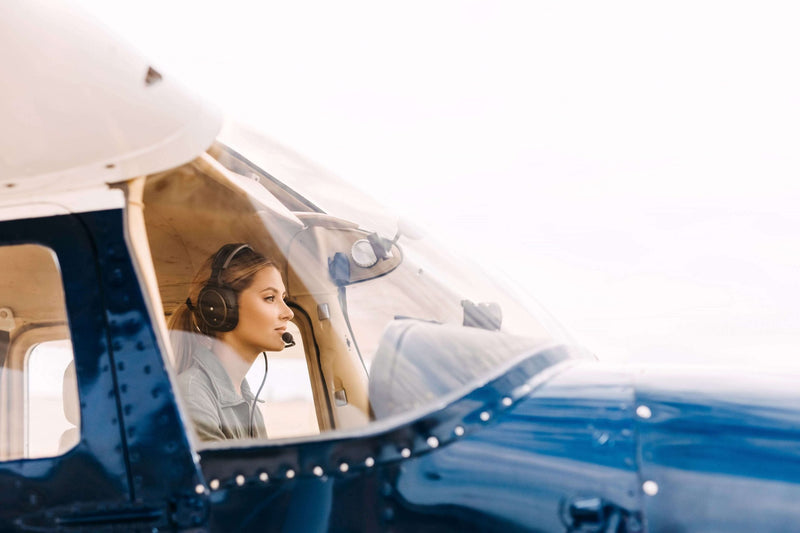
Very safety and detail oriented. Pre-flight briefing explained everything there was. To my knowledge, this flight school is exceptional in their ability.

Van Nuys is Class D from the surface to but not including 3,000 feet MSL, inside a 4.3-mile radius, during tower hours. Above that sits the Los Angeles Class B. Next door sits Burbank's Class C. This is a reference page for the airspace a student pilot at KVNY learns in — written with the rule citations, so you can check every line of it.
Van Nuys Airport is Class D. The FAA's legal description puts it as “that airspace extending upward from the surface to but not including 3,000 feet within a 4.3-mile radius of Van Nuys Airport,” excluding the Bob Hope Airport Class C area and a 1.8-mile radius around Whiteman Airport.
It is Class D only while the tower is open. The Chart Supplement entry reads CLASS D svc 1400–0645Z‡; other times CLASS E. Outside those hours the surface area reverts to Class E, the radio calls change, and so does what is legally required of you. Read that line on the Chart Supplement rather than assuming, because the double-dagger means the times shift with daylight saving.
Two numbers matter to a student and both are on the chart. The 3,000-foot ceiling is exclusive — at exactly 3,000 you are already out of it. And 4.3 miles is a radius, not a shape: the boundary is cut away where Burbank's Class C and Whiteman's own surface area take precedence. That is the part people get wrong on a first solo cross-country out of here.
Sources: FAA, Amendment of Class D and E Airspace; Van Nuys, CA, Federal Register, 6 June 2018. FAA Chart Supplement, Van Nuys (VNY). Field elevation 802 ft MSL; Runway 16R/34L 8,001 × 150 ft, Runway 16L/34R 4,013 × 75 ft.

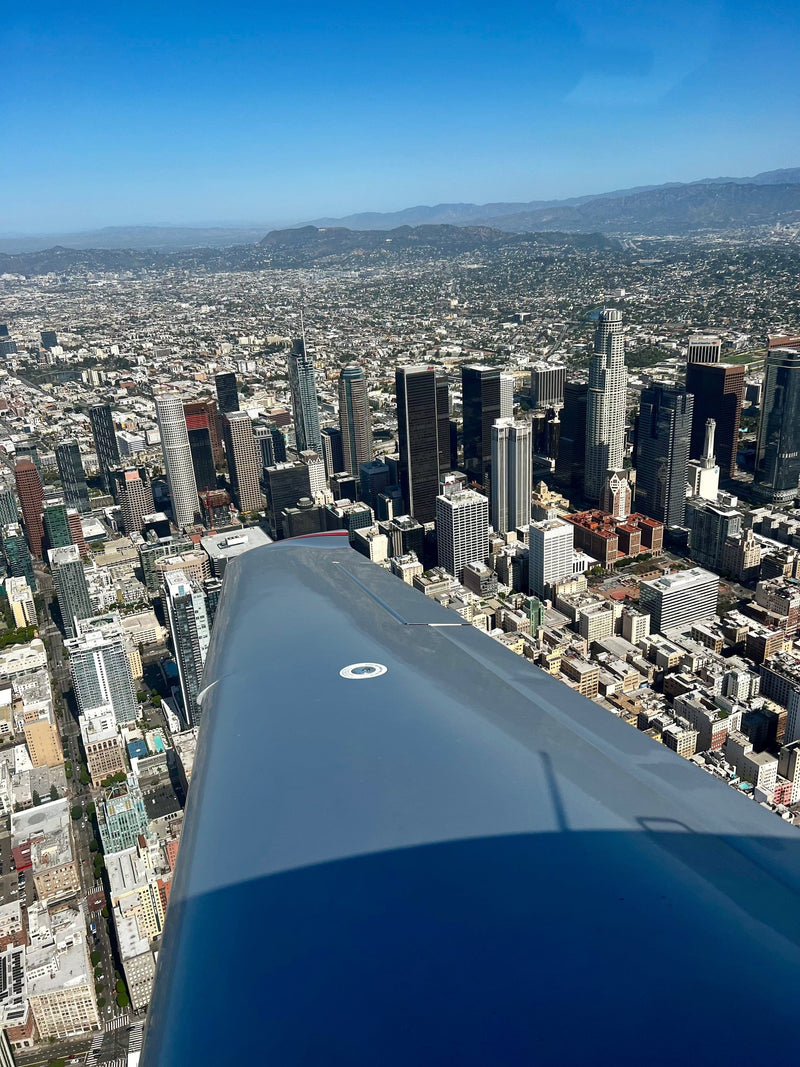
Van Nuys does not sit in open sky. It sits in the most densely structured piece of airspace in Southern California, and the first ten hours of training here are largely about learning where the edges are.
The LAX Class B is built in shelves that step down toward the primary airport. Entry into any of it requires an explicit clearance — the controller has to say the words “cleared into the Class B” under 14 CFR 91.131(a)(1). A radar advisory is not a clearance. Read the current Los Angeles Terminal Area Chart for the shelf floors above your position; they are chart data and they change.
Bob Hope Airport's Class C is explicitly carved out of the Van Nuys Class D. Two towered fields with touching surface areas is not a normal training environment. It is why traffic pattern discipline at KVNY is taught early rather than late.
Whiteman Airport has its own surface area cut out of ours. A third towered field inside the same valley means a student here learns frequency changes as a routine act rather than an event.
Van Nuys sits well inside the 30-nautical-mile Mode C veil around LAX. Under 14 CFR 91.215(b)(2) that means an operable Mode C transponder for essentially everything that flies here, and under 14 CFR 91.225 it means ADS-B Out as well.
When the tower shuts, the surface area becomes Class E. No clearance to enter, no takeoff clearance, no ground control — and every one of those absences is a habit you have to consciously replace with a CTAF call.
The Santa Monica Mountains to the south, the Santa Susanas to the north-west, the Verdugos to the east. Airspace is not the sole ceiling in this valley, and departure planning here involves both.
Four regulations cover almost everything a private pilot does in this airspace. They are short. Read them once and the radio work stops being mysterious.
There is a fifth thing, and it is not a regulation. Van Nuys uses two parallel runways — the 8,001-foot 16R/34L and the 4,013-foot 16L/34R — and the training pattern usually runs on the short one. Parallel operations mean side-by-side traffic, land-and-hold-short instructions on occasion, and a real requirement to read back exactly which runway you were given. That is not in the FARs. It is in the first three lessons.
This is the sequence a student here flies dozens of times before the checkride. It is deliberately unremarkable. The point is how many separate transactions sit inside a single VFR departure from a Class D field with a Class B overhead.
Frequencies as published in the FAA Chart Supplement for Van Nuys. Frequencies and airspace boundaries are revised on a 56-day chart cycle — verify against the current Chart Supplement and Los Angeles Terminal Area Chart before you fly. That caution is the point of this page, not a disclaimer on it.
A pilot trained at an uncontrolled field can fly. They have not necessarily talked to anyone. The first time they need a Class B transition or a Class C arrival, they are learning a skill under pressure at the worst possible moment, and it shows on the radio immediately.
Learn at Van Nuys and the sequence above is simply what flying sounds like. Clearance, ground, tower, departure, handoff. Los Angeles World Airports describes Van Nuys as one of the world's busiest general aviation airports, averaging over 217,000 takeoffs and landings a year across 730 acres. You do not get to be timid on the radio in that environment, and after forty hours you are not.
Busy has costs. You will hold short longer than a student at a quiet field. You will be number four in the pattern. You will be sent around, sometimes twice, and each of those is aircraft time you are paying for. On a Saturday morning the taxi to 16R can genuinely take fifteen minutes.
And there is a real gap: a pilot who only ever flies out of a towered field is uncomfortable the first time nobody answers. Uncontrolled-field procedure — self-announcing on CTAF, sorting out a pattern by radio with strangers — is a separate skill and it has to be deliberately taught. We fly it at the smaller fields around the basin on cross-countries rather than pretending Van Nuys covers it. Ask any school in a busy Class D how they handle that. It is a fair question and the answer tells you something.

Everything above is drawn from public FAA documents. We do not own any of it and we are not going to pretend otherwise. Instructors, clubs, forums and other schools are welcome to reproduce it.
Cite it as
LA Flight School, “Van Nuys Airspace (KVNY): Class D, Class B and the Rules That Apply”, 2026. https://la-flightschool.com/pages/van-nuys-airspace-kvny
Primary sources used on this page
FAA, Amendment of Class D and E Airspace; Van Nuys, CA (Federal Register, 6 June 2018) — the legal description of the surface area. FAA Chart Supplement, Van Nuys (VNY) — elevation, runways, frequencies, Class D effective hours. 14 CFR 91.129, 91.131, 91.215 and 91.225 — the operating rules. Los Angeles World Airports — airport size and annual operations. Los Angeles Terminal Area Chart — Class B shelf floors, which we deliberately do not reprint here because they change on the chart cycle and a stale number on a webpage is worse than no number.
Found an error? Tell us and we will correct the page and say that we did. Call (818) 290-8249 or use the contact form.
Every aircraft on our ramp at Van Nuys is one we own and maintain. All of them are transponder and ADS-B equipped, because in this airspace there is no version of the job where they are not.


Radio work is the cheapest thing in the world to rehearse on the ground and the most expensive thing to fumble in the air. The Redbird MCX is a full-motion, FAA-approved device, and a session in it is where the Van Nuys departure sequence stops being a script you are reading.
Simulator hours are built into every private pilot program — 2 hours on Standard and Premium, 5 hours on Comprehensive. A standalone session is $189.
Every instructor here holds a commercial or ATP certificate, a CFI, and a current medical, and is legally pilot in command on every flight you take with us. That is the baseline everywhere. What is specific to this field is that they work inside the Van Nuys Class D, under the LAX Class B and beside the Burbank Class C every single day, and they know how SoCal Approach actually sequences a VFR transition rather than how the textbook says it should.
Eleven of them is also why a fixed twice-a-week slot is realistic here. Weather takes mornings in this valley — our own analysis of twelve months of NOAA observations found only 40% of 7am observations in June met training minima at Van Nuys, against 93% by 11am. A deep instructor bench is what lets a lost morning be rebooked in the same week rather than the same month.

On Google. Three things come up again and again, and two of them are about this airport rather than about us.
The most repeated compliment in our reviews is the debrief after the flight, not the aircraft and not the price.
Eleven instructors and a fleet we own. When a marine layer morning goes, we rebook it rather than losing you a week.
The number you enroll at is the number you finish at. Enrolled students train at $179 an hour wet, single-engine, fixed at enrollment.
Sixty minutes, you fly the aircraft from the left seat, and you hear the whole Van Nuys departure sequence with an instructor beside you explaining what just happened. The hour is logged as dual instruction, and the full price is credited against any program if you enroll within 24 hours.
Half an hour on the ground. Your calendar, your budget, a written plan, and every question about this airport answered before you spend anything.
Call (818) 290-8249A real lesson, not a tour. Logged dual instruction. 90 minutes $299, 120 minutes $399. Credited in full on enrollment within 24 hours.
Full-motion and FAA-approved. Never canceled for a ceiling, and the cheapest hour in which to learn the radio.
Programs: Sport Pilot $8,400 · Private Pilot Standard $10,900 · Comprehensive $15,900 · Premium $22,500 · Instrument Rating $11,700 · Multi-Engine add-on $5,100 · Solo Certificate $5,500 · Teens ages 10–15 $4,200 · zero-to-airline $89,000. Enrolled students train at $179 an hour, wet, single-engine, fixed at enrollment. Financing from $2,500 down.
Clearance, ground, tower, departure. Sixty minutes and it stops being an abstraction. $229, credited in full against any program if you enroll within 24 hours. Call (818) 290-8249 or book online. Open 9am–9pm, seven days, at 7900 Balboa Blvd, Suite 108A, Van Nuys, CA 91406.
Van Nuys is Class D. The FAA legal description is airspace extending upward from the surface to but not including 3,000 feet MSL within a 4.3-mile radius of the airport, excluding the Bob Hope Airport Class C area and a 1.8-mile radius around Whiteman Airport. It is Class D only during published tower hours; at other times the surface area is Class E. Source: FAA, Amendment of Class D and E Airspace, Van Nuys, CA, Federal Register, 6 June 2018.
To but not including 3,000 feet MSL. The word excluding matters: at exactly 3,000 feet you are already above the Class D. Field elevation at Van Nuys is 802 feet MSL, so the surface area is roughly 2,200 feet deep over the airport itself.
No clearance, but you must establish two-way radio communication with the tower before entering and keep it while inside, under 14 CFR 91.129(c). Established has a specific meaning: the controller must respond using your call sign. If the answer is aircraft calling Van Nuys, stand by, you have not established communication and you may not enter.
Yes. The Los Angeles Class B is built in shelves that step down toward LAX and it overlies the San Fernando Valley. Entering any part of it requires an explicit ATC clearance under 14 CFR 91.131(a)(1) — the controller must say cleared into the Class B. Flight following is not a Class B clearance. Check the current Los Angeles Terminal Area Chart for the shelf floor above your position, because those altitudes are chart data and change on the 56-day cycle.
Yes. Van Nuys sits inside the 30-nautical-mile Mode C veil around LAX, so 14 CFR 91.215(b)(2) requires an operable Mode C transponder, and 14 CFR 91.225 requires ADS-B Out in the same airspace. Every aircraft in our fleet is equipped for both.
As published in the FAA Chart Supplement: ATIS 127.55, Clearance Delivery 126.6, Ground 121.7, Tower 119.3. Verify against the current Chart Supplement before you fly — frequencies are revised on the 56-day chart cycle and a webpage is not a legal source.
Los Angeles World Airports reports that Van Nuys averages over 217,000 takeoffs and landings a year across a 730-acre site, and describes it as one of the world's busiest general aviation airports. For a student that means longer holds and more go-arounds than a quiet field, and radio fluency that arrives much earlier than it otherwise would.
Two parallel runways: 16R/34L at 8,001 by 150 feet, and 16L/34R at 4,013 by 75 feet. Training patterns generally use the shorter parallel. Parallel operations mean you must read back exactly which runway you were assigned, every time.
Yes, at the start. You will hold short longer, fly a longer taxi, and get sent around more often than a student at a quiet field, and each of those is aircraft time you pay for. The trade is that radio work and airspace discipline become ordinary within the first forty hours instead of being learned under pressure later. The gap it leaves is uncontrolled-field procedure, which has to be taught deliberately on cross-country flights to smaller fields.
The surface area reverts to Class E. There is no takeoff clearance, no ground control and no tower to establish communication with — you self-announce on the common traffic advisory frequency instead. The Chart Supplement lists the Class D service hours in Zulu time with a daylight-saving marker, so read it rather than assuming.
The three private pilot packages, what each one includes, the financing options and a realistic timeline built around how often you can actually fly. Sent to you in one email. Nobody will pressure you.
Loved On Google
Every review below is real and shown verbatim, in the reviewer’s own words — written by the people who learned to fly here, not by us.
SAFETY FIRST
Very safety and detail oriented. Pre-flight briefing explained everything there was. To my knowledge, this flight school is exceptional in their ability.
 DISCOVERY FLIGHT
I recently had the chance to take my first-ever discovery flight, and it was nothing short of amazing! From the moment I stepped into the cockpit, the...
 SUNSET CIRRUS
It was a great flight! I did a sunset flight and Alex let us fly an awesome. Website was easy to book, and the plane itself was really fun to fly...
 FLYING LESSON
We had a great flying lesson with Ralph and came away with a much better understanding of both the aircraft and the principles of flight. Ralph is a...
 KIDS LUXURY FLIGHT
I got 2 luxury discovery flights for my kids. I wanted them to have the experience of flying. Our instructor Alex was amazing he made sure they feel...
 HONEYMOON SURPRISE
Last minute booking to surprise my wife on our honeymoon. She had no experience with flying and was scared of flying, but Alex was very easygoing and knew...
 FULL-MOTION SIM
Amazing flight school in van nuys airport. I have been a student here for the past few months and i could not be happier. I started doing a lot of...
 DISCOVERY FOR TWO
I booked a Discovery Flight for Two for my girlfriend's birthday and it was the perfect gift for her. She couldn't have been more excited to get to...
 SIMULATORS
Very professional and great airplanes. I love the flight simulators. The pricing is very fair compared to any other flight school
 TEEN FIRST LESSON
We gifted our teenage son his first flying lesson. He was so excited! Alex greeted us and gave a reassuring brief that made us all feel comfortable and at...
 FIRST-TIME FLYER
Flying is my husband's hobby and I was incredibly anxious and apprehensive about the discovery flight. However, I felt completely safe and at ease once we...
SAFETY FIRST
Very safety and detail oriented. Pre-flight briefing explained everything there was. To my knowledge, this flight school is exceptional in their ability.
DISCOVERY FLIGHT
I recently had the chance to take my first-ever discovery flight, and it was nothing short of amazing! From the moment I stepped into the cockpit, the...
SUNSET CIRRUS
It was a great flight! I did a sunset flight and Alex let us fly an awesome. Website was easy to book, and the plane itself was really fun to fly...
FLYING LESSON
We had a great flying lesson with Ralph and came away with a much better understanding of both the aircraft and the principles of flight. Ralph is a...
KIDS LUXURY FLIGHT
I got 2 luxury discovery flights for my kids. I wanted them to have the experience of flying. Our instructor Alex was amazing he made sure they feel...
HONEYMOON SURPRISE
Last minute booking to surprise my wife on our honeymoon. She had no experience with flying and was scared of flying, but Alex was very easygoing and knew...
FULL-MOTION SIM
Amazing flight school in van nuys airport. I have been a student here for the past few months and i could not be happier. I started doing a lot of...
DISCOVERY FOR TWO
I booked a Discovery Flight for Two for my girlfriend's birthday and it was the perfect gift for her. She couldn't have been more excited to get to...
SIMULATORS
Very professional and great airplanes. I love the flight simulators. The pricing is very fair compared to any other flight school
TEEN FIRST LESSON
We gifted our teenage son his first flying lesson. He was so excited! Alex greeted us and gave a reassuring brief that made us all feel comfortable and at...
FIRST-TIME FLYER
Flying is my husband's hobby and I was incredibly anxious and apprehensive about the discovery flight. However, I felt completely safe and at ease once we...
Reviews shown verbatim, exactly as each reviewer published them.
Aviation News
Notes from the flight line at Van Nuys — weather, regulation changes, checkride questions and the cost of training, written up as they come.
Open 7 days · 9:00 AM – 9:00 PM
Los Angeles Flight School