

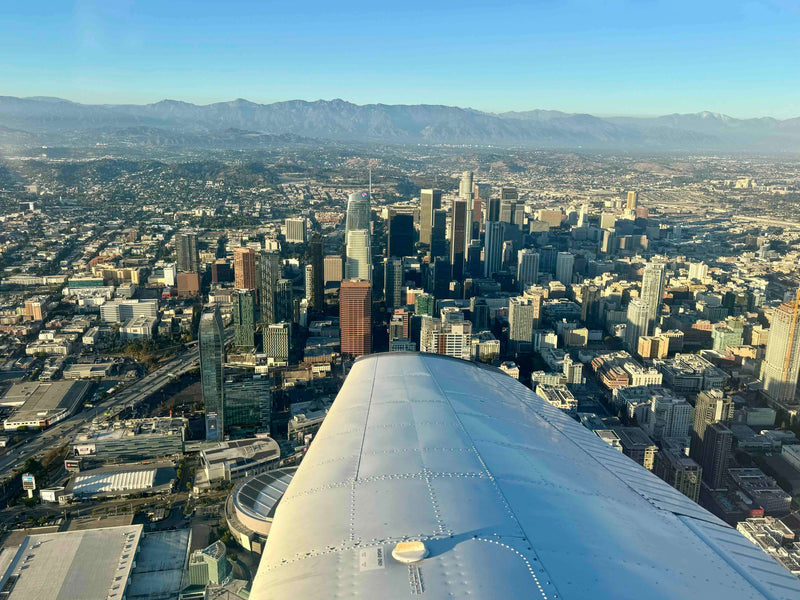
The first time you fly at night you will understand why people who have done it once keep doing it. The air over the Valley goes still, the radio goes quiet, and Los Angeles turns into the thing it looks like from the window of an airliner, except that you are at 3,000 feet with your hand on the throttle and the whole basin lit up from Malibu to the San Gabriels. It is also the part of private pilot training that the regulations are most specific about, and the part where a Los Angeles student has both the best and the most deceptive conditions in the country.
Here is what the FAA requires, how we fly it out of Van Nuys, and what the city lights do to your eyes that your instructor will warn you about before you ever leave the ground.

What The Rule Says
FAR 61.109(a)(2) sets the night requirements for the private pilot certificate, airplane single-engine. You need three hours of night flight training with an instructor, and inside those three hours two things must happen: one cross-country flight of more than 100 nautical miles total distance, and ten takeoffs and ten landings to a full stop, each one involving a flight in the traffic pattern, at an airport.
Two definitions matter. For the training itself, night is what Part 1 says it is: the time between the end of evening civil twilight and the beginning of morning civil twilight, which in Los Angeles is roughly half an hour after sunset to half an hour before sunrise. For carrying passengers at night later on, 61.57 uses a stricter window, one hour after sunset to one hour before sunrise, and the three takeoffs and landings to a full stop you need for that currency have to be in it. Your logbook should show which is which, and your instructor will make sure it does.
Everything else about the flight is ordinary Part 91. Position lights on from sunset to sunrise under 91.209, an anti-collision light if the aircraft has one, and the night VFR fuel reserve of forty-five minutes at normal cruise under 91.151 instead of the daytime thirty.
The Night Cross-Country From Van Nuys
A hundred nautical miles total distance rules out the short hops. Camarillo and back from Van Nuys is about sixty; the classic night cross-country for our students is Van Nuys to Santa Barbara and back, which comes to roughly 136 nautical miles and takes you along the coast in both directions, with Camarillo and Oxnard as the alternates you have already landed at in daylight.
It is a good route for a first night flight for a reason that only becomes obvious when you fly it. Outbound over the Conejo grade the ground is lit continuously, so you always have a horizon. Then the lights stop at the coast, and for the leg along the water to Santa Barbara there is nothing to your left but the dark Pacific and nothing ahead but the glow of the next town. That is where the lesson is: you find out, with an instructor beside you, what it feels like to lose the visual horizon, and how much you have to trust the attitude indicator to keep the wings level. Students who have flown that leg do not need the illusion explained to them afterwards.
Ten Landings, And Why They Are Harder
The ten full-stop landings usually happen across two or three sessions in the pattern at Van Nuys, sometimes with a few at Whiteman or Burbank for the variety. Night landings are harder than day landings for a specific reason: the visual cues you have been using to judge your height in the flare are gone. In daylight your peripheral vision reads the texture of the runway and the ground rushing past; at night there is a strip of edge lights and a black surface, and the tendency of almost every student is to flare high and land flat, or to fly it into the ground.
The fix is technique, not luck. You learn to use the runway edge lights as a height reference, to keep the aiming point in the same place on the windscreen, to make a normal approach at a normal speed rather than dragging it in, and to use the landing light for what it is good for and not for what it is not. By the tenth landing the flare is coming back, and the eleventh, on your own after the checkride, will feel like something you know how to do.
What The City Lights Do To Your Eyes
Los Angeles at night is the most beautifully lit piece of airspace in the United States and it produces every visual illusion in the Aeronautical Information Manual. Three of them show up on nearly every training flight.
The false horizon is the first. A sloping line of lights, a lit freeway climbing into the hills, or the edge of the marine layer over the coast can look enough like the horizon that you start to bank toward it without noticing. The instruments say wings level; your eyes disagree. On a night flight the instruments are right.
The black-hole approach is the second. An approach over unlit terrain toward a brightly lit runway, which is what you get landing toward the hills at the north end of the Valley or coming in over the water at the coast, makes the runway seem farther away and higher than it is, and pilots descend below the proper glidepath without feeling it. The cure is a normal pattern, a known descent rate, and the visual glideslope indicator beside the runway, which exists for exactly this.
Autokinesis is the third and the strangest: a single light stared at in the dark appears to move. It is why you keep your eyes moving between the outside and the panel rather than fixing on one point, and why an instructor will ask what that light is and watch to see how long you look at it.
None of this is a reason to worry. It is why the three hours exist. The illusions are predictable, the corrections are trained, and a student who has seen them once with an instructor recognises them for the rest of their flying life.
How We Schedule It
Night training at Los Angeles Flight School comes late in the syllabus, after the solo phase and usually alongside the cross-country work, when a student's landings are consistent and there is spare capacity for a new environment. In winter that means a lesson can start at six in the evening; in summer it means an eight-thirty start and a late finish. We fly the pattern work first, on a clear night with light wind, and the cross-country when the student is comfortable, avoiding the marine-layer months for the coastal route unless the forecast is clean. Van Nuys is a towered airport with a lit, 8,000-foot main runway, and the Valley at night is quiet, which makes it one of the easier places in the country to learn this.
If you want to see it before you commit to any of it, our night flight over the city lights is the discovery-flight version, an instructor flying while you look. And if you are already training, ask your instructor when the night phase is coming; it is the lesson most students say they were not expecting to enjoy as much as they did. The full picture of the certificate, night hours included, is on our page on private pilot license requirements.

Comments (0)
There are no comments for this article. Be the first one to leave a message!