

Sometime in October the Valley wakes up to a morning that does not look like the others. The air is bone dry, the San Gabriels look close enough to touch, the windsock at Van Nuys is standing straight out from the northeast, and the tower is landing everybody on runway 34 instead of 16. That is a Santa Ana, and if you are training at Van Nuys between now and March you will fly through a season of them.
They are not a reason to stay home. They are a reason to understand what the wind is doing, and they happen to teach three things the private pilot checkride cares about more than almost anything else: crosswinds, turbulence, and the decision to go or not go.

What A Santa Ana Actually Is
Most of the year the wind at Van Nuys comes in off the ocean. A sea breeze builds through the afternoon, blows from the south and southwest, and that is why the airport's normal traffic flow is southbound: departures and arrivals on runway 16R and 16L, the long runway and the short one, pointed toward the Santa Monica Mountains.
A Santa Ana reverses that. When a strong area of high pressure settles over the Great Basin, air flows outward from it, down across the deserts of Nevada and eastern California and through the mountain passes and canyons that lead to the coast. The air is dry to begin with, and as it descends several thousand feet it warms by compression, so it arrives in the Los Angeles basin hotter and drier than it left. The wind is from the northeast, the humidity can fall into single figures, and where the flow funnels through a pass or a canyon it accelerates. Gusts of forty to sixty miles an hour in the canyons are ordinary during a strong event.
The season runs from roughly October to March, with the strongest and most frequent events in the autumn. The winds are often at their worst overnight and through the morning, easing during the afternoon as the pressure gradient relaxes, though a strong event can blow for two or three days without much let-up.
What Changes At Van Nuys
The first thing you notice is the runway. With the wind out of the northeast the tower turns the airport around and runs a north flow: landing and departing on 34L and 34R, toward the hills at the north end of the Valley. If you have only ever flown the pattern for runway 16, the picture out of the window is unfamiliar, the pattern is on the other side of the field, and the landmarks you use for the downwind and base turns are different. Your instructor will have you fly it both ways for exactly this reason.
The second thing is that the wind is rarely straight down the runway. Runway 34 points a little west of north; a Santa Ana comes from the northeast, sometimes from due east. That is a crosswind, often a gusting one, and in a light training aircraft it is the most demanding part of the flight. The crosswind landing you practise in calm conditions with an instructor calling the drift is the one you will have to fly for real.
The third thing is turbulence. The mountains that ring the Valley are what make the Santa Anas accelerate, and the air on the downwind side of a ridge in a strong wind is rough. Expect mechanical turbulence low over the Verdugos and the Santa Susanas, rotor and wave activity downwind of the San Gabriels, and wind shear on approach as the flow spills over the hills at the north end of the field. Pilot reports on a Santa Ana morning frequently mention moderate turbulence below 5,000 feet, and the FAA will usually have an AIRMET Tango out for the area.
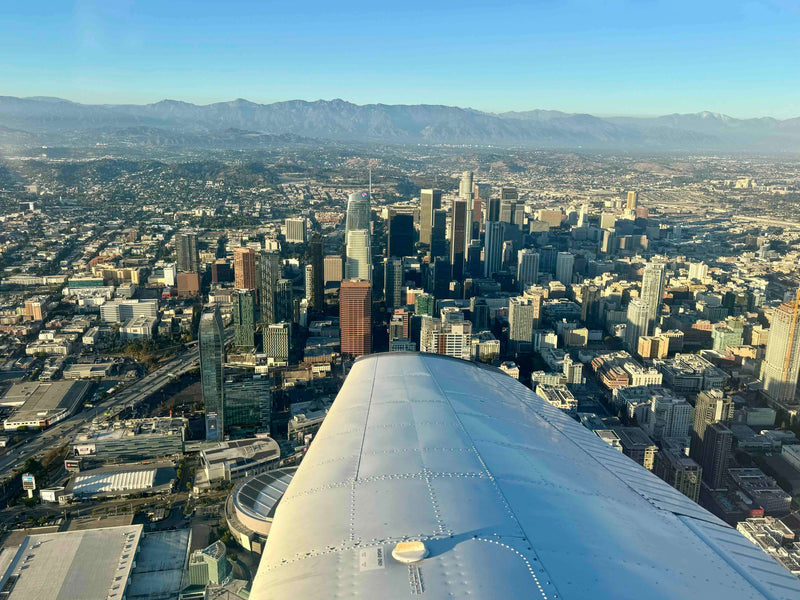
The fourth thing is the one everybody underrates: visibility. Once the wind has cleared the haze out to sea, a Santa Ana day is the clearest flying Los Angeles ever offers. Catalina, the Channel Islands and the snow on the San Gorgonio can all be in view from the pattern at Van Nuys. It is genuinely beautiful, and it is easy to let that persuade you the conditions are benign when the windsock says otherwise.
Fire, Smoke And Temporary Flight Restrictions
Santa Anas are fire weather. The combination of dry fuel, low humidity and strong wind is why the National Weather Service issues Red Flag Warnings for the mountains and valleys during a strong event, and why the largest fires in Southern California history have started in Santa Ana conditions.
For a pilot that means two things. Smoke from a fire can take the visibility from unlimited to marginal in an hour, and it drifts downwind, which during a Santa Ana means toward the coast and across the areas you fly in. And the FAA will put a Temporary Flight Restriction over any significant fire to protect the firefighting aircraft working it. A TFR is a hard boundary, the aircraft inside it are flying low and fast and not looking for you, and busting one is a certificate action. Checking the FAA TFR list is part of every preflight briefing during Santa Ana season, and on a day with active fires it is worth checking again just before you start the engine.
How We Fly It
We do not cancel for wind on its own. A twenty-knot wind straight down runway 34 is a fine training day and a good one for learning to read the windsock and the ATIS properly. What decides the flight is the crosswind component, the gust spread, and the turbulence reports, weighed against where the student is in the syllabus.
Every student at Los Angeles Flight School has a personal crosswind limit for solo flight that their instructor sets and raises as their landings improve. Early in training that limit is conservative, and a strong Santa Ana morning will be above it; the flight becomes a dual lesson instead, and a valuable one, because an instructor beside you is exactly how you learn to land in a gusting crosswind. Later in training the same conditions are within limits and you fly them alone, which is the point.
The practical adjustments are simple. We schedule wind-sensitive lessons, first solos and early cross-countries in the afternoon when the flow has usually eased. We brief the north-flow pattern before we go, not on the downwind. We look at the winds aloft for the practice area and the mountain passes on any cross-country, and we route around the lee side of the ridges rather than through it. We use the Redbird simulator to fly crosswind approaches and go-arounds on the days that are outside a student's limits, so the skill keeps building even when the aeroplane stays in the hangar. And on any day with a Red Flag Warning we check the TFR list twice.
What A Santa Ana Teaches You
The FAA's private pilot standards ask for crosswind takeoffs and landings, for recognising and correcting for wind shear, and above all for aeronautical decision making: the ability to look at the conditions, look at yourself, and decide honestly whether the flight is a good idea. A Santa Ana season is the best classroom for all three that a Los Angeles student will get. Students who train here through the autumn arrive at their checkride having landed in real crosswinds in real gusts, having watched an instructor turn a flight into a simulator session because the numbers said so, and having learned to check a TFR list without being reminded. That is worth more than a season of calm.
If you are thinking about starting this autumn, the Santa Anas are not a reason to wait for spring. They are a reason to train somewhere that knows what to do with them. Our flyable-days study puts numbers on how few days a year Van Nuys actually loses to weather, and our post on density altitude in the Valley covers the other side of the same mountains in the summer.


Comments (0)
There are no comments for this article. Be the first one to leave a message!