

Your first solo is three trips around the traffic pattern, it lasts about twenty minutes, and the flying part is the easy bit. Most people reach it somewhere between 15 and 25 hours of dual instruction. You will not be told the date in advance, because your instructor will not know it either until roughly ninety seconds before it happens.
Here is the whole thing, in order.

Before The Day: The Paperwork You Must Have
Two things have to be in place and neither is negotiable.
You need a student pilot certificate, and you need a medical certificate from an FAA-designated aviation medical examiner. No medical, no solo — there is no version of this where an instructor waives it, and it is worth starting the medical process early because a routine application is quick and a non-routine one is not. Your instructor also has to endorse your logbook for solo flight in the specific make and model, and that endorsement is theirs to give on the day.
You will also need to know the aircraft. Not vaguely. Airspeeds, emergency procedures, and the radio calls at a Class D field like Van Nuys, sitting under the LAX Class B shelf. Your instructor will quiz you on all of it, more than once, in the weeks before.
The Morning: An Ordinary Lesson That Is Not
Nothing about the start of the day announces itself. You preflight the airplane the way you have done thirty times. You brief, you taxi, you take off.
What is different is that your instructor has stopped teaching. There is no coaching on the radio, no hand hovering near the yoke, no a-little-more-right-rudder. They have gone quiet, and they are watching. This is the assessment, and if you notice it happening you have probably worked out what today is.
You fly the pattern. Upwind, crosswind, downwind, base, final. Three, four, maybe six circuits. Somewhere in there you will make a landing that is genuinely good, and then one that is merely fine, and your instructor will be watching for whether the merely-fine one bothered you enough to make the next one worse.
The Moment They Get Out
You taxi clear, and instead of turning back toward the run-up area your instructor asks you to stop. They take their headset off. They say something short — most of us say a version of three touch and goes, full stop on the last one, I will be watching — and then they open the door and step out onto the ramp.
The door closes. It is very loud, and then it is very quiet.
What almost everybody says afterwards is the same thing: the airplane felt lighter. It is not a feeling, it is physics. You have just removed roughly 170 pounds from the right seat of a light single, and on the first takeoff you will notice it climbing better than it ever has. Expect it and it will not startle you.
Circuit One
The first one is the one nobody remembers clearly. You will run the checklist twice because you do not trust yourself. You will make the radio call and it will come out slightly too fast. You will roll onto the runway and your brain will spend a moment insisting that someone has made an administrative mistake.
Then you fly it, and it works, because you have flown this exact pattern dozens of times with someone sitting beside you saying nothing.
The landing will probably be your best of the day. There is a reason for that: you are concentrating harder than you have ever concentrated on anything.
Circuit Two
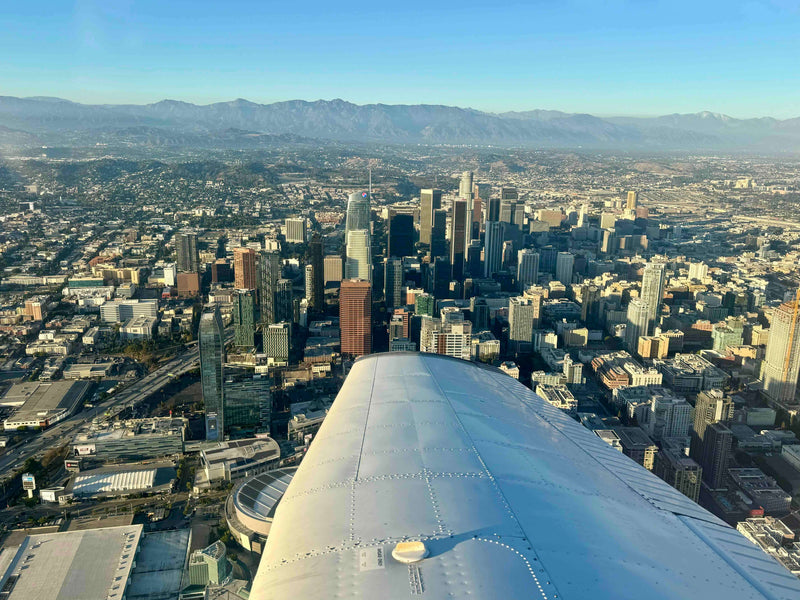
This is where the enjoyment arrives. On the downwind leg of the second circuit most people finally look out of the window — at the Valley, at the mountains, at their own hands on the yoke — and register that they are flying an airplane by themselves.
It is also where the mistakes come. Relaxation costs you altitude on downwind and speed on final. Your instructor knows this, and it is part of why they asked for three.
Circuit Three
The last one is a full stop. You will fly it more carefully than the second and less carefully than the first, which is roughly where a pilot should be.
Then you taxi in. Your instructor will be standing where they said they would be. Total time from the door closing to the engine shutting down: usually somewhere around twenty minutes.
The Shirt
Then somebody cuts the back off your shirt.
The tradition goes back to open-cockpit tandem trainers, where the instructor sat behind the student and, without an intercom, tugged on the student's shirt-tail to get their attention. Solo, there was nobody behind you to pull it. Cutting the tail off marked the day you stopped needing to be tugged.
The piece gets signed, dated, and pinned to the wall. Wear a shirt you do not love, and be aware that flight instructors are not to be trusted about how much of it they are going to remove.
What It Actually Feels Like
Less dramatic than you are imagining, and more significant.
The thing people expect is fear. What most report instead is an unusually specific kind of focus — everything narrows to airspeed, runway, radio — followed about four hours later by a delayed wave of it actually registering, usually while doing something entirely unrelated like driving home.
The other honest note: some people find the first solo emotional and some find it anticlimactic, and neither says anything about how good a pilot you will be. If you land, taxi in and feel mostly relieved, that is a completely normal response.
When It Happens, And Why The Number Varies
Between 15 and 25 hours is the usual range, and the variables are boringly practical. How often you fly is the big one. A student flying twice a week solos sooner and in fewer total hours than a student flying twice a month, because consistency is worth more than talent at this stage.
Weather is the other. In Los Angeles you are luckier than most — our twelve-month study of NOAA observations at Van Nuys found 355 flyable days a year against a 3,000-foot ceiling and 5 statute miles, the standard applied to student solo work. But in June, only 40% of 7am observations met those minima. If you are approaching solo in early summer, book afternoons.
Do not chase the number. An instructor who solos a student to hit a statistic is a bad instructor, and the hours before your solo are not wasted — they are the reason the twenty minutes afterwards go the way they do.
After The Solo
Solo does not mean finished. It is roughly the halfway mark of a private pilot certificate, and what follows is solo pattern work, then the solo cross-countries, then the maneuvers polished to standard, then the practical test. FAR 61.109 sets a 40-hour minimum; the national average is 60 to 75.
Some people stop here deliberately, which is a legitimate choice — our Solo Certificate program is $5,500 and takes you exactly this far. Most carry on to the private pilot certificate at $10,900.
Start The Clock
Every first solo begins with a first hour, and the first hour is the same for everyone. Book a $229 discovery flight — 60 minutes, you fly the aircraft yourself, the time is loggable dual instruction, and the price is credited in full against any program if you enroll within 24 hours. Read what happens on the hour if you want the detail first.
Prefer to talk it through on the ground? Book a free in-person consultation at Van Nuys, or call (818) 290-8249, 9am to 9pm, seven days a week.


Comments(0)
There are no comments for this article. Be the first one to leave a message!