

Six questions, asked before you hand over a deposit, will tell you more about a flight school than an afternoon of reading reviews. Ask them in person, at the airport, with the aircraft in view. Write the answers down. A school that is comfortable with all six is a school that will still be answering your calls at hour thirty.
None of these questions are hostile. They are the questions a school with nothing to hide would rather you asked, because the alternative is you finding out at hour twenty-two.

1. Do You Own The Aircraft, Or Are They Leaseback?
Ask it exactly like that. Many flight schools do not own the airplanes on their ramp. The aircraft belong to private owners who lease them back to the school, and the school pays for the hours it flies.
Leaseback is not fraud and it is not rare. But it changes who controls the maintenance schedule, and it changes what happens when an owner decides to sell, take the airplane away for a month, or stop paying for a repair. Your training calendar is downstream of somebody else's asset decision, and you will never be told about it in advance.
Owned fleets behave differently. When something needs attention it goes in on the school's schedule, and when an aircraft hits a 100-hour inspection under FAR 91.409(b) — required on aircraft used for instruction for hire — the school is planning around it weeks out rather than reacting.
Our answer: we own our fleet. Every training aircraft at Van Nuys is ours, maintained on our schedule.
2. How Many Instructors Do You Have?
This is the question that quietly determines how fast you finish. One instructor means one calendar. If yours takes a week off, gets hired by a regional airline, or simply has a full Saturday, you do not fly.
Follow it up with two more: how many are full-time, and what happens if my instructor leaves mid-course. The second answer matters more than the first. Instructor turnover is a fact of aviation — most CFIs are building toward 1,500 hours under 14 CFR 61.159 — so the question is not whether it happens but whether the school has a handover process or just hands you a new name.
Our answer: eleven instructors. All hold commercial or ATP certificates plus CFI and a current medical, and you are matched to one but you can change if the fit is wrong.
3. What Is The Overage Rate, And Is It Published?
This is the most important number in the conversation and the one most likely to be met with a pause.
Almost nobody finishes a private pilot certificate in exactly 40 hours. The FAA minimum under FAR 61.109 is 40; the national average is 60 to 75. So whatever the package says, you will very likely buy some additional hours, and the rate you buy them at is the difference between a training bill you can plan and one you cannot.
Ask for it as a number, per hour, wet, in writing. If the answer is it depends, or we would have to look at that, or a figure that only exists on a laminated card in a back office, you have learned something important.
Our answer: $179 an hour, wet, single-engine, published. That is the package rate for enrolled students and it is the same number on the website, in the enrollment paperwork and on the invoice.
4. Is That A Package Price Or An Estimate?
These are not the same thing, and the distinction is often blurred deliberately.
An estimate is a school's guess at what your training will cost. It is built on the FAA minimums, it is usually accurate for nobody, and it carries no obligation. A package price is a defined set of inclusions at a fixed number — this many aircraft hours, this much dual, this much ground, these materials — and it is a commitment.
Ask which one you are looking at, then ask what is inside it. Hours in the aircraft. Hours of dual instruction. Ground school hours. Simulator time. Books and materials. If any of those are missing from the sheet, they are being sold to you separately later.
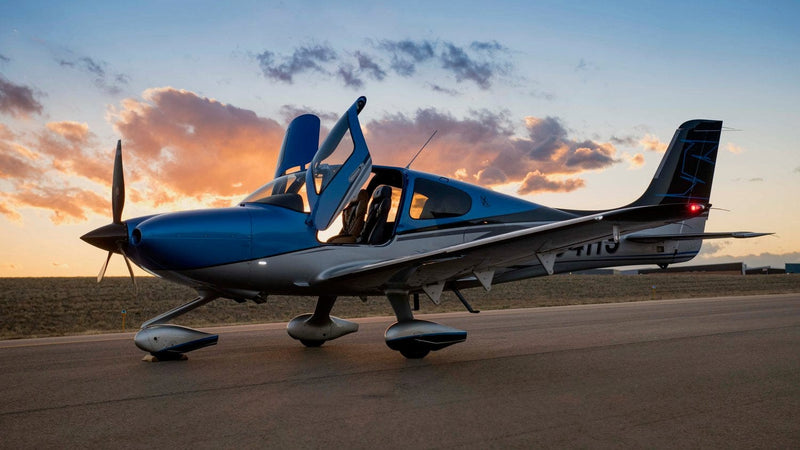
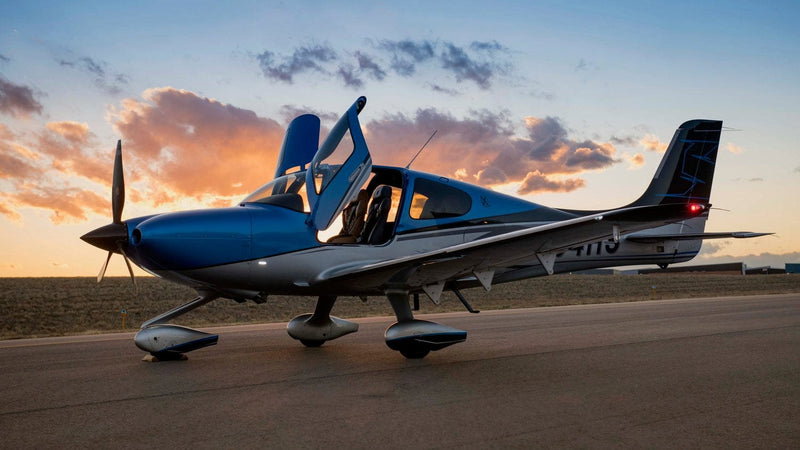
Our answer: package prices. The Standard Private Pilot Program is $10,900 for 40 hours of logged flight time, including 38 aircraft hours, 30 hours dual, 2 simulator hours, 3 hours of ground school and all books and materials. The Comprehensive is $15,900 built around 60 hours of logged flight time, and the Premium is $22,500 flown in the Cirrus SR22 Turbo. Financing starts from $2,500 down.
5. Is There A Simulator, And Is Time In It Included?
Two questions, and schools frequently answer the first and skip the second.
A proper full-motion, FAA-approved simulator is not a video game and it is not a desktop with a yoke clamped to it. It is where you learn instrument scan, radio work, emergency procedures and checklist flow at a fraction of the cost of doing it in the air — and it does not get canceled for a 900-foot ceiling. For a Los Angeles student in June, that last point is worth more than it sounds.
Then ask whether the hours are in your package or billed on top. Simulator time that costs extra tends not to get used, which defeats the point.
Our answer: a Redbird MCX full-motion FAA-approved simulator, with hours built into every private pilot program — 2 hours on the Standard and Premium programs, 5 hours on the Comprehensive. A standalone simulator session is $189 if you want to try one before enrolling.
6. How Often Can I Realistically Fly?
Note the word realistically. Every school will tell you that you can fly as often as you like. What you want is the constraint.
Ask how many aircraft there are and how many active students. Ask how far out the schedule is booked on a Saturday morning. Ask what happens in June when the marine layer sits over the coast until midday — a coastal school will tell you it is fine, and the data says otherwise.
Weather is the part people get wrong in both directions. We spent a year measuring it rather than guessing: twelve months of NOAA observations at Van Nuys against a 3,000-foot ceiling and 5 statute miles, the minima most schools apply to early dual and student solo work. The result was 355 flyable days a year. In August, 7am at Van Nuys met those minima 84% of the time against 48% at Santa Monica. Inland wins, and it is not close.
Our answer: 355 flyable days a year at Van Nuys, eleven instructors, and a fleet we own. The honest constraint is your calendar, not ours — and we will tell you plainly that if you can only fly once a fortnight, your certificate will cost more than the package price no matter where you train.
The Question Underneath All Six
What you are really testing is whether the school gives you specific answers. A school that owns its aircraft, publishes its hourly rate and can tell you its instructor headcount without checking is a school that has thought about your training as an operation rather than a sale.
Vagueness is the signal. Not price.
Come And Ask Us In Person
The best version of this conversation happens on the ramp. Book a free in-person consultation at 7900 Balboa Blvd in Van Nuys, bring the six questions, and we will walk you through the aircraft and the paperwork with no obligation.
If you would rather answer the more basic question first — whether you actually enjoy this — book a $229 discovery flight. You fly the airplane for 60 minutes, the time is loggable dual instruction, and the full price is credited against any program if you enroll within 24 hours. Here is exactly what the hour involves. Questions in the meantime: (818) 290-8249, 9am to 9pm, seven days.


Comments(0)
There are no comments for this article. Be the first one to leave a message!