

The most expensive way to learn to fly is slowly. That is the single most useful thing anyone can tell you about paying for flight training, and it is the opposite of what most people conclude when they look at the price for the first time.
Here is why. Flying is a motor skill. Fly twice a week and each lesson starts roughly where the last one ended. Fly twice a month and the first twenty minutes of every lesson is spent recovering what you lost, which means you are buying the same landing three times. The national average to a private pilot certificate is 60 to 75 hours against a 40-hour minimum under FAR 61.109, and the gap between those two numbers is mostly made of people who stretched their training out to make it affordable.

So the real question is not what is the cheapest way to pay for this. It is which funding structure lets me fly twice a week without stopping. Below is every option, with what is wrong with each.
Paying Cash
If you have the money, this is the cheapest route and there is nothing clever to add. No interest, no application, and no monthly obligation hanging over you if you decide six months in that flying is not for you.
The trap is psychological rather than financial. People paying cash tend to pay lesson by lesson, watch the balance move, and start skipping weeks when the number gets uncomfortable. That is exactly the pattern that turns a 40-hour certificate into a 75-hour one. If you are paying cash, commit the whole amount to a program up front and treat it as spent.
What A Package Actually Buys You
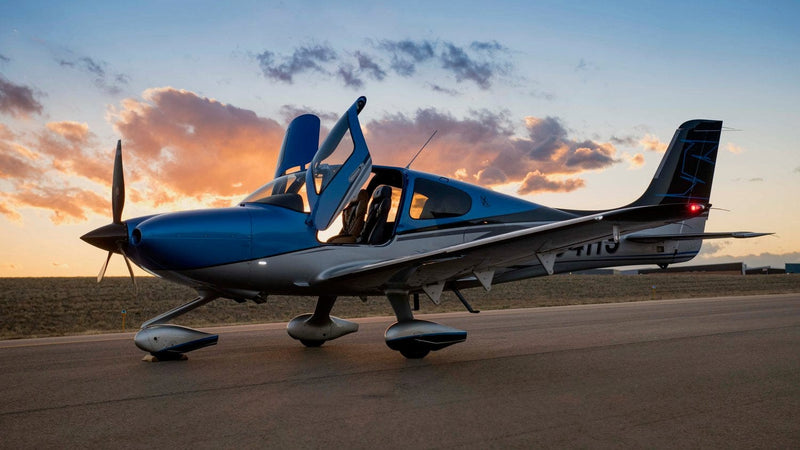
Our Standard Private Pilot Program is $10,900 and includes 38 hours in a single-engine Cessna, Piper or Diamond, 30 hours of dual instruction, 2 hours in the Redbird full-motion simulator, 3 hours of ground school, and books and materials, for 40 hours of logged flight time. The Comprehensive program is $15,900 and is built around 60 hours of logged flight time with 50 hours of dual and 10 hours of ground — which is where most people genuinely finish. The Premium program is $22,500 and is flown in the Cirrus SR22 Turbo with its glass cockpit.
Enrolled students train at $179 an hour wet for anything beyond the package. That rate is published, it does not move, and it is the reason a package is worth more than the discount on the sticker: it removes the argument about what an extra hour costs.
Financing
We work with Stratus Financial, and training can start from $2,500 down with monthly payments after that. This is the option that gets people flying who would otherwise spend two years saving, and two years of saving is two years of not flying.
Be clear-eyed about it. It is a loan. You will pay interest, and the total you hand over across the term is more than the package price. The honest case for it is not that it is cheap — it is that it lets you train continuously, which shortens the course, which claws some of the interest back in hours you never had to fly twice.
Before you sign anything, get three numbers in writing: the APR, the term in months, and the total amount repayable. If a lender will not give you the third number plainly, that is your answer.
In-House Payment Plans
We also run our own payment plans, which sit between cash and third-party financing. They are simpler, there is no credit application of the sort a lender runs, and the terms are shorter. They work well for the instrument rating at $11,700 or the multi-engine add-on at $5,100 — mid-sized amounts where a full financing application feels like overkill.
They are less useful for the $89,000 zero-to-airline track, where the sums and the timelines really do call for a proper lender.
Employer Sponsorship
This is underused and worth asking about. Some employers will fund training that has a defensible business case — a company that owns aircraft, a business with a genuine travel need, an operator that wants a pilot on staff. Others have general professional-development or tuition-assistance budgets that nobody has ever tried to point at a flight school.
The approach that works is a written proposal with a cost, a timeline and a benefit, not a conversation in a hallway. The approach that does not work is assuming the answer is no.
VA Benefits
Veterans education benefits can be used for flight training, but the rules are narrower than most people assume and it is worth being precise here rather than encouraging.
Flight training benefits generally require an approved program, and eligibility, coverage levels and any private pilot prerequisite depend on the specific benefit chapter you are entitled to. We are not telling you that our programs are VA-approved. If you intend to rely on VA benefits, confirm two things before you pay anyone a deposit: confirm your entitlement and its terms directly with the VA, and confirm with the school in writing whether the specific course you want is approved for the benefit you hold. Do that first. A benefit you assumed you had is a very bad thing to discover at hour ten.
Pay As You Go Versus Buying A Package
Pay as you go feels safer. You are only ever committed to the next lesson, and you can stop at any time. That is a genuine advantage if you are unsure whether you will enjoy flying at all, which is exactly what a discovery flight is for.
Once you have decided to do this, though, pay-as-you-go works against you in three ways. Your hourly cost is higher than the package rate. Your scheduling priority is lower, because a school allocates aircraft and instructor time around committed students. And you make a fresh spending decision every single week, which is a fresh opportunity to skip one.
Buy the package. It is not only cheaper per hour, it changes your behavior.
The Costs That Are Not The School's
A few things sit outside any package, whoever you train with. You will need an FAA medical certificate before you solo. There is a written knowledge exam, and there is a practical test with a designated examiner at the end. You will want a headset and a chart app. None of these are charged by us and none of them are optional, so account for them when you plan rather than being surprised by them.
Our flight training cost calculator will put a real total in front of you based on the program you pick and how often you plan to fly, which is more useful than any average.
What We Would Actually Advise
Pick the funding route that gets you flying twice a week and keeps you there until the certificate. For most people that is the Comprehensive program on a payment plan, not the Standard program paid lesson by lesson, even though the second one has a smaller number on it.
And fly in the afternoon between May and September. Our own study of a year of NOAA observations at Van Nuys found 355 flyable days, but in June only 40% of 7am observations met training minima against 97 to 100% from 1pm. A canceled lesson costs you nothing in money and a fortnight in momentum, and momentum is the thing you are actually buying.
Start With An Hour In The Aircraft
Before you finance anything, find out whether you like it. A $229 discovery flight is 60 minutes in which you fly the airplane yourself, it is loggable dual instruction, and the full price is credited against any program if you enroll within 24 hours. If you want to know exactly how the hour is structured, read what happens on a discovery flight.
If the money is the part you want to talk through, come in for a free in-person consultation at Van Nuys and we will go through the options with your actual numbers, or call (818) 290-8249 between 9am and 9pm any day of the week.


Comments(0)
There are no comments for this article. Be the first one to leave a message!