

Van Nuys Airport sits at 802 feet above sea level. At four in the afternoon in September, with the temperature at 100°F, your airplane performs as though the field were at about 4,100 feet. Same runway, same airplane. Nothing has changed except the air, and the air is the only thing the wing and the propeller actually work with.
That gap is density altitude. In the San Fernando Valley it is the most underrated number in local flying. Students here get crosswinds and radio work early because both are unavoidable at a busy Class D field. Density altitude tends to arrive later, usually on the first hot cross-country, sometimes as an unpleasant surprise on a short strip in the desert.
Getting The Number In Ten Seconds
Density altitude is pressure altitude corrected for temperature. Pressure altitude is what your altimeter reads with 29.92 set in the window. On a normal day at Van Nuys that lands within a hundred feet or so of the 802-foot field elevation.
The rule of thumb every student should have memorized:
Density altitude ≈ pressure altitude + 120 × (OAT in °C − ISA temperature in °C)
ISA temperature is 15°C at sea level, dropping about 2°C per thousand feet. At Van Nuys that puts a standard day at roughly 13°C, or 55°F. Anything warmer than that costs you.
Run it twice for the same date in September:
- 7:00 am, 18°C (64°F). 870 + 120 × 5 = 1,470 feet
- 4:00 pm, 38°C (100°F). 870 + 120 × 25 = 3,870 feet
A 2,400-foot swing between breakfast and the school run. On a 104°F day the afternoon figure crosses 4,100 feet. The Valley reaches those temperatures most Septembers, and it runs 15 to 20 degrees hotter than the coast while doing it.
You do not have to do the arithmetic at the hold short line. Van Nuys ATIS broadcasts density altitude whenever it exceeds field elevation by 1,000 feet or more, which in summer is most of the day. Listen for it. A great many pilots hear that part of the broadcast as background noise.

What It Costs You
Three separate things degrade at once, which is why the effect compounds faster than people expect.
The engine makes less power. A normally aspirated piston engine loses roughly 3% of its available horsepower per 1,000 feet of density altitude. At 4,000 feet you are flying behind something closer to a 145-horsepower engine than the 160 on the data plate.
The propeller bites less. Thinner air means less thrust for the same RPM. The propeller is a wing, and it suffers exactly the way the main wing does.
The wing needs more speed over the ground. Your airspeed indicator is a pressure instrument and it does not know or care about density altitude. You rotate at the same indicated speed you always do. You are simply moving about 8% faster across the pavement when you get there.
Put numbers on it. Takeoff ground roll increases roughly 10% per 1,000 feet of density altitude, and rate of climb falls off around 7%. Take a light two-seat trainer with a book ground roll near 1,100 feet on a standard day at sea level:
- At 1,500 feet density altitude: about 1,265 feet of ground roll
- At 4,100 feet density altitude: about 1,550 feet of ground roll
- Distance over a 50-foot obstacle grows faster than the ground roll does, often close to double the sea-level figure
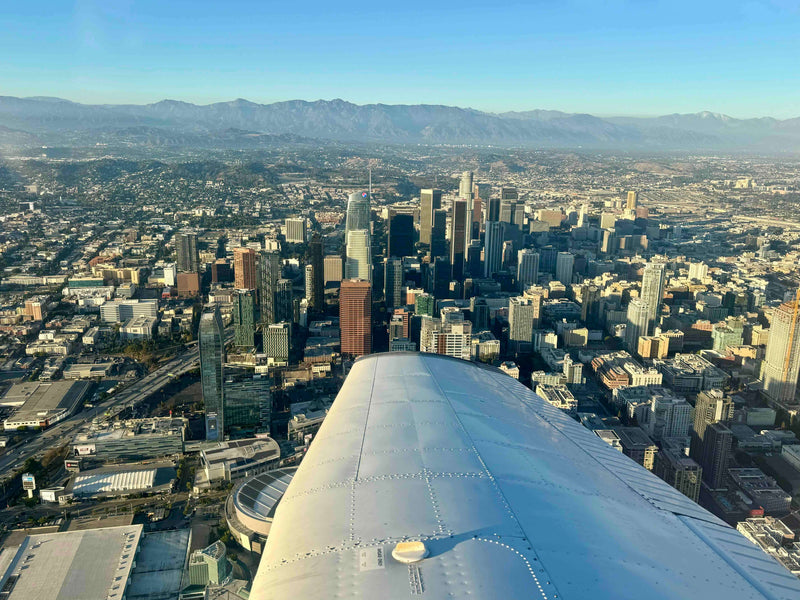
A Piper Warrior that climbs a little over 600 feet per minute at sea level is delivering something in the low 400s on that same afternoon, with two adults and full tanks. Runway 16R at Van Nuys is 8,001 feet long, so the takeoff roll is rarely the problem here. The climb is. You are departing into a bowl ringed by the Santa Susana and San Gabriel mountains, and 400 feet per minute changes what you can do with the first ten minutes of a flight.
Landing degrades too, and people forget this one. Higher true airspeed at touchdown means more energy to dissipate, a longer float and a longer rollout. Same indicated approach speed, more pavement used.
The Awkward Tension With Summer Scheduling
We have written before that summer mornings in Los Angeles are unreliable because of the marine layer, and that afternoons are the safer bet. Our own weather study behind the 355 flyable days at Van Nuys found only 40% of 7am observations in June met training minima, against 97 to 100% from 1pm onwards.
Both things are true and they pull in opposite directions. The resolution is seasonal. In late May and June the binding constraint is the ceiling, so fly the afternoon. By late August and through September the marine layer has weakened and heat is the constraint, so the best window slides back to mid-morning, roughly 9am to 11am. The cloud has burned off, the ground has not yet cooked, and the air is still reasonably smooth.
That flexibility is easier to arrange at a Part 61 school, where lessons can be resequenced around conditions rather than taught in a fixed order. Our instructors move students to a mid-morning slot in September without much drama.
Where It Stops Being Academic: Big Bear
Van Nuys itself is forgiving. Long runways and an airplane with margin. The trouble starts when Valley students fly the classic local cross-country up to Big Bear City, elevation 6,752 feet.
On a 30°C summer afternoon at Big Bear, the density altitude is above 10,000 feet. A normally aspirated trainer at that altitude has lost roughly a third of its horsepower before you release the brakes. Climb rate at full gross can fall into the low hundreds of feet per minute, which is not enough to outclimb rising terrain on a warm day. The runway length is not what bites people. The airplane's inability to go up afterwards is.
This is the flight where students learn to lean the mixture for maximum power before takeoff, which is not something anyone does at Van Nuys. It is also the flight where the correct decision is sometimes to wait until morning, and sometimes to leave fuel and a passenger behind. Learning to make that call with the performance charts open in front of you is the whole point of the exercise.
What To Actually Do About It
Work The Real Numbers, Not The Book Cover
14 CFR 91.103 requires you to become familiar with all available information concerning a flight before you begin it, and 91.103(b)(1) specifically names takeoff and landing distance data from the approved flight manual. Interpolating a performance chart for the actual temperature and pressure altitude is not a nice-to-have. It is the regulation. Most pilots who skip it have never been caught out, which is exactly why they keep skipping it.
Take Weight Out
Weight is the lever you fully control. Avgas weighs 6 pounds a gallon, so dropping from full tanks to three-quarters on a local flight removes real pounds and buys back climb rate. Nobody needs five hours of fuel for a lesson in the practice area.
Give Yourself Margin, Then Add More
Published performance figures come from a new airframe flown by a test pilot on a smooth day. Your aircraft has hours on it. A common approach is to add 50% to the calculated takeoff distance and treat that as the number that matters.
Learn The Charts Before You Need Them
Density altitude and aircraft performance sit squarely in the knowledge areas of 14 CFR 61.105 and they appear on the written exam. They are also one of the topics that is far easier to learn on the ground than in a hot cockpit at the run-up area. Our ground school in Los Angeles works through performance charts with local airports and real temperatures rather than generic examples.
The Honest Verdict On Flying Here
Los Angeles is an easy place to learn to fly and a slightly deceptive one. The weather is reliable enough that you can go a long way without ever being forced to think hard about performance, and the runways at Van Nuys are long enough to hide most sins. Pilots who train somewhere with 5,000-foot field elevations learn density altitude in week two because the airplane makes them.
Valley pilots have to go looking for it. The ones who do are fine. The ones who do not eventually attempt a hot departure out of a short strip with four people aboard, and that is a bad afternoon to have your first real conversation with the performance section of the handbook.
Come And Fly A September Morning
A $229 discovery flight puts you in the left seat for 60 minutes with an instructor beside you, and the time is loggable dual instruction. Ask your instructor what the ATIS is calling for density altitude when you walk out to the airplane. It is a good first question.
If you would rather sit down and talk through a training plan first, book a free in-person consultation at 7900 Balboa Blvd, Suite 108A, Van Nuys, CA 91406, or call (818) 290-8249. We are rated 5.0 stars from 120+ Google reviews, and Van Nuys gives us 355 flyable days a year to work with.


Comments(0)
There are no comments for this article. Be the first one to leave a message!