SAFETY FIRST
★★★★★
Very safety and detail oriented. Pre-flight briefing explained everything there was. To my knowledge, this flight school is exceptional in their ability.

To squawk is to set a four-digit code in the transponder so radar can tell who you are. A VFR pilot not talking to ATC squawks 1200. Three codes are emergencies: 7500 for a hijack, 7600 for a lost radio and 7700 for any other emergency. This guide covers every special code, the transponder modes, the ADS-B Out rule, and how it all works under the Los Angeles Class B from Van Nuys.
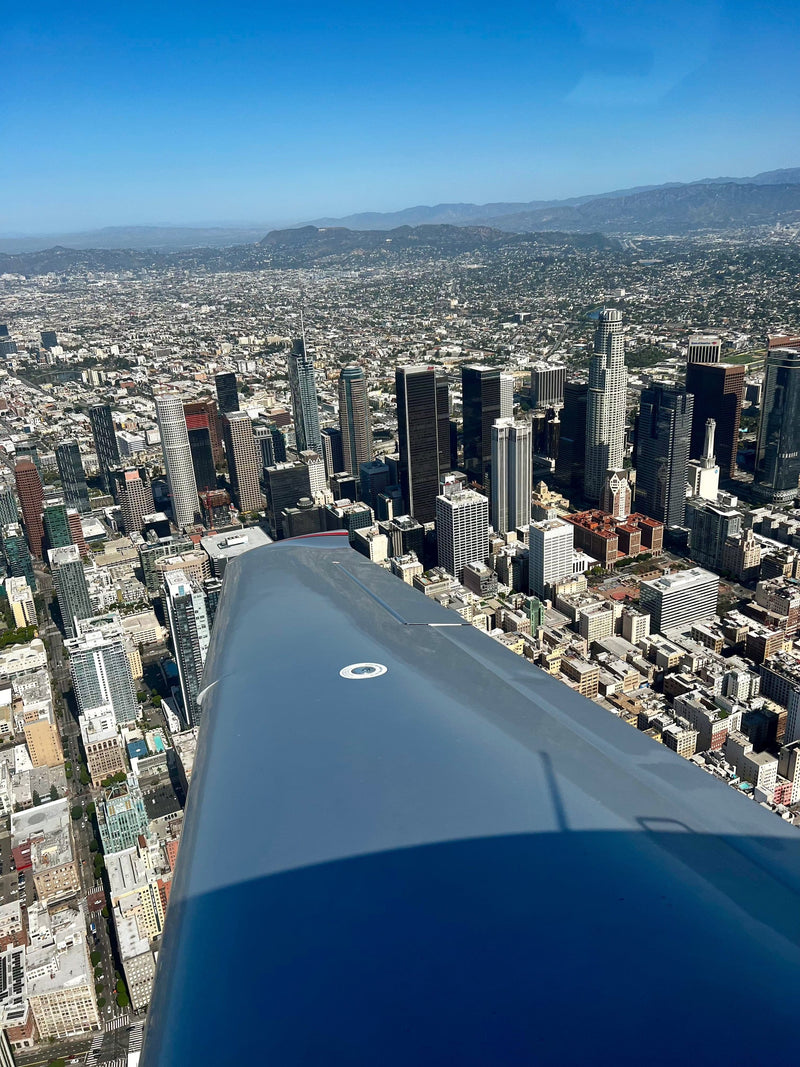
Downtown Los Angeles from a training flight, inside airspace where a transponder and ADS-B Out are required.
Squawk means to set a code in the transponder, the box that answers ground radar with an identity and, usually, an altitude.
When a controller says “Cessna Three Alpha Bravo, squawk four two seven one,” the pilot dials 4271 into the transponder and reads it back. The radar screen then shows that airplane with a data tag: call sign, altitude and ground speed. That is the whole meaning of squawk. The FAA’s Pilot/Controller Glossary defines it as the instruction to activate the transponder and ADS-B Out with altitude reporting on, on the mode or code given.
Squawking, as a verb, is just operating on a code. “We’re squawking 1200” means the airplane is VFR and not talking to ATC. “Squawk VFR” is a controller telling you to go back to 1200 when radar service ends. “Squawk ident” means press the IDENT button once, which makes your target bloom on the controller’s screen for a few seconds so they can pick you out of the traffic.
Each code is four digits, and each digit runs from 0 to 7, because transponder codes are octal. There is no 8 or 9 on the knob. That gives 4,096 possible codes, which is where the phrase “Mode A 4096-code capability” in 14 CFR 91.215(b) comes from. A handful are reserved, and those are the ones to know cold.
These are the codes reserved in the AIM and the FAA air traffic order, JO 7110.65. Everything else is a discrete code assigned by ATC for one flight.
| Code | Meaning | Who Uses It | Source |
|---|---|---|---|
| 1200 | VFR, not assigned another code | Any VFR aircraft not receiving ATC service, at any altitude | AIM 4-1-20 |
| 7700 | Emergency | Any aircraft in distress or urgency, especially when not already on an assigned code | AIM 4-1-20, 6-2-2 |
| 7600 | Lost two-way radio communications | An aircraft whose radios have failed | AIM 6-4-2, 14 CFR 91.185 |
| 7500 | Hijack or unlawful interference | An aircraft under unlawful interference | AIM 4-1-20, JO 7110.65 5-2-5 |
| 1202 | VFR glider | Gliders not in contact with ATC, in place of 1200 | AIM 4-1-20 |
| 1203 | VFR formation lead | Lead aircraft of a standard VFR formation not in contact with ATC; the others squawk standby | AIM 4-1-20 |
| 1255 | Firefighting | Firefighting aircraft not in contact with ATC, going to, from or inside the fire area | AIM 4-1-20 |
| 1277 | Search and rescue | Aircraft on Air Force or Coast Guard search and rescue missions, when advised | AIM 4-1-20 |
| 4000 | Frequent altitude changes | Typically military aircraft in restricted or warning areas, or on low-level routes | JO 7110.65 5-2-1 |
| 7400 | Unmanned aircraft lost link | Remotely piloted aircraft that have lost the control link | JO 7110.65 5-2-6 |
| 7777 | Military interceptor operations | Never used by civil aircraft | AIM 4-1-20 |
The three emergency codes are the only ones most pilots will ever set on purpose apart from 1200 and assigned codes. Learn them as a group: 75 “taken alive,” 76 “radio needs a fix,” 77 “going to heaven.”
The 1255 code is worth knowing in Southern California. Fire season brings temporary flight restrictions over burn areas, and the aircraft working inside them may be squawking 1255 rather than talking to approach.
Each emergency code sets off an alarm on every radar display that can see you. That is the point of them, and also why you never select one by accident.
Squawk 7700 means the aircraft has an emergency. AIM 6-2-2 tells a pilot in distress or urgency who is not already in radar contact and on a discrete code to set 7700. The code triggers an alarm at every facility that can see the target, which matters if you are on the wrong frequency, or no frequency at all. If you are already talking to a controller on an assigned code, the AIM says you may stay on that code.
Declaring an emergency gives you authority under 14 CFR 91.3(b) to deviate from any rule in Part 91 to the extent the emergency requires. Pilots wait too long to use it. Under 91.3(c) a written report is due only if the FAA asks for one.
Squawk 7600 means two-way radio communication has failed. ATC sees the code and expects you to follow the lost-communication procedure. For an IFR flight that is 14 CFR 91.185, which sets the route and altitude to fly. For a VFR pilot in visual conditions it is simpler: 91.185(b) says continue VFR and land as soon as practicable.
At a towered field like Van Nuys, a radio failure ends with light gun signals from the tower. We cover the full light-signal table on the Class D Airspace page. Before you squawk 7600, check the obvious things: volume, the frequency itself, the headset jack and the audio panel.
Squawk 7500 means the aircraft is being hijacked or is under unlawful interference. Only the nondiscrete code 7500 is decoded as a hijack, and it brings a response from far beyond air traffic control. It is the code you must never set by mistake.
AIM 4-1-20 tells pilots to avoid passing through 7500, 7600 and 7700 when changing codes. On a knob transponder that takes a little thought.
Read back the new code with your call sign so the controller can catch a mistake before you dial it. “Squawk 4271, Three Alpha Bravo.”
Going from 2700 to 7200, change the second digit first to make 2200, then the first to make 7200. Turning the first knob first gives 7700 for a second.
Leave the mode switch in ALT while you change it. Switching to standby first is not required by the AIM, and it drops your target and altitude off the controller’s screen.
Confirm the four digits you set are the four the controller gave you. A transposed code is a common error and the controller may not notice right away.
Press IDENT only when the controller asks you to squawk ident. Pressing it unasked confuses the picture for everyone else on that scope.
When radar service ends you will hear “squawk VFR” or “squawk 1200.” Set it and keep altitude reporting on.
The mode is what the transponder sends. The switch position is what you choose. Pilots mix the two up, so here they are side by side.
| Mode Or Setting | What It Does | Notes |
|---|---|---|
| Mode A | Replies with the four-digit code only | Identity, no altitude |
| Mode C | Replies with the code plus pressure altitude in 100 ft steps | What 14 CFR 91.215(b) means by altitude reporting |
| Mode S | Each aircraft has a unique address; supports selective interrogation and data link | Many Mode S units also broadcast 1090 MHz ADS-B (1090ES) |
| OFF | No reply | Before engine start and after shutdown |
| STBY (Standby) | Powered and warm, not replying | On the gate or when ATC says squawk standby |
| ON | Replies in Mode A only | No altitude; use only when ATC asks you to stop altitude squawk |
| ALT | Replies with code and altitude | The normal setting on the ground and in the air |
| TEST | Self-test | Before flight, where the unit supports it |
AIM 4-1-20 asks pilots to have the transponder and ADS-B Out transmitting, with altitude reporting, any time the aircraft is on the airport movement area, including taxiways and runways. At the parking spot you go to standby or off.
In the air the rule is in 14 CFR 91.215(c): if your aircraft has an operable transponder, you must operate it, including Mode C if installed, in all controlled airspace and in the airspace listed in 91.215(b). In Los Angeles that means the switch lives in ALT. If ATC says “stop altitude squawk,” your encoder may be giving a wrong altitude; set ON, not off.
14 CFR 91.215 covers the transponder and 91.225 covers ADS-B Out. The airspace lists are almost identical, which is the point: since 1 January 2020 you need both in the same places.
A Mode C transponder is required in Class A, B and C airspace, within 30 nautical miles of the primary airports listed in Part 91 Appendix D from the surface to 10,000 feet MSL, above the ceiling and within the lateral limits of a Class B or C area up to 10,000 feet MSL, and at and above 10,000 feet MSL over the 48 states excluding the airspace at and below 2,500 feet above the surface. That is 14 CFR 91.215(b).
ADS-B Out, under 91.225(d), is required in the same Class B and C airspace, the same 30-mile rings, above Class B and C areas to 10,000 feet, in Class E at and above 10,000 feet MSL with the same 2,500-foot exclusion, and in Class E over the Gulf of Mexico (the Gulf of America in current FAA publications) at and above 3,000 feet MSL within 12 nautical miles of the coast. In Class A it must be the 1090 MHz version, under 91.225(a). Below 18,000 feet either 1090ES or the 978 MHz UAT version meets 91.225(b).

Van Nuys sits inside the Los Angeles Mode C veil, so every airplane on our ramp has a transponder and ADS-B Out, and every student learns the codes from lesson one.
Van Nuys Airport is about 16.5 nautical miles north of LAX in a straight line, well inside the 30-mile Mode C veil described in 14 CFR 91.215(b)(2). The field is Class D Under The Los Angeles Class B Shelf, and the tower expects your transponder in ALT before you taxi.
Ask for flight following, and SoCal Approach, the TRACON that works the Los Angeles basin, will assign you a discrete code. You will hear “radar contact,” which is not a Class B clearance. Only the words “cleared into the Class Bravo” let you in, as the Airspace Classes Explained guide sets out. Burbank’s Class C Airspace is the nearest place where the transponder is required by the class itself.
Squawk codes come up on the written and in the oral. Expect them on the FAA Written Exam, and expect an examiner to ask what you would set for a radio failure on the Private Pilot Checkride. Radio phraseology starts with the Pilot Phonetic Alphabet; numbers are spoken digit by digit, so 4271 is “four two seven one,” never “forty-two seventy-one.”

A VFR pilot chooses whether to talk to radar. An IFR pilot never flies without an assigned code.
Squawk 1200 with altitude reporting, regardless of altitude. Read What VFR Means for the rest of the rules.
ATC assigns a discrete code and calls traffic for you, workload permitting. Service can end at any time with “squawk VFR.”
You get a code in your clearance before departure and keep it, or change it on instruction, until you land or cancel. The What Is IFR Guide covers what else changes, and the Instrument Rating is where you train for it.
Practice costs nothing in the simulator. Our Redbird MCX has a working transponder, and a session is a good place to rehearse a 7600 scenario before you meet one for real.
On a $229 discovery flight you fly the airplane out of a Class D field under the busiest airspace in the West, with an instructor beside you handling the radio and the transponder. Watch it done once, then learn to do it yourself.
7900 Balboa Blvd. Suite 108A, Van Nuys, CA 91406 · (818) 290-8249 · Open 9am–9pm, seven days · 5.0 from 120+ Google reviews
Squawk means setting a four-digit code in the transponder so ground radar can identify the aircraft. When a controller says squawk 4271, the pilot dials 4271, reads it back, and the radar shows that airplane with its call sign and altitude. Squawk ident means press the IDENT button once. Squawk VFR means return to 1200. The term covers the instruction and the code itself, so pilots also say an aircraft is squawking 1200 or squawking 7700.
The VFR code is 1200. Under AIM 4-1-20, a VFR pilot who has not been assigned a code by ATC squawks 1200 regardless of altitude, with altitude reporting on. Gliders use 1202 instead. If you request flight following, ATC replaces 1200 with a discrete code for the rest of the service, then tells you to squawk VFR when it ends. Some other countries use 7000 as the VFR code, so check before flying abroad.
Squawking 7700 sets off an emergency alert on every radar display that can see the aircraft, and controllers will try to contact you and clear traffic. AIM 6-2-2 recommends it when you have an emergency and are not already in contact with ATC on an assigned code. If you are talking to a controller, you may keep your assigned code and simply declare the emergency. Under 14 CFR 91.3, the pilot in command may deviate from Part 91 as far as the emergency requires.
Code 7500 means hijack or unlawful interference, 7600 means lost two-way radio communications, and 7700 means any other emergency. All three trigger alarms at air traffic facilities. Student pilots learn them with a rhyme: seventy-five taken alive, seventy-six radio needs a fix, seventy-seven going to heaven. Because they trigger a response, AIM 4-1-20 tells pilots to avoid passing through any of them when changing to an ordinary code.
Not everywhere, but almost everywhere around Los Angeles. 14 CFR 91.215 requires a Mode C transponder in Class A, B and C airspace, within 30 nautical miles of the major Class B airports from the surface to 10,000 feet MSL, and above 10,000 feet MSL outside the airspace within 2,500 feet of the surface. Van Nuys is inside the LAX 30-mile ring, so you need a transponder and ADS-B Out just to take off.
A transponder replies when ground radar interrogates it. ADS-B Out broadcasts the aircraft’s GPS position, altitude, speed and identity about once a second without being asked. Since 1 January 2020, 14 CFR 91.225 requires ADS-B Out in most of the same airspace where 91.215 requires a transponder. Many installations combine them: a Mode S transponder with extended squitter does both on 1090 MHz. ADS-B Out must transmit at all times unless ATC says otherwise.
Mode C is the transponder reply that includes pressure altitude in 100-foot increments, taken from an encoder connected to the static system. It is what the regulations mean by automatic altitude reporting. Mode A sends only the four-digit code. On most control heads the ALT position selects Mode C, and ON selects Mode A without altitude. Mode S is a newer standard that adds a unique aircraft address and data link, and still reports altitude.
Yes. Any pilot with an emergency, including a student pilot on a solo flight, should squawk 7700 when it helps get assistance, and should say mayday or pan-pan on the frequency in use or on 121.5 MHz. There is no penalty for using an emergency code in a real emergency. Students here practice emergency calls and code selection with an instructor and in the simulator before their first solo from Van Nuys.
Every rule on this page traces to Title 14 of the Code of Federal Regulations, the Aeronautical Information Manual or an FAA handbook or advisory circular. These links open the primary source.
Code meanings are from AIM paragraph 4-1-20 and FAA Order JO 7110.65, Chapter 5, Section 2, read in October 2026. Airspace requirements are from 14 CFR 91.215 and 91.225 as currently in force. Distances from Van Nuys are straight-line, computed from published airport coordinates.
The three private pilot packages, what each one includes, the financing options and a realistic timeline built around how often you can actually fly. Sent to you in one email. Nobody will pressure you.
Loved On Google
Every review below is real and shown verbatim, in the reviewer’s own words — written by the people who learned to fly here, not by us.
SAFETY FIRST
Very safety and detail oriented. Pre-flight briefing explained everything there was. To my knowledge, this flight school is exceptional in their ability.
 DISCOVERY FLIGHT
I recently had the chance to take my first-ever discovery flight, and it was nothing short of amazing! From the moment I stepped into the cockpit, the...
 SUNSET CIRRUS
It was a great flight! I did a sunset flight and Alex let us fly an awesome. Website was easy to book, and the plane itself was really fun to fly...
 FLYING LESSON
We had a great flying lesson with Ralph and came away with a much better understanding of both the aircraft and the principles of flight. Ralph is a...
 KIDS LUXURY FLIGHT
I got 2 luxury discovery flights for my kids. I wanted them to have the experience of flying. Our instructor Alex was amazing he made sure they feel...
 HONEYMOON SURPRISE
Last minute booking to surprise my wife on our honeymoon. She had no experience with flying and was scared of flying, but Alex was very easygoing and knew...
 FULL-MOTION SIM
Amazing flight school in van nuys airport. I have been a student here for the past few months and i could not be happier. I started doing a lot of...
 DISCOVERY FOR TWO
I booked a Discovery Flight for Two for my girlfriend's birthday and it was the perfect gift for her. She couldn't have been more excited to get to...
 SIMULATORS
Very professional and great airplanes. I love the flight simulators. The pricing is very fair compared to any other flight school
 TEEN FIRST LESSON
We gifted our teenage son his first flying lesson. He was so excited! Alex greeted us and gave a reassuring brief that made us all feel comfortable and at...
 FIRST-TIME FLYER
Flying is my husband's hobby and I was incredibly anxious and apprehensive about the discovery flight. However, I felt completely safe and at ease once we...
SAFETY FIRST
Very safety and detail oriented. Pre-flight briefing explained everything there was. To my knowledge, this flight school is exceptional in their ability.
DISCOVERY FLIGHT
I recently had the chance to take my first-ever discovery flight, and it was nothing short of amazing! From the moment I stepped into the cockpit, the...
SUNSET CIRRUS
It was a great flight! I did a sunset flight and Alex let us fly an awesome. Website was easy to book, and the plane itself was really fun to fly...
FLYING LESSON
We had a great flying lesson with Ralph and came away with a much better understanding of both the aircraft and the principles of flight. Ralph is a...
KIDS LUXURY FLIGHT
I got 2 luxury discovery flights for my kids. I wanted them to have the experience of flying. Our instructor Alex was amazing he made sure they feel...
HONEYMOON SURPRISE
Last minute booking to surprise my wife on our honeymoon. She had no experience with flying and was scared of flying, but Alex was very easygoing and knew...
FULL-MOTION SIM
Amazing flight school in van nuys airport. I have been a student here for the past few months and i could not be happier. I started doing a lot of...
DISCOVERY FOR TWO
I booked a Discovery Flight for Two for my girlfriend's birthday and it was the perfect gift for her. She couldn't have been more excited to get to...
SIMULATORS
Very professional and great airplanes. I love the flight simulators. The pricing is very fair compared to any other flight school
TEEN FIRST LESSON
We gifted our teenage son his first flying lesson. He was so excited! Alex greeted us and gave a reassuring brief that made us all feel comfortable and at...
FIRST-TIME FLYER
Flying is my husband's hobby and I was incredibly anxious and apprehensive about the discovery flight. However, I felt completely safe and at ease once we...
Reviews shown verbatim, exactly as each reviewer published them.
Aviation News
Notes from the flight line at Van Nuys — weather, regulation changes, checkride questions and the cost of training, written up as they come.
Open 7 days · 9:00 AM – 9:00 PM
Los Angeles Flight School