SAFETY FIRST
★★★★★
Very safety and detail oriented. Pre-flight briefing explained everything there was. To my knowledge, this flight school is exceptional in their ability.

Class C airspace surrounds busier towered airports that have radar approach control. It usually runs from the surface to 4,000 feet above the airport within 5 nautical miles, with a shelf out to 10. To enter you need two-way radio communication established with ATC, a Mode C transponder and ADS-B Out. Burbank, about 6.5 nautical miles from our ramp at Van Nuys, is the Class C most of our students fly through first.
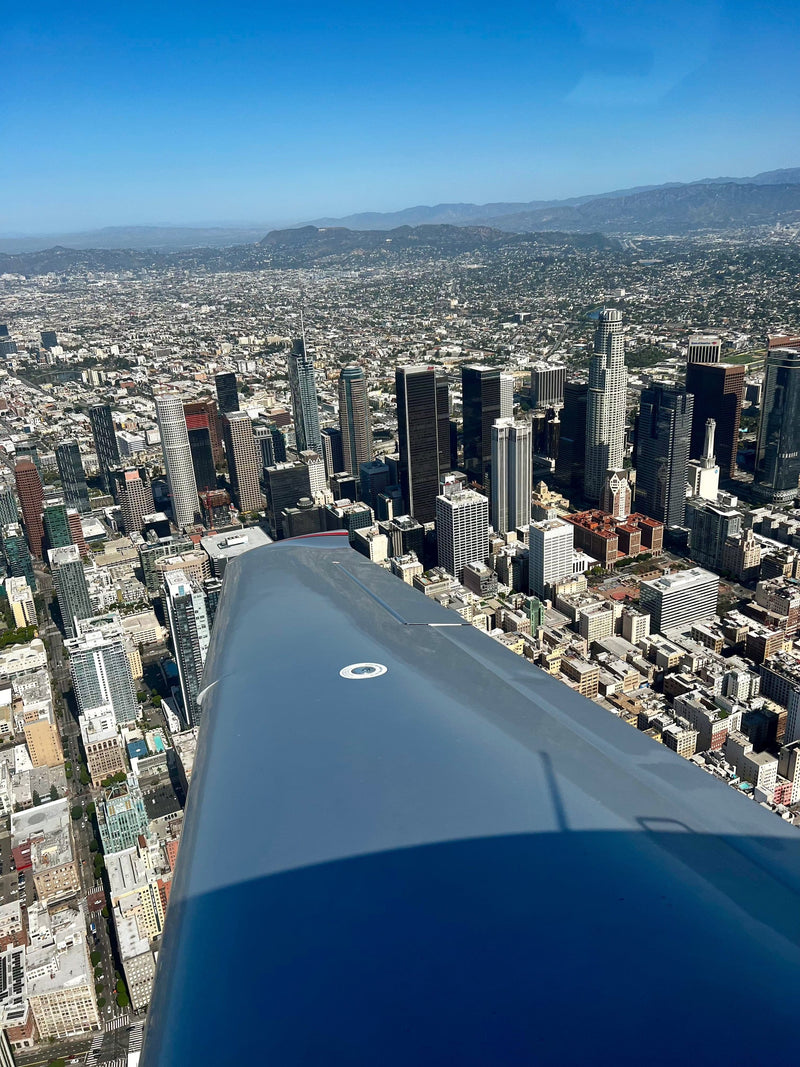
The Hollywood Hills and San Gabriel Mountains, the terrain around the Burbank Class C east of Van Nuys.
Class C is controlled airspace around an airport with an operating control tower, radar approach control and enough instrument traffic or passenger volume to need more than a Class D.
The FAA designates each Class C area individually in 14 CFR Part 71 and FAA Order JO 7400.11, and describes the typical shape in AIM 3-2-4. The usual form is two stacked circles: an inner core of 5 nautical miles radius from the surface to 4,000 feet above the airport elevation, and an outer shelf from 5 to 10 nautical miles that starts 1,200 feet above the airport and goes to the same ceiling. Real areas are tailored, with cut-outs for nearby airports and edges trimmed to meet Class B.
What makes it Class C is the radar. Inside it, ATC sequences every arriving aircraft, separates IFR traffic from IFR traffic, and gives traffic advisories and conflict resolution between IFR and VFR aircraft. A VFR pilot in Class C is a radar target with a discrete code, not an anonymous 1200 squawk. That service extends into an outer area, normally 20 nautical miles from the airport, which is not regulatory airspace: you can use it or not.
If you have read our Class D Airspace page, the entry test will be familiar. The difference is equipment, size and the radar service you get once inside. The full system of six classes is set out in Airspace Classes Explained.
Every requirement below comes from 14 CFR Part 91. Dimensions are the AIM’s typical figures; the chart shows the real ones for each airport.
| Requirement | Class C | Source |
|---|---|---|
| To enter | Two-way radio communication established with the ATC facility that provides service, before entry, and maintained inside | 14 CFR 91.130(c) |
| Clearance required | No. Two-way radio communication is the test | 14 CFR 91.130 |
| Radio | Two-way radio | 14 CFR 91.130(d) |
| Transponder | Mode C with altitude reporting, inside Class C and above it up to 10,000 ft MSL within its lateral limits | 14 CFR 91.215(b) |
| ADS-B Out | Required inside Class C and above it up to 10,000 ft MSL within its lateral limits | 14 CFR 91.225(d) |
| Pilot certificate | Any, including student pilot; no Class C endorsement exists | 14 CFR 61.95 applies to Class B only |
| VFR visibility | 3 statute miles | 14 CFR 91.155 |
| VFR cloud clearance | 500 ft below, 1,000 ft above, 2,000 ft horizontal | 14 CFR 91.155 |
| Speed limit | 200 knots indicated at or below 2,500 ft AGL within 4 NM of the primary airport | 14 CFR 91.117(b) |
| Departing a satellite airport | Towered: follow Class D rules. Non-towered: contact ATC as soon as practicable after takeoff | 14 CFR 91.130(c)(2) |
You do not wait for a clearance to enter Class C. You wait for the controller to say your call sign. Once they do, you are in unless told to stay out.
Call the approach control frequency on the chart well outside the outer shelf, with your position, altitude, destination or intentions, and the ATIS code. A reply that contains your call sign, even a short one, establishes communication. The controller will usually also give you a squawk code and, once they have you on radar, “radar contact.”
Three replies stop you. “Aircraft calling, stand by” without your call sign means communication is not established. “Remain outside the Class Charlie” with your call sign means it is established but you are not welcome yet. And silence means nothing at all. In each case you turn away or orbit outside the lateral limits and below the shelf floor, and try again.
Practice the call before you fly it. Read it aloud using the Pilot Phonetic Alphabet, and keep it short: who you are, where you are, what you want. Controllers in the Los Angeles basin are busy, and a clean first call gets a faster answer.

Class C is drawn on sectional and terminal area charts with solid magenta lines. The altitudes inside each ring are in hundreds of feet MSL: ceiling over floor.
Typically a 5 NM circle from the surface. On the chart the label reads, for example, 48 over SFC: the Class C goes from the surface up to and including 4,800 ft MSL.
Typically 5 to 10 NM, with a floor 1,200 ft above the airport. A label of 48 over 30 means a floor of 3,000 ft MSL and a ceiling of 4,800 ft MSL. Under the shelf you are outside Class C.
Not drawn as a ring and not regulatory. Normally 20 NM out, where approach will provide the same service to aircraft that ask for it.
The numbers on the chart are MSL, while the AIM’s typical dimensions are above airport elevation. Burbank shows why that matters. Its core, in the FAA’s 2015 airspace rule, runs from the surface to 4,800 ft MSL within 5 miles of the airport. Its outer shelf runs from 3,000 ft to 4,800 ft MSL out to 10 miles over much of the circle. Parts are cut away: the airspace below 3,000 ft MSL within 1.8 miles of Whiteman Airport, and everything south of the northern edge of the Los Angeles Class B. Airspace is amended from time to time, so take the current figures from the current Los Angeles terminal area chart, not from this page.
Flying under a shelf or around a core without talking to anyone is legal as long as you stay out, but most pilots in Los Angeles talk to approach anyway. The 30 nautical mile Mode C veil around LAX already requires your transponder and ADS-B Out, so the only thing you add by calling is help.
Four Class C areas sit within about 70 nautical miles of Van Nuys. Each one is confirmed by an FAA rule or notice, or by the airport operator, as listed below.
| Airport | Identifier | Straight-Line Distance From KVNY | Confirmed By |
|---|---|---|---|
| Hollywood Burbank Airport (Bob Hope Airport) | KBUR | 6.5 NM | FAA rule, Federal Register, 24 September 2015 |
| John Wayne Airport, Orange County | KSNA | 44.6 NM | FAA rule, Federal Register, 19 April 2002 |
| Ontario International Airport | KONT | 45.1 NM | FAA notice of airspace meeting, Federal Register, 1 July 2026 |
| Santa Barbara Municipal Airport | KSBA | 68.2 NM | Santa Barbara Airport, official site |
Los Angeles International is Class B, not Class C, and Van Nuys is Class D. Distances are great-circle figures we computed from published airport coordinates; flying distance depends on the route you are given. The Ontario notice concerns a proposal to amend that airport’s Class C, so check for changes before you plan a flight there.
The John Wayne rule is a reminder that the shape matters more than the class. The 2002 amendment kept access to a VFR practice area to the east by raising part of the outer floor rather than extending the shelf. Every Class C has a story like that, and the chart is where it shows up. The same rule ties the Santa Ana Class C to the hours of the Orange County tower, published by NOTAM. When a Class C tower closes, the airspace changes class, and the Chart Supplement tells you what it becomes. Check both before a flight that arrives late in the evening.
A Class C transition is a standard lesson for our private pilot students. This is the sequence an instructor walks you through; the controller’s instructions always win.
On the terminal area chart, find the Burbank core and shelf, the Class B floors above and the terrain below. Pick an altitude that keeps you clear of the Class B.
Listen to the Burbank ATIS before you call, so the controller does not have to read you the weather and altimeter setting.
Burbank’s radar service comes from Southern California TRACON. Call on the published frequency well before the shelf, with call sign, position, altitude and request.
When the reply includes your call sign and no instruction to stay out, communication is established. Set the squawk code you are given.
Hold the assigned heading and altitude. Remember the Class B above Burbank needs its own clearance; nothing about Class C entry authorizes you into Class B.
Approach will tell you when service ends or hand you off. Expect “squawk VFR, frequency change approved,” then go back to 1200.

Van Nuys is a Class D field under the Los Angeles Class B and next to the Burbank Class C. Students learn all three entry tests in their first certificate.
Most students elsewhere meet Class C for the first time on a long cross-country, alone. Here it is six and a half miles from the ramp, so the first Class C call happens with an instructor in the right seat, often in the first twenty hours. The 14 CFR 61.109 cross-country requirements, explained on the Private Pilot Cross-Country page, are much easier to plan when talking to approach is already routine.
Class C also teaches the squawk discipline covered in our Squawk Codes guide, the radar handoffs you will rely on later under Instrument Flight Rules, and the visual flying skills described in What Is VFR. The local picture is mapped out on the Van Nuys Airspace page, and the class above everything is on the Class A Airspace page.
You can rehearse the calls before paying for airplane time. The Redbird MCX Simulator lets an instructor pause mid-transmission and fix the wording. Class C training is part of every Private Pilot Program we run, and expect airspace questions on the FAA Written Exam and the oral.
A $229 discovery flight puts you at the controls out of a Class D field with Class C six and a half miles away and Class B overhead. An instructor handles the radio while you fly, so you hear exactly how the calls sound.
7900 Balboa Blvd. Suite 108A, Van Nuys, CA 91406 · (818) 290-8249 · Open 9am–9pm, seven days · 5.0 from 120+ Google reviews
To fly in Class C you need two-way radio communication established with the controlling ATC facility before entering, under 14 CFR 91.130, plus a Mode C transponder under 91.215 and ADS-B Out under 91.225. The VFR weather minimums are 3 statute miles visibility and 500 feet below, 1,000 feet above and 2,000 feet horizontally from clouds. Any pilot certificate is acceptable, including a student pilot certificate with the solo endorsements a student needs anyway.
No. Class C requires two-way radio communication established, not a clearance. Communication is established when the controller replies using your call sign. If the reply is aircraft calling, stand by, without your call sign, you must remain outside. If the controller says remain outside the Class Charlie, you must also stay out even though contact is established. Only Class B requires the words cleared into the Class Bravo.
The typical Class C described in AIM 3-2-4 has a 5 nautical mile core from the surface to 4,000 feet above the airport elevation and an outer shelf from 5 to 10 nautical miles, starting 1,200 feet above the airport and rising to the same ceiling. Real Class C areas are individually designed, so the chart gives the actual floors and ceilings in hundreds of feet MSL. Burbank’s ceiling, for example, is 4,800 feet MSL.
Yes. No regulation requires a special endorsement for Class C. The airspace endorsement in 14 CFR 61.95 applies only to Class B. A solo student still needs the normal solo and cross-country endorsements under 14 CFR 61.87 and 61.93 for the flight being made, and an instructor will usually fly a Class C transition with you first. Schools may also set their own limits on where students fly solo.
Yes. Hollywood Burbank Airport, designated in FAA airspace rules as Bob Hope Airport, Burbank, has Class C airspace. In the FAA’s 2015 rule it extends from the surface to 4,800 feet MSL within 5 miles of the airport, with an outer shelf from 3,000 to 4,800 feet MSL and cut-outs around Whiteman Airport and below the Los Angeles Class B. Check the current terminal area chart before flying it.
Not because of the Class C itself. 14 CFR 91.225 requires ADS-B Out inside Class C and above it within its lateral limits up to 10,000 feet MSL, but not below the shelf. Around Los Angeles that makes little difference, because the 30 nautical mile Mode C veil around LAX already requires a transponder and ADS-B Out from the surface to 10,000 feet MSL across most of the basin.
The outer area is a region, normally 20 nautical miles from the primary airport, where approach control offers the same sequencing and traffic services as inside the Class C itself. It is not regulatory airspace: you are not required to talk to anyone there. Pilots who do participate are expected to follow ATC instructions until they cancel service. It is not drawn as a ring on sectional charts.
Entering Class C without two-way radio communication established violates 14 CFR 91.130. If the controller sees it, you will usually be asked to call a phone number after landing, and the FAA may take enforcement action. If you realize you have entered, call approach right away, give your position and comply with instructions. Filing a report through the NASA Aviation Safety Reporting System within 10 days may help in some cases.
Every rule on this page traces to Title 14 of the Code of Federal Regulations, the Aeronautical Information Manual or an FAA handbook or advisory circular. These links open the primary source.
Regulatory text is from the current 14 CFR Part 91. Typical Class C dimensions and outer-area description are from AIM 3-2-4. Burbank and Santa Ana dimensions are from the FAA rules cited, which may have been amended since; use the current chart. Distances from Van Nuys are straight-line, computed from airport coordinates.
The three private pilot packages, what each one includes, the financing options and a realistic timeline built around how often you can actually fly. Sent to you in one email. Nobody will pressure you.
Loved On Google
Every review below is real and shown verbatim, in the reviewer’s own words — written by the people who learned to fly here, not by us.
SAFETY FIRST
Very safety and detail oriented. Pre-flight briefing explained everything there was. To my knowledge, this flight school is exceptional in their ability.
 DISCOVERY FLIGHT
I recently had the chance to take my first-ever discovery flight, and it was nothing short of amazing! From the moment I stepped into the cockpit, the...
 SUNSET CIRRUS
It was a great flight! I did a sunset flight and Alex let us fly an awesome. Website was easy to book, and the plane itself was really fun to fly...
 FLYING LESSON
We had a great flying lesson with Ralph and came away with a much better understanding of both the aircraft and the principles of flight. Ralph is a...
 KIDS LUXURY FLIGHT
I got 2 luxury discovery flights for my kids. I wanted them to have the experience of flying. Our instructor Alex was amazing he made sure they feel...
 HONEYMOON SURPRISE
Last minute booking to surprise my wife on our honeymoon. She had no experience with flying and was scared of flying, but Alex was very easygoing and knew...
 FULL-MOTION SIM
Amazing flight school in van nuys airport. I have been a student here for the past few months and i could not be happier. I started doing a lot of...
 DISCOVERY FOR TWO
I booked a Discovery Flight for Two for my girlfriend's birthday and it was the perfect gift for her. She couldn't have been more excited to get to...
 SIMULATORS
Very professional and great airplanes. I love the flight simulators. The pricing is very fair compared to any other flight school
 TEEN FIRST LESSON
We gifted our teenage son his first flying lesson. He was so excited! Alex greeted us and gave a reassuring brief that made us all feel comfortable and at...
 FIRST-TIME FLYER
Flying is my husband's hobby and I was incredibly anxious and apprehensive about the discovery flight. However, I felt completely safe and at ease once we...
SAFETY FIRST
Very safety and detail oriented. Pre-flight briefing explained everything there was. To my knowledge, this flight school is exceptional in their ability.
DISCOVERY FLIGHT
I recently had the chance to take my first-ever discovery flight, and it was nothing short of amazing! From the moment I stepped into the cockpit, the...
SUNSET CIRRUS
It was a great flight! I did a sunset flight and Alex let us fly an awesome. Website was easy to book, and the plane itself was really fun to fly...
FLYING LESSON
We had a great flying lesson with Ralph and came away with a much better understanding of both the aircraft and the principles of flight. Ralph is a...
KIDS LUXURY FLIGHT
I got 2 luxury discovery flights for my kids. I wanted them to have the experience of flying. Our instructor Alex was amazing he made sure they feel...
HONEYMOON SURPRISE
Last minute booking to surprise my wife on our honeymoon. She had no experience with flying and was scared of flying, but Alex was very easygoing and knew...
FULL-MOTION SIM
Amazing flight school in van nuys airport. I have been a student here for the past few months and i could not be happier. I started doing a lot of...
DISCOVERY FOR TWO
I booked a Discovery Flight for Two for my girlfriend's birthday and it was the perfect gift for her. She couldn't have been more excited to get to...
SIMULATORS
Very professional and great airplanes. I love the flight simulators. The pricing is very fair compared to any other flight school
TEEN FIRST LESSON
We gifted our teenage son his first flying lesson. He was so excited! Alex greeted us and gave a reassuring brief that made us all feel comfortable and at...
FIRST-TIME FLYER
Flying is my husband's hobby and I was incredibly anxious and apprehensive about the discovery flight. However, I felt completely safe and at ease once we...
Reviews shown verbatim, exactly as each reviewer published them.
Aviation News
Notes from the flight line at Van Nuys — weather, regulation changes, checkride questions and the cost of training, written up as they come.
Open 7 days · 9:00 AM – 9:00 PM
Los Angeles Flight School