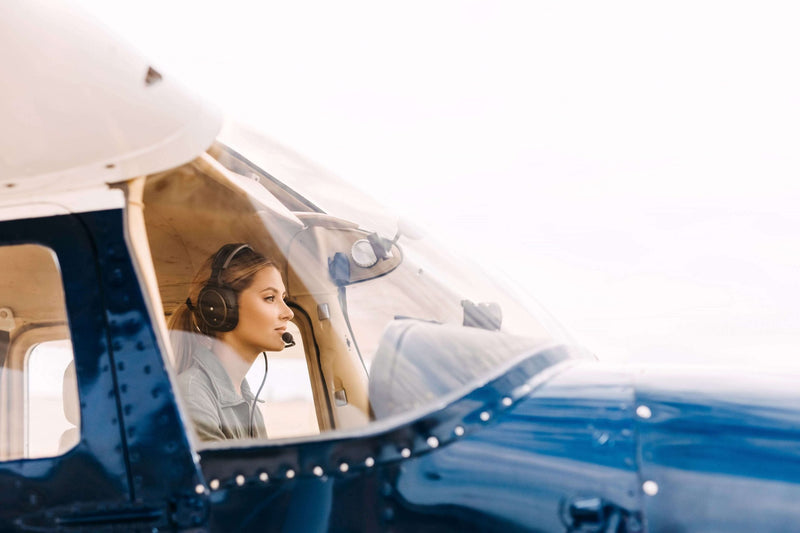
SAFETY FIRST
★★★★★
Very safety and detail oriented. Pre-flight briefing explained everything there was. To my knowledge, this flight school is exceptional in their ability.

A private pilot license needs 3 hours of dual cross-country, 5 hours of solo cross-country, one solo flight of at least 150 nautical miles with full-stop landings at three points, and one night dual cross-country of over 100 nautical miles. 14 CFR 61.109(a) sets all of it, and 14 CFR 61.1 decides what counts as cross-country in the first place.
A private pilot certificate requires 3 hours of dual cross-country training, 5 hours of solo cross-country, one solo flight of at least 150 nautical miles with full-stop landings at three points, and one night dual cross-country over 100 nautical miles, all under 14 CFR 61.109(a). A flight counts only if it lands more than 50 nautical miles straight-line from departure.
Source: 14 CFR 61.1, 61.93 and 61.109(a), checked against the eCFR (current to 14 October 2026), October 2026
Eight hours of it, split four ways. 14 CFR 61.109(a)(1) requires 3 hours of cross-country flight training with an instructor. 61.109(a)(2)(i) requires one night cross-country of over 100 nautical miles total distance, also with an instructor. 61.109(a)(5)(i) requires 5 hours of solo cross-country time. And 61.109(a)(5)(ii) requires one of those solo flights to be at least 150 nautical miles total distance, with full-stop landings at three points, and one segment of the flight consisting of a straight-line distance of more than 50 nautical miles between the takeoff and landing locations.
Before any of that counts, the flight has to qualify as cross-country at all. 14 CFR 61.1(b) defines cross-country time for a private pilot certificate as flight that includes a point of landing at least a straight-line distance of more than 50 nautical miles from the original point of departure, conducted in an appropriate aircraft and involving the use of pilotage, dead reckoning, electronic navigation aids, radio aids or other navigation systems. Fifty nautical miles exactly is not enough. It has to be more.
That definition is the reason a student can fly for two hours to a beautiful airport forty miles away and log none of it as cross-country. It is also why every cross-country syllabus in the country looks broadly the same: the regulation, not the instructor, chooses the airports.
For an airplane single-engine land rating. Each row is a separate requirement and one flight can satisfy more than one of them.
| Requirement | Regulation | The detail |
|---|---|---|
| Dual cross-country training | 14 CFR 61.109(a)(1) | 3 hours in a single-engine airplane |
| Night cross-country, dual | 14 CFR 61.109(a)(2)(i) | One flight of over 100 nautical miles total distance |
| Night takeoffs and landings | 14 CFR 61.109(a)(2)(ii) | 10 takeoffs and 10 landings to a full stop, each involving a traffic pattern, at an airport |
| Solo cross-country time | 14 CFR 61.109(a)(5)(i) | 5 hours |
| The long solo cross-country | 14 CFR 61.109(a)(5)(ii) | At least 150 nautical miles total, full-stop landings at three points, one segment of more than 50 nautical miles straight-line between takeoff and landing |
| Towered-airport solo landings | 14 CFR 61.109(a)(5)(iii) | 3 takeoffs and 3 landings to a full stop at an airport with an operating control tower |
| What counts as cross-country at all | 14 CFR 61.1(b) | A point of landing more than 50 nautical miles straight-line from the departure point, using pilotage, dead reckoning or navigation aids |
Van Nuys settles the last row of that table on its own. KVNY is a Class D field with an operating control tower, so every takeoff and landing at home base counts toward 61.109(a)(5)(iii) without a special trip.
The sequence is not in the regulation. It is what works, and it is what we fly from Van Nuys.
Usually Van Nuys to Santa Barbara and back, roughly 63 nautical miles each way up the coast, or Van Nuys to Bakersfield at about 87 nautical miles over the Newhall Pass. Both clear the 50-nautical-mile definition comfortably. The point of this flight is not navigation. It is the shift from flying a maneuver to running a flight: the plan, the fuel, the radio handoffs, the diversion you did not want and the decision about whether to make it.
One flight of over 100 nautical miles total distance under 61.109(a)(2)(i). Van Nuys to Santa Barbara and back is about 126 nautical miles in total and is the route most of our students fly for it. Los Angeles at night is genuinely useful to learn in: the ground is so bright that the horizon behaves differently from anywhere rural, and the transition from the lit basin out over dark water on the coastal leg is a lesson in visual illusion that no textbook delivers.
Building toward the 5 hours in 61.109(a)(5)(i). Typically a Van Nuys to Bakersfield round trip, or Van Nuys to Fox Field at Lancaster and on to somewhere past the 50-nautical-mile line. Each one needs a solo cross-country endorsement from your instructor under 14 CFR 61.93, given for the specific route after reviewing your planning, so nothing here is casual.
The flight everybody remembers. A common shape from Van Nuys is Fox Field at Lancaster, then Bakersfield, then home — about 33, 57 and 87 nautical miles, roughly 177 in total, with the Bakersfield leg comfortably over the 50-nautical-mile straight-line minimum and a full stop at all three points. Another is Santa Barbara, Bakersfield and home, closer to 245 nautical miles. Either satisfies 61.109(a)(5)(ii) with margin, and margin matters because a diversion should not invalidate the flight.
All five are logbook problems rather than flying problems, and all five are avoidable in the planning.
14 CFR 61.1(b) says more than 50 nautical miles straight-line from the original point of departure. A field measured at 50.0 nm does not count. Pick something with room in it.
61.109(a)(5)(ii) requires full-stop landings at three points. A touch and go at the middle airport, however tempting when the pattern is busy, breaks the requirement for that flight.
A 150-nautical-mile triangle made of three 50-mile legs meets the distance but fails the segment rule. One straight-line leg between a takeoff and a landing must exceed 50 nautical miles.
14 CFR 61.93 requires a solo cross-country endorsement for the specific route or, on a repeated route, a standing endorsement. Diverting to an airport your instructor has not endorsed is a regulatory problem as well as a logbook one.
Record the route point by point, the total distance and the full-stop landings. An examiner who cannot see the requirement satisfied in the logbook will treat it as not satisfied, and 14 CFR 61.51 puts the record-keeping on you.
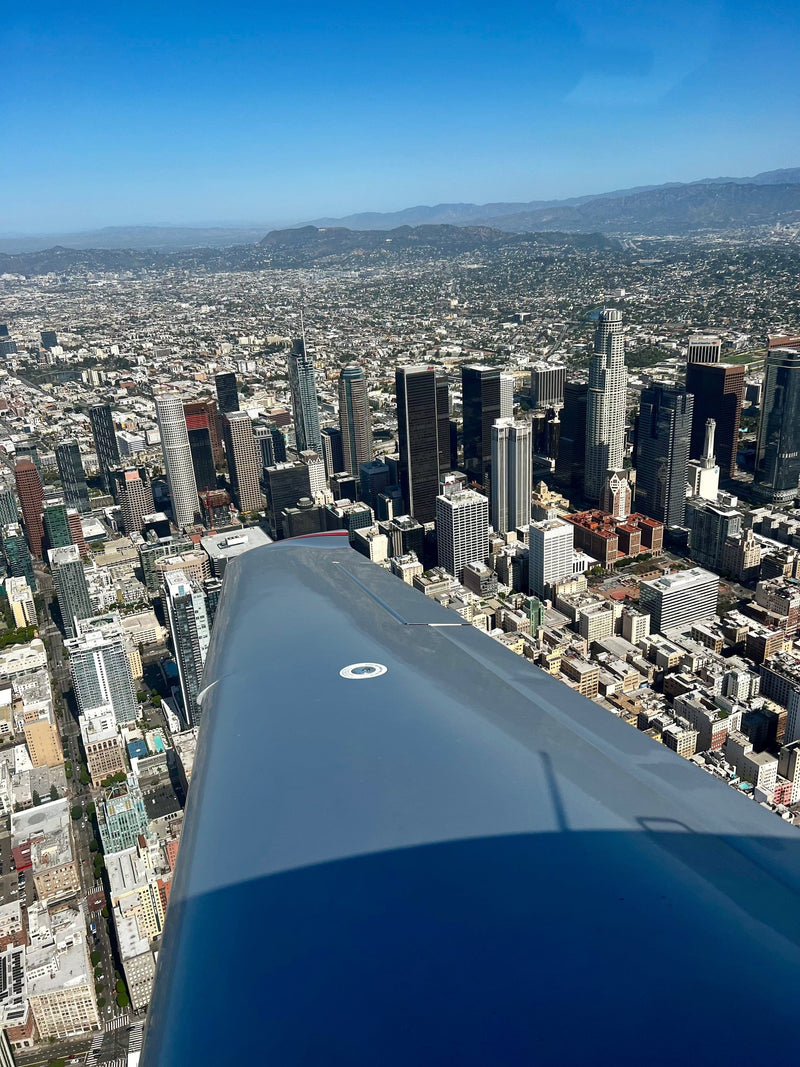
Van Nuys is a Class D field sitting directly under the Los Angeles Class B shelf, which means the first cross-country you fly involves a real conversation with a real controller rather than a self-announced departure into empty sky. Students who train in quiet airspace tend to find their first arrival into a busy terminal area alarming. Ours have been doing it since the third lesson.
The geography does the rest. Inside a 150-nautical-mile radius of Van Nuys there is coastline, a mountain pass, high desert at Lancaster and Palmdale, agricultural valley at Bakersfield, and an island at Catalina about 55 nautical miles offshore. That is four genuinely different flying environments and the density-altitude lesson at Big Bear, about 85 nautical miles east and at 6,750 feet of field elevation, sits inside the same radius.
And the weather cooperates more than it does almost anywhere else. We counted twelve months of NOAA hourly observations at Van Nuys against a 3,000-foot ceiling and 5 statute miles of visibility and found 355 usable days a year. Cross-country flights are the ones most often canceled by weather at other schools, because they need good conditions at both ends and in the middle. Here they mostly happen when they are booked.

Aircraft, instructor, ground school, simulator time and books are all included, and the cross-country hours are part of the package rather than an extra.
40 logged hours, the 14 CFR 61.109 minimum, including all the dual and solo cross-country the regulation requires.
60 logged hours. The extra twenty are mostly spent on cross-country work, which is where the difference between a license and a usable license actually lives.
The same cross-country syllabus flown in the Cirrus SR22 Turbo, which changes what a 150-nautical-mile flight feels like more than any other variable.
Start with an hour. A discovery flight is logged as dual instruction under 14 CFR 61.51, counts toward the 40 hours in 14 CFR 61.109, and the full price comes off any private pilot program if you enroll within 24 hours.
Enrolled students fly single-engine aircraft at $179 an hour, wet. That is the only hourly figure we publish. Financing from $2,500 down.
Three things repeat across our reviews on Google.
The most repeated compliment is about the twenty minutes at the table before the engine starts. On a cross-country day that briefing is most of the value.
Eleven instructors and a fleet we own outright. Cross-country flights need a long aircraft booking, and those are the first to disappear at a school that rents its fleet.
You enroll at $10,900 and you finish at $10,900. The cross-country hours are inside that, not billed on top of it.
A $229 discovery flight from Van Nuys puts you at the controls with a CFI as pilot in command under 14 CFR 91.3(a). The hour is logged as dual instruction and counts toward the 40 hours in 14 CFR 61.109, and the full price comes off any private pilot program if you enroll within 24 hours. Call (818) 290-8249 or book a free consultation and we will walk you through the whole syllabus.
A flight that includes a point of landing at least a straight-line distance of more than 50 nautical miles from the original point of departure, flown in an appropriate aircraft, using pilotage, dead reckoning, electronic navigation aids, radio aids or other navigation systems. That is the definition in 14 CFR 61.1(b), and it is the reason a two-hour flight to a field 40 nautical miles away logs no cross-country time.
Eight hours in total for an airplane single-engine rating: 3 hours of dual cross-country training under 14 CFR 61.109(a)(1) and 5 hours of solo cross-country under 61.109(a)(5)(i). On top of that sit the specific flights — the night cross-country over 100 nautical miles and the 150-nautical-mile long solo.
14 CFR 61.109(a)(5)(ii) requires one solo cross-country flight of at least 150 nautical miles total distance, with full-stop landings at three points, and one segment of the flight consisting of a straight-line distance of more than 50 nautical miles between the takeoff and landing locations. From Van Nuys a common route is Fox Field at Lancaster, then Bakersfield, then home, about 177 nautical miles in total.
Not at the three points. The regulation requires full-stop landings at three points, so a touch and go at an intermediate airport does not satisfy 61.109(a)(5)(ii) for that flight. Touch and goes elsewhere on the trip are fine, they just do not count toward that requirement.
14 CFR 61.109(a)(2)(i) requires one dual night cross-country flight of over 100 nautical miles total distance. From Van Nuys, Santa Barbara and back is about 126 nautical miles and is the route most of our students fly for it. The same night training block also requires 10 takeoffs and 10 landings to a full stop, each involving a traffic pattern.
Yes. Under 14 CFR 61.93 an instructor must review your planning for the specific flight and endorse your logbook before you go, and a separate endorsement covers repeated flights over a route within 50 nautical miles of the departure airport. Diverting to an unendorsed airport is a regulatory issue as well as a logbook one.
Santa Barbara at about 63 nautical miles, Bakersfield at about 87, Fox Field at Lancaster at about 33, and Catalina at about 55 across water. Big Bear at about 85 nautical miles and 6,750 feet of field elevation is the density-altitude lesson. All of them are inside a comfortable training day.
Straight-line distance between the original point of departure and the point of landing. Route mileage does not count. A meandering 90-nautical-mile track that lands 45 nautical miles from where it started is not cross-country time for a private pilot certificate.
At least 8 of the 40 under 14 CFR 61.109, so about a fifth. In practice most students fly more, because cross-country flights are where the fuel planning, radio work and diversion decisions become instinctive rather than theoretical, and examiners can tell the difference.
Yes. The Standard program at $10,900 includes 40 logged hours and the Comprehensive at $15,900 includes 60, with the cross-country flights inside those totals. Enrolled students fly single-engine aircraft at $179 an hour, wet, and there is no separate charge for a longer booking.
The three private pilot packages, what each one includes, the financing options and a realistic timeline built around how often you can actually fly. Sent to you in one email. Nobody will pressure you.
Loved On Google
Every review below is real and shown verbatim, in the reviewer’s own words — written by the people who learned to fly here, not by us.
SAFETY FIRST
Very safety and detail oriented. Pre-flight briefing explained everything there was. To my knowledge, this flight school is exceptional in their ability.
 DISCOVERY FLIGHT
I recently had the chance to take my first-ever discovery flight, and it was nothing short of amazing! From the moment I stepped into the cockpit, the...
 SUNSET CIRRUS
It was a great flight! I did a sunset flight and Alex let us fly an awesome. Website was easy to book, and the plane itself was really fun to fly...
 FLYING LESSON
We had a great flying lesson with Ralph and came away with a much better understanding of both the aircraft and the principles of flight. Ralph is a...
 KIDS LUXURY FLIGHT
I got 2 luxury discovery flights for my kids. I wanted them to have the experience of flying. Our instructor Alex was amazing he made sure they feel...
 HONEYMOON SURPRISE
Last minute booking to surprise my wife on our honeymoon. She had no experience with flying and was scared of flying, but Alex was very easygoing and knew...
 FULL-MOTION SIM
Amazing flight school in van nuys airport. I have been a student here for the past few months and i could not be happier. I started doing a lot of...
 DISCOVERY FOR TWO
I booked a Discovery Flight for Two for my girlfriend's birthday and it was the perfect gift for her. She couldn't have been more excited to get to...
 SIMULATORS
Very professional and great airplanes. I love the flight simulators. The pricing is very fair compared to any other flight school
 TEEN FIRST LESSON
We gifted our teenage son his first flying lesson. He was so excited! Alex greeted us and gave a reassuring brief that made us all feel comfortable and at...
 FIRST-TIME FLYER
Flying is my husband's hobby and I was incredibly anxious and apprehensive about the discovery flight. However, I felt completely safe and at ease once we...
SAFETY FIRST
Very safety and detail oriented. Pre-flight briefing explained everything there was. To my knowledge, this flight school is exceptional in their ability.
DISCOVERY FLIGHT
I recently had the chance to take my first-ever discovery flight, and it was nothing short of amazing! From the moment I stepped into the cockpit, the...
SUNSET CIRRUS
It was a great flight! I did a sunset flight and Alex let us fly an awesome. Website was easy to book, and the plane itself was really fun to fly...
FLYING LESSON
We had a great flying lesson with Ralph and came away with a much better understanding of both the aircraft and the principles of flight. Ralph is a...
KIDS LUXURY FLIGHT
I got 2 luxury discovery flights for my kids. I wanted them to have the experience of flying. Our instructor Alex was amazing he made sure they feel...
HONEYMOON SURPRISE
Last minute booking to surprise my wife on our honeymoon. She had no experience with flying and was scared of flying, but Alex was very easygoing and knew...
FULL-MOTION SIM
Amazing flight school in van nuys airport. I have been a student here for the past few months and i could not be happier. I started doing a lot of...
DISCOVERY FOR TWO
I booked a Discovery Flight for Two for my girlfriend's birthday and it was the perfect gift for her. She couldn't have been more excited to get to...
SIMULATORS
Very professional and great airplanes. I love the flight simulators. The pricing is very fair compared to any other flight school
TEEN FIRST LESSON
We gifted our teenage son his first flying lesson. He was so excited! Alex greeted us and gave a reassuring brief that made us all feel comfortable and at...
FIRST-TIME FLYER
Flying is my husband's hobby and I was incredibly anxious and apprehensive about the discovery flight. However, I felt completely safe and at ease once we...
Reviews shown verbatim, exactly as each reviewer published them.
Aviation News
Notes from the flight line at Van Nuys — weather, regulation changes, checkride questions and the cost of training, written up as they come.
Open 7 days · 9:00 AM – 9:00 PM
Los Angeles Flight School