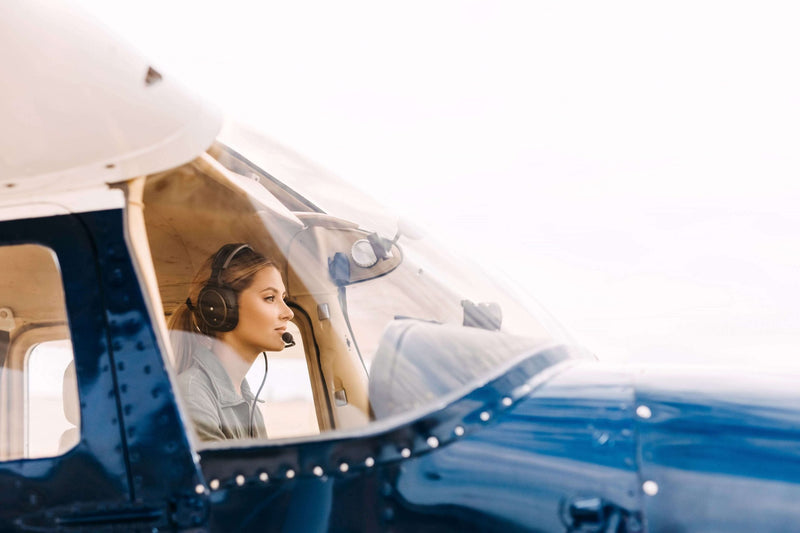
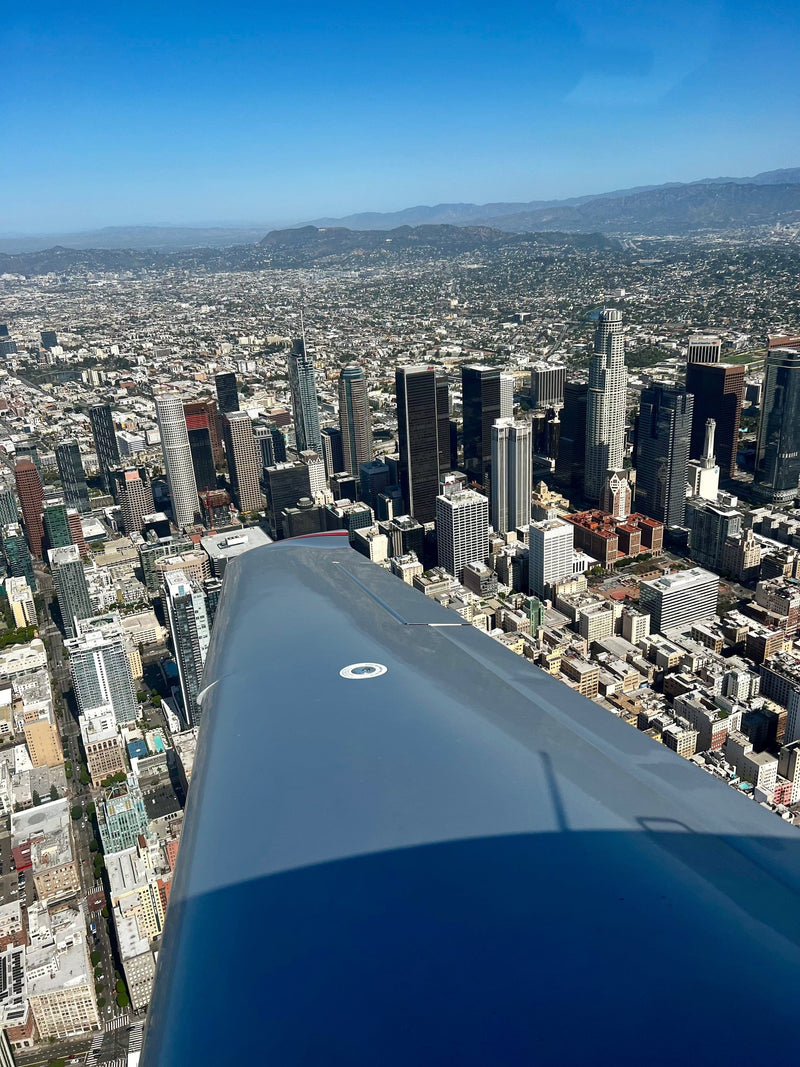
Training aircraft on a cross-country flight above the San Fernando Valley near Van Nuys Airport
Flight training near me

Flight Training Near Me: How to Pick a Flight School in Los Angeles

Nine airports in the LA basin run primary flight training, and the one closest to your house is usually not the one you should pick. Here is what each field is actually like, the four things that decide what you spend, and the questions to ask before you hand anybody a deposit.

Call (818) 290-8249
Van Nuys Airport (KVNY)Part 61 · aircraft we own$179/hr package rate~300 flyable days a year
9LA-basin airports where you can realistically learn to fly
$10,900standard private pilot program, 40 hours logged
11flight instructors on staff at Van Nuys
4.9★500+ reviews across Google and Yelp
The honest map

Where flight training actually happens in the LA basin

Nine fields inside roughly an hour of central Los Angeles teach primary students. They are not interchangeable. Runway length, tower hours, terrain and the marine layer change what a lesson looks like before anybody quotes you a price.

Type "flight training near me" into a search box and you get a list sorted by distance from your phone. That list tells you nothing useful. It does not tell you which fields have a runway long enough to be forgiving on your first ten landings, or which ones are socked in until eleven in the morning for six weeks every June. So here is the geography, written straight — no school names, just fields.

AirportWhat kind of field it isWhat training there is like
Van Nuys (KVNY)Class D, parallel runways at 8,003 ft and 4,011 ft, tower staffed around the clockBusy — one of the highest-volume general aviation airports in the world. You learn real radio work by your third lesson because there is no alternative, and the LAX Class B shelf sits overhead, so airspace stops being a chapter in a book.
Whiteman (KWHP)Class D, single 4,120 ft runway, part-time tower, PacoimaSmall and close-in, with rising terrain to the north. Quiet pattern most of the day. When the tower closes you are announcing on CTAF, which is good training — most students never touch a non-towered field until their cross-countries.
Santa Monica (KSMO)Class D, 3,500 ft runway since the 2017 shortening, closure agreed for after 2028Beautiful location, short runway, finite future. The coastal marine layer parks on it through late spring. A fine place to fly, a strange place to start a two-year training plan.
Burbank (KBUR)Class C, full airline operationYou are sequenced behind regional jets, which is excellent for learning Class C procedures and expensive for pattern work. Hold-short time is Hobbs time. Primary students end up doing their maneuver training somewhere else anyway.
Long Beach (KLGB)Class D, five runways, one of the strictest noise ordinances in the countryHigh training volume with multiple runways in use at once, so the sequencing is complex from day one. The noise rules are enforced, not decorative, and they shape where you can practise.
Camarillo (KCMA)Class D, 6,013 ft runway, Ventura CountyWide, calm and easy on the nerves, with plenty of practice area to the north. The trade is a marine layer that often burns off later there than over the Valley, plus the drive if you live inland.
El Monte (KEMT)Class D, 3,995 ft runway, San Gabriel ValleyShort runway with terrain close to the north. Summer density altitude is a daily fact rather than a theoretical exercise, which makes students trained there better at performance planning than most.
Torrance / Zamperini (KTOA)Class D, 5,001 ft main runway, two miles from the oceanThe marine layer is the schedule. Excellent crosswind practice and a pleasant field, but summer mornings get pushed more often than students expect when they sign up in October.
Fullerton (KFUL)Class D, 3,121 ft runway, north Orange CountyThe shortest paved runway of the group, so short-field technique is not an optional endorsement lesson — it is every landing. Dense traffic and a lot of other training aircraft.

Runway lengths and airspace classes as published. Conditions change; check current charts and NOTAMs before you plan anything around them.

Take this seriously

"Nearest" is the wrong filter, and it is not close

A flight lesson is a three-hour commitment. Thirty minutes of preflight and briefing, roughly ninety minutes on the Hobbs, then a debrief you should not be rushing. Add the drive and you have blocked out most of a morning either way.

So when you compare a school twenty minutes away against one forty minutes away, you are arguing over twenty extra minutes each way against a three-hour block. That is the entire case for the closer school. It is a weak case.

Here is the strong case on the other side. A school with four aircraft and sixty active students will cancel you — an annual runs long, a magneto fails a run-up, an instructor takes an airline class date. You lose two weeks, and the next lesson starts with re-teaching the maneuver you had almost owned.

That is the number that matters. Twenty minutes of driving costs you twenty minutes. A cancelled lesson costs you a lesson, and a two-week gap costs you a third of the next one.

Flight instructor briefing a student beside a training aircraft on the ramp at Van Nuys Airport
Where the money goes

Four things decide what flight training costs you — and none of them is the hourly rate

People shop this decision on the posted rate. The posted rate is the least predictive number on the page. These four are the ones that move your final bill by thousands.

01

How often you actually fly

FAR 61.109 sets the private pilot minimum at 40 hours. The national average is 60 to 75. The gap between those two numbers is almost entirely lesson frequency. Fly twice a week and each lesson starts where the last one ended. Fly twice a month and you spend the first twenty minutes of every flight re-learning steep turns.

02

Whether the school owns the aircraft

Some schools own and maintain their fleet. Others broker aircraft from private owners or a club and take a cut. Brokered aircraft get pulled for the owner's weekend, go down for maintenance on somebody else's timeline, and are the single most common reason a lesson evaporates the night before.

03

Packages versus metered pricing

A package is a price. An estimate is a hope. If a school quotes you an hourly figure and multiplies it by 40, you are being quoted the best possible outcome, and almost nobody finishes at 40 hours. Ask which one you are looking at, in those words.

04

Instructor continuity

Instructors who are building hours for an airline leave, usually with two weeks' notice, usually right as you are prepping for the checkride. A new instructor will spend two or three flights evaluating you before they sign anything. That is three to five hours you pay for twice.

The retraining tax

What flying twice a month really costs

This is the cost nobody quotes you, because it does not appear on any price list. It appears as extra hours at the end.

How often you flyWhere students typically finishExtra hours over the minimumAt the $179 package rate
Two lessons a weekClose to the 40-hour FAR 61.109 minimum0–5 hrsup to $895
One lesson a weekAround the 60-hour national average20 hrs$3,580
Two lessons a month75 hours is common, and some never finish35 hrs$6,265

Read that table again with the geography in mind. A student who picks the school ten minutes closer and then flies twice a month has saved forty minutes of driving per lesson and spent an extra $6,265 finishing. That is the trade almost everybody makes without noticing.

So pick the school where you can reliably get two slots a week with the same instructor, then organise your life around the drive. Weekend-only students are the ones who stall out.

Before you pay anyone

Six questions to ask any flight school, including this one

Ask these on the phone before you drive anywhere. The answers take four minutes to collect and will tell you more than an hour-long tour.

1

"How many aircraft do you own?"

Own, not access. Then ask how many active students. Four aircraft and eighty students is a scheduling problem you will be paying for. If the honest answer is "we broker them", that is not disqualifying, but it changes what a cancellation means.

2

"How many instructors are on staff?"

One or two instructors means one or two calendars, and your training moves at the speed of whoever is free. It also means a single resignation stops you cold. Ask how long the current instructors have been there.

3

"What happens if my instructor leaves?"

The right answer is a named process: your records transfer, another instructor picks you up within a week, and the transition flights are not billed as an evaluation. A vague answer here is the most expensive vague answer on this list.

4

"Is that price a package or an estimate?"

Say the word "estimate" out loud and watch what happens. A package names the hours it includes — 40 logged, 60 logged — and holds the price. An estimate is a multiplication you will be re-doing at hour 55.

5

"What is not included?"

Every school has exclusions. The FAA written exam, the examiner's fee for the practical test, your medical certificate and your headset are typically paid separately no matter where you train. You want them named up front, not discovered.

6

"Can I see the maintenance schedule?"

FAR 91.409(b) requires a 100-hour inspection on any aircraft used for instruction for hire. A school that runs a tight fleet will show you the squawk sheet without blinking. A school that hesitates has told you something.

The one real advantage of training here

About 300 flyable days a year, and that is the whole ballgame

Southern California gets roughly 300 days a year you can fly a training flight. A student in Chicago, Seattle or Boston is fighting icing, ceilings and crosswinds that shut down primary training for weeks at a time, and every one of those weeks is a skill you have to buy back.

It is why people fly out here for accelerated courses. If you already live in the San Fernando Valley, on the Westside, in Pasadena, Santa Clarita, the Conejo Valley or Ventura County, you have the best primary training weather in the country forty minutes from your door and you did nothing to earn it.

One real caveat: June gloom. Coastal fields sit under a marine layer that can hold until late morning through May and June. Inland Valley fields like Van Nuys clear earlier and more often, which is why so much of the region's primary training happens up here rather than by the water.

View over the wing of a training aircraft above downtown Los Angeles on a clear day
The fleet

Aircraft we own, inspected on our schedule

Not a broker's rental and not a club airframe with 12,000 hours on it that disappears every other weekend. These are ours. They are on this ramp at Van Nuys, they are maintained to our own schedule, and our instructors fly them every day.

Diamond DA20 training aircraft on the ramp at Van Nuys Airport
Diamond DA20 — bubble canopy, light controls, a favourite for early landing practice.
Piper Warrior training aircraft parked at Van Nuys Airport
Piper Warrior — stable, forgiving, and the aircraft most of our students solo in.
Cessna 162 Skycatcher light sport aircraft at Van Nuys Airport
Cessna 162 — the sport pilot trainer, and a cheap way to build stick and rudder.
Piper Arrow II complex single-engine aircraft at Van Nuys Airport
Piper Arrow II — retractable gear and constant-speed prop for commercial work.
Cirrus SR22 Turbo with glass cockpit at Van Nuys Airport
Cirrus SR22 Turbo — glass cockpit and CAPS whole-airframe parachute, flown on the Premium program.
Piper Seminole twin-engine training aircraft at Van Nuys Airport
Piper Seminole — the twin, for the multi-engine add-on later on.

Single-engine training on the Standard and Comprehensive programs is flown in the Cessna, Piper and Diamond aircraft. The Premium program is flown in the Cirrus SR22 Turbo.

Redbird MCX

The weather day that still counts as training

A full-motion, FAA-approved, fully enclosed simulator. On the two or three mornings a year the Valley genuinely does not cooperate, procedures, instrument scan, radio work and emergencies all happen anyway — and they transfer straight to the aircraft.

Simulator hours are built into every private pilot program — 2 hours on Standard and Premium, 5 hours on Comprehensive. Standalone sessions are $189.

Your instructor

Eleven instructors, so your training does not run on one person's calendar

Every instructor here holds a commercial or ATP certificate plus a CFI and a current medical, and is legally pilot in command on every flight you take. The responsibility for the aircraft is not on you until you solo, and after that only when they say so.

Eleven of them is the number that matters for scheduling. It means two lessons a week is something we can promise rather than hope for. It also means that if you and your instructor do not click, you change, and it takes one phone call.

We hire people who teach here as the job, not as a waiting room with a ramp attached. That is almost impossible to see from a website, so ask every school you call how long their instructors have been on staff.

Flight instructor and student wearing headsets in the cockpit of a training aircraft at Van Nuys
What people say

4.9 stars, 500+ reviews

Across Google, Yelp and the aviation forums, the same three things come up again and again — and none of them is the aircraft.

Instructors who actually teach

The most repeated compliment in our reviews is not the fleet and not the price. It is the debrief — the twenty minutes after shutdown where the lesson gets made.

Scheduling that holds

Eleven instructors and a fleet we own means lessons happen when we said they would. Reviewers who came from other schools mention this more than anything else.

Prices that do not move

The number you enroll at is the number you finish at. On a purchase this size, that is worth more than a discount.

Our answer, since you asked

What we are, in the same terms we just told you to use

LA Flight School is at 7900 Balboa Blvd, Suite 108A, Van Nuys, CA 91406, on Van Nuys Airport. Part 61, which means the syllabus flexes to your schedule instead of the other way round. We own and maintain our aircraft. We have eleven instructors on staff.

Private pilot training is sold as three packages — $10,900, $15,900 and $22,500 — not as an hourly estimate, and the package rate works out to $179 an hour, wet, single-engine. Financing starts at $2,500 down. We are open 9am to 9pm, seven days, because people with jobs need evening slots.

We serve the whole San Fernando Valley, the Westside, Pasadena, Santa Clarita, the Conejo Valley and Ventura County. If you are forty minutes out, you are well inside the group of students who finish here on time.

Start with a $229 discovery flight. It is a real lesson — you fly the aircraft from the left seat, the time is loggable dual instruction, and the full $229 is credited against any program if you enroll within 24 hours. Nobody will ask you to commit to anything on the ramp.

Cirrus SR22 on the ramp at Van Nuys Airport at sunset
Pricing

Private pilot programs — the price is the price

Each one names the hours it includes and holds the number. Books and training materials are in. Financing from $2,500 down, with monthly plans.

Standard Private Pilot

$10,900 · 40 hrs logged

The efficient path if you can fly twice a week and you want the certificate without extras.

  • Single-engine (Cessna · Piper · Diamond)38 hrs
  • Redbird full-motion simulator2 hrs
  • Dual flight instruction30 hrs
  • Ground school3 hrs
  • Books & training materialsIncluded
Most chosen

Comprehensive Private Pilot

$15,900 · 60 hrs logged

Built around the 60-hour national average rather than the legal minimum. This is the one most people should buy.

  • Single-engine (Cessna · Piper · Diamond)55 hrs
  • Redbird full-motion simulator5 hrs
  • Dual flight instruction50 hrs
  • Ground school10 hrs
  • Books & training materialsIncluded

Premium Private Pilot

$22,500 · 40 hrs logged

Flown entirely in the Cirrus SR22 Turbo with a full glass cockpit and the CAPS airframe parachute.

  • Cirrus SR22 Turbo (glass cockpit)38 hrs
  • Redbird full-motion simulator2 hrs
  • Dual flight instruction30 hrs
  • Ground school3 hrs
  • Books & training materialsIncluded
Other programs at Van NuysPrice
Discovery flight — a real logged lesson, credited in full on enrollment within 24 hours$229
Sport Pilot certificate$8,400
Solo Certificate$5,500
Teen program, ages 10–15$4,200
Instrument Rating$11,700
Multi-engine add-on (Piper Seminole)$5,100
Redbird MCX simulator session$189
Zero-to-airline career program$89,000
Package flight rate, wet, single-engine$179 / hr
$500 off any private pilot program this summer. Standard $10,400 · Comprehensive $15,400 · Premium $22,000. Ask when you enroll.
Next step

Fly one lesson before you choose anything

You will learn more about a flight school in ninety minutes on the ramp and in the air than in a week of reading. Take the controls, watch how the instructor teaches, look at the aircraft, then decide. The $229 comes straight back off your program if you enroll within 24 hours.

Discovery Flight For One
$229
60 minutes · you fly the aircraft · loggable dual instruction · credited in full on enrollment within 24 hours
7900 Balboa Blvd, Suite 108A, Van Nuys, CA 91406 · (818) 290-8249 · 9am–9pm, 7 days
FAQ

Flight training near me — the questions people actually ask

Straight answers with real numbers, for anyone comparing flight schools in Los Angeles.

The best school near you is the one that can put you in an aircraft twice a week with the same instructor, not the one with the shortest drive. Ask any school how many aircraft it owns and how many instructors are on staff before you compare prices. We fly out of Van Nuys Airport (KVNY) with 11 instructors and a fleet we own and maintain, and private pilot packages are $10,900, $15,900 and $22,500.

A private pilot certificate in Los Angeles costs $10,900 for our Standard program with 40 hours logged, $15,900 for the Comprehensive program with 60 hours logged, or $22,500 for the Premium program flown in a Cirrus SR22 Turbo. The package flight rate works out to $179 an hour, wet, in a single-engine aircraft. Financing starts at $2,500 down. Beware any quote given as an hourly figure multiplied by 40 hours — that is an estimate, not a price.

Ask six questions on the phone: how many aircraft do you own, how many instructors are on staff, what happens if my instructor leaves, is that price a package or an estimate, what is not included, and can I see the maintenance schedule. FAR 91.409(b) requires a 100-hour inspection on any aircraft used for instruction for hire, so a well-run school will show you its records without hesitating. Those answers take four minutes to collect and predict your total cost better than any hourly rate.

The hourly rate is often lower in a small town, but the total is frequently higher because the weather cancels you. Southern California gives you roughly 300 flyable days a year, while students in the Midwest and Northeast lose whole weeks to ceilings and icing, and every lost week costs re-learning time. At $179 an hour, 20 extra hours of retraining is $3,580 — more than most rate differences will ever save you.

Up to about 45 minutes is fine, and most of our students come from that far out. A flight lesson is roughly a three-hour commitment once you count the preflight brief, 1.5 hours on the Hobbs and the debrief, so 20 extra minutes each way is a small share of the day. Aircraft availability and instructor turnover cost you far more than the drive ever will.

No. You need to be able to reach the airport twice a week, which is a scheduling question rather than a distance question. Our students come from across the San Fernando Valley, the Westside, Pasadena, Santa Clarita, the Conejo Valley and Ventura County, and we run lessons 9am to 9pm seven days a week so people with jobs can fly on weekday evenings.

Nine fields in the LA basin realistically support primary training: Van Nuys (KVNY), Whiteman (KWHP), Santa Monica (KSMO), Burbank (KBUR), Long Beach (KLGB), Camarillo (KCMA), El Monte (KEMT), Torrance/Zamperini (KTOA) and Fullerton (KFUL). They differ enormously — runways stretch from 3,121 ft at Fullerton to 8,003 ft at Van Nuys, and coastal fields lose mornings to the marine layer that inland fields keep.

Van Nuys Airport is the Valley's training field and the busiest general aviation airport in the region. We are at 7900 Balboa Blvd, Suite 108A, Van Nuys, CA 91406, on the field, open 9am to 9pm seven days a week. Call (818) 290-8249 or book a $229 discovery flight and fly the aircraft yourself before you commit to anything.

Flying twice a week, most students reach the private pilot checkride in four to six months. FAR 61.109 sets the legal minimum at 40 hours of flight time and the national average is 60 to 75 hours, and the difference between those numbers is almost entirely lesson frequency. Students who fly twice a month commonly need 75 hours, which is 35 extra hours — $6,265 at the $179 package rate.

A discovery flight is a real first lesson, not a sightseeing ride: you fly the aircraft from the left seat with an instructor beside you, and the time is loggable dual instruction that counts toward your certificate. Ours is $229 for 60 minutes, and the full amount is credited against any program if you enroll within 24 hours. It is the cheapest way to judge a flight school, because you see the aircraft, the instructor and the briefing before you spend $10,900.

Part 61 is fine for almost everyone, and it is what we operate under. Part 141 uses an FAA-approved syllabus with a fixed order and can reduce the private pilot minimum to 35 hours, which matters mainly for full-time students and certain visa or veterans' benefit situations. Part 61 lets the syllabus flex around your work schedule, and since the national average is 60 to 75 hours either way, the 5-hour difference in the minimum rarely changes what you actually spend.

No cost, no obligation

Get the full training plan and price sheet

The three private pilot packages, what each one includes, the financing options and a realistic timeline built around how often you can actually fly. Sent to you in one email. Nobody will pressure you.

  • Every package price, itemised
  • Financing from $2,500 down
  • A timeline based on your schedule

One email. Opt out any time.