SAFETY FIRST
★★★★★
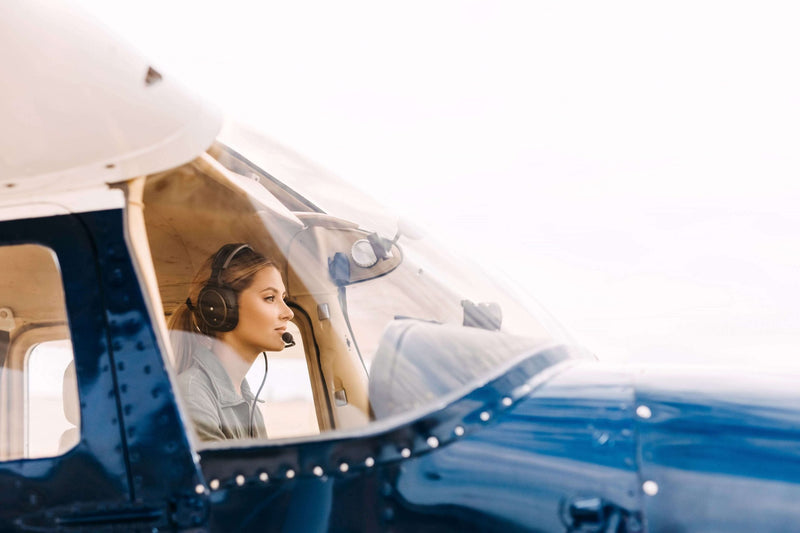
Very safety and detail oriented. Pre-flight briefing explained everything there was. To my knowledge, this flight school is exceptional in their ability.

We measured it: 355 days a year at Van Nuys meet the ceiling and visibility a school will send a student up in. That is roughly eleven months of usable weather, in Class D airspace tucked under the LAX Class B shelf, eleven miles from the coast and forty from the desert. This page is about what training in Southern California actually gives you, and what it costs.
Californians who want to fly get told the state is a good place to learn and left to work out the rest. It is a good place to learn. It is also 800 miles long, and the half you pick decides how many lessons you fly in a year.
We train at Van Nuys, in the San Fernando Valley, and everything on this page is written from that ramp. The valley sits inland of the coastal marine layer that shuts down beach airports on summer mornings, and it sits south of the winter systems that take weeks out of a training schedule further north. That is not marketing. It is the difference between 355 usable days and 277.
Our honest position on the rest of the state: if you live in Northern California, train in Northern California. Nobody should commute four hundred miles to a flight lesson. What we can tell you about is Southern California, where we fly every day, and where the airspace and the weather do more of the teaching than any school does.

Twelve months of NOAA ASOS observations at fifteen training airports, 1 August 2025 to 1 August 2026, using a 3,000 ft ceiling and 5 statute miles of visibility — the threshold most schools apply to student solo and early dual.
| Airport | Flyable days per year |
|---|---|
| Van Nuys, CA (KVNY) | 355 |
| Burbank, CA (KBUR) | 356 |
| Phoenix Deer Valley, AZ | 356 |
| Kissimmee, FL | 355 |
| Santa Monica, CA (KSMO) | 343 |
| Whiteman, CA (KWHP) | 334 |
| Torrance, CA (KTOA) | 332 |
| Everett, WA | 278 |
| Hillsboro, OR | 277 |
Full method, raw tables and all fifteen airports are published in our flyable days flight training study. Van Nuys also met basic VFR minimums of 1,000 ft and 3 statute miles on 363 days.
Here is the thing the day count hides. A California flight school loses almost no whole days to weather. What it loses is mornings.
In June at Van Nuys, only 40% of 7am observations met training minima. By 11am that is 93%, and from 1pm onward it runs 97 to 100%. The marine layer burns off; it does not linger. The same June morning at Santa Monica, eleven miles closer to the water, is worse and stays worse for longer — in August at 7am, Van Nuys read 84% against Santa Monica’s 48%.
So the practical advice for anyone learning to fly in Southern California is boring and specific: book afternoons from May through July, and stop treating a scrubbed dawn lesson as bad luck. It is a pattern, it is predictable, and you can schedule around it. Students who insist on 7am slots in June are the ones who tell us the weather canceled half their training.
Compare that to a school in the Pacific Northwest, where a front parks over the field for five days and there is no hour of the day that helps. That is the argument for California, and it is a stronger argument than sunshine.
Van Nuys is a Class D field beneath the LAX Class B shelf, and it is one of the busiest general aviation airports in the world. On a normal Tuesday you are sequenced between a Citation, a helicopter and three other trainers, and the tower expects you to keep up.
That is uncomfortable for about six lessons. Then it becomes the single most valuable thing about training here. A pilot who learned at a quiet uncontrolled strip in the Central Valley has to go and get comfortable with towers later, usually badly and usually alone. A pilot who learned at Van Nuys walks into any tower in the country and it is the same job, just slower.
The airspace itself is the syllabus. Class B overhead. Class C at Burbank and Point Mugu. Class D at Van Nuys, Whiteman, Camarillo and Santa Monica. Class E and Class G within twenty minutes. The LAX Mode C veil sits over all of it, which means you learn transponder and ADS-B rules as a matter of routine rather than as a written-test question.
If you want the regulations rather than the anecdote, we wrote them out: airspace classes explained, with the entry requirements and the cloud clearances in a table.

Everything here is inside 150 miles of the ramp, which means it fits a training flight rather than a holiday. The variety is the point: most students in flat, uniform terrain never fly anything that is not their home airport with a different runway number.
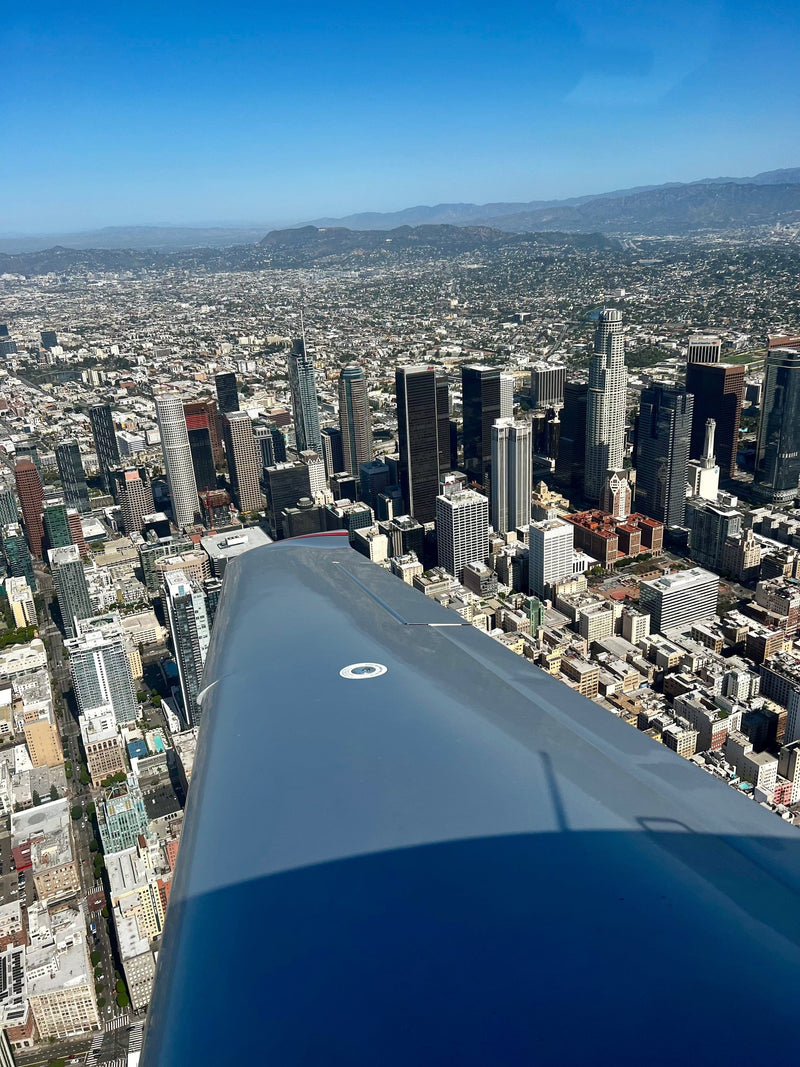
Camarillo, Oxnard, Santa Barbara and Catalina. Over-water legs, a real island approach, and the marine layer to respect. Catalina’s runway sits on a plateau with a displaced threshold and drop-offs at both ends.
Palmdale, Mojave and Apple Valley across the San Gabriels. Density altitude on a summer afternoon at 2,800 feet elevation teaches performance charts faster than any classroom.
Big Bear at 6,752 feet, an hour from the ramp. Mountain flying, canyon wind and a runway that behaves nothing like Van Nuys.
For the flying, yes, and the weather data supports it rather than the marketing. For the cost, no — and anyone telling you otherwise is selling.
California is expensive. Fuel is expensive, hangarage is expensive, insurance is expensive, and instructors have to live here. A private pilot certificate in rural Oklahoma will cost less. What you get for the difference is more flyable days, harder airspace and terrain variety that would take a Midwest student a cross-country trip to reach.
The honest way to think about it: you are not paying more per hour so much as needing fewer calendar months. A student who flies twice a week in Los Angeles and rarely cancels finishes faster than a student who books twice a week somewhere with 277 usable days and flies once. Currency is the whole game in flight training. Hours you fly in a gap-free run are worth more than the same hours spread over two years, because you stop re-learning what you already paid to learn.
The other thing nobody mentions: California has a very large used-aircraft market, a lot of maintenance capacity and more designated examiners than most states. Checkride scheduling here is a nuisance rather than a crisis.
California does not issue pilot licenses and never has. Pilot certificates are issued by the Federal Aviation Administration under 14 CFR Part 61, and a certificate issued in California is valid in all fifty states, in exactly the same way a certificate issued in Ohio is valid here.
The authority sits in federal law. The FAA Administrator issues airman certificates under 49 U.S.C. 44703, and no state licenses pilots. That is why nobody at a California agency can help you with a pilot certificate, and why a search for a “California pilot license” turns up flight schools rather than a state office.
A private pilot certificate also has no expiry date printed on it. What lapses is currency, not the certificate: a flight review every 24 calendar months under 14 CFR 61.56, three takeoffs and landings in the preceding 90 days before you may carry passengers under 14 CFR 61.57, and a medical certificate with its own validity period under 14 CFR 61.23.
California does regulate aviation — just not pilots. The state’s role runs to airports and heliports, through the Caltrans Division of Aeronautics, and to aircraft registration and property tax. None of it touches what is in your wallet after a checkride.
So when somebody searches for a pilot license in California, they usually want one of two things: where to train, or what the FAA route actually looks like. The next two sections are the second one.
Six steps, in this order. Doing them out of order is the most common and most expensive mistake in flight training.
You get a pilot license in California the same way you get one anywhere in the United States: a student pilot certificate, a medical, flight training with a certificated instructor, a written knowledge test, and a practical test with an FAA examiner. The eligibility rules for a private pilot certificate are in 14 CFR 61.103 and the flight-hour requirements are in 14 CFR 61.109.
Nothing on that list is Californian. What California changes is how quickly you can get through it, because 355 flyable days a year and eleven instructors mean the calendar stops being the obstacle.
A $229 discovery flight is a real lesson: you fly from the left seat and the hour is loggable dual instruction. If you enroll within 24 hours the full price comes off the program. Do this before you spend anything else.
Under 14 CFR 61.23 you need at least a third-class medical to exercise student pilot privileges in an airplane, issued by an FAA-designated aviation medical examiner. Get it early. Finding out about a medical issue after you have paid for thirty hours is the worst order to do this in. The sport pilot route does not require one.
14 CFR 61.83 sets the bar: at least 16 years old for airplanes, and able to read, speak, write and understand English. You apply through IACRA with your instructor, and student pilot certificates issued since 2016 do not expire.
Before you fly alone your instructor gives you a pre-solo knowledge test and an endorsement under 14 CFR 61.87. Most students at Van Nuys solo somewhere between 15 and 25 hours, and the ones who fly twice a week solo sooner than the ones who fly twice a month.
Sixty questions on the private pilot airplane test, and 70% is a pass. You need an instructor endorsement to sit it, and the result must be current within the 24 calendar months preceding your practical test under 14 CFR 61.39. Take it early rather than late.
An oral examination and a flight test with a designated pilot examiner, against the FAA Airman Certification Standards. 14 CFR 61.103 requires you to be at least 17 years old to hold a private pilot certificate. Pass, and the certificate is federal and permanent.
Most people who fly two to three times a week finish a private pilot certificate in five to eight months. Our Standard program is $10,900 for 40 logged hours and the Comprehensive is $15,900 for 60, and the Comprehensive is what most students actually choose, because 60 hours is where the national average lands rather than the 40-hour legal floor in 14 CFR 61.109.
The expensive mistake is not the hourly cost. It is stopping. Every month you do not fly, you arrive at the next lesson having lost skills you already paid to acquire, and your instructor spends the first half of the hour rebuilding them. Two lessons a week for four months costs less than one lesson a week for a year, even though the second sounds gentler on a budget. This is the single most useful thing anybody will tell you about learning to fly.
The second mistake is booking dawn slots in June. Only 40% of 7am June observations at Van Nuys meet training minima, against 97 to 100% from 1pm. Book the afternoon, and put the mornings you lose into the Redbird MCX instead, which does not have a ceiling.
Two practical points people miss. Financing starts at $2,500 down, so the whole program does not need to be in the bank on day one. And if you are not a US citizen or permanent resident, you must have TSA approval through the Alien Flight Student Program under 49 CFR Part 1552 before flight training begins — start that early, because it is a queue rather than a formality.
The full cost breakdown, including what is not in the program price, is on our private pilot license cost page and the pilot training cost guide.
These are the numbers, not estimates. Aircraft time inside a program is billed at $179 an hour, wet, single-engine. Financing starts at $2,500 down.
| Program | Price | What it covers |
|---|---|---|
| Sport Pilot | $8,400 | The fastest legal route to flying as pilot in command |
| Private Pilot — Standard | $10,900 | 40 logged hours, 2 hours Redbird, 3 hours ground, books included |
| Private Pilot — Comprehensive | $15,900 | 60 logged hours, 5 hours Redbird, 10 hours ground — most chosen |
| Private Pilot — Premium | $22,500 | 40 logged hours flown in the Cirrus SR22 Turbo, glass cockpit |
| Instrument Rating | $11,700 | The rating that makes a California certificate useful under a marine layer |
| Multi-Engine add-on | $5,100 | Flown in the Piper Seminole |
| Solo Certificate | $5,500 | Through first solo |
| Teens, ages 10–15 | $4,200 | Structured program for younger students |
| Zero to airline | $89,000 | Full professional track, private through the ratings |
| Redbird simulator session | $189 | Full-motion, FAA-approved, never canceled for weather |
A fuller breakdown of every fee sits on our pilot training cost page and the flight school cost in Los Angeles guide.
A $229 discovery flight is a real lesson. You fly the aircraft from the left seat and the hour is loggable dual. If you enroll within 24 hours the full price comes off the program.
A third-class medical from an aviation medical examiner and a student pilot certificate through IACRA. Foreign nationals need TSA approval before training starts.
The 40-hour minimum in 14 CFR 61.109 is a legal floor, not a forecast. The national average sits between 60 and 75 hours. Flying twice a week is what keeps you near the bottom of that.
Solo usually lands between 15 and 25 hours. Cross-countries take you to Camarillo, Santa Barbara and Big Bear. Then the written, the oral and the flight test with a designated examiner.
Every aircraft on this ramp is ours. We own them, we maintain them, and 14 CFR 91.409(b) puts them on a 100-hour inspection cycle because they are used for instruction for hire.


Single-engine training on the Standard and Comprehensive programs is flown in the Cessna, Piper and Diamond aircraft. The Premium program is flown in the Cirrus SR22 Turbo.
Forty percent of 7am June slots at Van Nuys are below training minima. A full-motion Redbird MCX does not care what the ceiling is.
Simulator hours are built into every private pilot program — 2 hours on Standard and Premium, 5 hours on Comprehensive. A standalone session is $189.
Every instructor here holds a commercial or ATP certificate plus a CFI and a current medical, and is legally pilot in command on every flight you fly with them. That is the boring, important part.
The part that affects you is scheduling. A two-instructor school means one person’s holiday is your lost month. Eleven means a booked lesson gets flown. You are matched to an instructor at the start and you can change if the fit is wrong — ask, and nobody will take it personally.
They teach here as a career rather than as a waiting room for an airline class date. It shows most in the debrief, which is the thing our Google reviewers mention more than the aircraft or the price.

Over 120 reviews on Google, all of them five stars, and the same three things come up again and again.
The most repeated line in our Google reviews is about the debrief after the flight, not the airplane.
Eleven instructors and a fleet we own and maintain. A booked Saturday morning stays a booked Saturday morning.
The price you enroll at is the price you finish at. Reviewers mention this more than they mention the flying.
Every option below has two doors. Book it now, or book a free consultation and ask the awkward questions first. Both go to the same people.
A real lesson with your hands on the controls, over the Valley and the coast. Loggable as dual instruction.
40 logged hours in the Cessna, Piper or Diamond. Where most California students start.
60 logged hours, which is where the national average actually lands. The realistic option.
The certificate flown in the Cirrus SR22 Turbo, with Perspective glass and the CAPS airframe parachute.
In California this is not a luxury. It is what makes your certificate work on a marine-layer morning.
The shortest legal route to acting as pilot in command. Fewer privileges, fewer hours, less money.
Multi-engine add-on $5,100 · Solo Certificate $5,500 · Teens 10–15 $4,200 · zero to airline $89,000. Financing from $2,500 down.
Sixty minutes, hands on the controls, and the hour goes in a logbook as dual instruction. $229, credited in full against any program if you enroll within 24 hours. If you would rather sit down and go through the numbers before you fly anything, the consultation is free and there is no pitch attached to it.
Our published California program prices are $10,900 for the Standard private pilot course with 40 logged hours, $15,900 for the Comprehensive course with 60 logged hours, and $22,500 for the Premium course flown in a Cirrus SR22 Turbo. Aircraft time inside a program is $179 an hour, wet, single-engine. Financing starts at $2,500 down.
For flying conditions, it is among the best in the country. We measured twelve months of NOAA observations at Van Nuys Airport and found 355 days a year met a 3,000 ft ceiling and 5 statute miles of visibility, against 277 at Hillsboro, Oregon and 278 at Everett, Washington. California costs more per hour than the Midwest, but you lose far fewer lessons to weather.
355 at Van Nuys Airport, measured over the twelve months to 1 August 2026 using a 3,000 ft ceiling and 5 statute miles of visibility. 363 days met basic VFR minimums of 1,000 ft and 3 statute miles. Nearby fields ran lower: Santa Monica 343, Whiteman 334, Torrance 332.
Afternoons from May through July. In June at Van Nuys only 40% of 7am observations met training minima, rising to 93% by 11am and 97 to 100% from 1pm. The marine layer burns off rather than lingering, so the constraint on California training is the hour of the day, not the season.
Pick by airspace, fleet ownership and instructor depth rather than by hourly rate. Train where the airspace is busy enough to teach you radio work, where the school owns and maintains its own aircraft, and where there are enough instructors that one person's holiday does not cost you a month. We train at Van Nuys, a Class D field under the LAX Class B shelf, with eleven instructors and a fleet we own.
Most students who fly two to three times a week finish a private pilot certificate in five to eight months. The legal minimum is 40 hours under 14 CFR 61.109; the national average sits between 60 and 75 hours. California's 355 flyable days mean the limiting factor is usually how often you can get to the airport, not the weather.
No. Students drive in from across Ventura County, the San Fernando Valley, the Westside, Santa Clarita and the San Gabriel Valley. Everything inside 150 miles of the ramp is a normal commute for a lesson. If you live in Northern California, train in Northern California; nobody should drive four hundred miles for a flight lesson.
Class B, C, D, E and G, all within a short training flight. Van Nuys is Class D under the LAX Class B shelf, Burbank is Class C six miles away, and the LAX Mode C veil covers the whole basin under 14 CFR 91.215. Pilots trained here handle tower frequencies anywhere in the country because they had no choice but to learn them.
Yes. A $229 discovery flight for one is 60 minutes with your hands on the controls from the left seat, and the time is loggable dual instruction. If you enroll within 24 hours the full $229 comes off your program price. Longer 90 and 120 minute options are also available.
Not legally, but it is worth more here than in most states. The coastal marine layer produces low ceilings on summer mornings that a VFR-only pilot has to sit out. The instrument rating is $11,700 and is normally added after the private certificate.
No. California does not license pilots and no state does. Pilot certificates are issued by the FAA under 14 CFR Part 61, on the authority of 49 U.S.C. 44703, and a certificate earned in California is valid in all fifty states. California's aviation role covers airports and heliports through the Caltrans Division of Aeronautics, not pilots.
Six steps: a third-class medical under 14 CFR 61.23, a student pilot certificate through IACRA under 14 CFR 61.83, flight training with a certificated instructor, a solo endorsement under 14 CFR 61.87, the written knowledge test, and a practical test with a designated examiner. Private pilot eligibility is set by 14 CFR 61.103 and the 40-hour minimum by 14 CFR 61.109. Our Standard program is $10,900.
$10,900 for our Standard private pilot program with 40 logged hours, $15,900 for the Comprehensive with 60 logged hours, and $22,500 for the Premium flown in a Cirrus SR22 Turbo. Aircraft time inside a program is $179 an hour, wet, single-engine, and financing starts at $2,500 down. Most students choose the Comprehensive because 60 hours is where the national average lands.
You must be at least 16 to hold a student pilot certificate for airplanes and therefore to fly solo, under 14 CFR 61.83, and at least 17 to hold a private pilot certificate under 14 CFR 61.103. There is no minimum age to start dual instruction, and our structured program for ages 10 to 15 is $4,200.
The three private pilot packages, what each one includes, the financing options and a realistic timeline built around how often you can actually fly. Sent to you in one email. Nobody will pressure you.
Loved On Google
Every review below is real and shown verbatim, in the reviewer’s own words — written by the people who learned to fly here, not by us.
SAFETY FIRST
Very safety and detail oriented. Pre-flight briefing explained everything there was. To my knowledge, this flight school is exceptional in their ability.
 DISCOVERY FLIGHT
I recently had the chance to take my first-ever discovery flight, and it was nothing short of amazing! From the moment I stepped into the cockpit, the...
 SUNSET CIRRUS
It was a great flight! I did a sunset flight and Alex let us fly an awesome. Website was easy to book, and the plane itself was really fun to fly...
 FLYING LESSON
We had a great flying lesson with Ralph and came away with a much better understanding of both the aircraft and the principles of flight. Ralph is a...
 KIDS LUXURY FLIGHT
I got 2 luxury discovery flights for my kids. I wanted them to have the experience of flying. Our instructor Alex was amazing he made sure they feel...
 HONEYMOON SURPRISE
Last minute booking to surprise my wife on our honeymoon. She had no experience with flying and was scared of flying, but Alex was very easygoing and knew...
 FULL-MOTION SIM
Amazing flight school in van nuys airport. I have been a student here for the past few months and i could not be happier. I started doing a lot of...
 DISCOVERY FOR TWO
I booked a Discovery Flight for Two for my girlfriend's birthday and it was the perfect gift for her. She couldn't have been more excited to get to...
 SIMULATORS
Very professional and great airplanes. I love the flight simulators. The pricing is very fair compared to any other flight school
 TEEN FIRST LESSON
We gifted our teenage son his first flying lesson. He was so excited! Alex greeted us and gave a reassuring brief that made us all feel comfortable and at...
 FIRST-TIME FLYER
Flying is my husband's hobby and I was incredibly anxious and apprehensive about the discovery flight. However, I felt completely safe and at ease once we...
SAFETY FIRST
Very safety and detail oriented. Pre-flight briefing explained everything there was. To my knowledge, this flight school is exceptional in their ability.
DISCOVERY FLIGHT
I recently had the chance to take my first-ever discovery flight, and it was nothing short of amazing! From the moment I stepped into the cockpit, the...
SUNSET CIRRUS
It was a great flight! I did a sunset flight and Alex let us fly an awesome. Website was easy to book, and the plane itself was really fun to fly...
FLYING LESSON
We had a great flying lesson with Ralph and came away with a much better understanding of both the aircraft and the principles of flight. Ralph is a...
KIDS LUXURY FLIGHT
I got 2 luxury discovery flights for my kids. I wanted them to have the experience of flying. Our instructor Alex was amazing he made sure they feel...
HONEYMOON SURPRISE
Last minute booking to surprise my wife on our honeymoon. She had no experience with flying and was scared of flying, but Alex was very easygoing and knew...
FULL-MOTION SIM
Amazing flight school in van nuys airport. I have been a student here for the past few months and i could not be happier. I started doing a lot of...
DISCOVERY FOR TWO
I booked a Discovery Flight for Two for my girlfriend's birthday and it was the perfect gift for her. She couldn't have been more excited to get to...
SIMULATORS
Very professional and great airplanes. I love the flight simulators. The pricing is very fair compared to any other flight school
TEEN FIRST LESSON
We gifted our teenage son his first flying lesson. He was so excited! Alex greeted us and gave a reassuring brief that made us all feel comfortable and at...
FIRST-TIME FLYER
Flying is my husband's hobby and I was incredibly anxious and apprehensive about the discovery flight. However, I felt completely safe and at ease once we...
Reviews shown verbatim, exactly as each reviewer published them.
Aviation News
Notes from the flight line at Van Nuys — weather, regulation changes, checkride questions and the cost of training, written up as they come.
Open 7 days · 9:00 AM – 9:00 PM
Los Angeles Flight School