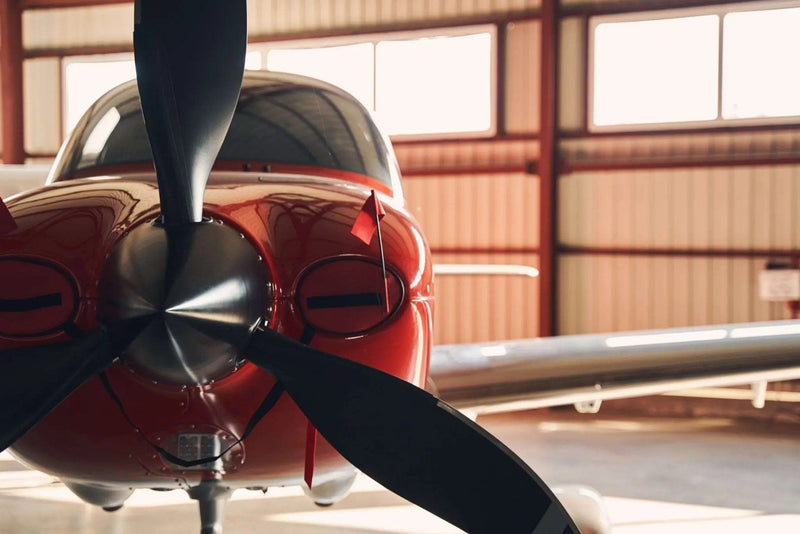
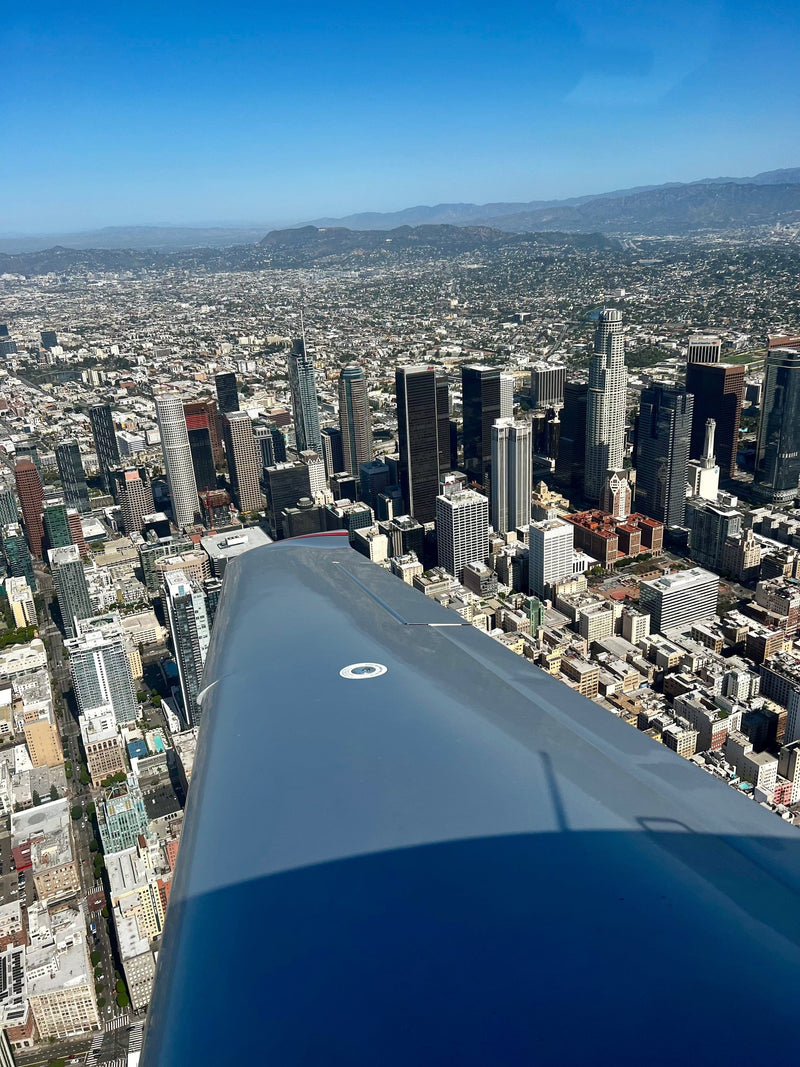
SAFETY FIRST
★★★★★
Very safety and detail oriented. Pre-flight briefing explained everything there was. To my knowledge, this flight school is exceptional in their ability.

If you take your multi-engine practical test in an airplane whose engines sit on the fuselage centerline, your certificate is issued “LIMITED TO CENTER THRUST”. The rule behind it is 14 CFR 61.45(b)(2), and the fix is simple: train and test in a conventional twin.
It is a restriction printed on a pilot certificate limiting multi-engine privileges to airplanes whose engines are mounted on the fuselage centerline — one pulling and one pushing, like a Cessna Skymaster. A pilot holding it may act as pilot in command of a centerline-thrust twin and of nothing else with two engines.
The regulation that creates it is 14 CFR 61.45(b)(2), and it is worth reading because it explains the logic rather than just the outcome. It says an applicant for a certificate or rating may use an aircraft with operating characteristics that preclude the applicant from performing all of the tasks required for the practical test, but that the applicant's certificate or rating will then be issued with an appropriate limitation.
Apply that to a centerline-thrust twin. Both engines are in line with the fuselage, so losing one produces no meaningful yawing moment. There is no asymmetric thrust to control, so there is no VMC to demonstrate, no critical engine to identify and no engine-out yaw to fly. Those tasks cannot be performed, so they are not tested, so the privileges are restricted to airplanes where they do not arise.
It is not a punishment and it is not a mark against the pilot. It is the FAA declining to certify a skill it did not watch you demonstrate, which is exactly what you would want it to do.
Both appear in Appendix 1 of the Commercial Pilot – Airplane ACS (FAA-S-ACS-7B), which carries a task table for removing each one.
| Limitation | How you get it | How it comes off |
|---|---|---|
| LIMITED TO CENTER THRUST | Taking the multi-engine practical test in a twin with both engines on the fuselage centerline, so the asymmetric tasks cannot be performed. Created by 14 CFR 61.45(b)(2). | A further practical test in a conventional twin, covering the tasks in the ACS Appendix 1 table headed Removal of the “Limited to Center Thrust” Limitation. |
| AIRPLANE MULTIENGINE VFR ONLY | Holding an instrument rating and adding a multi-engine class rating without demonstrating the instrument tasks in a multiengine airplane. Your instrument privileges then do not extend to twins. | The tasks in the ACS Appendix 1 table headed Removal of the “Airplane Multiengine VFR Only” Limitation, flown in a multiengine airplane. |
Neither is permanent and neither is unusual. What both have in common is that they are entirely avoidable at the point of training, and awkward to remove afterwards, because removing them means finding an examiner, an airplane and a second checkride fee.
Three groups, and none of them chose it on purpose. The first is pilots who trained where the sole twin available was a Skymaster or another centerline design, often because it was the least costly twin an operator could keep on line.
The second is military and ex-military pilots and some pilots converting foreign licenses, where the airplane used for the test happened to be center-thrust. The third is pilots who took the rating decades ago in an airplane that has long since left the fleet and who have never had a reason to look at the back of their certificate.
It matters the moment you want to fly a Seminole, a Duchess, a Baron, a Seneca or anything else with engines on the wings. That is essentially the entire light twin fleet. It also matters for employment, because operators fly conventional twins.
If you are in that position the fix is a training block and a practical test, not a whole new rating. Bring us the certificate and we will tell you what the ACS Appendix 1 table asks for and roughly how many hours it usually takes to be ready for it.

Everything difficult about a conventional twin comes from thrust being offset from the centerline. Remove the offset and you remove the syllabus.
Thrust in line with the fuselage produces no moment about the vertical axis when one engine stops. The airplane slows down; it does not try to turn.
14 CFR 1.2 defines VMC as the minimum control speed with the critical engine inoperative. With no asymmetric thrust there is no minimum control speed to demonstrate in the sense the ACS means.
The critical engine is the one whose failure most adversely affects performance and handling. On a centerline design neither engine is offset, so the concept does not apply.
The single most drilled sequence in multi-engine training exists because the airplane tells you which engine failed by yawing. Without the yaw, the drill has no cue to hang on.
This is the part people miss. A centerline twin still loses most of its climb performance on one engine. The FAA Airplane Flying Handbook's statement that losing 50 percent of power reduces climb performance 80 to 90 percent is about power, not about geometry.
You are certified for the airplanes where the untested skills are not required. You are not certified for the ones where they are.
Train and test in a conventional twin, and fly the instrument tasks while you are in it. That is the whole answer, and it is what happens here by default rather than as an upgrade.
Our Piper Seminole has wing-mounted engines and produces genuine asymmetric thrust, so every task in the ACS can be performed and no center-thrust limitation attaches. It also has counter-rotating propellers, which means it has no critical engine — that is a different point and it does not create a limitation, because the airplane can still demonstrate VMC with either engine at idle.
For the second limitation, the fix is to include the instrument tasks in the rating if you hold an instrument rating. It adds very little to a syllabus that already contains single-engine approaches, and it keeps Airplane Multiengine VFR Only off a certificate you will carry for the rest of your flying life. We do it as standard, inside the $5,100.
If you are shopping for multi-engine training anywhere, this is a question worth asking before you pay: what airplane will I take the test in, and will the instrument tasks be flown? The answers determine what is printed on your certificate, and printing is easier than un-printing.
The Redbird MCX is full-motion and FAA-approved, and it will fail an engine asymmetrically as many times as you want it to.
Removing a center-thrust limitation is mostly about becoming fluent in identify-verify-feather. The simulator is where that fluency is least expensive to build. Standalone sessions are $189.
Pilots who came to us to remove a limitation tend to write about the ground school, which is where most of the work actually is.
The compliment that comes up most often in our reviews is not the airplane and it is not the ramp. It is that somebody sat down afterwards and drew the yaw on a whiteboard until it made sense.
Eleven instructors and a fleet we own and maintain. On a rating you are trying to finish inside two weeks, a school that cancels twice is the difference between done and half-done.
What you enroll at is what you finish at. On a $5,100 add-on that promise is most of the point, and reviewers keep writing about it because it is not universal.
Our multi-engine add-on is $5,100 and is flown in a wing-engined twin, so neither limitation attaches. Limitation-removal training is quoted individually after we have seen your certificate and logbook.
The whole rating: Seminole time, dual instruction, ground and systems work, engine-out training and checkride preparation, at a price that is fixed when you enroll.
An hour in the Seminole before you commit $5,100 to it. Book it on the product page — an hour in the left seat settles the question faster than any amount of reading.
A real lesson in a single. You fly the airplane, the time is loggable dual instruction, and the full $229 is credited against any program if you enroll within 24 hours.
Full-motion, FAA-approved and never canceled for weather. Engine failures cost nothing here, which is why the first dozen of yours happen on the ground.
If you hold a center-thrust or VFR-only limitation, the free consultation is the right first step. We will tell you what the ACS asks for and roughly how long it takes, before anybody talks about money.
It restricts your multi-engine privileges to airplanes with both engines mounted on the fuselage centerline. You may not act as pilot in command of a conventional twin with wing-mounted engines, which is most of the light twin fleet.
14 CFR 61.45(b)(2). It provides that an applicant may use an aircraft with operating characteristics that preclude performing all of the tasks required for the practical test, but that the certificate or rating will then be issued with an appropriate limitation. A centerline twin cannot produce asymmetric thrust, so the VMC and engine-out tasks go untested.
By passing a practical test in a conventional twin covering the tasks in Appendix 1 of the Commercial Pilot – Airplane ACS (FAA-S-ACS-7B), in the table headed Removal of the “Limited to Center Thrust” Limitation. It is a training block and a checkride, not a new rating.
Yes, and it is easy. Train and take the practical test in a conventional twin with wing-mounted engines. Our Piper Seminole is one, which is why no center-thrust limitation attaches to a rating earned here.
It appears when a pilot who holds an instrument rating adds a multi-engine class rating without demonstrating the instrument tasks in a multiengine airplane, and it means your instrument privileges do not extend to twins. Appendix 1 of FAA-S-ACS-7B contains the removal task table. Flying the instrument tasks during the rating avoids it entirely, and we do that as standard.
No. The Seminole has wing-mounted engines and produces genuine asymmetric thrust, so every ACS task can be performed. Its counter-rotating propellers mean it has no critical engine, which is a separate point and does not create any limitation.
Yes, and badly. The FAA Airplane Flying Handbook's statement that losing 50 percent of power reduces climb performance 80 to 90 percent is about power, not about where the engines are bolted. What a centerline design removes is the control problem, not the performance problem.
It depends entirely on how current you are and how much asymmetric flying you have done, which is why we quote it after looking at a logbook rather than on a web page. The material is the engine-out half of a normal multi-engine rating.
Operators fly conventional twins, so a center-thrust limitation is a practical obstacle. We make no claims about hiring or employment outcomes; what we can say is that the limitation restricts you out of most of the light twin fleet.
The most familiar example is the Cessna Skymaster, with one engine in the nose and one in the tail. Push-pull designs of that kind are uncommon today, which is part of why the limitation is more often inherited from an old checkride than chosen.
No. 14 CFR 61.63(c)(4) excuses an additional knowledge test for a pilot who already holds an airplane rating at that certificate level, and limitation removal is a practical test matter. There is still an oral element on the day.
At Van Nuys Airport (KVNY), in our Piper Seminole. We are at 7900 Balboa Blvd, Suite 108A, Van Nuys, CA 91406, open 9am to 9pm, seven days a week. Call (818) 290-8249 and bring the certificate.
The three private pilot packages, what each one includes, the financing options and a realistic timeline built around how often you can actually fly. Sent to you in one email. Nobody will pressure you.
Loved On Google
Every review below is real and shown verbatim, in the reviewer’s own words — written by the people who learned to fly here, not by us.
SAFETY FIRST
Very safety and detail oriented. Pre-flight briefing explained everything there was. To my knowledge, this flight school is exceptional in their ability.
 DISCOVERY FLIGHT
I recently had the chance to take my first-ever discovery flight, and it was nothing short of amazing! From the moment I stepped into the cockpit, the...
 SUNSET CIRRUS
It was a great flight! I did a sunset flight and Alex let us fly an awesome. Website was easy to book, and the plane itself was really fun to fly...
 FLYING LESSON
We had a great flying lesson with Ralph and came away with a much better understanding of both the aircraft and the principles of flight. Ralph is a...
 KIDS LUXURY FLIGHT
I got 2 luxury discovery flights for my kids. I wanted them to have the experience of flying. Our instructor Alex was amazing he made sure they feel...
 HONEYMOON SURPRISE
Last minute booking to surprise my wife on our honeymoon. She had no experience with flying and was scared of flying, but Alex was very easygoing and knew...
 FULL-MOTION SIM
Amazing flight school in van nuys airport. I have been a student here for the past few months and i could not be happier. I started doing a lot of...
 DISCOVERY FOR TWO
I booked a Discovery Flight for Two for my girlfriend's birthday and it was the perfect gift for her. She couldn't have been more excited to get to...
 SIMULATORS
Very professional and great airplanes. I love the flight simulators. The pricing is very fair compared to any other flight school
 TEEN FIRST LESSON
We gifted our teenage son his first flying lesson. He was so excited! Alex greeted us and gave a reassuring brief that made us all feel comfortable and at...
 FIRST-TIME FLYER
Flying is my husband's hobby and I was incredibly anxious and apprehensive about the discovery flight. However, I felt completely safe and at ease once we...
SAFETY FIRST
Very safety and detail oriented. Pre-flight briefing explained everything there was. To my knowledge, this flight school is exceptional in their ability.
DISCOVERY FLIGHT
I recently had the chance to take my first-ever discovery flight, and it was nothing short of amazing! From the moment I stepped into the cockpit, the...
SUNSET CIRRUS
It was a great flight! I did a sunset flight and Alex let us fly an awesome. Website was easy to book, and the plane itself was really fun to fly...
FLYING LESSON
We had a great flying lesson with Ralph and came away with a much better understanding of both the aircraft and the principles of flight. Ralph is a...
KIDS LUXURY FLIGHT
I got 2 luxury discovery flights for my kids. I wanted them to have the experience of flying. Our instructor Alex was amazing he made sure they feel...
HONEYMOON SURPRISE
Last minute booking to surprise my wife on our honeymoon. She had no experience with flying and was scared of flying, but Alex was very easygoing and knew...
FULL-MOTION SIM
Amazing flight school in van nuys airport. I have been a student here for the past few months and i could not be happier. I started doing a lot of...
DISCOVERY FOR TWO
I booked a Discovery Flight for Two for my girlfriend's birthday and it was the perfect gift for her. She couldn't have been more excited to get to...
SIMULATORS
Very professional and great airplanes. I love the flight simulators. The pricing is very fair compared to any other flight school
TEEN FIRST LESSON
We gifted our teenage son his first flying lesson. He was so excited! Alex greeted us and gave a reassuring brief that made us all feel comfortable and at...
FIRST-TIME FLYER
Flying is my husband's hobby and I was incredibly anxious and apprehensive about the discovery flight. However, I felt completely safe and at ease once we...
Reviews shown verbatim, exactly as each reviewer published them.
Aviation News
Notes from the flight line at Van Nuys — weather, regulation changes, checkride questions and the cost of training, written up as they come.
Open 7 days · 9:00 AM – 9:00 PM
Los Angeles Flight School