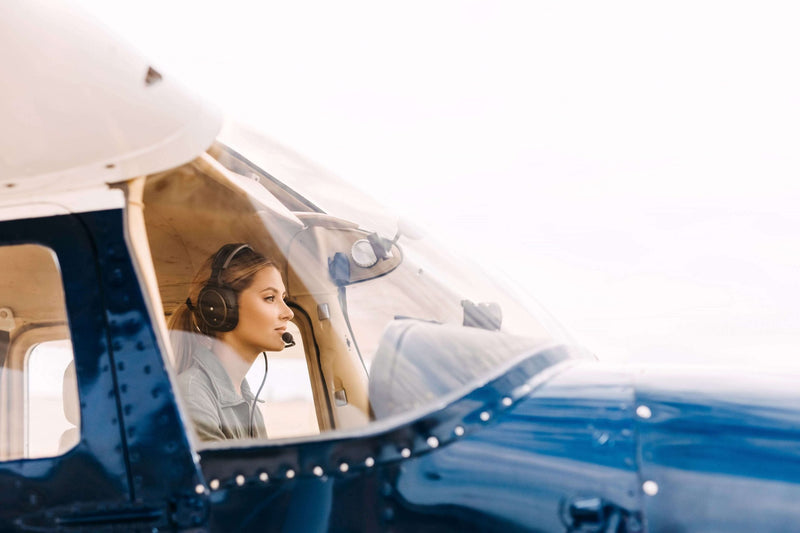
SAFETY FIRST
★★★★★
Very safety and detail oriented. Pre-flight briefing explained everything there was. To my knowledge, this flight school is exceptional in their ability.

VMC is the minimum control speed with the critical engine inoperative, defined in 14 CFR 1.2 and demonstrated to the FAA under 14 CFR 23.2135(c). It is a certificated number, not a technique — and almost everything difficult about flying a light twin follows from it.
VMC is the slowest speed at which you can still keep a twin going where you are pointing it after one engine quits. 14 CFR 1.2 defines it as the minimum control speed with the critical engine inoperative, and 14 CFR 23.2135(c) describes it as the calibrated airspeed at which, following the sudden critical loss of thrust, it is possible to maintain control of the airplane.
It is marked on your airspeed indicator as a red radial line, and the manufacturer had to fly it to get the type certificate. That is what makes it different from almost every other number a pilot carries around: VMC is not a rule of thumb, a company policy or an instructor's preference. It is part of the airplane's certification basis.
It is also, on the day you fly, probably not the number painted on the dial. The certification conditions are chosen to be as unhelpful as possible, so the red line is the worst case rather than the current case. Understanding which way the real number moves, and why, is most of what separates a pilot who has a multi-engine rating from a pilot who can use one.
The FAA Airplane Flying Handbook (FAA-H-8083-3C, Chapter 13) lists them. Read the list as a set of deliberate choices, each one making the number as high as it can honestly be.
| Condition | Why it is chosen |
|---|---|
| Maximum available takeoff power on the operating engine | Most thrust, therefore most yaw. |
| Propellers in the takeoff position | The failed propeller is windmilling, not feathered. |
| Most unfavourable weight and center of gravity | An aft CG shortens the arm the rudder works on. |
| Landing gear retracted | Retracted gear removes keel area and directional stability. |
| Takeoff flap setting | The configuration you would actually be in when it happens. |
| Trimmed for takeoff | No help from trim you would not have had. |
| Out of ground effect | No borrowed performance. |
| Not more than 5° of bank toward the operating engine | A cap on the one thing that helps most. |
Because every condition is stacked against you, the certificated number is conservative for most of the flying you will do — and dangerously optimistic for none of it. That asymmetry is the point.
Because the yaw arrives first and the roll is what the yaw does to the wings.
Two engines either side of a fuselage produce thrust on two arms of equal length. Take one away and the remaining thrust is now a force offset from the centerline, and an offset force about the vertical axis is a yawing moment. The airplane starts to swing toward the dead engine. Rudder opposes that, and up to a point the rudder wins.
Then the yaw does something else. As the nose swings toward the dead engine, the wing on the operating side is now moving through the air faster than the wing on the dead side, and a faster wing makes more lift. The airplane rolls toward the dead engine. Meanwhile the sideslip from the yaw is putting the fuselage side-on to the airflow, which is the least efficient thing an airplane can do.
Slow down and both effects get worse, because rudder authority falls with the square of airspeed while the thrust asymmetry does not fall at all. Keep slowing and you reach the speed where full rudder is exactly enough. Below it, nothing you can do with the rudder is enough, and the airplane rolls toward the dead engine whether you like it or not. That speed is VMC.
This is why the recovery is counter-intuitive and why it has to be drilled. A VMC roll is not a stall and adding power does not help — adding power increases the asymmetry that is causing it. You reduce power on the operating engine, which shrinks the yawing moment, and you lower the nose to get the airspeed back. The Airman Certification Standards for the demonstration ask for a prompt, coordinated recovery within 20 degrees of bank.
Six variables, and an examiner will ask you about at least four of them.
| Variable | Effect on VMC | Why |
|---|---|---|
| Bank toward the operating engine | Lower | A horizontal component of lift helps the rudder. The FAA handbook notes that zero sideslip, and therefore best single-engine climb, may occur at bank angles of less than 5°. |
| Landing gear extended | Lower | The handbook is explicit: VMC increases when the gear is retracted, because extended gear aids directional stability. |
| Center of gravity moved aft | Higher | A shorter moment arm between the CG and the rudder means less yawing moment available from the same deflection. |
| Dead propeller feathered | Lower | Removing the drag disc behind the failed engine removes part of the asymmetry. |
| Density altitude increased | Lower | A normally aspirated operating engine makes less power, so it produces less yaw. This is the dangerous one. |
| Weight increased | Complicated | More weight means more lift, so a given bank angle produces a larger horizontal component. Read your flight manual rather than a rule of thumb. |
The density altitude line deserves a warning. As VMC falls with altitude and stalling speed stays put in indicated terms, the two converge — and in some light twins the airplane will stall before it reaches VMC. An asymmetric stall in a twin is a far worse event than a loss of directional control, which is exactly why the FAA Airplane Flying Handbook puts the VMC demonstration no lower than 3,000 feet above the ground and the ACS requires a safe maneuvering altitude above 3,000 feet AGL.
Because a centered ball with the wings level is, on one engine, one of the draggiest ways to fly. The airflow is meeting the fuselage at an angle, the rudder is deflected a long way to hold it, and the whole airplane is working against itself.
The condition you actually want is called zero sideslip: a small bank toward the operating engine, enough rudder to stop the yaw, and the relative wind meeting the airplane straight on. The FAA Airplane Flying Handbook notes that zero sideslip, and therefore the best single-engine climb performance, may occur at bank angles of less than five degrees. The inclinometer ball will sit off center toward the operating engine, and that is correct.
The exact bank angle and ball position for a given airplane come from its flight manual and from an instructor who has flown that airframe, not from a web page. What is worth carrying around is the principle: on one engine, the ball is not the target. Climb rate is the target, and you find it by flying the airplane slightly banked and completely un-slipped.
On a twin with a marginal single-engine climb, the difference between zero sideslip and wings-level with a centered ball is not cosmetic. It can be the difference between a climb and a descent.

Enough that the FAA compares it to the drag of the whole airplane.
The Airplane Flying Handbook states that a windmilling propeller at small blade angles produces drag comparable to that of the entire airframe, while the parasite drag of a single feathered propeller is a small part of the airplane's total drag. Nothing else you can do about an engine failure changes the numbers as much as feathering does.
Feathering turns the blades to roughly ninety degrees to the plane of rotation, edge-on to the relative wind, so the propeller stops turning and the disc stops being a disc. On light twins, oil pressure normally holds the blades out of feather, with springs and counterweights driving them toward it. The practical consequence is that an engine which loses oil pressure will feather itself, and that an unfeathering accumulator exists so that instructors can restart a genuinely feathered engine in training rather than in an emergency.
Because feathering cannot be casually undone in flight, and because feathering the live engine leaves you with nothing, the sequence is fixed and verbal. Identify: dead foot, dead engine — the foot that is not pushing is on the side that is not producing thrust. Verify: close the throttle you believe is dead and confirm nothing changes. Feather: only then, and with your eyes on the control you are moving.
Students say this out loud for weeks and feel ridiculous doing it. Then an engine quits for real, the airplane yaws, the noise changes, and the hand goes to the right lever without being asked. That is the entire purpose of the exercise.
The critical engine is the one whose failure most adversely affects performance and handling. On a conventional twin with both propellers turning clockwise from the cockpit, that is the left engine.
The FAA handbook's lead explanation. At a high angle of attack the descending propeller blade meets the air at a greater angle and produces more thrust than the ascending blade. On each engine the descending blade is on the right of its own disc, so each thrust line shifts outboard to the right — leaving the right engine on the longer arm.
The extra thrust from the descending blade also accelerates air over the wing behind it. That puts the center of the slipstream-assisted lift further outboard on the right wing than on the left, which is a rolling difference on top of the yawing one.
The corkscrew of air from the left engine strikes the vertical fin and produces a small helpful yawing force. Lose the left engine and you lose that help exactly when you need it. Lose the right and it is still there.
With both propellers turning clockwise, engine torque rolls the airplane left. On one engine that roll adds to the roll toward a failed left engine and opposes the roll toward a failed right one.
Our Piper Seminole turns one propeller clockwise and one anticlockwise. The thrust lines are symmetric, every one of the four effects above cancels, and the airplane has no critical engine. Either failure is the same failure.
The oral does not care what you trained in. And the first conventional twin you fly after this rating will have a critical engine whether or not you have felt one, which is a good reason to understand it properly rather than to be relieved you did not have to.
Four of them, and they are all in the flight manual rather than in your head.
| Figure | What it means |
|---|---|
| Accelerate-stop distance | The FAA handbook defines it as the runway length required to accelerate to a specified speed, experience an engine failure, and bring the airplane to a complete stop. If the runway is shorter than this, an abort has consequences. |
| Accelerate-go distance | The horizontal distance required to continue the takeoff and climb to 50 feet, assuming an engine failure at rotation or lift-off. On many light twins, on a warm day, at gross weight, this number is larger than any runway you were planning to use. |
| Single-engine service ceiling | Reached when the airplane can no longer maintain a 50 feet-per-minute rate of climb with one engine inoperative. Above it you are not climbing in any useful sense. |
| Single-engine absolute ceiling | Where climb is no longer possible at all. Above this altitude, blue line becomes the speed for the slowest rate of descent rather than the best rate of climb. |
Working these out for a Van Nuys departure on a July afternoon at gross weight is a ground-school exercise with a real answer, and it is the exercise that changes how pilots brief a twin takeoff.
The Redbird MCX is full-motion and FAA-approved, and an engine failure in it costs nothing but your attention.
Simulator work is where identify-verify-feather stops being a recitation. A standalone Redbird session is $189; multi-engine students use the simulator inside the $5,100 add-on.
The engine-out material is the part students come back and thank instructors for, which tells you where the teaching actually happens.
The compliment that comes up most often in our reviews is not the airplane and it is not the ramp. It is that somebody sat down afterwards and drew the yaw on a whiteboard until it made sense.
Eleven instructors and a fleet we own and maintain. On a rating you are trying to finish inside two weeks, a school that cancels twice is the difference between done and half-done.
What you enroll at is what you finish at. On a $5,100 add-on that promise is most of the point, and reviewers keep writing about it because it is not universal.
The whole rating is $5,100 and the price is fixed at enrollment.
The whole rating: Seminole time, dual instruction, ground and systems work, engine-out training and checkride preparation, at a price that is fixed when you enroll.
An hour in the Seminole before you commit $5,100 to it. Book it on the product page — an hour in the left seat settles the question faster than any amount of reading.
A real lesson in a single. You fly the airplane, the time is loggable dual instruction, and the full $229 is credited against any program if you enroll within 24 hours.
Full-motion, FAA-approved and never canceled for weather. Engine failures cost nothing here, which is why the first dozen of yours happen on the ground.
The free consultation is a conversation with somebody who teaches this every week. Or take the $499 Seminole hour and feel the asymmetry with a multi-engine instructor beside you.
Minimum control speed with the critical engine inoperative. That is the definition given in 14 CFR 1.2. 14 CFR 23.2135(c) adds the operational meaning: the calibrated airspeed at which, following the sudden critical loss of thrust, it is possible to maintain control of the airplane. It is marked as a red radial line on the airspeed indicator.
Reduce power on the operating engine and lower the nose to regain airspeed. Adding power makes it worse, because the asymmetric thrust is what is rolling you. The Airman Certification Standards ask for prompt coordinated control inputs and no more than 20 degrees of bank during the recovery.
Because as density altitude rises, VMC falls while stalling speed does not, so the two speeds converge and an asymmetric stall becomes possible. The FAA Airplane Flying Handbook recommends performing the demonstration at least 3,000 feet above ground level and the ACS requires a safe maneuvering altitude above 3,000 feet AGL.
It lowers it. The FAA Airplane Flying Handbook states that VMC increases when the landing gear is retracted, because extended gear aids directional stability. It is a favorite oral question precisely because most pilots guess the other way.
VYSE, the best rate of climb speed with one engine inoperative, painted as a blue radial line on the airspeed indicator. It is not defined in 14 CFR 1.2 — it is a flight manual speed and an instrument marking, described for pilots in Chapter 13 of the FAA Airplane Flying Handbook. Above the single-engine absolute ceiling it gives the slowest rate of descent rather than a climb.
The safe, intentional one-engine-inoperative speed — the minimum speed at which an instructor will deliberately fail an engine on you. Like VYSE it is not in 14 CFR 1.2; it comes from the airplane's flight manual and is described in the FAA Airplane Flying Handbook. It exists so that training does not become the hazard it is teaching you to survive.
Because zero sideslip, not a centered ball, gives the best single-engine climb. The FAA Airplane Flying Handbook notes that zero sideslip may occur at bank angles of less than five degrees toward the operating engine, with the ball displaced toward that engine. Flying wings-level with a centered ball puts the fuselage side-on to the airflow and costs climb performance you cannot spare.
The FAA Airplane Flying Handbook compares a windmilling propeller at small blade angles to the drag of the entire airframe, and describes a single feathered propeller's parasite drag as a small part of the airplane's total. That comparison is the reason feathering is the first performance decision after control is regained.
No. The Seminole has counter-rotating propellers, so the two thrust lines are symmetric and neither engine failing is worse than the other. You still have to know the critical engine theory for the oral examination, and you will meet a real critical engine the first time you fly a conventional twin.
The FAA Airplane Flying Handbook defines it as the horizontal distance required to continue the takeoff and climb to 50 feet, assuming an engine failure at rotation or lift-off. On a light twin at gross weight on a warm day it is frequently longer than the runway available, which is a planning fact rather than a flying one.
Most of it. Normal twin operations take the first two or three hours; the rest is asymmetric flight, VMC demonstrations, drag identification and single-engine approaches. The complete rating is $5,100 here and most pilots reach checkride standard in ten to fifteen hours.
No. It is what the rating teaches. What helps is arriving with your systems knowledge current and your flying reasonably sharp, because ten to fifteen hours is not long enough to fix rusty basic handling and learn asymmetric flight at the same time.
The three private pilot packages, what each one includes, the financing options and a realistic timeline built around how often you can actually fly. Sent to you in one email. Nobody will pressure you.
Loved On Google
Every review below is real and shown verbatim, in the reviewer’s own words — written by the people who learned to fly here, not by us.
SAFETY FIRST
Very safety and detail oriented. Pre-flight briefing explained everything there was. To my knowledge, this flight school is exceptional in their ability.
 DISCOVERY FLIGHT
I recently had the chance to take my first-ever discovery flight, and it was nothing short of amazing! From the moment I stepped into the cockpit, the...
 SUNSET CIRRUS
It was a great flight! I did a sunset flight and Alex let us fly an awesome. Website was easy to book, and the plane itself was really fun to fly...
 FLYING LESSON
We had a great flying lesson with Ralph and came away with a much better understanding of both the aircraft and the principles of flight. Ralph is a...
 KIDS LUXURY FLIGHT
I got 2 luxury discovery flights for my kids. I wanted them to have the experience of flying. Our instructor Alex was amazing he made sure they feel...
 HONEYMOON SURPRISE
Last minute booking to surprise my wife on our honeymoon. She had no experience with flying and was scared of flying, but Alex was very easygoing and knew...
 FULL-MOTION SIM
Amazing flight school in van nuys airport. I have been a student here for the past few months and i could not be happier. I started doing a lot of...
 DISCOVERY FOR TWO
I booked a Discovery Flight for Two for my girlfriend's birthday and it was the perfect gift for her. She couldn't have been more excited to get to...
 SIMULATORS
Very professional and great airplanes. I love the flight simulators. The pricing is very fair compared to any other flight school
 TEEN FIRST LESSON
We gifted our teenage son his first flying lesson. He was so excited! Alex greeted us and gave a reassuring brief that made us all feel comfortable and at...
 FIRST-TIME FLYER
Flying is my husband's hobby and I was incredibly anxious and apprehensive about the discovery flight. However, I felt completely safe and at ease once we...
SAFETY FIRST
Very safety and detail oriented. Pre-flight briefing explained everything there was. To my knowledge, this flight school is exceptional in their ability.
DISCOVERY FLIGHT
I recently had the chance to take my first-ever discovery flight, and it was nothing short of amazing! From the moment I stepped into the cockpit, the...
SUNSET CIRRUS
It was a great flight! I did a sunset flight and Alex let us fly an awesome. Website was easy to book, and the plane itself was really fun to fly...
FLYING LESSON
We had a great flying lesson with Ralph and came away with a much better understanding of both the aircraft and the principles of flight. Ralph is a...
KIDS LUXURY FLIGHT
I got 2 luxury discovery flights for my kids. I wanted them to have the experience of flying. Our instructor Alex was amazing he made sure they feel...
HONEYMOON SURPRISE
Last minute booking to surprise my wife on our honeymoon. She had no experience with flying and was scared of flying, but Alex was very easygoing and knew...
FULL-MOTION SIM
Amazing flight school in van nuys airport. I have been a student here for the past few months and i could not be happier. I started doing a lot of...
DISCOVERY FOR TWO
I booked a Discovery Flight for Two for my girlfriend's birthday and it was the perfect gift for her. She couldn't have been more excited to get to...
SIMULATORS
Very professional and great airplanes. I love the flight simulators. The pricing is very fair compared to any other flight school
TEEN FIRST LESSON
We gifted our teenage son his first flying lesson. He was so excited! Alex greeted us and gave a reassuring brief that made us all feel comfortable and at...
FIRST-TIME FLYER
Flying is my husband's hobby and I was incredibly anxious and apprehensive about the discovery flight. However, I felt completely safe and at ease once we...
Reviews shown verbatim, exactly as each reviewer published them.
Aviation News
Notes from the flight line at Van Nuys — weather, regulation changes, checkride questions and the cost of training, written up as they come.
Open 7 days · 9:00 AM – 9:00 PM
Los Angeles Flight School