SAFETY FIRST
★★★★★
Very safety and detail oriented. Pre-flight briefing explained everything there was. To my knowledge, this flight school is exceptional in their ability.

The commercial pilot ACS is FAA-S-ACS-7B, the Commercial Pilot for Airplane Category Airman Certification Standards, effective 31 May 2024. It has 11 areas of operation and 60 tasks, and every commercial maneuver you have heard of is in it: steep spirals, chandelles, lazy eights, eights on pylons and the power-off 180. Not all of them are flown on the day. Here is what is, and to what standard.
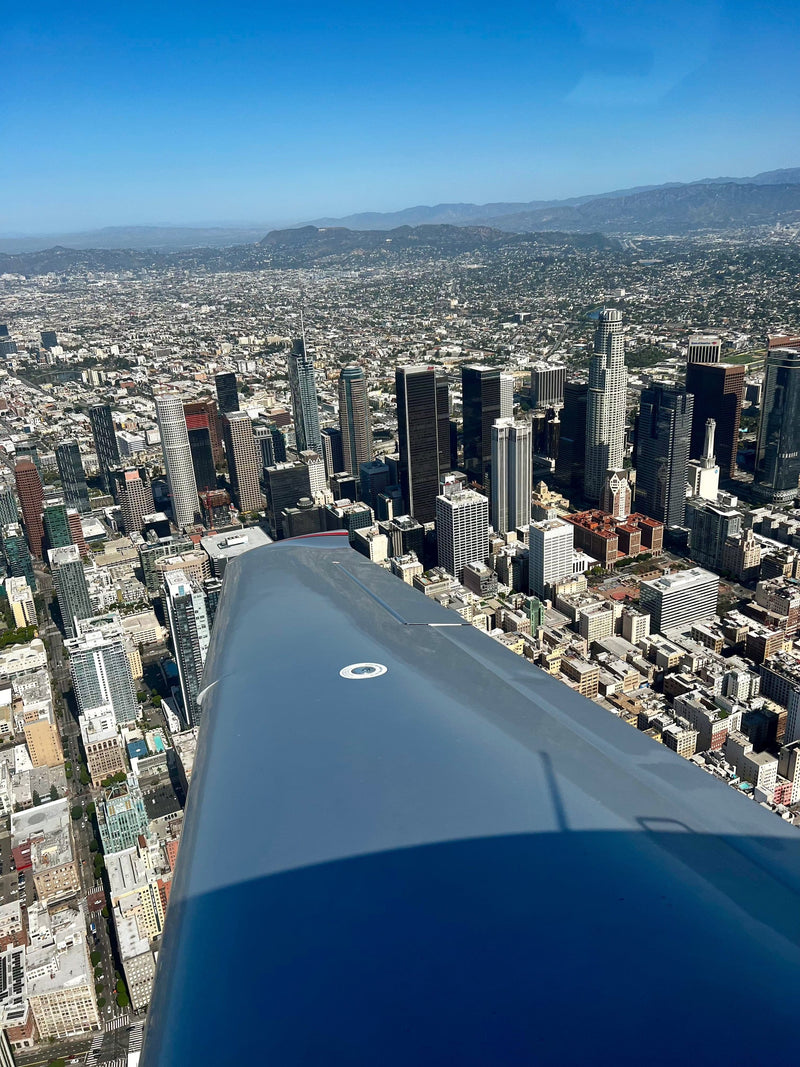
An LA Flight School trainer over the San Fernando Valley, the home airspace for commercial lessons.
The commercial pilot ACS is the FAA document that defines the commercial pilot practical test in an airplane. The current edition is FAA-S-ACS-7B, dated November 2023 and effective 31 May 2024, and the FAA’s Airman Certification Standards page still lists it as current at the end of October 2026. It superseded FAA-S-ACS-7A with Change 1. The commercial ACS first replaced the old Commercial Pilot Practical Test Standards, FAA-S-8081-12C, in June 2017.
The commercial ACS looks like the private pilot document with the screws tightened. Most tasks carry over by name. The tolerances shrink, the steep turn steepens from 45 to 50 degrees, and Area V gains four maneuvers that exist only at this level. Two private pilot areas disappear: there is no Basic Instrument Maneuvers area and no Night Operations area, because the regulation in 14 CFR 61.127(b)(1) does not list them for a commercial applicant. High-Altitude Operations takes their place.
Each task still has the same three parts — knowledge, risk management and skill — and the same rule applies under 14 CFR 61.43: fail any area of operation and you fail the test. The wider process of a practical test is in our FAA checkride guide; the career that sits behind this certificate is in how to become a commercial pilot.
Every area and task in FAA-S-ACS-7B, with the letters used on the knowledge test report and the examiner’s plan of action. The last column counts the tasks that apply to a single-engine land airplane.
| Area Of Operation | Tasks In FAA-S-ACS-7B | ASEL Tasks |
|---|---|---|
| I. Preflight Preparation | A. Pilot Qualifications · B. Airworthiness Requirements · C. Weather Information · D. Cross-Country Flight Planning · E. National Airspace System · F. Performance and Limitations · G. Operation of Systems · H. Human Factors · I. Water and Seaplane Characteristics (seaplane only) | 8 |
| II. Preflight Procedures | A. Preflight Assessment · B. Flight Deck Management · C. Engine Starting · D. Taxiing (ASEL, AMEL) · E. Taxiing and Sailing (ASES, AMES) · F. Before Takeoff Check | 5 |
| III. Airport and Seaplane Base Operations | A. Communications, Light Signals, and Runway Lighting Systems · B. Traffic Patterns | 2 |
| IV. Takeoffs, Landings, and Go-Arounds | A. Normal Takeoff and Climb · B. Normal Approach and Landing · C. Soft-Field Takeoff and Climb · D. Soft-Field Approach and Landing · E. Short-Field Takeoff and Maximum Performance Climb · F. Short-Field Approach and Landing · G–L. Confined Area, Glassy Water and Rough Water Takeoffs and Landings (seaplane only) · M. Power-Off 180° Accuracy Approach and Landing (ASEL, ASES) · N. Go-Around/Rejected Landing | 8 |
| V. Performance Maneuvers and Ground Reference Maneuvers | A. Steep Turns · B. Steep Spiral · C. Chandelles · D. Lazy Eights · E. Eights on Pylons (B to E are ASEL, ASES) | 5, of which 3 are flown |
| VI. Navigation | A. Pilotage and Dead Reckoning · B. Navigation Systems and Radar Services · C. Diversion · D. Lost Procedures | 4 |
| VII. Slow Flight and Stalls | A. Maneuvering During Slow Flight · B. Power-Off Stalls · C. Power-On Stalls · D. Accelerated Stalls · E. Spin Awareness | 5 |
| VIII. High-Altitude Operations | A. Supplemental Oxygen · B. Pressurization (skills only if the airplane has it) | 2 |
| IX. Emergency Operations | A. Emergency Descent · B. Emergency Approach and Landing (Simulated) · C. Systems and Equipment Malfunctions · D. Emergency Equipment and Survival Gear · E–G. Engine Failure and Inoperative-Engine Tasks (multiengine only) | 4 |
| X. Multiengine Operations | A. Maneuvering with One Engine Inoperative · B. VMC Demonstration · C. One Engine Inoperative by Reference to Instruments · D. Instrument Approach and Landing with an Inoperative Engine (all multiengine only) | 0 |
| XI. Postflight Procedures | A. After Landing, Parking, and Securing (ASEL, AMEL) · B. Seaplane Post-Landing Procedures (ASES, AMES) | 1 |
Source: FAA-S-ACS-7B table of contents, November 2023, effective 31 May 2024. The document holds 60 tasks across all four airplane classes. A single-engine land applicant meets 44 of them, and flies only three of the five Area V maneuvers, chosen under the rule explained below.
All five commercial maneuvers are in the current ACS, and so is the power-off 180. These are the standards from the skill elements of FAA-S-ACS-7B.
| Maneuver | Standard In The ACS | Element Code |
|---|---|---|
| Steep turns | 360° turn at about 50° bank; altitude ±100 ft, airspeed ±10 kt, bank ±5°, roll out on entry heading ±10° | CA.V.A.S3, S5 |
| Steep spiral | At least three 360° turns around a ground point, bank not over 60°; airspeed ±10 kt, roll out ±10°; finish no lower than 1,500 ft AGL | CA.V.B.S2–S6 |
| Chandelle | About 30° bank; climbing turn to the 90° point, constant-rate rollout to the 180° point ±10° just above stall speed; no lower than 1,500 ft AGL | CA.V.C.S2–S7 |
| Lazy eight | About 30° bank at the steepest point; at each 180° point altitude ±100 ft, airspeed ±10 kt, heading ±10° from entry | CA.V.D.S5 |
| Eights on pylons | Bank not over 40°; pylons held at pivotal altitude without slips or skids | CA.V.E.S2–S8 |
| Power-off 180° accuracy landing | Touch down within 200 ft beyond or on the specified point, with no side drift | CA.IV.M.S8 |
| Short-field landing | Touch down within 100 ft beyond or on the specified point | CA.IV.F.S10 |
| Accelerated stall | 45° bank, power at or below maneuvering speed, completed no lower than 3,000 ft AGL | CA.VII.D.S2, S5 |
Appendix 3 of FAA-S-ACS-7B sets the selection for an initial single-engine commercial applicant. The examiner must choose steep turns or a steep spiral, chandelles or lazy eights, and eights on pylons, which is always flown. A multiengine applicant flies only steep turns. You do not know in advance which half of each pair you will get, so you prepare all five.
The power-off 180 has its own rule. Appendix 3 says that a go-around caused by your inability to complete the task within tolerance is unsatisfactory, while a go-around forced by runway safety concerns outside your control is not. It also says neither you nor the examiner should force a landing to complete the task. In other words, a go-around made for the right reason is not a fail; one made because the glide was misjudged is.
The checkride follows Appendix 1 of FAA-S-ACS-7B, which is written the same way as in every pilot ACS. What changes at the commercial level is what the examiner expects to hear.
A plan of action and a scenario. The examiner writes a plan covering every required area and task and builds scenarios around them. For a commercial applicant those scenarios lean toward operations you might be paid for, which is why privileges and limitations under 14 CFR 61.133 come up early.
A minimum per task. At least one knowledge element, at least one risk management element, every skill element unless noted, and every element coded on your knowledge test report. The examiner can combine tasks freely.
The ground portion first. You must pass it before the flight, and questions continue in the air. Area VIII, High-Altitude Operations, is mostly tested here; pressurization skills apply only if the airplane is pressurized, and none of our training fleet is.
Outcomes. A temporary certificate, a Notice of Disapproval, or a Letter of Discontinuance with 60 days to finish under 14 CFR 61.43(f).

The commercial knowledge test is code CAX: 100 questions, minimum age 16, 70 percent to pass. FAA-S-ACS-7B prints an allotted time of 3.0 hours, but the FAA has since published a correction table giving 2.5 hours, matching the Airman Knowledge Testing Matrix. Every question you miss appears on the report as an ACS code such as CA.I.C.K2 — Commercial Airplane, Area I, Task C, knowledge element 2. Your instructor must retrain those areas and endorse it under 14 CFR 61.39(a)(6), the examiner must test them, and the report is valid for 24 calendar months. The FAA written exam guide covers booking and the test day.
Appendix 1 names the usual grounds for disapproval: examiner intervention, poor scanning, consistently exceeding tolerances, slow correction and failure to manage risk. The risk elements in each task show where they start.
Task M lists selection of the touchdown area by pilot capability and aircraft performance, and the effects of crosswind, windshear, tailwind and wake turbulence. Most misses are energy errors made at the abeam point, not at the flare.
Both tasks name uncoordinated flight and energy management as risks. The airplane is slow and turning at the top of each maneuver, which is exactly where a skid becomes a stall.
Task E lists low-altitude maneuvering, stall, spin and controlled flight into terrain, and emergency landing considerations. You are at pivotal altitude, often under 1,000 feet, watching a pylon instead of your airspeed.
Area VII Task D lists the factors that lead to an inadvertent accelerated stall, the limits of stall warning and secondary stalls. The ACS also requires power at or below maneuvering speed before entry.
Area VIII Task A covers supplemental oxygen regulations, hypoxia, time of useful consciousness and the hazards of compressed gas and oxygen-rich fires. Applicants who train only at low altitude often know this area least.
Area I Task A tests pilot qualifications. At this level that means what you may and may not be paid for. Expect a scenario that sounds like a job and ask yourself whether it is a Part 91 flight or something more.
Commercial training here is flown from a towered Class D field under the Los Angeles Class B shelf, in a fleet that covers the complex and glass-cockpit time 14 CFR 61.129 asks for.
The complex airplane. 14 CFR 61.129(a)(3)(ii) requires 10 hours of training in a complex airplane, a turbine airplane or a technically advanced airplane. We fly the Piper Arrow for it, with retractable gear and a constant-speed propeller, and the glass-cockpit Cirrus SR22T is also in the fleet. Appendix 3 of the ACS points to 14 CFR 61.45 for the test aircraft and does not require a complex airplane for the checkride itself.
Areas II, III and IX in a complex airplane. Gear, propeller and systems failures are rehearsed in the Redbird MCX before they are flown, which suits the systems and equipment malfunctions task in Area IX.
The night requirement. 61.129(a)(4)(ii) requires 5 hours of night VFR with 10 takeoffs and 10 landings at an airport with an operating control tower. Van Nuys has a tower, so the home field satisfies it.
Pattern work. The power-off 180 is practiced in the traffic pattern when traffic and the tower allow it, with the touchdown point chosen before the abeam call.


The Class B overhead matters more for commercial students than for private ones, because chandelles, lazy eights and steep spirals need altitude. Each one must be completed no lower than 1,500 feet above the ground, and the accelerated stall no lower than 3,000, so every lesson starts with picking an area where that altitude is available below the shelf. Our Van Nuys airspace page shows how the layers stack.
Six steps, built on 14 CFR 61.123, 61.129, 61.39 and the ACS itself.
Read the two side by side. Every tolerance that tightened and every task that is new is a line on your training plan.
One hundred questions, 2.5 hours, 70 to pass, minimum age 16. Take it before the maneuver training gets intense, so missed codes can be retrained in the airplane.
250 hours, including 100 PIC, 50 cross-country, 20 hours of training with 10 of instrument and 10 in a complex, turbine or technically advanced airplane, and the solo or PIC requirements.
The examiner chooses steep turns or the steep spiral, chandelles or lazy eights, plus eights on pylons. Prepare all five to the ACS numbers and the choice stops mattering.
Fly it in varied wind, from the same abeam point, and learn when to go around. A well-timed go-around is part of the standard.
61.129(a)(3)(v) requires 3 hours of test preparation within the preceding 2 calendar months, and 61.39(a)(6) an endorsement in the same window. You must also be 18 under 61.123.
The full hour-by-hour breakdown is on commercial pilot license requirements, and the program itself on commercial pilot training at Van Nuys. Most applicants pair the certificate with the $11,700 instrument rating, because without one 14 CFR 61.133(b) prohibits carrying passengers for hire on cross-country flights over 50 nautical miles or at night. To exercise commercial privileges you also need at least a second-class medical under 61.23(a)(2). For a full career budget see commercial pilot license cost, or the $82,000 zero-to-airline program covering commercial, instrument, multi-engine and CFI.
Commercial pilots usually sit three or four practical tests in a row. These are the documents on either side of this one.
The private pilot ACS is the base the commercial document tightens, and the instrument rating ACS removes the 61.133(b) passenger-for-hire limitation.
Areas IX and X apply when you test in a twin. Our multi-engine checkride guide covers them; the add-on in the Piper Seminole is $5,100.
An instructor will read your logbook against 14 CFR 61.129 and the commercial ACS and tell you which hours and which maneuvers are still missing. Book a free consultation, or a discovery flight if you are starting from zero. Call (818) 290-8249 for commercial program pricing.
7900 Balboa Blvd. Suite 108A, Van Nuys, CA 91406 · (818) 290-8249 · Open 9am–9pm, seven days · 5.0 from 120+ Google reviews
FAA-S-ACS-7B, Commercial Pilot for Airplane Category Airman Certification Standards. It is dated November 2023, took effect on 31 May 2024 and superseded FAA-S-ACS-7A with Change 1. The FAA's Airman Certification Standards page, last updated in September 2026, still lists 7B as current at the end of October 2026. The examiner must use the ACS in effect on the date of your test, so download a fresh copy from faa.gov shortly before your checkride.
Three performance maneuvers plus the power-off 180 for a single-engine applicant. Appendix 3 of FAA-S-ACS-7B requires the examiner to select steep turns or a steep spiral, chandelles or lazy eights, and eights on pylons. The power-off 180 degree accuracy approach and landing is Area IV, Task M, for single-engine airplanes. The examiner picks within each pair, so you need to prepare all five maneuvers. A multiengine commercial applicant flies only steep turns from Area V.
Yes. Area IV, Task M, the Power-Off 180 Degree Accuracy Approach and Landing, applies to single-engine land and sea airplanes in FAA-S-ACS-7B. The standard is a touchdown at a proper pitch attitude within 200 feet beyond or on the specified point, with no side drift. A go-around caused by your own inability to meet the tolerance is unsatisfactory, while one forced by runway safety issues outside your control is not, and the ACS says no one should force the landing.
Not under the current ACS. Appendix 3 of FAA-S-ACS-7B refers to 14 CFR 61.45 for aircraft requirements and sets no complex-airplane requirement for the test. The training rule is separate: 14 CFR 61.129(a)(3)(ii) requires 10 hours of training in a complex, turbine-powered or technically advanced airplane before you apply. At Van Nuys that time is flown in the Piper Arrow, and many applicants then take the checkride in the airplane they know best.
It is tighter and it is structured differently. Steep turns go from 45 to 50 degrees of bank, the normal landing window shrinks from 400 to 200 feet and the short-field window from 200 to 100. Area V adds steep spirals, chandelles, lazy eights and eights on pylons, Area VII adds accelerated stalls, and Area VIII becomes High-Altitude Operations. The Basic Instrument Maneuvers and Night Operations areas of the private pilot ACS do not appear.
It is the Commercial Pilot Airplane knowledge test that goes with this ACS: 100 questions, minimum age 16, 70 percent to pass. FAA-S-ACS-7B prints an allotted time of 3.0 hours, but the FAA's ACS Knowledge Test Table of correct allotted times shows 2.5 hours, matching the Airman Knowledge Testing Matrix. You must pass it within the 24 calendar months before the month you complete the practical test, under 14 CFR 61.39(a)(1).
Yes, but the certificate will carry a limitation. Under 14 CFR 61.133(b), a commercial pilot certificate issued without an instrument rating in the same category and class reads that the carriage of passengers for hire on cross-country flights over 50 nautical miles or at night is prohibited. The limitation is removed when you complete the instrument rating requirements of 14 CFR 61.65. For most career pilots that makes the instrument rating the step before the commercial.
At LA Flight School at Van Nuys Airport, 7900 Balboa Blvd. Suite 108A, trained under 14 CFR Part 61 in a fleet that includes the Piper Arrow for complex time, the Cirrus SR22T and the Redbird MCX full-motion simulator. The instrument rating is $11,700 and the zero-to-airline program, covering commercial, instrument, multi-engine and CFI, is $82,000. Book a free consultation or call (818) 290-8249, open 9am to 9pm, seven days.
Every standard on this page is taken from the FAA document itself or from Title 14 of the Code of Federal Regulations. These links open the primary source.
Areas, tasks, tolerances and appendix rules are quoted from FAA-S-ACS-7B as downloaded from faa.gov on 31 October 2026; the FAA ACS page lists it as current, effective 31 May 2024. The CAX allotted time of 2.5 hours is from the FAA’s correction table (October 2024). Regulations checked against the eCFR, October 2026. Prices current at 31 October 2026.
The three private pilot packages, what each one includes, the financing options and a realistic timeline built around how often you can actually fly. Sent to you in one email. Nobody will pressure you.
Loved On Google
Every review below is real and shown verbatim, in the reviewer’s own words — written by the people who learned to fly here, not by us.
SAFETY FIRST
Very safety and detail oriented. Pre-flight briefing explained everything there was. To my knowledge, this flight school is exceptional in their ability.
 DISCOVERY FLIGHT
I recently had the chance to take my first-ever discovery flight, and it was nothing short of amazing! From the moment I stepped into the cockpit, the...
 SUNSET CIRRUS
It was a great flight! I did a sunset flight and Alex let us fly an awesome. Website was easy to book, and the plane itself was really fun to fly...
 FLYING LESSON
We had a great flying lesson with Ralph and came away with a much better understanding of both the aircraft and the principles of flight. Ralph is a...
 KIDS LUXURY FLIGHT
I got 2 luxury discovery flights for my kids. I wanted them to have the experience of flying. Our instructor Alex was amazing he made sure they feel...
 HONEYMOON SURPRISE
Last minute booking to surprise my wife on our honeymoon. She had no experience with flying and was scared of flying, but Alex was very easygoing and knew...
 FULL-MOTION SIM
Amazing flight school in van nuys airport. I have been a student here for the past few months and i could not be happier. I started doing a lot of...
 DISCOVERY FOR TWO
I booked a Discovery Flight for Two for my girlfriend's birthday and it was the perfect gift for her. She couldn't have been more excited to get to...
 SIMULATORS
Very professional and great airplanes. I love the flight simulators. The pricing is very fair compared to any other flight school
 TEEN FIRST LESSON
We gifted our teenage son his first flying lesson. He was so excited! Alex greeted us and gave a reassuring brief that made us all feel comfortable and at...
 FIRST-TIME FLYER
Flying is my husband's hobby and I was incredibly anxious and apprehensive about the discovery flight. However, I felt completely safe and at ease once we...
SAFETY FIRST
Very safety and detail oriented. Pre-flight briefing explained everything there was. To my knowledge, this flight school is exceptional in their ability.
DISCOVERY FLIGHT
I recently had the chance to take my first-ever discovery flight, and it was nothing short of amazing! From the moment I stepped into the cockpit, the...
SUNSET CIRRUS
It was a great flight! I did a sunset flight and Alex let us fly an awesome. Website was easy to book, and the plane itself was really fun to fly...
FLYING LESSON
We had a great flying lesson with Ralph and came away with a much better understanding of both the aircraft and the principles of flight. Ralph is a...
KIDS LUXURY FLIGHT
I got 2 luxury discovery flights for my kids. I wanted them to have the experience of flying. Our instructor Alex was amazing he made sure they feel...
HONEYMOON SURPRISE
Last minute booking to surprise my wife on our honeymoon. She had no experience with flying and was scared of flying, but Alex was very easygoing and knew...
FULL-MOTION SIM
Amazing flight school in van nuys airport. I have been a student here for the past few months and i could not be happier. I started doing a lot of...
DISCOVERY FOR TWO
I booked a Discovery Flight for Two for my girlfriend's birthday and it was the perfect gift for her. She couldn't have been more excited to get to...
SIMULATORS
Very professional and great airplanes. I love the flight simulators. The pricing is very fair compared to any other flight school
TEEN FIRST LESSON
We gifted our teenage son his first flying lesson. He was so excited! Alex greeted us and gave a reassuring brief that made us all feel comfortable and at...
FIRST-TIME FLYER
Flying is my husband's hobby and I was incredibly anxious and apprehensive about the discovery flight. However, I felt completely safe and at ease once we...
Reviews shown verbatim, exactly as each reviewer published them.
Aviation News
Notes from the flight line at Van Nuys — weather, regulation changes, checkride questions and the cost of training, written up as they come.
Open 7 days · 9:00 AM – 9:00 PM
Los Angeles Flight School