SAFETY FIRST
★★★★★
Very safety and detail oriented. Pre-flight briefing explained everything there was. To my knowledge, this flight school is exceptional in their ability.

The first class medical is the FAA medical certificate you must hold to exercise airline transport pilot privileges. The standards live in 14 CFR Part 67, Subpart A; the requirement itself is in 61.23. If the airlines are the plan, get one before you spend real money on training.
Book It Or Gift It
Every discovery flight below can be booked for yourself in the next few minutes, or bought as a gift certificate that is emailed within minutes and never expires. Same flight, same price, either way.
 Most Given
 Two Seats
 The Nice One
 Twin Engine
One person, one instructor, and no audience. Hands on the controls from the left seat, briefed before you go and debriefed after you land.
Hands-On Stick TimePre-Flight BriefingLoggable Flight Time
Flight Length
$229Book It Or Gift It
Same Price Either Way
The same flight with a passenger in the back seat, briefed and on the intercom. Couples book it; so do parents who would rather watch than hear about it.
One Passenger SeatPiper Warrior Or ArcherHeadsets For Both
Flight Length
$299Book It Or Gift It
Same Price Either Way
The nicest airplane we put a first-time flyer in. Glass cockpit, air conditioning, leather seats, and a parachute built into the airframe rather than strapped to the person.
Turbocharged Cirrus SR22Air ConditioningWhole-Airframe Parachute
Flight Length
$499Book It Or Gift It
Same Price Either Way
Two engines, and the airplane instrument-rated pilots move into when they start thinking about a career. Flown from the left seat with a multi-engine instructor.
Piper Seminole TwinMulti-Engine DepartureCareer-Track Instructor
Flight Length
$499Book It Or Gift It
Same Price Either Way
Gift It issues a real gift certificate, emailed within minutes, which never expires and credits in full toward training. Flights are limited to 180 lb per person, 370 lb combined. Questions: (818) 290-8249, 9 AM–9 PM, seven days.
SAFETY FIRST
Very safety and detail oriented. Pre-flight briefing explained everything there was. To my knowledge, this flight school is exceptional in their ability.
 DISCOVERY FLIGHT
I recently had the chance to take my first-ever discovery flight, and it was nothing short of amazing! From the moment I stepped into the cockpit, the...
 SUNSET CIRRUS
It was a great flight! I did a sunset flight and Alex let us fly an awesome. Website was easy to book, and the plane itself was really fun to fly...
 FLYING LESSON
We had a great flying lesson with Ralph and came away with a much better understanding of both the aircraft and the principles of flight. Ralph is a...
 KIDS LUXURY FLIGHT
I got 2 luxury discovery flights for my kids. I wanted them to have the experience of flying. Our instructor Alex was amazing he made sure they feel...
 HONEYMOON SURPRISE
Last minute booking to surprise my wife on our honeymoon. She had no experience with flying and was scared of flying, but Alex was very easygoing and knew...
 FULL-MOTION SIM
Amazing flight school in van nuys airport. I have been a student here for the past few months and i could not be happier. I started doing a lot of...
 DISCOVERY FOR TWO
I booked a Discovery Flight for Two for my girlfriend's birthday and it was the perfect gift for her. She couldn't have been more excited to get to...
 SIMULATORS
Very professional and great airplanes. I love the flight simulators. The pricing is very fair compared to any other flight school
 TEEN FIRST LESSON
We gifted our teenage son his first flying lesson. He was so excited! Alex greeted us and gave a reassuring brief that made us all feel comfortable and at...
 FIRST-TIME FLYER
Flying is my husband's hobby and I was incredibly anxious and apprehensive about the discovery flight. However, I felt completely safe and at ease once we...
SAFETY FIRST
Very safety and detail oriented. Pre-flight briefing explained everything there was. To my knowledge, this flight school is exceptional in their ability.
DISCOVERY FLIGHT
I recently had the chance to take my first-ever discovery flight, and it was nothing short of amazing! From the moment I stepped into the cockpit, the...
SUNSET CIRRUS
It was a great flight! I did a sunset flight and Alex let us fly an awesome. Website was easy to book, and the plane itself was really fun to fly...
FLYING LESSON
We had a great flying lesson with Ralph and came away with a much better understanding of both the aircraft and the principles of flight. Ralph is a...
KIDS LUXURY FLIGHT
I got 2 luxury discovery flights for my kids. I wanted them to have the experience of flying. Our instructor Alex was amazing he made sure they feel...
HONEYMOON SURPRISE
Last minute booking to surprise my wife on our honeymoon. She had no experience with flying and was scared of flying, but Alex was very easygoing and knew...
FULL-MOTION SIM
Amazing flight school in van nuys airport. I have been a student here for the past few months and i could not be happier. I started doing a lot of...
DISCOVERY FOR TWO
I booked a Discovery Flight for Two for my girlfriend's birthday and it was the perfect gift for her. She couldn't have been more excited to get to...
SIMULATORS
Very professional and great airplanes. I love the flight simulators. The pricing is very fair compared to any other flight school
TEEN FIRST LESSON
We gifted our teenage son his first flying lesson. He was so excited! Alex greeted us and gave a reassuring brief that made us all feel comfortable and at...
FIRST-TIME FLYER
Flying is my husband's hobby and I was incredibly anxious and apprehensive about the discovery flight. However, I felt completely safe and at ease once we...
A first class medical certificate is the FAA medical you must hold to exercise airline transport pilot privileges. The medical standards are written in 14 CFR Part 67, Subpart A. The rule that ties a class of medical to a privilege is 61.23. Those two citations are the entire legal picture, and everything else on this page follows from them.
It is the highest of three classes. Third class covers private, recreational, student and flight instructor privileges. Second class covers commercial privileges, which is to say flying for hire. First class covers ATP privileges, which in practice means the left seat at an airline and, under Part 121, most of the right seat as well.
One thing trips up nearly everybody. The class of medical grants you nothing on its own. It is a gate, not a license. Holding a first class medical no more makes you an airline pilot than a clean driving record makes you a bus driver. What it does is remove the medical obstacle permanently from your planning. The certificates and the hours are a separate problem, and a much more predictable one.

Validity depends on three things: the class of certificate, the privilege you are exercising with it, and your age on the date of the examination rather than your age today. Every period runs to the end of the last day of the month, so an exam on 12 March expires on the 31st.
| Class of medical | Privilege being exercised | Under 40 at exam | 40 or over at exam |
|---|---|---|---|
| First class | Airline transport pilot | 12 calendar months | 6 calendar months |
| First class | Commercial pilot | 12 calendar months | 12 calendar months |
| First class | Private, recreational, student, CFI, sport | 60 calendar months | 24 calendar months |
| Second class | Commercial pilot | 12 calendar months | 12 calendar months |
| Second class | Private, recreational, student, CFI, sport | 60 calendar months | 24 calendar months |
| Third class | Private, recreational, student, CFI, sport | 60 calendar months | 24 calendar months |
Two details worth pulling out of that table. A second class medical certificate is good for 12 calendar months for commercial privileges no matter how old you are; age only changes how long it keeps working further down. And a third class certificate carries no commercial or ATP privilege at all, at any age, which is why it is not on the top two rows.
This is the most misunderstood mechanic in FAA medical certification, and misunderstanding it costs people money every year.
A first class medical certificate does not turn into a worthless piece of paper when the twelve or six months are up. It steps down. For the remainder of the longer periods listed in 61.23(d), that same physical certificate keeps working as a second class, and after that as a third class. Nothing is reissued. Nothing is renewed. The paper in your flight bag simply carries fewer privileges as each period runs out.
One exam. One certificate. Three expiry dates running at the same time. Read it that way and the table above stops looking arbitrary.
First class issued 12 March 2026.
| ATP privileges | through 30 Sep 2026 |
| Commercial privileges | through 31 Mar 2027 |
| Private, student, CFI | through 31 Mar 2028 |
On 1 October 2026 that certificate is not expired. It is a second class. On 1 April 2027 it becomes a third class. You can keep flying your own airplane on it until the end of March 2028 — two full years after an exam a lot of pilots would describe as a six-month medical.
First class issued the same day, 12 March 2026.
| ATP privileges | through 31 Mar 2027 |
| Commercial privileges | through 31 Mar 2027 |
| Private, student, CFI | through 31 Mar 2031 |
Under 40, the ATP and commercial periods are identical, so there is no visible middle step. The third class privilege runs sixty calendar months. Five years of legal private and student flying out of one appointment.
Here is what that means if you are still a student. Take a first class at 26 while you are working on your private certificate and you are covered for solo, for the private checkride, and for everything up to the commercial for the next sixty calendar months. You do not renew anything to keep training. You renew when you need the ATP privilege back, and that is roughly when an airline is about to hire you.
The step-down runs from the examination date, not from the day the higher privilege lapsed. The periods overlap; they do not queue up behind one another. Getting that backwards is how people convince themselves a first class buys them six months plus twelve months plus twenty-four. It does not.
This is what a good instructor tells people, and it is advice a lot of flight schools quietly skip, because it hands you a reason not to enroll yet.
Get it anyway. Book the first class medical before you write a check for a training package.
The reasoning is short. First class standards are the strictest of the three, so the exam functions as a ceiling test. If you can hold a first class you can hold a second and a third, because the lower classes ask for less. Pass it once and every medical question below it is settled for years.
Now run it the other way. You start on a third class, you train, you enjoy it, and at 250 hours you go for a first class ahead of your first commercial job. Something turns up. A cardiac finding. A vision issue nobody had measured properly. A medication you have taken for a decade that the FAA treats differently from the way your own doctor does. You have now spent tens of thousands of dollars and two years on a career you cannot enter, and the information that would have told you was available on day one for the price of one appointment.
Most people pass. That is the honest framing, and it should be said plainly — the large majority of first class applicants are issued, very often in the office on the day. But most people is not a plan, and the cost of finding out is one morning.
There is a smaller second reason. If something does need a Special Issuance, the FAA process takes months and sometimes the better part of a year. Starting that clock at hour zero means it runs alongside your training instead of stopping it dead at the point you need a commercial certificate.
The counter-argument, stated fairly: a first class costs more than a third class and you will renew it more often once you are flying professionally. That is true and it is a rounding error against the cost of a commercial certificate. Nobody has ever regretted knowing early.
Less than most pages claim. Several Part 67 standards are word for word identical across all three classes. Here is where they actually diverge.
| Standard | First class — Part 67 Subpart A | Third class — Subpart C |
|---|---|---|
| Distant visual acuity | 20/20 or better in each eye separately, with or without corrective lenses — 67.103(a) | 20/40 or better in each eye separately — 67.303(a) |
| Near vision | 20/40 at 16 inches, each eye — 67.103(b) | 20/40 at 16 inches, each eye — identical |
| Intermediate vision | 20/40 at 32 inches from age 50, each eye — 67.103(b) | No intermediate standard |
| Fields of vision | Normal fields of vision required — 67.103(d) | Not specified |
| Eye muscle balance | Bifoveal fixation and vergence-phoria tested if phoria limits are exceeded — 67.103(f) | Not specified |
| Electrocardiogram | Required at the first application after your 35th birthday, then annually after your 40th — 67.111(b) | Not required |
| Hearing | Conversational voice at 6 feet, speech discrimination, or audiometry — 67.105 | The same standard, 67.305 |
| Color vision | Perceive the colors necessary for safe airman duties — 67.103(c) | The same wording, 67.303(c) |
Read that honestly and the gap is narrower than the internet suggests. Corrected vision to 20/20 in each eye, a closer look at the eyes themselves, and an ECG once you are 35. That is most of the written difference.
The bigger difference is not in Part 67 at all. It is scrutiny. A first class application is reviewed as a document that could put its holder in the front of an airliner, and AMEs and the FAA regional flight surgeons apply that lens. The borderline finding that draws a shrug on a third class draws a request for records on a first. The cardiovascular history questions in 67.111 are the same list as 67.311, but the follow-up you get on them is not.
Corrective lenses are fine at every class. The standard is correctable acuity, not naked-eye acuity. Glasses and contacts disqualify nobody from anything. The certificate is issued with a limitation requiring you to wear them, which is a line of text, not an obstacle. Laser correction is likewise routine, with a stability and healing period afterwards.
Five steps. The whole thing is usually one morning, and the paperwork is the part people get wrong.
The application is filed online at MedXPress before you ever sit down with an examiner. It produces a confirmation number the AME uses to pull your file. Answer the medical history section completely — the FAA cross-references what you write against other records, and an omission is a far bigger problem than a disclosed condition ever is.
Use the FAA AME locator. This matters: not every aviation medical examiner is authorized to issue a first class certificate. A Senior AME can perform all three classes; other examiners are designated for second and third class only. Filter for first class, or ask when you book the appointment. Turning up at the wrong office wastes the morning.
Photo identification, your glasses or contact lenses along with the prescription, and any records relating to something you disclosed. If you have a condition with a paper trail, bringing that paper trail is frequently what turns a deferral into a same-day issuance.
Vision at distance, near and intermediate, hearing, blood pressure and pulse, urinalysis, a general physical, and a review of your history. An ECG if you have passed your 35th birthday. Most applicants leave with the certificate in hand the same morning.
A deferral is not a denial. The AME sends the file to the FAA for a decision instead of issuing in the office. Respond to FAA requests fast, because waiting on you is the slowest part of the process, and keep flying on any valid lower-class certificate you already hold in the meantime.
14 CFR 67.401 is the provision that lets the FAA issue a medical certificate to somebody who does not meet a standard in Part 67. It is called a Special Issuance and it is used constantly. Diabetes, treated coronary artery disease, a history of certain cancers, arrhythmias, sleep apnoea and a long list of psychiatric and neurological conditions are all routinely certificated this way, at first class, with monitoring conditions attached.
Two shortcuts are worth knowing by name. AASI — AME Assisted Special Issuance — lets your own examiner re-issue the certificate in the office each year for a defined set of conditions, rather than sending the file back to Oklahoma City every time. CACI, Conditions AMEs Can Issue, goes further: for a published set of common conditions the AME may issue on the spot provided the condition meets the criteria. Between them they cover a lot of ground people assume is automatically disqualifying.
What we will not do is tell you how your case will go. We are a flight school, not a medical practice. We do not conduct exams, we do not influence outcomes, and nobody here can read your history and predict an issuance. Only an AME can examine you, and only the Federal Air Surgeon can decide a deferred case. Anybody who tells you otherwise, including anybody at this school, would be guessing.
What we will say is go and find out early, and be completely honest on the form. Non-disclosure is the one thing that reliably converts a manageable medical question into a certificate action.

You do not need any medical certificate to begin flight training. You need one before you fly solo, and for most students that lands somewhere between 15 and 25 hours in. That gap is the window in which to sort the medical out, and if the airlines are the destination, use it for a first class rather than a third.
A discovery flight needs no medical at all. You fly the aircraft, the time is loggable dual instruction, and the full price is credited against any program if you enroll within 24 hours. It is a legitimate way to find out whether you actually like this before you go anywhere near an examiner.
If you are weighing a career change, the free in-person consultation is the better first move. No aircraft, no charge.

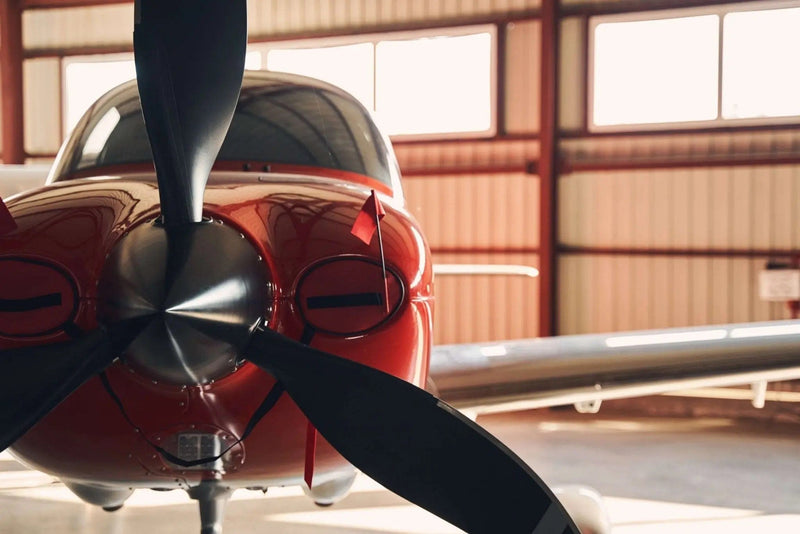
Every aircraft on this ramp is ours. We own it, we maintain it on our own schedule, and our instructors fly it daily.


Single-engine training on the Standard and Comprehensive programs is flown in the Cessna, Piper and Diamond aircraft. The Premium program is flown in the Cirrus SR22 Turbo. Multi-engine time is flown in the Piper Seminole.
FAA-approved, fully enclosed and it moves. Instrument scan, procedures, radio work and engine failures all transfer straight into the airplane, and a Redbird session is never canceled for weather or a maintenance squawk.
Simulator hours are built into every private pilot program — 2 hours on Standard and Premium, 5 hours on Comprehensive — and they carry a heavier load again on the instrument rating.
Every instructor here holds a commercial or ATP certificate, a CFI, and a current medical of their own — which means they have sat on the other side of the AME desk and can tell you what the morning is actually like. The instructor is legally pilot in command on every flight you make with them.
There are eleven of them. That matters more than it sounds: you are not stuck waiting on one person's calendar, and a canceled lesson usually gets refilled the same week rather than the next month. You are matched to an instructor at the start and you can change if the fit is wrong. Nobody takes it personally.

On Google the same three things come up over and over, and none of them is the price.
The most repeated compliment in our reviews is not the aircraft. It is the debrief — the twenty minutes on the ground where the lesson gets turned into something you can repeat.
Eleven instructors and a fleet we own means lessons happen when we say they will. Career students on a timeline notice this more than anyone.
The number you enroll at is the number you finish at. Reviewers mention it constantly, which tells you something about the rest of the industry.
The medical is the gate. This is what sits on the other side of it. These are full package prices, not deposits and not estimates.
Where every career starts. The certificate the third class covers and the first class covers comfortably.
Non-negotiable for a career. Every airline job and almost every commercial one assumes you hold it.
Flown in the Piper Seminole. Twin time is what recruiters look for and it is the cheapest rating on this page.
Private through commercial with the instrument and multi-engine ratings inside it, run as one continuous program.
The Comprehensive private pilot program is $15,900 for 60 logged hours, and the Premium program is $22,500 flown entirely in the Cirrus SR22 Turbo. Enrolled students train at the $179 per hour package rate, wet, single-engine.
One thing no package includes, and no school's package can: the 1,500 hours of total time an ATP certificate requires under FAR 61.159. Those hours come from working — instructing, banner towing, charter, survey — after your commercial certificate is in hand. Budget for the certificates. Plan for the hours. They are two different problems and conflating them is how people end up surprised in year three.
Sit down with us at Van Nuys and we will map the medical, the certificates and the 1,500 hours against your age, your timeline and your budget. It costs nothing and it is the single most useful hour you can spend at the start of a pilot career.
The questions people actually type, with the regulation number attached to each answer.
A first class medical certificate is valid for airline transport pilot privileges for 12 calendar months if you were under 40 on the date of the examination, and 6 calendar months if you were 40 or over. Those periods are set by 14 CFR 61.23(d) and they run to the end of the last day of the month. The certificate then continues to serve as a second class and a third class for longer periods, so it does not stop being useful when the ATP period ends.
The three classes match three levels of privilege. A third class medical covers private, recreational, student and flight instructor flying and requires 20/40 distant vision in each eye. A second class medical covers commercial privileges, is valid 12 calendar months for those privileges at any age, and requires 20/20 distant vision. A first class medical covers airline transport pilot privileges, requires 20/20 distant vision, and adds an ECG at 35 and annually from 40.
No. You do not need any medical certificate to begin flight lessons, and you do not need one for a discovery flight. You need a medical before your first solo, which for most students is somewhere between 15 and 25 hours in. If you are training toward an airline career, get the first class rather than the third, because the first class standards are the strictest and passing them settles every class below.
Yes. Under 14 CFR 61.23(d) one certificate carries three expiry dates that run simultaneously from the examination date. A first class issued to a 42-year-old on 12 March 2026 gives ATP privileges through 30 September 2026, commercial privileges through 31 March 2027, and private, student and flight instructor privileges through 31 March 2028. Nothing is reissued; the same piece of paper simply steps down.
14 CFR 67.103 requires distant visual acuity of 20/20 or better in each eye separately, with or without corrective lenses, plus near vision of 20/40 at 16 inches and, from age 50, intermediate vision of 20/40 at 32 inches. It also requires normal fields of vision. The standard is correctable acuity, so glasses and contact lenses are acceptable at every class; the certificate is simply issued with a limitation requiring you to wear them.
Yes, but not at every exam and not at every age. Under 14 CFR 67.111(b) an electrocardiogram is required at the first first-class application after your 35th birthday, and then annually after your 40th birthday. There is no ECG requirement at second or third class. The ECG must be dated no earlier than 60 days before the application.
Yes. Corrective lenses are explicitly permitted by 14 CFR 67.103(a), which asks for 20/20 or better in each eye with or without correction. If you need glasses or contacts to reach 20/20, the first class medical is issued with a limitation stating that corrective lenses must be worn while exercising the privileges of the certificate. Laser vision correction is also routinely accepted after a healing and stability period.
14 CFR 67.111 through 67.113 list conditions including myocardial infarction, angina, coronary heart disease requiring treatment, cardiac valve replacement, a permanent pacemaker, heart replacement, epilepsy, a disturbance of consciousness without satisfactory explanation, psychosis, bipolar disorder and substance dependence. Many of these are still certificated in practice through a Special Issuance under 14 CFR 67.401. Only an AME or the FAA can determine your outcome; no flight school can.
The fee is set by the individual aviation medical examiner, not by the FAA and not by any flight school, so it varies from one office to another and city to city. A first class exam costs more than a third class because it includes additional vision testing and, from age 35, an electrocardiogram. Call two or three examiners from the FAA AME locator and ask before you book.
Complete the FAA MedXPress application online first, then use the FAA AME locator to find an examiner. Check that the examiner is authorized for first class exams, because a Senior AME can issue all three classes while other examiners are designated for second and third class only. Bring photo identification, your glasses or contacts with the prescription, and records for anything you disclosed. Most applicants are issued the same morning.
For most commercial flying, yes. A second class medical certificate covers commercial pilot privileges and is valid 12 calendar months for those privileges regardless of your age, under 14 CFR 61.23(d). You need a first class only to exercise airline transport pilot privileges, which is what airline operations under Part 121 require. Many working pilots hold a first class anyway because it steps down to a second class for the same 12 months.
The three private pilot packages, what each one includes, the financing options and a realistic timeline built around how often you can actually fly. Sent to you in one email. Nobody will pressure you.
Loved On Google
Every review below is real and shown verbatim, in the reviewer’s own words — written by the people who learned to fly here, not by us.
SAFETY FIRST
Very safety and detail oriented. Pre-flight briefing explained everything there was. To my knowledge, this flight school is exceptional in their ability.
DISCOVERY FLIGHT
I recently had the chance to take my first-ever discovery flight, and it was nothing short of amazing! From the moment I stepped into the cockpit, the...
SUNSET CIRRUS
It was a great flight! I did a sunset flight and Alex let us fly an awesome. Website was easy to book, and the plane itself was really fun to fly...
FLYING LESSON
We had a great flying lesson with Ralph and came away with a much better understanding of both the aircraft and the principles of flight. Ralph is a...
KIDS LUXURY FLIGHT
I got 2 luxury discovery flights for my kids. I wanted them to have the experience of flying. Our instructor Alex was amazing he made sure they feel...
HONEYMOON SURPRISE
Last minute booking to surprise my wife on our honeymoon. She had no experience with flying and was scared of flying, but Alex was very easygoing and knew...
FULL-MOTION SIM
Amazing flight school in van nuys airport. I have been a student here for the past few months and i could not be happier. I started doing a lot of...
DISCOVERY FOR TWO
I booked a Discovery Flight for Two for my girlfriend's birthday and it was the perfect gift for her. She couldn't have been more excited to get to...
SIMULATORS
Very professional and great airplanes. I love the flight simulators. The pricing is very fair compared to any other flight school
TEEN FIRST LESSON
We gifted our teenage son his first flying lesson. He was so excited! Alex greeted us and gave a reassuring brief that made us all feel comfortable and at...
FIRST-TIME FLYER
Flying is my husband's hobby and I was incredibly anxious and apprehensive about the discovery flight. However, I felt completely safe and at ease once we...
SAFETY FIRST
Very safety and detail oriented. Pre-flight briefing explained everything there was. To my knowledge, this flight school is exceptional in their ability.
DISCOVERY FLIGHT
I recently had the chance to take my first-ever discovery flight, and it was nothing short of amazing! From the moment I stepped into the cockpit, the...
SUNSET CIRRUS
It was a great flight! I did a sunset flight and Alex let us fly an awesome. Website was easy to book, and the plane itself was really fun to fly...
FLYING LESSON
We had a great flying lesson with Ralph and came away with a much better understanding of both the aircraft and the principles of flight. Ralph is a...
KIDS LUXURY FLIGHT
I got 2 luxury discovery flights for my kids. I wanted them to have the experience of flying. Our instructor Alex was amazing he made sure they feel...
HONEYMOON SURPRISE
Last minute booking to surprise my wife on our honeymoon. She had no experience with flying and was scared of flying, but Alex was very easygoing and knew...
FULL-MOTION SIM
Amazing flight school in van nuys airport. I have been a student here for the past few months and i could not be happier. I started doing a lot of...
DISCOVERY FOR TWO
I booked a Discovery Flight for Two for my girlfriend's birthday and it was the perfect gift for her. She couldn't have been more excited to get to...
SIMULATORS
Very professional and great airplanes. I love the flight simulators. The pricing is very fair compared to any other flight school
TEEN FIRST LESSON
We gifted our teenage son his first flying lesson. He was so excited! Alex greeted us and gave a reassuring brief that made us all feel comfortable and at...
FIRST-TIME FLYER
Flying is my husband's hobby and I was incredibly anxious and apprehensive about the discovery flight. However, I felt completely safe and at ease once we...
Reviews shown verbatim, exactly as each reviewer published them.
Aviation News
Notes from the flight line at Van Nuys — weather, regulation changes, checkride questions and the cost of training, written up as they come.
Open 7 days · 9:00 AM – 9:00 PM
Los Angeles Flight School