The FAA color vision test, and what happens if you don’t pass it
Color vision is checked at every FAA medical under 14 CFR Part 67. Failing one screening test does not end your flying career — the FAA publishes a list of acceptable tests, you may take more than one, and there is a documented route to having a color vision limitation removed from your certificate.
One failed plate test is not a verdict
If you have just been handed a sheet of colored dots and told you missed too many, read this before you do anything else. You have not lost anything yet. The color vision standard in 14 CFR §67.103(c), §67.203(c) and §67.303(c) is one sentence long and it is identical for all three classes of medical: the “ability to perceive those colors necessary for the safe performance of airman duties.”
Notice what that sentence does not say. It does not name a test. It does not set a score. The regulation states an outcome, and the FAA decides separately — in guidance to Aviation Medical Examiners, not in the rule itself — which instruments are acceptable for demonstrating it. That distinction is the whole reason there is more than one road through this.
Two things follow. First, if you do not pass one acceptable test you can be tested with another. Second, if you cannot pass any of them, an AME can still issue you a medical certificate with a color vision limitation, and that limitation can later be removed. People with color vision deficiency are flying today, including for a living. The process is bureaucratic and slow. It is not closed.

Background reading
This page is about the testing and the process — which tests exist, what a failure actually does to your certificate, and how the limitation comes off. If you want the wider picture first — what color blindness is, the different types, why aviation cares about color at all, and the career outlook — read our longer explainer: Understanding color blindness: can you become a pilot? FAA rules and your options. Start there if this is all new to you, then come back here for the mechanics.
The standard is the same for a student pilot and an airline captain
Most people assume the first class medical has a tougher color vision bar than the third. It does not. The wording is word-for-word identical across all three classes.
| Class of medical | Regulation | Color vision standard |
|---|---|---|
| First class (ATP privileges) | 14 CFR §67.103(c) | Ability to perceive those colors necessary for the safe performance of airman duties |
| Second class (commercial privileges) | 14 CFR §67.203(c) | Ability to perceive those colors necessary for the safe performance of airman duties |
| Third class (private and student privileges) | 14 CFR §67.303(c) | Ability to perceive those colors necessary for the safe performance of airman duties |
Source: 14 CFR Part 67, Subparts A, B and D. Vision standards elsewhere in Part 67 do differ by class — distant visual acuity is 20/20 for first class and 20/40 for third — but the color paragraph is common to all three.
What color vision test does the FAA actually use?
This is the part where most articles on the internet are years out of date, including some still being published. The answer changed.
For decades the screen almost everyone met was a book of pseudoisochromatic plates — Ishihara, Dvorine, Richmond HRR — the colored dot patterns with a number hidden inside. Those plates are still what most people picture when they hear “color blindness test”, and they are still used in plenty of non-aviation settings. For FAA pilot screening, the FAA moved to a published list of computer-based instruments, effective 1 January 2025, and its guidance to examiners is blunt that tests not on that list are not acceptable.
Three instruments are on the current published list for pilots. Each has its own numeric pass standard:
| Test | Abbreviation | Published passing standard |
|---|---|---|
| Colour Assessment & Diagnosis test | CAD | Red-green threshold of 1.7 if color normal; under 6 if diagnosed deutan; under 12 if diagnosed protan — and yellow-blue under 2.4 |
| Rabin Cone Contrast Test (military version) | RCCT | 55 or higher on each of red, green and blue |
| Waggoner Computerized Color Vision Test | WCCVT | General 21 of 25 or better with tritan 10 of 12; or protan 20 of 32, deutan 20 of 32 and tritan 10 of 12 |
Two details in there are worth more than the scores themselves. You may take more than one. The tests measure slightly different things, and a person who fails one can pass another — this is normal, it is anticipated by the guidance, and it is not gaming the system. And passing any single acceptable test settles it completely: the FAA’s own guidance states that if an individual passes any of the acceptable computer tests, no limitation, no Letter of Evidence and no Statement of Demonstrated Ability is needed for any class.
Lists change. The one above is what the FAA published for pilot screening as of this writing, and we will update it, but the person who knows what is current on the day of your exam is your AME. Ask before you book which instruments they hold — not every examiner has all three, and that alone decides which test you sit.
What happens if I fail the FAA color vision test
Nobody explains this sequence clearly, which is why the failure feels final when it is not. Here is the shape of it.
Try another acceptable test
Not passing one instrument does not disqualify you from the others. There is also no published cap on attempts — FAA guidance states there is no limit to the number of trials allowed. If your examiner only has one machine, you can be tested elsewhere and have the result documented.
A certificate is still issued
If you cannot pass any acceptable test and you are otherwise qualified, the AME does not have to defer you and does not have to deny you. Guidance directs the examiner to issue a third class medical carrying limitation #104: “Valid for day visual flight rules (VFR) only.” You hold a real medical certificate and you can fly.
Ask for the limitation to be reviewed
The FAA operates a color vision limitation review. It is the route for someone who cannot pass the screening tests but wants a first or second class certificate, or who holds an older limitation, Letter of Evidence or Statement of Demonstrated Ability and wants it revisited. It is submitted with an attestation and test results, and it is decided case by case.
The limitation comes off
A color vision limitation is not permanently welded to your file. Holders of the older limitations #16 and #17 can have them removed by passing an acceptable test. This is the single fact most worth knowing on the day you fail a screen — the restriction is a status, not a sentence.
This area has changed materially since 2024 and older write-ups describe a different process — the Statement of Demonstrated Ability, the light gun signal test on an airport tower, the operational colour vision test flown with an inspector. Those mechanisms shaped the current system and people still hold documents from them. Do not assume any of it is the step you will be asked to take. Confirm the current procedure with your AME and with the FAA before you make plans around it.
What a color vision limitation actually stops you doing
It is a genuine restriction and pretending otherwise would be useless to you. It is also narrower than most people fear.
| Limitation code | Wording on the certificate | What it means in practice |
|---|---|---|
| #104 | Valid for day visual flight rules (VFR) only | The current color vision limitation. Daytime VFR flying only. No night flying, and not valid for IFR operations. |
| #17 | Not valid for night flying or by color signal control | An older limitation still held by many pilots. Rules out night flight and operations conducted by light gun signal. |
| #16 | Not valid for flights requiring color signal control during daylight hours | Narrower again — daytime flying is fine, light gun operations are not. |
| #5 | Third-Class Letter of Evidence (LOE) | A legacy document some pilots hold from the previous system. |
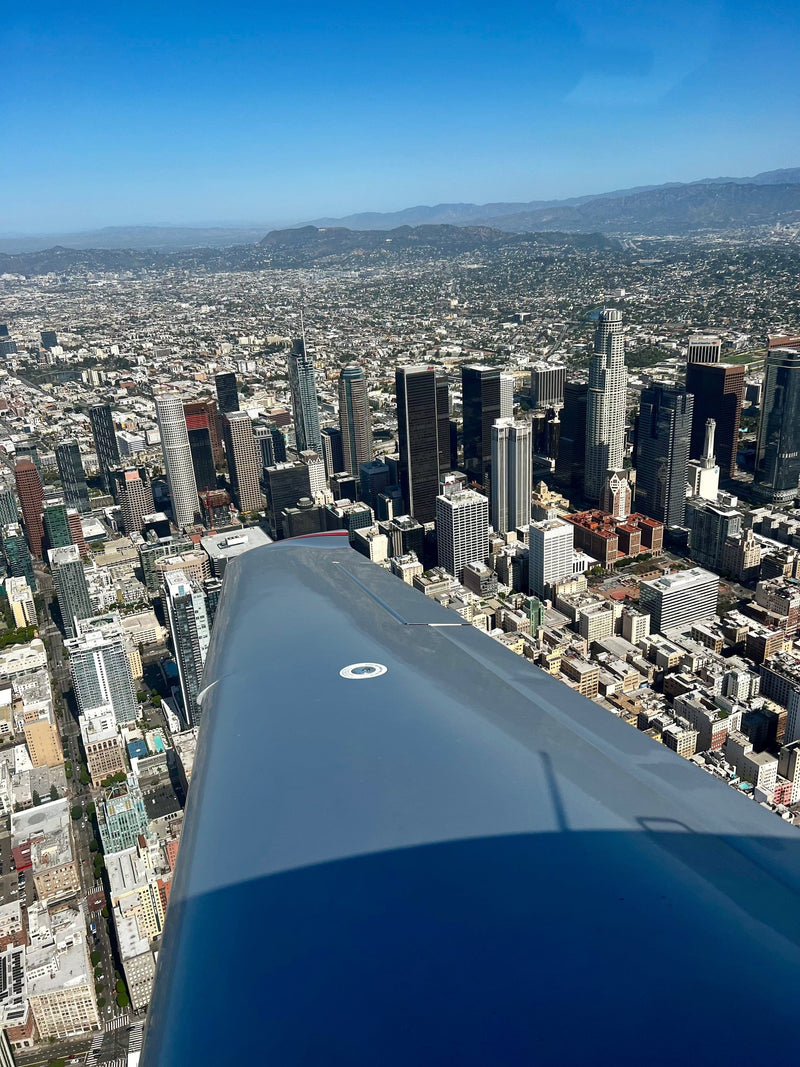
Read #104 carefully, because the practical consequence is specific. You can still earn a private pilot certificate. You can still fly friends and family, still fly cross-country, still fly the Los Angeles coastline on a Saturday morning. What you cannot do while it stands is fly at night, and that has knock-on effects: the three hours of night training and the ten night takeoffs and landings required under FAR 61.109 for a private pilot certificate are a problem you have to solve, not ignore. This is the conversation to have with an instructor and an AME early, not halfway through a course.
For a career, the limitation matters more. Commercial operations are not realistically compatible with a day-VFR-only restriction. That is precisely why the removal route exists and why anyone with professional ambitions should treat getting the limitation lifted as step one of their training plan rather than a problem for later.
Online color blindness tests prove nothing
We get calls from people who have decided they cannot become a pilot because of a website. Not an examiner — a website. They took a free Ishihara test on a phone at midnight, missed four plates, and spent the next week grieving a career they never actually tried for.
Those tests are worthless as evidence. Color reproduction on a consumer screen is not controlled: brightness, color temperature, night mode, ambient light, the age of the panel and the browser’s color management all shift the result. Printed plate books have the same problem when they are photocopied or faded. The FAA does not accept any of it, and neither should you.
The corollary is also true. Passing an online test does not clear you. The only result that counts is one obtained on an FAA-acceptable instrument, administered by an examiner, and recorded in your file. If you are worried, go and get the real answer. It is a cheaper way to spend an afternoon than a year of anxiety.

Settle the color question before you spend real money
You do not need a medical certificate to start flight training, and you do not need one to fly a discovery flight. You do need one before you fly solo, which typically lands somewhere between 15 and 25 hours in. That gap is where people get hurt financially — they enrol, they fly a dozen lessons, and only then find out the medical has a complication.
If you already suspect a color vision deficiency, invert the order. Book the medical first. Find an examiner through the FAA’s AME locator, ask which color vision instruments they hold, and get the result on paper before you commit to a program. The answer is usually better than people expect, and when it is not, you have found out for the price of one appointment instead of ten flight hours.
Small things that are worth doing anyway: go rested, go earlier in the day, and do not sit the test straight after a night shift or a long drive. Ask about the lighting in the room. Wear your normal corrective lenses if you have them, but leave any tinted or color-correcting lenses at home — turning up in glasses designed to alter color perception is a good way to invalidate the result.

Can you fly jets if you’re colorblind?
Yes, people do. The honest version of the answer has a condition attached, and we would rather give you the condition than a slogan.
The route runs through the limitation
Professional flying requires a second class medical for commercial privileges and a first class for ATP. A day-VFR-only restriction is incompatible with that work. The path to a jet is the path to getting the limitation removed — there is no way around it and no operator who will ignore it.
Many people clear it
Mild deficiency is common and often passes on one of the acceptable instruments even after a plate test was failed. A large share of the people who arrive convinced their career is over turn out to be in this group. Nobody can promise you are, including us.
Some people don’t, and still fly
If the limitation stands, a private pilot certificate and day VFR flying remain fully available. That is not the consolation prize it sounds like. Most of the flying most pilots ever do — the hundred-mile lunch, the coastline, taking your family up — happens in daylight under VFR.
We are a flight school, not an Aviation Medical Examiner. We can tell you what the standard says and what the process is. Only an AME or the FAA can tell you what your result will be.
What this means if you want to fly with us
You can fly a $229 discovery flight with no medical certificate at all. You take the controls, the hour is loggable dual instruction, and if you enrol within 24 hours the full price is credited against your program. Nobody asks about your color vision to book it. If you want to find out whether you even like this before you deal with the FAA, that is the order to do it in.
Sport Pilot at $8,400 requires no medical certificate either. A valid US driver’s licence is the alternative, provided no FAA medical has previously been denied, suspended or revoked — that proviso matters, and it is the reason we tell people not to apply for a medical they are not ready for. Sport Pilot has real limits: day VFR, light sport aircraft, one passenger. For some readers of this page those limits overlap almost exactly with what a #104 limitation would impose anyway.
If the goal is a private pilot certificate or a career, book the free consultation. Bring whatever test result you already have. We will tell you honestly where you stand and where you need an AME rather than us, and we will not sell you a program you might not be able to finish.

The aircraft you would actually be flying
Every aircraft on this ramp is ours — owned, inspected on our schedule under FAR 91.409(b), and flown by our instructors daily. Modern panels, legible displays, and cockpits you can learn in.


Single-engine training on the Standard and Comprehensive programs is flown in the Cessna, Piper and Diamond aircraft. The Premium program is flown in the Cirrus SR22 Turbo.
A full-motion simulator, and it is not a toy
FAA-approved, fully enclosed, and it moves. If you are waiting on a medical decision, sim time is the one part of training you can get on with in the meantime — procedures, radio work and instrument scan all transfer straight to the aircraft.
Simulator hours are built into every private pilot program — 2 hours on Standard and Premium, 5 hours on Comprehensive.
Career instructors, not hour-builders passing through
Every instructor here holds a commercial or ATP certificate plus a CFI and a current medical, and is legally pilot in command on every flight you make with them. There are eleven of them, so your training does not stall because one person’s calendar filled up.
That matters more than usual on this topic. An instructor who has walked two or three students through a color vision limitation knows which questions to put to an AME and in what order, and knows when to tell you to stop flying and go sort the paperwork out. You are matched to an instructor at the start and you can change if the fit is wrong. Nobody here will be offended.

4.9 stars, 500+ reviews
Across Google, Yelp and the aviation forums, the same three things come up again and again.
Straight answers
The compliment we get most from people in the middle of a medical problem is that we told them the awkward part instead of the comfortable part.
Scheduling that works
Eleven instructors and a fleet we own means lessons happen when we say they will, not three weeks later.
Prices that don’t move
The number you enrol at is the number you finish at. Reviewers mention this constantly.
Two things you can do without a medical certificate
Nothing on this list requires you to have settled your color vision question first. Deal with the FAA in parallel, not before.
Free in-person consultation
Sit down at Van Nuys with someone who has been through this with other students. Bring any test result you have. We will map out the order to do things in and tell you where you need an AME instead of us.
Discovery Flight For One
A real lesson. You fly the aircraft, the time is loggable dual instruction, and no medical certificate is required to do it. Credited in full against any program if you enrol within 24 hours.
Sport Pilot Program
No FAA medical certificate required — a valid US driver’s licence is the alternative, provided no medical has been denied, suspended or revoked. Day VFR, light sport aircraft, one passenger.
Private pilot programs run $10,900 Standard (40 hours logged), $15,900 Comprehensive (60 hours logged) and $22,500 Premium in the Cirrus SR22 Turbo. Enrolled students train at the $179 an hour package rate, wet. Financing from $2,500 down. We would rather you had your medical answer before you commit to one of these.
Get a straight answer before you spend anything
Forty-five minutes at Van Nuys Airport, no cost and no pitch. Bring your test result, your questions and your worst-case scenario. We will tell you which parts we can help with, which parts belong to an AME, and what the realistic order of operations looks like from here.
Color vision and medicals
Understanding color blindness: can you become a pilot?Can you be a pilot with glasses or color blindness?How to get your FAA medical certificate in Los AngelesFAA medical certificate classes explainedFAA color vision test — questions people actually ask
Yes. Color vision is assessed at every FAA medical under 14 CFR Part 67, but the standard is functional — the ability to perceive the colors necessary for safe performance of airman duties — not a specific score. If you do not pass one acceptable test you can take another, and if you cannot pass any of them an AME can still issue a third class medical carrying limitation #104, “Valid for day visual flight rules (VFR) only.” Many pilots with color vision deficiency fly, and the limitation can later be removed.
Yes. A color vision deficiency does not prevent you from earning a private pilot certificate. The worst realistic outcome of a failed screening is a medical certificate with limitation #104, “Valid for day visual flight rules (VFR) only” — you still train, still solo, still take the checkride, still carry passengers, but you do it in daylight under VFR. Sport Pilot needs no FAA medical certificate at all.
The FAA publishes a list of acceptable color vision screening instruments for pilots, and effective 1 January 2025 that list is computer-based: the Colour Assessment & Diagnosis test (CAD), the Rabin Cone Contrast Test (RCCT, military version, requiring 55 or higher on red, green and blue) and the Waggoner Computerized Color Vision Test (WCCVT). FAA guidance is explicit that tests not on the published list are not acceptable. Ask your AME which instruments they hold before booking, because not every examiner has all three.
You are not denied. You can be tested on another acceptable instrument, and there is no published limit on the number of attempts. If you cannot pass any of them and are otherwise qualified, FAA guidance directs the examiner to issue a third class medical certificate with limitation #104, “Valid for day visual flight rules (VFR) only,” rather than deferring or denying. You can then request an FAA review to have that limitation reconsidered.
Yes. FAA guidance states there is no limit to the number of trials allowed on an acceptable color vision test, and you may attempt any or all of the three instruments on the current list. Passing any single acceptable test resolves the issue completely — the FAA's own wording is that no limitation, no Letter of Evidence and no Statement of Demonstrated Ability is then needed for any class.
Yes. Passing any acceptable color vision test removes the need for a limitation at any class of medical. Pilots holding the older limitations #16 or #17 can have them removed by passing an acceptable test, and there is an FAA color vision limitation review for people who cannot pass the screening tests but want a first or second class certificate, or who hold a legacy Letter of Evidence or Statement of Demonstrated Ability. Requests are decided case by case, so confirm the current procedure with your AME.
Limitation #104 reads “Valid for day visual flight rules (VFR) only,” so yes — while it stands you fly in daylight under VFR. The older limitation #17 reads “Not valid for night flying or by color signal control.” This matters for the private pilot certificate, because FAR 61.109 requires 3 hours of night flight training including 10 night takeoffs and landings, so raise it with an instructor and an AME before you start a course rather than halfway through.
People do, but the route runs through having the limitation removed rather than around it. Commercial flying requires a second class medical and ATP privileges require a first class, and a day-VFR-only restriction is not compatible with that work. Because the FAA now accepts three different computer-based screening instruments and you may attempt all of them, a meaningful number of people who failed a plate test go on to pass one of them. Nobody can promise you will.
It depends entirely on whether the color vision limitation can be lifted, not on the diagnosis itself. A pilot who passes any acceptable FAA color vision test holds an unrestricted medical and competes for jobs on equal terms. A pilot who cannot, and holds limitation #104 “Valid for day visual flight rules (VFR) only,” is realistically limited to private flying while that restriction stands. Only an AME or the FAA can tell you which group you are in.
No, and they carry no weight at all. Screen brightness, color temperature, night mode, ambient light and panel age all shift the colors, so a home result is not evidence in either direction. The FAA accepts results only from the instruments on its published acceptable-test list, administered by an examiner and recorded in your file. Failing an online test is not a reason to abandon flight training.
No. Sport Pilot requires no FAA medical certificate — a valid US driver's licence serves as the alternative, provided you have never had an FAA medical certificate denied, suspended or revoked. That proviso is important: if you are unsure about color vision, do not apply for a medical casually, because a denial closes the driver's-licence route. Our Sport Pilot program is $8,400.
No — colour blindness, spelled either way, is not disqualifying under 14 CFR Part 67. The regulation asks only for the ability to perceive the colours necessary for the safe performance of airman duties, and the FAA provides several acceptable tests plus a documented route to removing a colour vision limitation from a certificate. The realistic worst case is a day-VFR-only restriction, not a refusal to certificate you.
No. A $229 discovery flight at Van Nuys requires no medical certificate of any kind — you fly the aircraft with an instructor as pilot in command, and the hour is loggable dual instruction. You need a medical before you fly solo, which typically falls between 15 and 25 hours into training. The full $229 is credited against any program if you enrol within 24 hours.
Get the full training plan and price sheet
The three private pilot packages, what each one includes, the financing options and a realistic timeline built around how often you can actually fly. Sent to you in one email. Nobody will pressure you.
- Every package price, itemised
- Financing from $2,500 down
- A timeline based on your schedule