SAFETY FIRST
★★★★★
Very safety and detail oriented. Pre-flight briefing explained everything there was. To my knowledge, this flight school is exceptional in their ability.

Fear of flying is rarely fear of heights and often not fear of crashing. It is what happens when a person is placed somewhere they cannot see, cannot interpret, cannot influence, and cannot leave. This page takes that apart condition by condition, and then describes the one hour that reverses all four at once.
Flight instructors notice something odd early in their careers. The people who are frightened of flying are almost never frightened while flying the aircraft. Put a nervous passenger in the left seat of a four-seat trainer — smaller, louder, lower, closer to the weather, every objective factor worse — and the fear frequently does not turn up. That is a strange result if the fear is about altitude or about the possibility of a crash, because both of those are still present, and arguably more so.
It is not a strange result at all if the fear is about control and information. Those are the two things that change between the two seats, and they change completely.
This page is the argument for that, laid out so you can disagree with it. It is also the reason a flight school has anything to contribute here at all. We are not psychologists and we are not going to pretend to be. What we have is a fairly clear view of the specific conditions a cockpit creates, and they happen to be the exact inverse of the conditions a cabin creates.

Each of these is a well-recognized amplifier of anxiety on its own. A commercial cabin applies all four simultaneously for several hours.
Two thirds of seats on a narrowbody have no usable view. The ones that do are frequently over a wing, behind an engine, or in the dark. Your balance system is reporting motion your eyes cannot corroborate, which is the same sensory conflict that produces motion sickness, and your brain treats unexplained motion as more threatening than explained motion. Every pilot in the world will tell you the same thing: the horizon is calming.
A normal flight produces perhaps twenty distinct mechanical noises, and nobody ever tells passengers what any of them are. Gear retraction sounds like something breaking. A noise abatement thrust cutback sounds exactly like an engine quitting. In the absence of an explanation your nervous system supplies one, and the explanation it supplies is not a neutral one, because that is what nervous systems are for.
There is nothing you can do that changes any outcome. No control, no input, no decision. This is the condition that most reliably converts discomfort into distress, and it is the reason the same bump feels different depending on which seat you are in. Perceived control does not have to be exercised to work. It has to exist.
The door is shut and will not open for five hours, which is a problem in itself for anyone with a claustrophobic component. On top of it, you have delegated your survival to a person you have never met, will never see, and cannot ask a question of. Trust in an anonymous stranger is a much thinner thing than trust in a person who is talking to you.
You have already run this experiment. In a car on a mountain road, the driver is usually fine and the passenger is usually not. Nothing about the vehicle changed between those two seats. Same corners, same speed, same suspension.
What changed is prediction. The driver’s brain knows which way the car is about to move, roughly half a second before it moves, because the driver is the thing deciding. Predicted motion is processed differently from imposed motion. This is the standard explanation in the motion sickness literature and it is also why the passenger who takes the wheel stops feeling sick within a few minutes.
Flying is the same effect with the volume turned up. The pilot flying is never surprised by the aircraft, because every input came from them and every noise is a consequence of something they did. The passenger is surprised by all of it. That is not a difference in courage. It is a difference in information flow, and it is fixable.

A lot of people report the two days before a flight as the worst part. That fact tells you where the fear lives.
If the fear were a response to the physical experience of flying, it would peak in the air. For a large number of people it peaks in the departure lounge, or the night before, or at the moment the booking confirmation arrives. What is happening in those moments is not turbulence. It is imagination running unchecked in the absence of information, which is precisely what an information vacuum produces.
This is also why reciting accident statistics does so little. The statistic answers the question "how likely is a crash". The nervous system is asking a different question: "what is about to happen to me, and can I do anything about it". Numbers do not answer that. A sequence of events, told in order, in advance, by somebody who knows, does answer it.
Everything useful in this field follows from that distinction. Explaining the mechanism helps. Naming the noises helps. Being able to stop something helps. Being told you are statistically safe does not help much, and being told to relax helps not at all, because neither of them supplies control or information.
The whole of condition two, in one table. Read it once and a large part of the fear loses its subject matter.
| What you hear or feel | When | What it actually is |
|---|---|---|
| A rising whine, then a solid thunk under the floor | At the gate, before pushback | Hydraulic pumps coming up to pressure, then the door or jetbridge latching. Nothing has moved yet. |
| A rhythmic barking, like a large dog, every couple of seconds | On the ground and during taxi | On Airbus A320-family jets this is the Power Transfer Unit, a pump that borrows pressure from one hydraulic system to feed another when the second engine is not running. It is famous, it is normal, and it stops once both engines are turning. |
| Engines spool up, a firm push into the seat | Takeoff roll | Takeoff thrust. The push you feel is roughly a quarter of the force gravity is already applying to you sitting still. |
| A heavy clunk and the wind noise suddenly drops | 10 to 20 seconds after the wheels leave | The landing gear folding into the wheel wells and the doors closing over it. The aircraft gets quieter and faster at the same time, which is why the drop in noise feels like a loss of power. |
| The engine note falls away sharply and the nose lowers | Between 800 and 3,000 feet above the airport | A thrust cutback. FAA Advisory Circular 91-53A lets crews reduce power for noise abatement at no less than 800 feet above field elevation and hold the profile to 3,000 feet. This is the single most misread moment in airline flying: it feels exactly like an engine quitting, and it is a scheduled power reduction the crew makes on purpose. |
| A grinding, whirring noise, and the wing visibly gets thinner | Climbing through roughly 1,000 to 3,000 feet | Flaps and slats retracting on a speed schedule. Big wing for slow flight, small wing for fast flight. The wing is meant to change shape. |
| Small repeated jolts, like a car on a cattle grid | Any phase of flight | Air is not smooth. It has texture, layers and rising columns over hot ground, and the aircraft is riding over them. Nothing is breaking. |
| The wingtip flexing up and down several feet | Turbulence, and on every takeoff | The wing is a spring, deliberately. It is designed to bend so that gust loads are absorbed rather than resisted. A wing that did not move would be the problem. |
| Engines go quiet and the floor seems to fall away | Top of descent, 30 to 40 minutes before landing | Power back towards idle to start down. The sinking feeling is your inner ear reporting a change in vertical speed of a few hundred feet a minute, which it exaggerates badly. |
| A rumble and a shudder, and panels lift off the top of the wing | Descent, and again after touchdown | Speedbrakes and spoilers. They spoil the lift on purpose to let the aircraft come down or stay down. |
| A whine, then a firm mechanical thump under your feet | Five to ten minutes before landing | Landing gear extending and locking. The thump is the locks engaging, and the crew wants to hear it. |
| A loud roar immediately after the wheels touch | Landing rollout | Reverse thrust. Loudest noise of the whole flight, made while you are already on the ground doing 130 knots and slowing. |
Power reduction altitudes are from FAA Advisory Circular 91-53A, Noise Abatement Departure Profile. Everything else on this table is what the aircraft is doing mechanically at that moment.
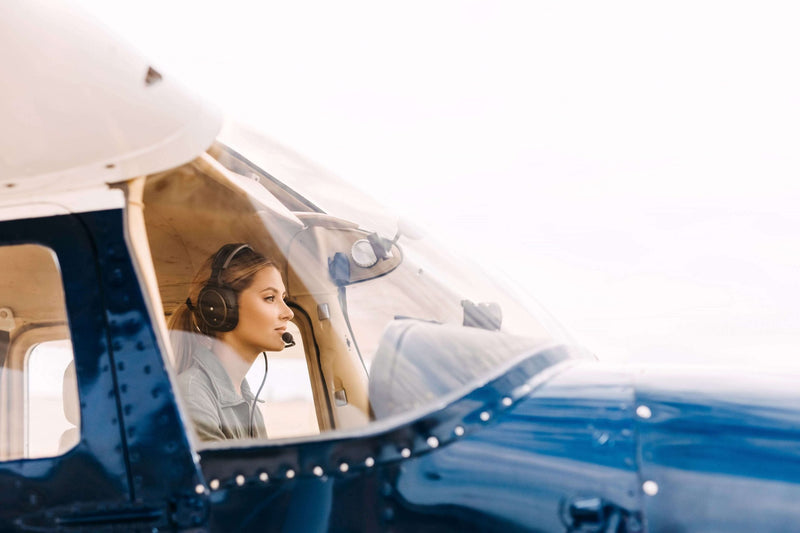
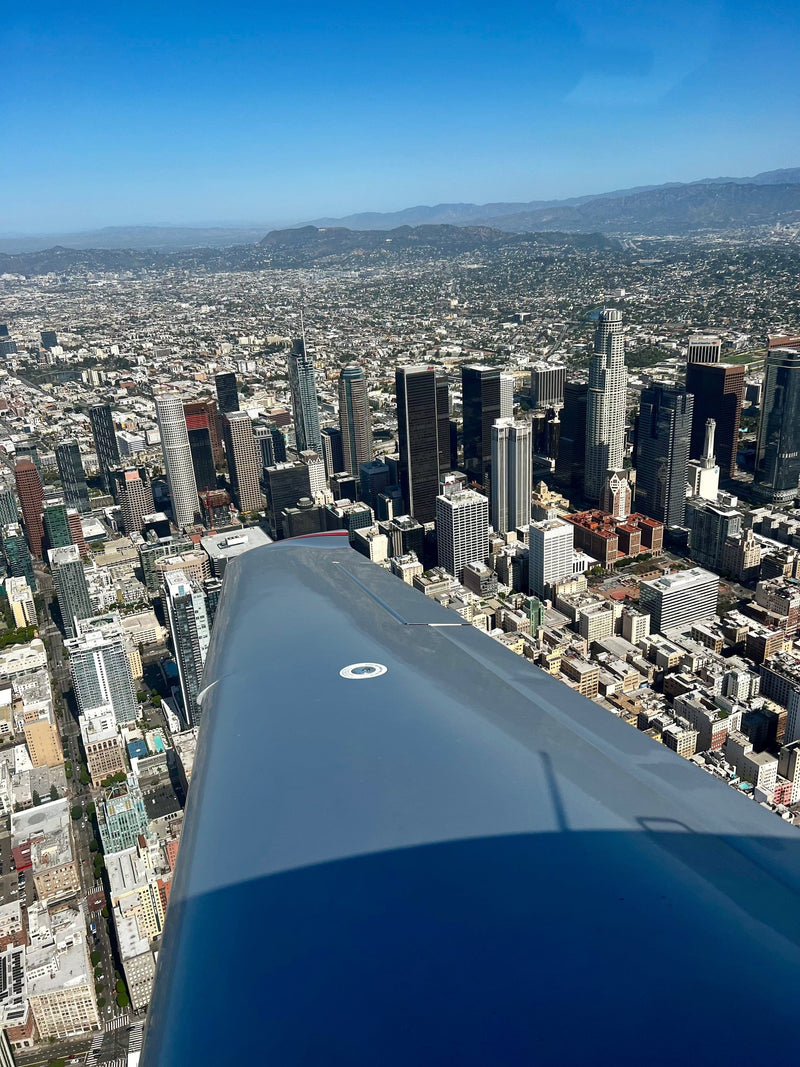
Take the four conditions and run them backwards. You can see: windows on three sides, a horizon in front of you, and the San Fernando Valley underneath you looking exactly like the map you already know. You can interpret: the noise changed because you moved the throttle, so the noise is yours.
You can influence: your hands are on the controls, the aircraft is responding to your inputs, and within two minutes you will notice that it is stable and largely wants to fly itself. And the person responsible for your safety is 18 inches away, has a name, is answering your questions, and is legally pilot in command for the whole flight under Part 61.
That is four for four, in about an hour, for $229. We are not claiming it resolves a phobia, and we do not publish a success rate because we have not run a study. What we are claiming is narrower and testable: the specific conditions that generate most fear of flying are absent from the left seat of a training aircraft. You are welcome to go and check.

We build pilots. We are not a clinic, and this page is not medical advice.
One caveat, and it matters. A mechanism is not a diagnosis. Some people have aerophobia in the clinical sense, with a panic response, and for them the analysis above is interesting and the recommendation that follows from it is wrong.
If that is you, the sequence is a licensed psychologist first, using cognitive behavioral therapy and graded exposure, and an aircraft afterwards. A cockpit at 2,500 feet is a bad place to find out you needed clinical support. We would rather tell you that on a free phone call than sell you an hour you were not ready for.
If the thought of a flight brings on a racing heart, shortness of breath, sweating or a sense of dread you cannot talk yourself out of, that is a clinical picture and a licensed psychologist is the right first call. Cognitive behavioral therapy and graded exposure therapy have the strongest evidence behind them for specific phobias.
Plenty of people arrive here after doing that work, with a therapist who has suggested real-world exposure as the next stage. Some bring their therapist’s notes. That is a good use of an hour in the Redbird or in the aircraft, and we will work to whatever plan you have been given.
Two things, both honest: exposure to the real thing with a professional pilot sitting beside you, and an explanation of what is happening while it happens. No claims beyond that. We do not diagnose, we do not publish a success rate, and we will tell you on the phone if we think you should talk to someone else first.
Full-motion, FAA-approved, fully enclosed, and it does not leave the building.
The Redbird MCX gives you three of the four conditions back — you can see, you can interpret, you can influence — while adding a fourth the aircraft cannot: you can stop it and get out. A session is $189, and it is the step we suggest first for anybody who is unsure.
Small aircraft look frightening from outside and stop looking frightening once you are sitting in one with the door open on the ramp.


Single-engine training is flown in the Cessna, Piper and Diamond aircraft. The Cirrus SR22 Turbo carries a whole-airframe CAPS parachute, which is the aircraft most nervous first-timers ask about by name.
Condition four is about anonymity as much as it is about competence. On a discovery flight you meet your instructor before the flight, do the walkaround with them, and can ask them anything at any point including in the air. They hold a commercial or airline transport pilot certificate, a flight instructor certificate and a current medical, and they are legally pilot in command throughout. Discovery flights near you at Van Nuys start at $229 for sixty minutes.
They will also tell you what is about to happen before it happens, which is the entire remedy for condition two. If you say you want to stop, you stop, and Van Nuys is a few minutes away for the whole local flight.
Over 120 reviews, all on Google. What first-timers describe most often is the narration — being told what was coming before it arrived.
The line that comes up most in our Google reviews is about the briefing table, not the flight. People who arrive nervous mention being told what was about to happen before it happened.
Eleven instructors and a fleet we own means an hour on the ground before an hour in the air is a scheduling decision, not a favor.
You book at $229 or $189 and that is what it costs. Reviewers mention the absence of surprises about as often as they mention the view.
All 120+ reviews are on Google. We do not aggregate ratings from anywhere else, and we do not publish a figure we cannot point at.
The free consultation is first for a reason. Somebody reading a page about mechanisms at 1am needs a conversation more than a booking form.
Sit down with an instructor at Van Nuys and ask everything, including the questions you think sound stupid. Nothing is booked at the end of it unless you want it booked. If we think a psychologist should see you before an aircraft does, we will say so here.
A full-motion, FAA-approved, fully enclosed simulator on the ground. Turbulence, engine sounds, weather and motion, with a stop button and a door you can open. The safest possible first exposure, and it is never canceled for weather.
A real aircraft, a real hour, and you fly it. Your instructor is legally pilot in command and can take the controls at any moment. The time is logged as dual instruction, and the full price is credited against any program if you enroll within 24 hours.
Bring the person who talked you into this. One of you flies, the other sits behind and watches. The 90 and 120-minute versions are $399 and $499.
The shortest legal route to flying yourself: day VFR, one passenger, no Class B airspace without an endorsement. A real certificate with real limits, and a smaller commitment than a private pilot license.
The 40-hour package that meets the FAR 61.109 minimum. Most people who start this because they were frightened of flying never intended to get a license, and then did.
The Comprehensive Private Pilot program is $15,900 for 60 logged hours and the Premium program is $22,500 in the Cirrus SR22 Turbo. Instrument Rating $11,700, Multi-Engine add-on $5,100, Solo Certificate $5,500, Teens aged 10 to 15 $4,200. Financing starts at $2,500 down through Stratus Financial or our in-house plans. Enrolled students fly single-engine aircraft at $179 an hour wet inside their package. Aircraft are available to qualified pilots who have checked out with us — call for availability.
Half an hour with an instructor at Van Nuys, at no cost and with nothing booked at the end of it. If the four conditions above describe your experience, say so, and we will tell you which of the two steps to take first, or if a psychologist should come before either of them.
Prefer to write it down first? Use the contact form, or read what a discovery flight actually involves before you decide anything.
Because a passenger cabin removes four things at once: you cannot see out, you cannot interpret the noises, you cannot influence anything, and you cannot leave. Each of those is a recognized amplifier of anxiety on its own, and a commercial flight applies all four for hours at a time. Altitude is rarely the actual variable, which is why the same person can be calm on a balcony and frightened in row 24.
For most people, yes, though not for everyone. The clearest evidence is that nervous passengers are often fine when they are the one flying a small aircraft, where the objective risk factors are not lower and the aircraft is smaller and louder. What changes between the two seats is control and information, so those are the variables doing the work.
Because the driver’s brain predicts the motion about half a second before it happens, since the driver is the one deciding on it. Predicted motion is processed differently from imposed motion, which is the standard explanation in the motion sickness literature. It is the same mechanism that makes a bump feel different to a pilot and to a passenger.
Because the fear is generated by an information vacuum rather than by the physical experience. In the days before a flight there is nothing happening except imagination, and imagination fills a vacuum with the worst available answer. This is also why a sequence of events explained in advance calms people down more reliably than a safety statistic does.
It is a thrust cutback for noise abatement, not a failure. FAA Advisory Circular 91-53A permits crews to reduce power at no less than 800 feet above field elevation and to hold the profile to 3,000 feet. The landing gear has usually just retracted as well, so the aircraft becomes quieter and faster at the same moment, which makes the power reduction feel much larger than it is.
It reverses all four conditions at once. You can see the horizon, you know what the noises mean because you caused them, your hands are on the controls, and the person responsible for the flight is sitting next to you answering questions. A Discovery Flight For One at Van Nuys is $229 for 60 minutes and the instructor is legally pilot in command throughout.
Because it supplies neither control nor information, which are the two things that are actually missing. It also carries an implication that the fear is a failure of composure, which adds embarrassment to anxiety and makes people stop asking questions. Naming what is about to happen works. Telling somebody to calm down does not.
They answer a question the nervous system is not asking. A statistic addresses how likely a crash is; the fear is asking what is about to happen and whether anything can be done about it. Precise figures are still useful for explaining a specific event — for example that the NTSB recorded 26 seriously injured passengers from turbulence on US Part 121 airlines across 2009 to 2018 — but as a standalone argument they rarely change how anyone feels.
Use the simulator. A $189 Redbird MCX session at Van Nuys gives you three of the four conditions back, and adds one an aircraft cannot: you can stop it at any second and open the door. It is the step we suggest first for anybody unsure, and the aircraft can follow two or three weeks later.
No. We are a flight school and we do not diagnose anything, publish a success rate, or provide clinical care. If your response to flying includes panic symptoms, a licensed psychologist using cognitive behavioral therapy and graded exposure is the right first step, and real-world exposure with us is a reasonable second one.
The three private pilot packages, what each one includes, the financing options and a realistic timeline built around how often you can actually fly. Sent to you in one email. Nobody will pressure you.
Loved On Google
Every review below is real and shown verbatim, in the reviewer’s own words — written by the people who learned to fly here, not by us.
SAFETY FIRST
Very safety and detail oriented. Pre-flight briefing explained everything there was. To my knowledge, this flight school is exceptional in their ability.
 DISCOVERY FLIGHT
I recently had the chance to take my first-ever discovery flight, and it was nothing short of amazing! From the moment I stepped into the cockpit, the...
 SUNSET CIRRUS
It was a great flight! I did a sunset flight and Alex let us fly an awesome. Website was easy to book, and the plane itself was really fun to fly...
 FLYING LESSON
We had a great flying lesson with Ralph and came away with a much better understanding of both the aircraft and the principles of flight. Ralph is a...
 KIDS LUXURY FLIGHT
I got 2 luxury discovery flights for my kids. I wanted them to have the experience of flying. Our instructor Alex was amazing he made sure they feel...
 HONEYMOON SURPRISE
Last minute booking to surprise my wife on our honeymoon. She had no experience with flying and was scared of flying, but Alex was very easygoing and knew...
 FULL-MOTION SIM
Amazing flight school in van nuys airport. I have been a student here for the past few months and i could not be happier. I started doing a lot of...
 DISCOVERY FOR TWO
I booked a Discovery Flight for Two for my girlfriend's birthday and it was the perfect gift for her. She couldn't have been more excited to get to...
 SIMULATORS
Very professional and great airplanes. I love the flight simulators. The pricing is very fair compared to any other flight school
 TEEN FIRST LESSON
We gifted our teenage son his first flying lesson. He was so excited! Alex greeted us and gave a reassuring brief that made us all feel comfortable and at...
 FIRST-TIME FLYER
Flying is my husband's hobby and I was incredibly anxious and apprehensive about the discovery flight. However, I felt completely safe and at ease once we...
SAFETY FIRST
Very safety and detail oriented. Pre-flight briefing explained everything there was. To my knowledge, this flight school is exceptional in their ability.
DISCOVERY FLIGHT
I recently had the chance to take my first-ever discovery flight, and it was nothing short of amazing! From the moment I stepped into the cockpit, the...
SUNSET CIRRUS
It was a great flight! I did a sunset flight and Alex let us fly an awesome. Website was easy to book, and the plane itself was really fun to fly...
FLYING LESSON
We had a great flying lesson with Ralph and came away with a much better understanding of both the aircraft and the principles of flight. Ralph is a...
KIDS LUXURY FLIGHT
I got 2 luxury discovery flights for my kids. I wanted them to have the experience of flying. Our instructor Alex was amazing he made sure they feel...
HONEYMOON SURPRISE
Last minute booking to surprise my wife on our honeymoon. She had no experience with flying and was scared of flying, but Alex was very easygoing and knew...
FULL-MOTION SIM
Amazing flight school in van nuys airport. I have been a student here for the past few months and i could not be happier. I started doing a lot of...
DISCOVERY FOR TWO
I booked a Discovery Flight for Two for my girlfriend's birthday and it was the perfect gift for her. She couldn't have been more excited to get to...
SIMULATORS
Very professional and great airplanes. I love the flight simulators. The pricing is very fair compared to any other flight school
TEEN FIRST LESSON
We gifted our teenage son his first flying lesson. He was so excited! Alex greeted us and gave a reassuring brief that made us all feel comfortable and at...
FIRST-TIME FLYER
Flying is my husband's hobby and I was incredibly anxious and apprehensive about the discovery flight. However, I felt completely safe and at ease once we...
Reviews shown verbatim, exactly as each reviewer published them.
Aviation News
Notes from the flight line at Van Nuys — weather, regulation changes, checkride questions and the cost of training, written up as they come.
Open 7 days · 9:00 AM – 9:00 PM
Los Angeles Flight School