Private Pilot Training for West Hollywood Residents
The certificate takes most West Hollywood students four to six months, costs $10,900 in the standard programme, and begins with one drive over the Sepulveda Pass.
What the certificate asks of you, and when to fly
A lot of our West Hollywood enquiries arrive on a Monday, from people whose weekend was somebody else's night out. Hospitality runs this city. The hotels along Sunset, the kitchens on Santa Monica Boulevard, the rooms off Robertson and Melrose all produce a large population of capable adults who are genuinely free at ten on a Tuesday morning, when everyone else is at a desk. That happens to be one of the better hours of the week to be airborne out of Van Nuys, and it is why the schedule works here.
The Private Pilot Certificate has a fixed shape and it helps to see the whole of it early. You must be sixteen to fly solo and seventeen to hold the certificate. You need a third-class medical from an FAA-designated examiner, a sixty-question written exam, and a practical test with a designated examiner at the end. Forty hours of flight time is the legal floor, and inside that floor sit twenty hours with an instructor, ten hours solo, night flying, basic instrument work and a long solo navigation flight of your own.
Very few adults finish at forty. Sixty to seventy hours is the honest number for someone flying around a working life, and what decides it is not talent but spacing. Two lessons a week and you build; one lesson a fortnight and you spend each session recovering what you lost. The standard programme is $10,900 and the comprehensive is $15,900, the difference being extra instructor hours and simulator time bought up front rather than discovered in month five. Financing runs through Stratus Financial or our own payment plans.
The part West Hollywood students underrate is the week after the checkride. The certificate is not a trophy, it is a key to the ramp: once you are checked out, Santa Barbara for lunch or Big Bear on a clear winter morning becomes an ordinary Saturday rather than an expedition. You will also have learned inside some of the busiest general aviation airspace in the country, which makes flying anywhere else feel unhurried.
Routes to the certificate, with the price on each
Six ways in, all published, none of them quoted as an hourly rate that quietly grows.
Standard Private Pilot
The full FAA Private Pilot Certificate. Where most students start.
Learn morePremium Private Pilot
The widest margin of hours for students who want no surprises.
Learn moreInstrument Rating
The rating that makes a licence useful in Southern California weather.
Learn moreTry it first — a discovery flight from Van Nuys
You fly the aircraft from the left seat with an instructor beside you. The time is loggable and counts toward a certificate.
Luxury Cirrus For Two
The SR22 Turbo, glass cockpit. 90 min $549, 120 min $699.
Learn moreRedbird Simulator Session
FAA-approved full-motion MCX, on the field at Van Nuys.
Learn moreOver the Sepulveda Pass to 7900 Balboa Blvd
The route we would put you on is the freeway one. Take Santa Monica Boulevard west out of the city, join the 405 northbound at the Wilshire interchange, and climb the Sepulveda Pass past the Getty. You come down into the Valley at Ventura Boulevard, carry on north past Burbank and Victory, and leave the freeway at Roscoe Boulevard. Turn west, run two miles to Balboa Boulevard, then north again. Nineteen miles in total and around forty minutes when the pass is behaving.
The pass is the whole gamble. Northbound after four in the afternoon it can add twenty-five minutes for no reason anybody can explain, so book mornings or late evenings and the drive stops being an argument. The over-the-hill alternative is Coldwater Canyon Avenue: pick it up at Beverly Boulevard, wind up past the reservoir, cross Mulholland and drop into Studio City, then take Victory or Sherman Way west to Balboa. It is prettier, roughly the same duration, and far less prone to sitting still.
We are at 7900 Balboa Boulevard, Suite 108A, along the western fence of Van Nuys Airport. Parking is free in our own lot immediately outside the door, with no meter, no permit zone and nothing to validate on the way out, which after years of West Hollywood kerbside politics tends to raise a comment. The building is a shared hangar complex holding several unrelated aviation firms, so aim for the suite number. Somebody answers (818) 290-8249 from nine until nine.
Why the drive north is the right trade
You take the checkride where you trained
Designated examiners work at Van Nuys regularly, so the practical test happens on the field you have flown from all year, in an aircraft you already know, on runways you have landed on two hundred times. Students who train at a quiet field and then travel for their checkride add nerves nobody needs on the one day it counts.
The practice area is ten minutes away
Head northwest and the Simi Hills and open ground above Chatsworth give you room for stalls, steep turns and slow flight almost immediately. Fields further south spend fifteen minutes of every lesson just escaping traffic. Over a sixty-hour course that difference is real progress, and progress inside the package you paid for is the whole point.
Maintenance lives in the same complex
An aircraft that goes unserviceable at four in the afternoon gets looked at that same evening rather than trucked somewhere else. Fewer cancellations means the twice-weekly rhythm that gets people through the syllabus actually survives contact with reality, which matters far more to how quickly you finish than any single line on a price list.
Instructors who have been doing it for years
Every instructor here is FAA-certified with fifteen years or more behind them, rather than a low-time pilot counting the months until an airline call. Continuity through a six-month course is worth a great deal, and it is a large part of why the school holds a 5.0 rating across 53 Google reviews.
The aircraft your course is actually flown in
You will learn in the Cessna 162 Skycatcher, the Piper Warrior or the Diamond DA20. All three are covered by the programme price, and the choice matters twice: once while you are training and again every weekend afterwards, because the aircraft you qualify in is the aircraft you carry on flying. West Hollywood students often gravitate to the DA20 for the bubble canopy, which gives you an uninterrupted view sideways and down over a basin you have only ever seen from street level.
Beyond the certificate the ramp keeps going. The Piper Arrow II brings retractable gear and a constant-speed propeller, the Cirrus SR22 Turbo carries a full glass panel and a whole-airframe parachute, and the twin-engine Piper Seminole is where the $5,100 multi-engine rating is flown. Sitting inside the building is the Redbird MCX, a full-motion simulator at $189 for a sixty-minute session, where an engine failure can be repeated eleven times in a sitting, weather can be dialled in on demand, and nothing is burning fuel while you get it right. All of it is on one ramp at Van Nuys Airport.
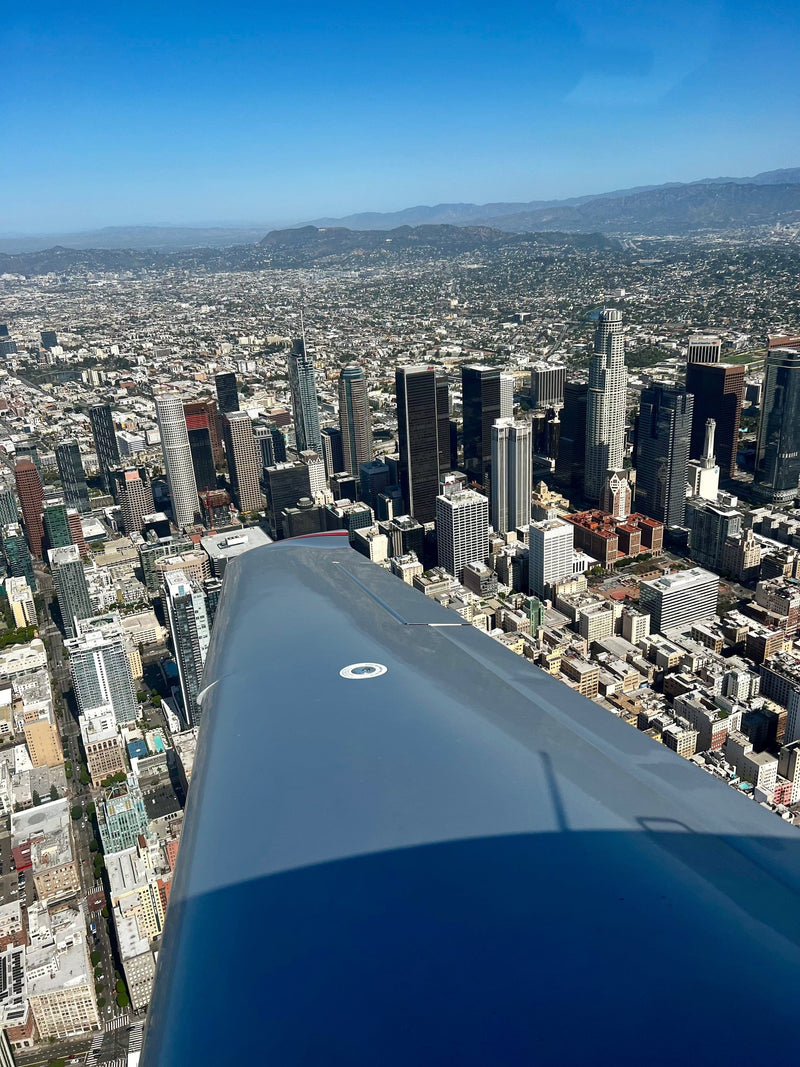
West Hollywood from 2,500 feet
Four things that pick the city out of an otherwise uniform basin on the way home.
The Beverly Center
A vast pale block with cars spiralling up its outside, sitting at La Cienega and Beverly with nothing near it of comparable bulk. It is the single easiest fix on the southern boundary from the air.
The studio lot at Formosa
White soundstages and a small back street tucked behind Santa Monica Boulevard, a working lot in the middle of apartments. From above it reads as one big rectangle of roofs where the housing pattern breaks.
The pools off Fountain
Hundreds of small blue rectangles set into courtyards between Fountain and Willoughby, dense enough that the whole district glitters on a bright afternoon. No other part of the basin repeats the pattern quite so tightly.
The San Vicente diagonal
One boulevard runs at a stubborn angle across an otherwise obedient grid, slicing from Beverly up toward Santa Monica Boulevard. Students use it to orient themselves over the flatlands before they can name much else.
Common questions
Around forty minutes for nineteen miles via Santa Monica Boulevard, the 405 and Roscoe. Before ten in the morning it can be thirty. Northbound between four and seven on a weekday it can stretch past sixty minutes, and we would rather move your lesson than pretend otherwise. Coldwater Canyon is the reliable alternative.
Nothing that serves a full private course well. Our aircraft, our instructors and our office are at Van Nuys Airport, which is where every lesson starts and ends; West Hollywood is simply where these students drive in from. The nearer coastal options run shorter runways and thinner fleets, and heading south adds congestion rather than saving time. Van Nuys gives you two parallel runways, a full-time tower, seven aircraft types and a full-motion simulator on one ramp.
In our own free lot directly outside Suite 108A at 7900 Balboa Boulevard. There is no meter, no permit district, no structure and nobody to tip. It takes about ninety seconds from kerb to front door, which is not a sentence anybody gets to write about a trip within West Hollywood.
The standard private pilot programme is $10,900, comprehensive is $15,900 and premium is $22,500. The certificate at the end is the same one; what changes is how much instructor time, simulator time and contingency is included. Stratus Financial lends against it, we run in-house payment plans, and the consultation costs nothing.
Not to begin, but you need a third-class medical from an FAA-designated aviation medical examiner before your first solo, so it is sensible to get it done in the first few weeks. Most people pass without difficulty. If you have a condition you are unsure about, raise it at the consultation and we will tell you what to expect.
Forty is the FAA minimum and very few working adults land on it. Sixty to seventy is the realistic band for someone training around a job. Flying twice a week keeps you near the bottom of that range; flying once a month pushes you toward the top and costs more overall.
It fits better than most jobs do. We fly from nine in the morning until nine at night, seven days a week, so a Tuesday or Wednesday mid-morning slot is available exactly when hospitality workers are free and the airspace is quiet. Many West Hollywood students never fly a weekend at all.
You come to Suite 108A, sit down with an instructor, walk out to the aircraft on the ramp and ask whatever you want about hours, medicals, timelines and money. It takes about thirty minutes and costs nothing. If an aircraft and instructor are free, a discovery flight can often follow.
Book a Tuesday morning and beat the pass
Come north before the 405 fills up, park free outside the door and go and look at the aircraft you would be learning in. Call (818) 290-8249 to arrange a free consultation, or start with a discovery flight at $229.