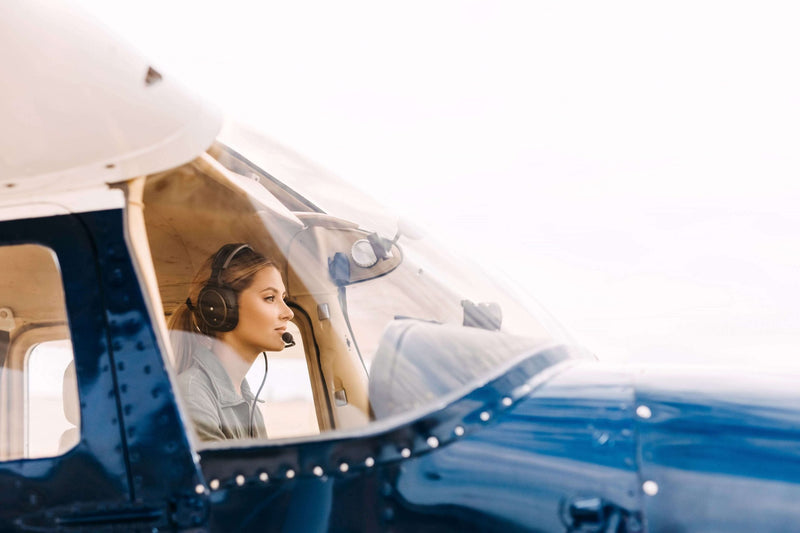
SAFETY FIRST
★★★★★
Very safety and detail oriented. Pre-flight briefing explained everything there was. To my knowledge, this flight school is exceptional in their ability.

Torrance is thirty miles south of our ramp, so this page is mostly about whether that drive is worth making and how South Bay students make each trip pay for itself.
The South Bay is not short of runways. Zamperini Field sits in the middle of Torrance, Hawthorne is ten minutes up Crenshaw, and Long Beach and Compton are both close. Nobody drives to Van Nuys because they have run out of tarmac nearby. They do it because the school matters more than the postcode, and because what they want out of a certificate is not available at every field with a fuel pump on it. Our own base is Van Nuys Airport, Suite 108A at 7900 Balboa Boulevard. Torrance is where the drive starts, not where we teach.
Weather is the reason most often given. Torrance sits two miles from the water, and from May into July the coastal fields spend a substantial share of their mornings underneath a marine layer that clears late or not at all. Van Nuys is thirty miles inland with the Santa Monica Mountains in between, and it burns off far earlier here. For a student on a fixed number of weekends a year, that difference is the gap between finishing this year and finishing next year.
Torrance has aviation in its bones, which shapes the students who come from there. Robinson builds helicopters on the edge of Zamperini Field, the aerospace and manufacturing belt runs from Carson to El Segundo, and a large share of the people we train from the South Bay work somewhere in that supply chain. They tend to be technical, they ask sharp questions about maintenance and syllabus structure, and they want the price written down before anything starts.
The practical answer to distance is not to fly more often but to fly longer. South Bay students book two lessons in one visit: a morning flight, a break with a proper debrief, then an afternoon session or a run in the simulator. One drive, twice the training. Because the school takes bookings from nine in the morning until nine at night, seven days a week, that shape of day is easy to arrange rather than a special favor.

Published prices for the whole course, so a South Bay student can compare properly before spending a Saturday on the 405.
The full FAA Private Pilot Certificate. Where most students start.
Learn MoreThe widest margin of hours for students who want no surprises.
Learn MoreThe rating that makes a license useful in Southern California weather.
Learn MoreYou fly the aircraft from the left seat with an instructor beside you. The time is loggable and counts toward a certificate.
The SR22 Turbo, glass cockpit. 90 min $699, 120 min $949.
Learn MoreFAA-approved full-motion MCX, on the field at Van Nuys.
Learn MoreThe route is simple and the traffic is not. Head north on the 405 from Torrance Boulevard, Hawthorne Boulevard or Crenshaw, past LAX and up through the Sepulveda Pass, which is the busiest stretch of freeway in the country and the part of the trip that decides your morning. Come down into the Valley, exit at Roscoe Boulevard, and go west about a mile and a half to Balboa. Turn south and the airport is immediately on your left.
Timing is the whole game. Mid-morning on a weekday, thirty miles takes forty to forty-five minutes. Weekend mornings before ten are often quicker still. Between seven and nine, and again from four until seven, the pass can turn that into ninety minutes, so we steer South Bay students toward late-morning and early-afternoon slots. Sherman Way is a workable alternative exit if Roscoe is backed up, and the 110 to the 101 sometimes wins when the 405 is closed.
Our door is Suite 108A at 7900 Balboa Blvd, Van Nuys, CA 91406, with our own free lot immediately outside it. There is no structure, no ticket and no gate code to remember, and a car can sit there all day, which matters when you have booked a morning flight and an afternoon simulator session on the same visit. Phone (818) 290-8249 when you clear the pass and the aircraft will be out and waiting for you.

Coastal fields lose a large number of summer mornings to low cloud. Thirty miles inland, with a mountain range between us and the ocean, Van Nuys usually opens up hours earlier. Over the course of a certificate that adds up to weeks of progress, which is the strongest single argument for training away from the water if you live near it.
Trainers, a complex retractable, a glass-cockpit Cirrus, a twin and a full-motion simulator are all here. You can go from a first lesson to a multi-engine rating without changing schools or starting again with an instructor who does not know your history. That continuity is worth real money over several years.
Our FAA-certified instructors carry fifteen years or more of experience each. In an industry where teaching is often a way-station toward an airline job, an instructor who remembers your weak crosswind landing from two months ago is a real advantage, particularly when you can only get up here once a week.
You are given the price of the course, not a rate that quietly accumulates. For someone weighing a thirty-mile commitment that clarity matters more than a headline figure. Come for the free in-person consultation and you will leave knowing exactly what the certificate costs and how the payments can be spread.
Primary training happens in the Cessna 162 Skycatcher, the Diamond DA20 and the Piper Warrior. They are light, straightforward airplanes that expose sloppy rudder work immediately, which is exactly what you want early on. Your package covers the aircraft and the instructor together, so moving between the three types costs you nothing and a Sunday run down the coast toward Palos Verdes and back is part of the training rather than an extra. South Bay students tend to price that out before they enroll, and we would rather they did.
Above the trainers sit the aircraft people stay for. The Piper Arrow II brings retractable gear and a constant-speed propeller into your logbook. The Cirrus SR22 Turbo is a turbocharged, glass-cockpit four-seater with a whole-airframe parachute, and it is a serious cross-country machine for a family. The Piper Seminole is the twin used for multi-engine training, which is a $5,100 package. The Redbird MCX full-motion simulator covers instrument approaches, engine failures and diversions on the ground, where repetition costs almost nothing.

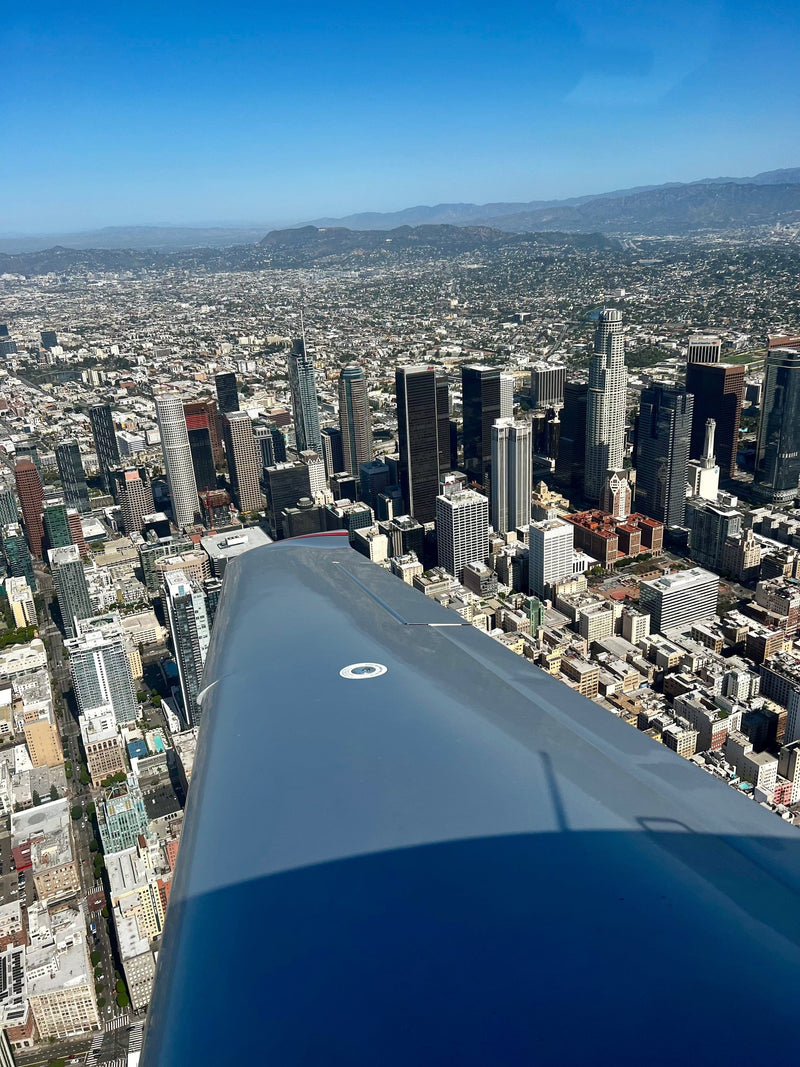
On a ninety-minute or two-hour flight there is time to run the coastline south and see home.
A green hump pushing out into the Pacific with cliffs dropping straight into the water on its southern edge. It is visible from a surprising distance and is what every South Bay student looks for first.
Torrance's own airport, its runways cut at an angle into the surrounding street grid just west of Crenshaw. Seeing your local field from three thousand feet is usually the moment the geography of the South Bay clicks into place.
A dense gray block of stacks, tanks and pipework north of Del Amo, entirely different in texture from the housing around it. From the air it explains the industrial belt running down to the harbor.
The airship's home field sits just east in Carson, a distinctive open patch with a mooring mast in the middle. If the blimp is on the ground you will see it before anything else nearby.
It is worth it if what you want is a full fleet, long opening hours and clear inland mornings. It is not worth it for a rushed single hour after work, because the drive eats the benefit. Almost every South Bay student reaches the same conclusion: fewer visits, longer sessions.
Thirty miles up the 405 through the Sepulveda Pass. Mid-morning it is forty to forty-five minutes, and weekend mornings are often faster. Peak hours can double it. Book late morning or early afternoon and the trip stays reasonable; avoid anything that puts you in the pass at five o'clock in either direction.
Plenty of people do, and there is nothing wrong with those airports. The question is what a given school offers you: whether it has a twin and a Cirrus as well as trainers, whether it opens at weekends, whether it publishes a course price. Summer mornings lost to coastal cloud are the other half.
Yes, and for a Torrance student that is usually the right approach. A morning flight, a proper debrief and lunch, then an afternoon lesson or a Redbird session makes one drive do the work of two. Fatigue is real, so instructors often use the second session for ground or simulator work.
The standard private pilot course is $10,900 and the comprehensive version is $15,900. Adding an instrument rating afterwards is $11,700, and a multi-engine rating is $5,100. These are whole-course prices covering aircraft, instructor and ground school. Financing is available through Stratus Financial and through payment plans we run in house.
The FAA minimum is forty and most people finish between fifty-five and seventy-five. Frequency drives that number more than natural ability. Two doubled visits a week will see you through in four to five months; one visit a fortnight stretches past a year and costs more.
The path starts with the private certificate wherever you live. Our zero-to-airline program is $89,000 in total and covers the sequence of certificates, ratings and hour-building that follows. It is close to a full-time commitment for much of its length, so plan the drive around it properly before beginning.
Come to Suite 108A, park free outside, and spend an unhurried session with an instructor at no charge going through the syllabus, the aircraft and the costs. You can book a discovery flight the same day if a slot is open. Most people combine the two into one trip, which we arrange by phone beforehand.
Pick a weekend morning, come north before the pass fills up, and give yourself a consultation and a flight in the same visit. Call (818) 290-8249 and we will build the day around the time you can realistically get here from Torrance.
The three private pilot packages, what each one includes, the financing options and a realistic timeline built around how often you can actually fly. Sent to you in one email. Nobody will pressure you.
Loved On Google
Every review below is real and shown verbatim, in the reviewer’s own words — written by the people who learned to fly here, not by us.
SAFETY FIRST
Very safety and detail oriented. Pre-flight briefing explained everything there was. To my knowledge, this flight school is exceptional in their ability.
 DISCOVERY FLIGHT
I recently had the chance to take my first-ever discovery flight, and it was nothing short of amazing! From the moment I stepped into the cockpit, the...
 SUNSET CIRRUS
It was a great flight! I did a sunset flight and Alex let us fly an awesome. Website was easy to book, and the plane itself was really fun to fly...
 FLYING LESSON
We had a great flying lesson with Ralph and came away with a much better understanding of both the aircraft and the principles of flight. Ralph is a...
 KIDS LUXURY FLIGHT
I got 2 luxury discovery flights for my kids. I wanted them to have the experience of flying. Our instructor Alex was amazing he made sure they feel...
 HONEYMOON SURPRISE
Last minute booking to surprise my wife on our honeymoon. She had no experience with flying and was scared of flying, but Alex was very easygoing and knew...
 FULL-MOTION SIM
Amazing flight school in van nuys airport. I have been a student here for the past few months and i could not be happier. I started doing a lot of...
 DISCOVERY FOR TWO
I booked a Discovery Flight for Two for my girlfriend's birthday and it was the perfect gift for her. She couldn't have been more excited to get to...
 SIMULATORS
Very professional and great airplanes. I love the flight simulators. The pricing is very fair compared to any other flight school
 TEEN FIRST LESSON
We gifted our teenage son his first flying lesson. He was so excited! Alex greeted us and gave a reassuring brief that made us all feel comfortable and at...
 FIRST-TIME FLYER
Flying is my husband's hobby and I was incredibly anxious and apprehensive about the discovery flight. However, I felt completely safe and at ease once we...
SAFETY FIRST
Very safety and detail oriented. Pre-flight briefing explained everything there was. To my knowledge, this flight school is exceptional in their ability.
DISCOVERY FLIGHT
I recently had the chance to take my first-ever discovery flight, and it was nothing short of amazing! From the moment I stepped into the cockpit, the...
SUNSET CIRRUS
It was a great flight! I did a sunset flight and Alex let us fly an awesome. Website was easy to book, and the plane itself was really fun to fly...
FLYING LESSON
We had a great flying lesson with Ralph and came away with a much better understanding of both the aircraft and the principles of flight. Ralph is a...
KIDS LUXURY FLIGHT
I got 2 luxury discovery flights for my kids. I wanted them to have the experience of flying. Our instructor Alex was amazing he made sure they feel...
HONEYMOON SURPRISE
Last minute booking to surprise my wife on our honeymoon. She had no experience with flying and was scared of flying, but Alex was very easygoing and knew...
FULL-MOTION SIM
Amazing flight school in van nuys airport. I have been a student here for the past few months and i could not be happier. I started doing a lot of...
DISCOVERY FOR TWO
I booked a Discovery Flight for Two for my girlfriend's birthday and it was the perfect gift for her. She couldn't have been more excited to get to...
SIMULATORS
Very professional and great airplanes. I love the flight simulators. The pricing is very fair compared to any other flight school
TEEN FIRST LESSON
We gifted our teenage son his first flying lesson. He was so excited! Alex greeted us and gave a reassuring brief that made us all feel comfortable and at...
FIRST-TIME FLYER
Flying is my husband's hobby and I was incredibly anxious and apprehensive about the discovery flight. However, I felt completely safe and at ease once we...
Reviews shown verbatim, exactly as each reviewer published them.
Aviation News
Notes from the flight line at Van Nuys — weather, regulation changes, checkride questions and the cost of training, written up as they come.
Open 7 days · 9:00 AM – 9:00 PM
Los Angeles Flight School