SAFETY FIRST
★★★★★
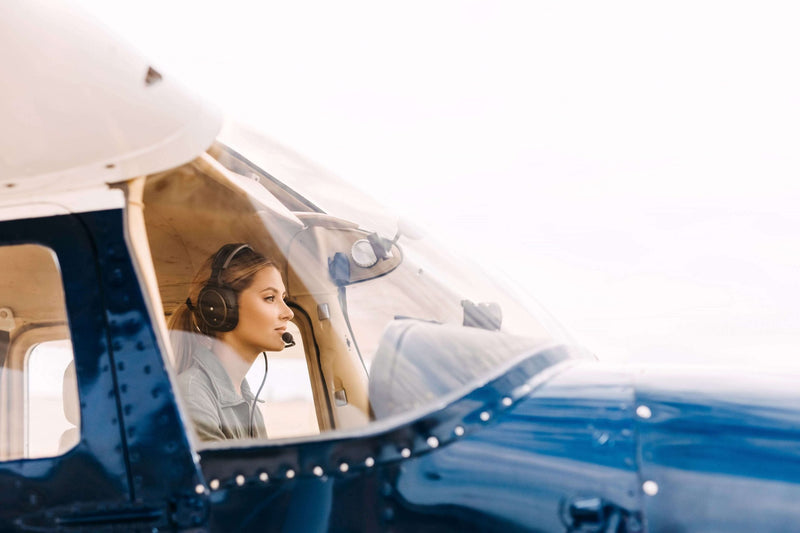
Very safety and detail oriented. Pre-flight briefing explained everything there was. To my knowledge, this flight school is exceptional in their ability.

Everything between the Ventura Freeway and Victory Boulevard is inside a ten-minute run of the airport gate, which is why so many Tarzana households start flight training and actually finish it.
North Tarzana is a plain rectangle of streets between the freeway and Victory, bordered by Corbin on one side and White Oak on the other. It is quiet, it is residential, and it is remarkably well placed for anyone who wants to learn to fly. Tampa Avenue and Reseda Boulevard both run arrow-straight toward the airport, so the trip is one turn and no freeway. Ten minutes of ordinary Valley driving separates a kitchen table on Clark Street from a briefing room on the ramp at Van Nuys.
The name comes from Edgar Rice Burroughs, who bought the ranch land here in 1919 and gave it the name of the character he had invented. A century later the ranch is a grid of bungalows and duplexes, and the airplanes that pass overhead on their way in and out of Van Nuys are part of the ambient noise of the place. Plenty of our students say the idea started that way: looking up from a garden on Vanalden or Etiwanda and wondering who exactly was allowed to do that.
The answer is that almost anyone is, and the barrier is far lower than people assume. There is no aptitude test to sit and no degree required. You need to be able to read and speak English, pass a straightforward medical, and then put in the hours. We have taught teenagers still at school, nurses, contractors, retired teachers and people who came in on a Saturday to buy their partner a gift voucher and were back on Monday enrolling themselves.
What flight training genuinely demands is rhythm. Two lessons a week and you will feel yourself improving; one a month and you will spend most of each lesson recovering what you lost. Because we are open from nine in the morning to nine at night every day of the week, that rhythm is easier to hold here than at a school with weekday-only office hours. Fly at seven in the evening in July, or at nine on a Sunday before the day gets away from you.

Courses & Pricing
Course prices are packages, not hourly rates - the aircraft, your instructor, ground school and simulator time are all in the figure. Van Nuys Airport, KVNY. Financing Available Through Stratus & In-House Plans.

Start Here
The First Hour At The Controls. Credited Toward Your Training If You Enroll Within 24 Hours Of Landing.
All Prices In USD. 7900 Balboa Blvd, Suite 108A, Van Nuys, CA 91406 · Open 9 AM–9 PM, Seven Days. Free In-Person Tour Of The School
Book It Or Gift It
Every discovery flight below can be booked for yourself in the next few minutes, or bought as a gift certificate that is emailed within minutes and never expires. Same flight, same price, either way.
 Most Given
 Two Seats
 The Nice One
 Twin Engine
One person, one instructor, and no audience. Hands on the controls from the left seat, briefed before you go and debriefed after you land.
Hands-On Stick TimePre-Flight BriefingLoggable Flight Time
Flight Length
$229Book It Or Gift It
Same Price Either Way
The same flight with a passenger in the back seat, briefed and on the intercom. Couples book it; so do parents who would rather watch than hear about it.
One Passenger SeatPiper Warrior Or ArcherHeadsets For Both
Flight Length
$299Book It Or Gift It
Same Price Either Way
The nicest airplane we put a first-time flyer in. Glass cockpit, air conditioning, leather seats, and a parachute built into the airframe rather than strapped to the person.
Turbocharged Cirrus SR22Air ConditioningWhole-Airframe Parachute
Flight Length
$499Book It Or Gift It
Same Price Either Way
Two engines, and the airplane instrument-rated pilots move into when they start thinking about a career. Flown from the left seat with a multi-engine instructor.
Piper Seminole TwinMulti-Engine DepartureCareer-Track Instructor
Flight Length
$499Book It Or Gift It
Same Price Either Way
Gift It issues a real gift certificate, emailed within minutes, which never expires and credits in full toward training. Flights are limited to 180 lb per person, 370 lb combined. Questions: (818) 290-8249, 9 AM–9 PM, seven days.
From anywhere in the grid above the freeway, take Tampa Avenue or Reseda Boulevard north. Cross Victory, cross Vanowen, and turn east at Sherman Way or Saticoy toward Balboa Boulevard. The airport sits on the eastern side of Balboa and the entrance to 7900 is clearly signed. There is no freeway on this route and no toll, and at most hours of the day the whole thing takes ten to twelve minutes from Oxnard Street.
If you live south of the 101 near Ventura Boulevard, the freeway is quicker. Head east on the Ventura Freeway to the Balboa Boulevard exit, then north on Balboa for roughly four miles. Balboa crosses the Sepulveda Basin on that stretch, so you pass the recreation area and the water before the hangars appear on your right. Reckon on fifteen minutes in the middle of the day, more between four and seven in the evening.
Our door is Suite 108A at 7900 Balboa Blvd, Van Nuys, CA 91406. Park in the lot outside, which is free and belongs to us, and come straight in. Nobody needs a badge, a code or an escort here, and nobody will send you off to a different building on the far side of the field. The number to call ahead on is (818) 290-8249, and someone is in from nine until nine, weekends included.

Our teaching staff are FAA-certified with fifteen years or more behind them. That matters because the industry norm is an instructor quietly counting hours toward an airline job who will be gone by spring. Continuity is worth real money: someone who remembers which maneuver you struggled with in March does not need to rediscover it in June.
The Redbird MCX means a fogged-in morning or a maintenance day is not a wasted one. Engine failures, instrument approaches, diversions and emergency descents can be flown repeatedly, paused, discussed and flown again, which is impossible in an airplane. Students who use it well tend to arrive at the checkride noticeably calmer than those who do not.
Van Nuys sits underneath the Los Angeles Class B shelf with Burbank's airspace immediately to the east. Learning here means learning transitions, clearances and traffic avoidance as normal daily practice. Pilots who train in simple airspace often find their first arrival into a complex terminal area genuinely alarming; you will have been doing it since your third lesson.
The course prices on this page are the course prices. There is no meter running quietly in the background, no surprise fuel surcharge and no invented administration fee at the end. Before you commit anything you can sit down with us in person, free of charge, and go through the whole cost line by line.
Training begins in the Cessna 162 Skycatcher, the Diamond DA20 or the Piper Warrior, and which one you use is largely a matter of what suits you and what is free at your preferred time. The point worth understanding early is that these aircraft stay useful to you after the checkride. The same three aircraft carry on being yours to fly once you hold a certificate and no longer need an instructor in the right seat, which is what turns an afternoon over the coast into an ordinary plan rather than an expedition.
Further up the ramp there is somewhere to go next. The Piper Arrow II brings retractable gear and a variable-pitch propeller into the picture. The Cirrus SR22 Turbo is a turbocharged glass-cockpit aircraft with a parachute built into the airframe, and it is the machine most people picture when they imagine flying their family somewhere for a long weekend. The Piper Seminole is the twin used for the $5,100 multi-engine rating. All of it sits on one ramp at Van Nuys Airport, ten minutes from Tarzana, so nothing on that list requires you to leave and join another school.

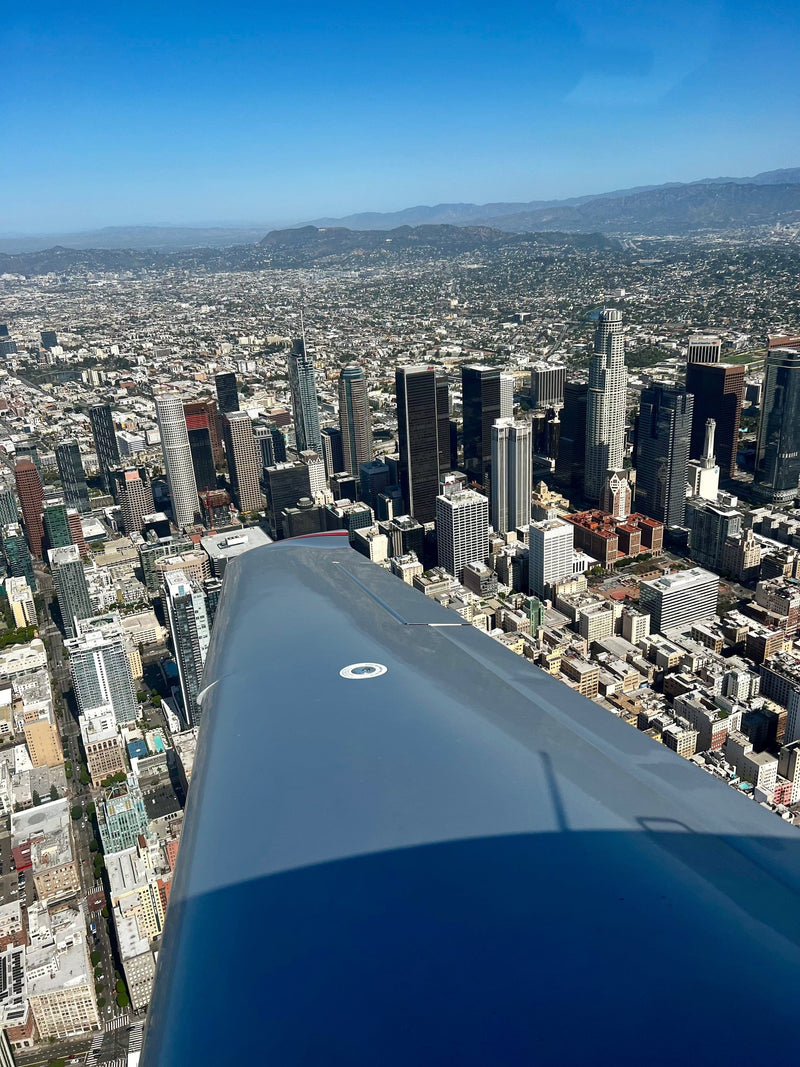
Fly south-west after departure and the neighborhood assembles below you in about ninety seconds.
The largest single structure in the neighborhood, a pale block with a helipad on the roof, standing clear of the houses around Tampa and Clark. It is the easiest visual fix in Tarzana.
The ballfields and pool off Vanalden read as a bright green patch punched out of the residential grid. On a Saturday morning you can see the games in progress from a couple of thousand feet.
The 101 slices the neighborhood into north and south halves, a boundary every local uses without thinking. From above, that division is the first thing you notice about Tarzana.
A dead-straight line from the freeway all the way past Nordhoff, one of the few Valley roads that never bends. New students use it to find their way back to the field.
Tampa Avenue or Reseda Boulevard straight north, then east on Sherman Way or Saticoy to Balboa. Ten to twelve minutes, no freeway at all. From south of the 101, take the freeway east to the Balboa exit and come up through the Sepulveda Basin instead.
Yes to both. We run from nine in the morning to nine at night, every day. Early morning air over the Valley is the smoothest of the day and that slot is the one experienced students fight for. In summer the light holds past eight.
Most of our Tarzana students do exactly that. A lesson runs roughly two hours from arrival to debrief, which fits a school day or a long lunch given how short the drive is. Bookings run seven days a week, so weekends absorb the weeks when the diary goes wrong.
It is a multiple-choice FAA knowledge test covering regulations, weather, navigation, aerodynamics and aircraft systems. Most students sit it partway through training, usually around the time cross-country work begins. Passing it early takes pressure off the closing stages and stops theory becoming a bottleneck.
An FAA designated examiner questions you on the ground for a couple of hours, then flies with you while you demonstrate the maneuvers, navigation and emergency procedures. It tests judgment as much as handling. Your instructor will not sign you off until your practice runs beat the standard consistently.
It is busy, and that turns out to be an advantage. Beginners are taught the radio calls before they need them and never left to guess. Two thousand introductory flights have gone safely out of this field. Within a few lessons the traffic stops sounding like chaos and starts sounding like information.
Enroll within twenty-four hours of your discovery flight and one hundred per cent of what you paid comes off your training. That applies to the $229 aircraft flight and the $189 simulator session alike. The introduction is effectively free for anyone who carries on.
The private certificate at $10,900 is the foundation and nobody skips it. From there the instrument rating is $11,700 and the multi-engine rating is $5,100. For an airline flight deck, the zero-to-airline program is $89,000. Financing runs through Stratus Financial or our own plans.
You can be standing next to a training aircraft twelve minutes after leaving your house in Tarzana, and the consultation costs nothing. Ring (818) 290-8249, or turn up at Suite 108A any day between nine and nine.
The three private pilot packages, what each one includes, the financing options and a realistic timeline built around how often you can actually fly. Sent to you in one email. Nobody will pressure you.
Loved On Google
Every review below is real and shown verbatim, in the reviewer’s own words — written by the people who learned to fly here, not by us.
SAFETY FIRST
Very safety and detail oriented. Pre-flight briefing explained everything there was. To my knowledge, this flight school is exceptional in their ability.
 DISCOVERY FLIGHT
I recently had the chance to take my first-ever discovery flight, and it was nothing short of amazing! From the moment I stepped into the cockpit, the...
 SUNSET CIRRUS
It was a great flight! I did a sunset flight and Alex let us fly an awesome. Website was easy to book, and the plane itself was really fun to fly...
 FLYING LESSON
We had a great flying lesson with Ralph and came away with a much better understanding of both the aircraft and the principles of flight. Ralph is a...
 KIDS LUXURY FLIGHT
I got 2 luxury discovery flights for my kids. I wanted them to have the experience of flying. Our instructor Alex was amazing he made sure they feel...
 HONEYMOON SURPRISE
Last minute booking to surprise my wife on our honeymoon. She had no experience with flying and was scared of flying, but Alex was very easygoing and knew...
 FULL-MOTION SIM
Amazing flight school in van nuys airport. I have been a student here for the past few months and i could not be happier. I started doing a lot of...
 DISCOVERY FOR TWO
I booked a Discovery Flight for Two for my girlfriend's birthday and it was the perfect gift for her. She couldn't have been more excited to get to...
 SIMULATORS
Very professional and great airplanes. I love the flight simulators. The pricing is very fair compared to any other flight school
 TEEN FIRST LESSON
We gifted our teenage son his first flying lesson. He was so excited! Alex greeted us and gave a reassuring brief that made us all feel comfortable and at...
 FIRST-TIME FLYER
Flying is my husband's hobby and I was incredibly anxious and apprehensive about the discovery flight. However, I felt completely safe and at ease once we...
SAFETY FIRST
Very safety and detail oriented. Pre-flight briefing explained everything there was. To my knowledge, this flight school is exceptional in their ability.
DISCOVERY FLIGHT
I recently had the chance to take my first-ever discovery flight, and it was nothing short of amazing! From the moment I stepped into the cockpit, the...
SUNSET CIRRUS
It was a great flight! I did a sunset flight and Alex let us fly an awesome. Website was easy to book, and the plane itself was really fun to fly...
FLYING LESSON
We had a great flying lesson with Ralph and came away with a much better understanding of both the aircraft and the principles of flight. Ralph is a...
KIDS LUXURY FLIGHT
I got 2 luxury discovery flights for my kids. I wanted them to have the experience of flying. Our instructor Alex was amazing he made sure they feel...
HONEYMOON SURPRISE
Last minute booking to surprise my wife on our honeymoon. She had no experience with flying and was scared of flying, but Alex was very easygoing and knew...
FULL-MOTION SIM
Amazing flight school in van nuys airport. I have been a student here for the past few months and i could not be happier. I started doing a lot of...
DISCOVERY FOR TWO
I booked a Discovery Flight for Two for my girlfriend's birthday and it was the perfect gift for her. She couldn't have been more excited to get to...
SIMULATORS
Very professional and great airplanes. I love the flight simulators. The pricing is very fair compared to any other flight school
TEEN FIRST LESSON
We gifted our teenage son his first flying lesson. He was so excited! Alex greeted us and gave a reassuring brief that made us all feel comfortable and at...
FIRST-TIME FLYER
Flying is my husband's hobby and I was incredibly anxious and apprehensive about the discovery flight. However, I felt completely safe and at ease once we...
Reviews shown verbatim, exactly as each reviewer published them.
Aviation News
Notes from the flight line at Van Nuys — weather, regulation changes, checkride questions and the cost of training, written up as they come.
Open 7 days · 9:00 AM – 9:00 PM
Los Angeles Flight School