SAFETY FIRST
★★★★★
Very safety and detail oriented. Pre-flight briefing explained everything there was. To my knowledge, this flight school is exceptional in their ability.

Twenty-two miles over the Sepulveda Pass buys you a control tower, seven aircraft types and a coastline fifteen minutes off the departure end of the runway.
A private certificate means something particular when you live on the water. Catalina becomes a Sunday morning: twenty-six miles of open channel, then a runway carved off the top of a ridge at Avalon with the sea on both ends of it. Santa Barbara is under forty minutes. San Luis Obispo and the whole central coast open up for a weekend rather than a fortnight's planning. None of that is theoretical flying. It is the ordinary use a Westside pilot puts a license to within a month of passing.
Getting there involves learning airspace properly, and the Westside is a good place to be forced into it. The shoreline route past the international airport runs through a corridor with hard altitude limits and its own procedures, and every flight you make down the beach from the north means talking to controllers, holding a number and knowing exactly where the floor of the overlying airspace sits. Students who learn that at a busy towered field find it routine. Students who learn at a quiet one often avoid the coast entirely for years.
The Santa Monica people who train with us are not one type. There are analysts and researchers from the offices around Main Street, teachers, physiotherapists, restaurant owners off Montana, people from Ocean Park and Sunset Park in their forties who have wanted this since childhood, and a decent number who already sail out of the Marina and have concluded that the airplane is the same instinct with better range. What they have in common is a willingness to drive thirty minutes for equipment that is worth the drive.
The prices are fixed and printed. An introductory lesson with you flying the aircraft is $229 for sixty minutes, and the time is entered in a logbook with your name on it. The standard private certificate is $10,900, the premium course is $22,500, and the instrument rating that solves the low cloud problem is $11,700. Enroll within twenty-four hours and the introductory flight costs you nothing in the end. Stratus Financial or an in-house plan handles the rest, and the first consultation is free.

Everything below is a published total, not an hourly figure with an asterisk on it.
The full FAA Private Pilot Certificate. Where most students start.
Learn MoreThe widest margin of hours for students who want no surprises.
Learn MoreThe rating that makes a license useful in Southern California weather.
Learn MoreYou fly the aircraft from the left seat with an instructor beside you. The time is loggable and counts toward a certificate.
The SR22 Turbo, glass cockpit. 90 min $699, 120 min $949.
Learn MoreFAA-approved full-motion MCX, on the field at Van Nuys.
Learn MoreThe default is the 10 east to the 405 north, and then one long climb over the Santa Monica Mountains. The freeway crests near the Skirball and drops onto the valley floor at Ventura Boulevard. Leave it at Victory Boulevard and run west about two miles to Balboa, or stay on to Roscoe and come south. Either way you finish on Balboa Boulevard with the airport fence on one side of you. Twenty-two miles, thirty minutes when the hill is in a reasonable mood.
It is not always in a reasonable mood, and there is no point pretending. Northbound from four in the afternoon the pass can turn thirty minutes into sixty. Mid-morning is the dependable window in both directions, and it happens to be good flying weather too, once the cloud has burned back off the coast. Worth knowing: Sepulveda Boulevard runs alongside the freeway over the same hill, and on the days the 405 has simply stopped, it keeps moving.
Our end is the easy end. Parking is our own lot at 7900 Balboa Boulevard, free and unmetered, with no structure to spiral through and no ticket to feed. After years of Santa Monica parking that takes some getting used to. The office is Suite 108A, which matters because the address is a shared hangar site with a number of separate aviation firms in it. First visit: photo identification, closed shoes, and arrive fifteen minutes early.

Marine cloud can hold over the beach until noon while the valley floor has been in sun since seven. Lessons that would have been scrubbed at the coast simply happen here. Over a full certificate that is the difference between finishing in six months and drifting past a year with the same amount of money spent.
Two parallel runways, a tower working all day and traffic that never really thins out. Radio calls, sequencing and clearances become ordinary in your first few lessons. That is what makes the shoreline corridor past the international airport feel like a normal Tuesday rather than an ordeal you rehearse for.
Turn southwest after takeoff and you are over the Santa Monica Mountains almost immediately, with the bay opening up beyond them. Training here does not mean giving up the view. It means the view arrives after the climb, and you get the smoother inland air to actually learn maneuvers in.
A Cirrus SR22 Turbo and a Piper Seminole sit on the same ramp as the trainers. When your flying grows into longer trips or a twin, the airplane is already there and the checkout is with an instructor who taught you. Nobody has to start again at a different school with a different syllabus.
You will start in a Cessna 162 Skycatcher or a Piper Warrior. Both are plain, sturdy training airplanes that respond honestly and refuse to disguise a sloppy approach, which is precisely what you want while somebody is teaching you to land. The Diamond DA20 is the one with the bubble canopy, and on a clear morning the Santa Monica Mountains fill the whole front of it. Your package covers the aircraft and the instructor together, so the choice between them is yours to make. The Redbird MCX full-motion simulator, $189 for a sixty-minute session, handles emergencies and instrument work between flights.
The rest of the fleet is what your license grows into. The Piper Arrow II brings retractable gear and a constant-speed propeller, the complex time commercial students need. The Cirrus SR22 Turbo has the glass panel, the airframe parachute and the legs to reach Monterey before lunch. The Piper Seminole is the twin used for the $5,100 multi-engine rating. All of them are maintained in the same complex they fly from, and all of them stay open to you once you are checked out.

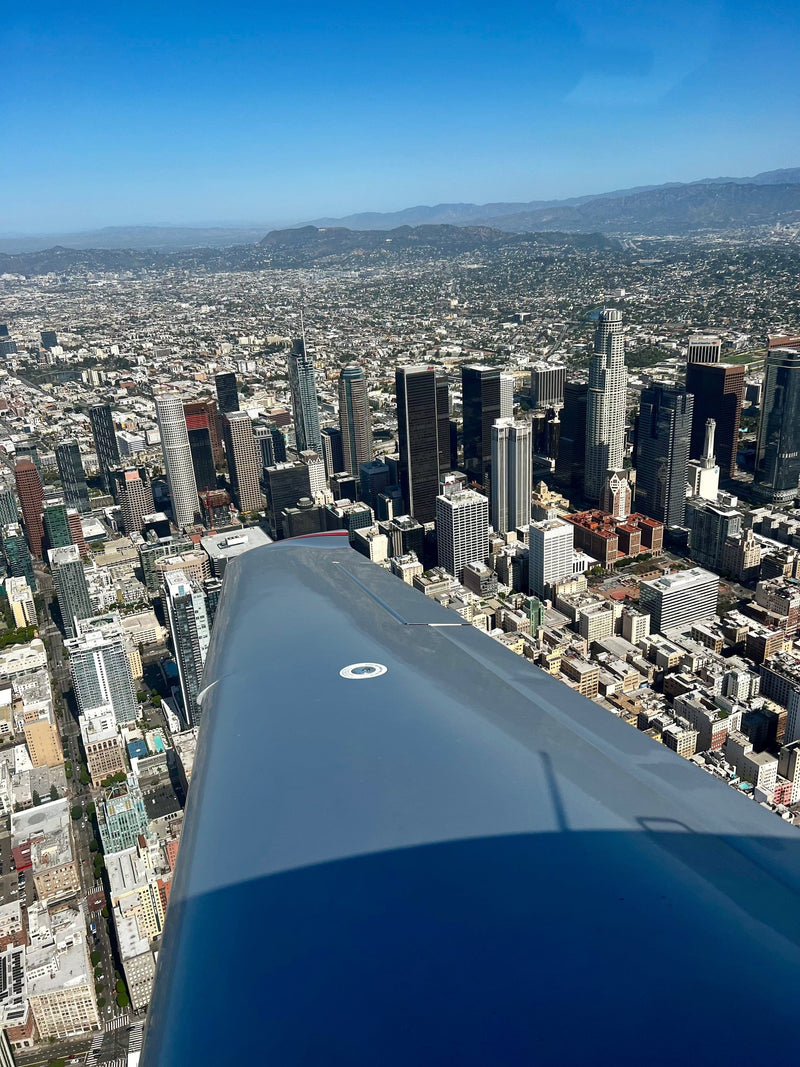
Turn southwest out of Van Nuys and the Westside unfolds in about eight minutes.
A dark irregular shape held in the hills right on the spine of the range, invisible from almost every road below it. It is the first thing students learn to steer by when they head for the coast.
Two long green cuts running down the back of Brentwood toward San Vicente, with fire road scars threading along the ridges between them. From the air the boundary between wildland and city is a single sharp line.
Where the 10 dives under Palisades Park and comes out on Pacific Coast Highway, the exact point at which the freeway system meets the sea. It reads as a bright notch in the bluff from several miles out.
A green bowl set well below the surrounding streets, clubhouse on the rim and the canyon running down to the beach. One of the cleanest landmarks on the Westside from two thousand feet.
Around thirty minutes mid-morning, going east on the 10 and north on the 405 over the pass. Late afternoons northbound are the problem and can push it toward sixty minutes. Most Santa Monica students settle into a late-morning or a mid-evening slot, which also happens to be when the flying is at its best.
Santa Monica has its own airport and we are not on it; the school is at Van Nuys Airport, Suite 108A. Coastal fields are smaller, the cloud sits over them longer, and the range of aircraft is narrower. What you get inland is two runways, a tower, seven aircraft types and a full-motion simulator on one field, plus far fewer weather cancellations. The half hour in the car buys a training environment you would eventually go looking for anyway.
In our own lot at 7900 Balboa Boulevard, free, unmetered and ungated, with spaces immediately outside the door. Come to Suite 108A. The building is a shared hangar complex occupied by several unrelated aviation businesses, so use the suite number rather than looking for signage from the street.
Yes, regularly. The Santa Monica Mountains are minutes from the runway and the shoreline lies just beyond them. Maneuver work happens over the smoother inland practice areas, but cross-country training, night flying and most of the flights you fly for the sheer pleasure of it will take you back over the bay.
The standard course is $10,900. The comprehensive version, with much more instruction and simulator time included, is $15,900, and the premium course is $22,500. The FAA written exam fee and the examiner's fee at the checkride sit outside those figures. Your first lesson is credited in full if you enroll within a day.
Six to nine months at two lessons a week for most adults. Forty hours is the FAA minimum and hardly anyone finishes there; sixty to seventy is realistic. How often you fly matters more than anything else. Fly once a month and you spend a large part of every lesson recovering ground you had already covered.
Yes, and a great many people do it as their first proper trip. It is twenty-six miles of open water to a runway on a ridge with drop-offs at both ends, so it deserves respect and a briefing. We cover overwater considerations, terrain and the airport's quirks before you go. The aircraft you trained in stay open to you after a checkout with one of our instructors.
Not for your first lessons, but you need one before you can solo, so arrange it early. An FAA aviation medical examiner issues it and several practice on the Westside. If anything in your history might require extra paperwork, begin in week one rather than meeting the delay at hour twenty.
Ring (818) 290-8249 and take a late-morning slot, after the cloud has lifted off the bay and before the pass turns against you. We are at 7900 Balboa Blvd, Suite 108A in Van Nuys, open nine to nine daily, with free parking at the door.
The three private pilot packages, what each one includes, the financing options and a realistic timeline built around how often you can actually fly. Sent to you in one email. Nobody will pressure you.
Loved On Google
Every review below is real and shown verbatim, in the reviewer’s own words — written by the people who learned to fly here, not by us.
SAFETY FIRST
Very safety and detail oriented. Pre-flight briefing explained everything there was. To my knowledge, this flight school is exceptional in their ability.
 DISCOVERY FLIGHT
I recently had the chance to take my first-ever discovery flight, and it was nothing short of amazing! From the moment I stepped into the cockpit, the...
 SUNSET CIRRUS
It was a great flight! I did a sunset flight and Alex let us fly an awesome. Website was easy to book, and the plane itself was really fun to fly...
 FLYING LESSON
We had a great flying lesson with Ralph and came away with a much better understanding of both the aircraft and the principles of flight. Ralph is a...
 KIDS LUXURY FLIGHT
I got 2 luxury discovery flights for my kids. I wanted them to have the experience of flying. Our instructor Alex was amazing he made sure they feel...
 HONEYMOON SURPRISE
Last minute booking to surprise my wife on our honeymoon. She had no experience with flying and was scared of flying, but Alex was very easygoing and knew...
 FULL-MOTION SIM
Amazing flight school in van nuys airport. I have been a student here for the past few months and i could not be happier. I started doing a lot of...
 DISCOVERY FOR TWO
I booked a Discovery Flight for Two for my girlfriend's birthday and it was the perfect gift for her. She couldn't have been more excited to get to...
 SIMULATORS
Very professional and great airplanes. I love the flight simulators. The pricing is very fair compared to any other flight school
 TEEN FIRST LESSON
We gifted our teenage son his first flying lesson. He was so excited! Alex greeted us and gave a reassuring brief that made us all feel comfortable and at...
 FIRST-TIME FLYER
Flying is my husband's hobby and I was incredibly anxious and apprehensive about the discovery flight. However, I felt completely safe and at ease once we...
SAFETY FIRST
Very safety and detail oriented. Pre-flight briefing explained everything there was. To my knowledge, this flight school is exceptional in their ability.
DISCOVERY FLIGHT
I recently had the chance to take my first-ever discovery flight, and it was nothing short of amazing! From the moment I stepped into the cockpit, the...
SUNSET CIRRUS
It was a great flight! I did a sunset flight and Alex let us fly an awesome. Website was easy to book, and the plane itself was really fun to fly...
FLYING LESSON
We had a great flying lesson with Ralph and came away with a much better understanding of both the aircraft and the principles of flight. Ralph is a...
KIDS LUXURY FLIGHT
I got 2 luxury discovery flights for my kids. I wanted them to have the experience of flying. Our instructor Alex was amazing he made sure they feel...
HONEYMOON SURPRISE
Last minute booking to surprise my wife on our honeymoon. She had no experience with flying and was scared of flying, but Alex was very easygoing and knew...
FULL-MOTION SIM
Amazing flight school in van nuys airport. I have been a student here for the past few months and i could not be happier. I started doing a lot of...
DISCOVERY FOR TWO
I booked a Discovery Flight for Two for my girlfriend's birthday and it was the perfect gift for her. She couldn't have been more excited to get to...
SIMULATORS
Very professional and great airplanes. I love the flight simulators. The pricing is very fair compared to any other flight school
TEEN FIRST LESSON
We gifted our teenage son his first flying lesson. He was so excited! Alex greeted us and gave a reassuring brief that made us all feel comfortable and at...
FIRST-TIME FLYER
Flying is my husband's hobby and I was incredibly anxious and apprehensive about the discovery flight. However, I felt completely safe and at ease once we...
Reviews shown verbatim, exactly as each reviewer published them.
Aviation News
Notes from the flight line at Van Nuys — weather, regulation changes, checkride questions and the cost of training, written up as they come.
Open 7 days · 9:00 AM – 9:00 PM
Los Angeles Flight School