SAFETY FIRST
★★★★★
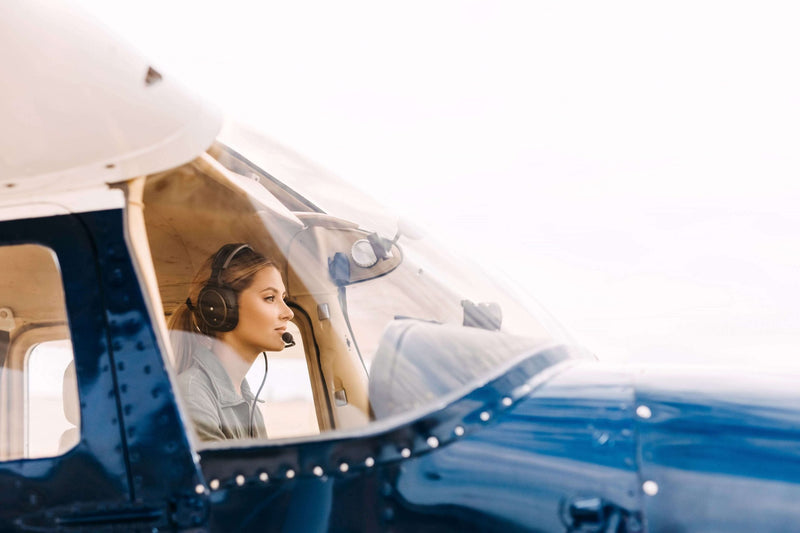
Very safety and detail oriented. Pre-flight briefing explained everything there was. To my knowledge, this flight school is exceptional in their ability.

Thirty minutes south through the Newhall Pass and you are at a towered field with a full training fleet, a motion simulator and a certificate course that starts whenever you do.
Nobody moves to Santa Clarita for the commute. People move here because a house with a garden is still possible, then spend a decade paying for it in hours on the 5 and the 14. That makes the case for a pilot certificate an unusual one up here. It is not about escaping traffic on a Tuesday. It is about what a Saturday holds once Mammoth, Monterey and Catalina are ninety minutes away instead of most of a day.
The Santa Clarita people who finish certificates with us are usually organized rather than obsessive. Studio crews who live north because a mortgage in Sherman Oaks was never happening. Nurses and paramedics on three-day rotations. Engineers, teachers at The Master's University, contractors, and a steady trickle of sixteen and seventeen year olds from Saugus, West Ranch and Golden Valley whose parents worked out that a teenager can hold a certificate before they finish high school.
Geography is kinder to you than the map suggests. The Santa Susana and San Gabriel ranges sit between your house and the airport, but the training airspace on the far side of them is largely over your own valley, so the hour you pay for is spent above Bouquet Canyon and the ridges toward Agua Dulce rather than in transit. Cross-country training then runs north up the Owens corridor or west toward the coast, both of which start from ground you already know from the driver's seat.
The costs are published and they do not move. A discovery flight, sixty minutes with you flying it, is $229 and is logged as instruction. The teen package is $4,200, a sport license is $8,400, and the full private certificate is $10,900 in its standard form. If you enroll within twenty-four hours of that first flight, its whole cost comes off the tuition. Stratus Financial and an in-house payment plan cover the rest, and the consultation where we go through all of it is free.

Pick by budget and by how much of your week you can genuinely hand over.
The full FAA Private Pilot Certificate. Where most students start.
Learn MoreThe widest margin of hours for students who want no surprises.
Learn MoreThe rating that makes a license useful in Southern California weather.
Learn MoreYou fly the aircraft from the left seat with an instructor beside you. The time is loggable and counts toward a certificate.
The SR22 Turbo, glass cockpit. 90 min $699, 120 min $949.
Learn MoreFAA-approved full-motion MCX, on the field at Van Nuys.
Learn MoreFrom Canyon Country, Saugus and Newhall you take the 14 south. From Valencia, Castaic and Stevenson Ranch it is the 5. The two join at the Newhall Pass and drop together through Sylmar onto the valley floor, and that is where you choose. Stay on the 405 to Roscoe Boulevard and go west, or split off onto the 118, run west to Balboa and turn south through Granada Hills. Both land you at the same fence in roughly the same time.
The pass sets the clock, not the mileage. Southbound it congeals between six and nine in the morning; northbound it does the same from four until seven. Outside those windows the run is genuinely about thirty minutes, which is why students from up here tend to take late-morning or last-of-the-evening slots. If the freeway has failed altogether, The Old Road beside the 5 and Sierra Highway beside the 14 both still work, slowly, and both are worth having in your head.
At the far end there is nothing to negotiate. Our lot at 7900 Balboa Boulevard is free, ungated and never full, so arriving takes seconds rather than minutes. Head for Suite 108A: the address is a shared hangar complex containing several unrelated aviation companies, some with confusingly similar names, so go by the suite number. We are open nine in the morning to nine at night, seven days a week, and a booked aircraft is held for you.

Maneuvers are flown over the open ground north and west of the valley floor, which is the country you already live in. Less time transiting means more of each paid hour spent on the actual exercise. Across a whole certificate that difference adds up to several hours of flying you never had to buy.
Van Nuys runs two parallel runways under a full-time tower with constant traffic. You learn clearances, sequencing and pattern discipline as a normal part of lesson three, not as a frightening thing you postpone. Pilots who train at sleepy fields tend to arrive at the checkride still tight on the microphone.
Private, instrument, commercial, multi-engine and the airline track all live at the same address with the same instructors and one file on you. Nobody up here has to go shopping for a second school when the twin or the instrument rating comes around, which is where a lot of training quietly stalls.
Courses are quoted as whole prices rather than as a meter that drifts upward. Aircraft, instructor, ground school and simulator time all sit inside the package figure, the Redbird MCX is $189 for a sixty-minute session, and financing runs through Stratus Financial or a payment plan we hold in house. The first consultation is free and nobody will steer you toward a package you do not need.
Early lessons happen in the Cessna 162 Skycatcher or the Piper Warrior, and your package covers both. They are deliberately unremarkable machines, which is the point: light on the controls, tolerant of a bad landing, and completely honest about lazy feet. The Diamond DA20 is the one people book for the view, with a canopy that leaves the whole northern skyline uninterrupted. The Redbird MCX full-motion simulator, $189 for a sixty-minute session, handles emergencies, instrument scan and procedure drilling between flights, which is where a lot of expensive aircraft time gets saved.
Beyond the certificate the fleet keeps up with you. The Piper Arrow II brings retractable gear and a constant-speed propeller for the complex time commercial students need. The Cirrus SR22 Turbo has a full glass cockpit and a parachute for the entire airframe, and it is the aircraft that makes a weekend in Monterey a plan rather than a fantasy. The Piper Seminole is the twin used for the $5,100 multi-engine rating. Maintenance happens in the same complex, so nothing disappears for weeks.

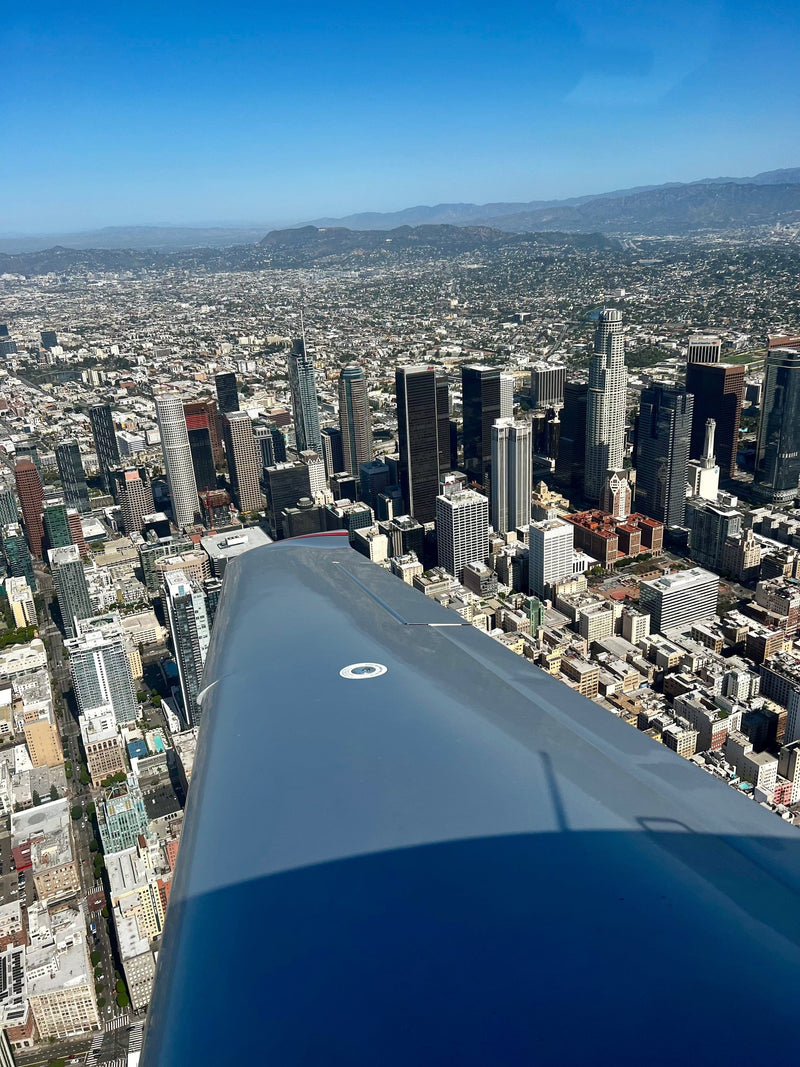
Fly north out of Van Nuys and the whole valley opens up in under ten minutes.
The steel is visible long before the car parks are, a knot of loops and towers on its own hill beside the 5. It is the easiest visual fix in the valley.
Two bodies of water stacked behind the dam at the top of the grade, deep blue against dry hills. On a clear day you can pick it out from thirty miles south.
The stacked ramps where the 5 and the 14 cross, rebuilt after the 1971 and 1994 earthquakes brought parts of it down. From above, the geometry finally makes sense.
A thin sliver of water folded into the hills north-east of Saugus, the canyon road curling beside it. Much of your ground reference work happens over this country.
About thirty minutes outside peak hours, whether you come down the 14 or the 5. The Newhall Pass is the variable, and a bad one between six and nine and again from four to seven. Book late morning or the final evening slot and the drive stops mattering.
Not with this equipment. We train only at Van Nuys Airport, and the alternatives up your way are thin: Agua Dulce is a small private strip and Whiteman is nearer but far more limited. Neither gives you a control tower, parallel runways, seven aircraft types and a full-motion simulator on the same field. The extra ten minutes in the car buys the training environment you would otherwise have to go and find later anyway.
Our own lot at 7900 Balboa Boulevard, free and ungated, with spaces immediately outside the door. The office is Suite 108A. The address is a shared hangar site occupied by a number of separate aviation businesses, so the suite number rather than a sign is what gets you to the right place on your first visit.
The standard course is $10,900. The comprehensive version, with substantially more instruction and simulator time included, is $15,900, and the premium course is $22,500. Budget separately for the FAA written exam and the examiner's fee at the checkride. Your first flight is credited in full if you enroll within a day of it.
Yes, and a fair number of Santa Clarita students do exactly that. We fly seven days a week, nine in the morning until nine at night, so a three-day rotation or four tens is straightforward. Block slots a few weeks ahead and instructor and aircraft are both held.
Forty is the legal minimum and almost nobody finishes there. Sixty to seventy hours is the realistic range for an adult flying twice a week. Fly once a fortnight and the number climbs, because each lesson starts by rebuilding what the last one taught you. This is the single biggest lever you control over the final cost.
There is no minimum age for lessons. Solo comes at sixteen and the private certificate at seventeen, so a fourteen year old can begin and simply pace the training toward those birthdays. The teen package is $4,200 and is built around a school year. Several families from Valencia and Canyon Country are working through it now.
Not for your first lessons, but you cannot solo without one, so start the process early. An FAA-designated aviation medical examiner issues it and there are several in the north valley. If you have a condition that might need paperwork, get it moving in week one rather than finding out about it at hour twenty.
Call (818) 290-8249 and take a late-morning slot, when the pass is behaving and the air over the ranges is still smooth. We are at 7900 Balboa Blvd, Suite 108A, open nine to nine every day, with free parking and a free first consultation.
The three private pilot packages, what each one includes, the financing options and a realistic timeline built around how often you can actually fly. Sent to you in one email. Nobody will pressure you.
Loved On Google
Every review below is real and shown verbatim, in the reviewer’s own words — written by the people who learned to fly here, not by us.
SAFETY FIRST
Very safety and detail oriented. Pre-flight briefing explained everything there was. To my knowledge, this flight school is exceptional in their ability.
 DISCOVERY FLIGHT
I recently had the chance to take my first-ever discovery flight, and it was nothing short of amazing! From the moment I stepped into the cockpit, the...
 SUNSET CIRRUS
It was a great flight! I did a sunset flight and Alex let us fly an awesome. Website was easy to book, and the plane itself was really fun to fly...
 FLYING LESSON
We had a great flying lesson with Ralph and came away with a much better understanding of both the aircraft and the principles of flight. Ralph is a...
 KIDS LUXURY FLIGHT
I got 2 luxury discovery flights for my kids. I wanted them to have the experience of flying. Our instructor Alex was amazing he made sure they feel...
 HONEYMOON SURPRISE
Last minute booking to surprise my wife on our honeymoon. She had no experience with flying and was scared of flying, but Alex was very easygoing and knew...
 FULL-MOTION SIM
Amazing flight school in van nuys airport. I have been a student here for the past few months and i could not be happier. I started doing a lot of...
 DISCOVERY FOR TWO
I booked a Discovery Flight for Two for my girlfriend's birthday and it was the perfect gift for her. She couldn't have been more excited to get to...
 SIMULATORS
Very professional and great airplanes. I love the flight simulators. The pricing is very fair compared to any other flight school
 TEEN FIRST LESSON
We gifted our teenage son his first flying lesson. He was so excited! Alex greeted us and gave a reassuring brief that made us all feel comfortable and at...
 FIRST-TIME FLYER
Flying is my husband's hobby and I was incredibly anxious and apprehensive about the discovery flight. However, I felt completely safe and at ease once we...
SAFETY FIRST
Very safety and detail oriented. Pre-flight briefing explained everything there was. To my knowledge, this flight school is exceptional in their ability.
DISCOVERY FLIGHT
I recently had the chance to take my first-ever discovery flight, and it was nothing short of amazing! From the moment I stepped into the cockpit, the...
SUNSET CIRRUS
It was a great flight! I did a sunset flight and Alex let us fly an awesome. Website was easy to book, and the plane itself was really fun to fly...
FLYING LESSON
We had a great flying lesson with Ralph and came away with a much better understanding of both the aircraft and the principles of flight. Ralph is a...
KIDS LUXURY FLIGHT
I got 2 luxury discovery flights for my kids. I wanted them to have the experience of flying. Our instructor Alex was amazing he made sure they feel...
HONEYMOON SURPRISE
Last minute booking to surprise my wife on our honeymoon. She had no experience with flying and was scared of flying, but Alex was very easygoing and knew...
FULL-MOTION SIM
Amazing flight school in van nuys airport. I have been a student here for the past few months and i could not be happier. I started doing a lot of...
DISCOVERY FOR TWO
I booked a Discovery Flight for Two for my girlfriend's birthday and it was the perfect gift for her. She couldn't have been more excited to get to...
SIMULATORS
Very professional and great airplanes. I love the flight simulators. The pricing is very fair compared to any other flight school
TEEN FIRST LESSON
We gifted our teenage son his first flying lesson. He was so excited! Alex greeted us and gave a reassuring brief that made us all feel comfortable and at...
FIRST-TIME FLYER
Flying is my husband's hobby and I was incredibly anxious and apprehensive about the discovery flight. However, I felt completely safe and at ease once we...
Reviews shown verbatim, exactly as each reviewer published them.
Aviation News
Notes from the flight line at Van Nuys — weather, regulation changes, checkride questions and the cost of training, written up as they come.
Open 7 days · 9:00 AM – 9:00 PM
Los Angeles Flight School