SAFETY FIRST
★★★★★
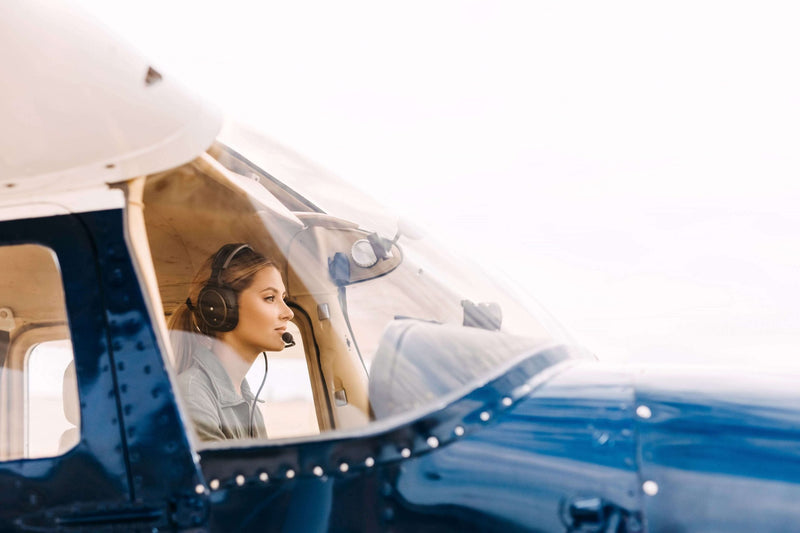
Very safety and detail oriented. Pre-flight briefing explained everything there was. To my knowledge, this flight school is exceptional in their ability.

Pasadena drivers reach our ramp in about thirty-five minutes, and what waits at the end is a complete certificate course, a control tower, and mountains worth learning over.
Every drive out of Pasadena is a commitment. Big Bear is most of a Saturday morning once the 210 fills. Mammoth eats a whole day. San Luis Obispo is a weekend in itself before you have unpacked anything. A private certificate rearranges that arithmetic more thoroughly than almost anything else you could buy: the same three trips become fifty minutes, ninety minutes and a little over ninety, flown by you, with the traffic you used to sit in reduced to a bright line somewhere under the wing.
The certificate holders we turn out from this side of town skew older than people expect. A lot of them are finishing something they started and abandoned decades ago, usually around the point where a first child arrived. They come from Altadena, Sierra Madre, San Marino, South Pasadena and the streets above Washington: teachers, contractors, a surprising number of people who retired early and decided a logbook was the correct response. What they share is a schedule with real gaps in it, and gaps are what finish certificates.
Flying this direction has a particular shape. Your training flights go west and north, out over the open ground past the 118, because that is where the practice areas sit. Your cross-countries go the other way, and that is where Pasadena students learn something early: the front range behind your house tops five thousand seven hundred feet at Mount Wilson, the air over it moves in ways the valley floor never does, and Burbank's airspace sits squarely between you and home.
The numbers sit on the page rather than behind a phone call. A discovery flight, sixty minutes in the aircraft with you flying it, is $229, and every minute of it is logged instruction. The standard private certificate is $10,900, the comprehensive version is $15,900, and the instrument rating that makes a winter trip over the mountains sensible is $11,700. Enroll within a day of that first flight and the $229 comes straight off the tuition. Financing runs through Stratus Financial or an in-house plan, and the first consultation costs nothing at all.

Five routes in, each priced whole, none of them quoted by the hour and left to drift.
The full FAA Private Pilot Certificate. Where most students start.
Learn MoreThe widest margin of hours for students who want no surprises.
Learn MoreThe rating that makes a license useful in Southern California weather.
Learn MoreYou fly the aircraft from the left seat with an instructor beside you. The time is loggable and counts toward a certificate.
The SR22 Turbo, glass cockpit. 90 min $699, 120 min $949.
Learn MoreFAA-approved full-motion MCX, on the field at Van Nuys.
Learn MoreIf you live north of Colorado, in Altadena or anywhere along the foothills, the mountain route is the calm one. Pick up the 210 westbound and follow it along the base of the range through La Cañada, past the Tujunga wash and down into Sylmar. Where the interchanges tangle at the top of the valley, take the 118 west, then leave it at Balboa Boulevard and turn south. Four miles of ordinary suburban road later the airport fence appears on your right. Call it thirty-five minutes with the traffic behaving.
From Old Pasadena, the Playhouse District or anywhere south of the 210, the middle route is shorter in miles. The 134 runs west under the Verdugos through Glendale and Burbank and feeds into the 101, and Balboa is roughly eleven miles beyond that merge, with a two-mile run north from the exit. Twenty-five miles all in. Mid-morning it wins comfortably. From four o'clock onward the squeeze through Sherman Oaks turns it into the slower option, and the northern route repays knowing.
Allow more than the drive itself, because a lesson runs closer to two hours once briefing and preflight are counted. A six o'clock booking means leaving Pasadena around five. Parking is our own lot at 7900 Balboa Boulevard: free, ungated, no permit, no app, no attendant. Walk to Suite 108A rather than hunting for a sign, since the site is a shared hangar complex holding several unrelated aviation firms. Bring photo identification the first time and wear closed shoes.

Trainer, complex single, twin, glass-panel Cirrus and a full-motion simulator, all sitting on one ramp with the same instructors and a single set of records. Nothing about your progression here requires finding a new school, a new syllabus, or another set of people who have no idea how you actually fly.
Two parallel runways and steady traffic mean you are talking to controllers from the first lesson rather than deferring it. Pilots trained at quiet fields often arrive at their checkride still tense on the radio. Yours will be ordinary by then, which is what makes flying into Long Beach or Palm Springs afterward feel like nothing.
Living against the front range means your flying will involve terrain whether you plan for it or not. Instructors here work density altitude, mountain wave and canyon winds into training as a matter of course, because the ridge north of the valley behaves the same way the one above Altadena does.
Programs are quoted as totals, not as a figure that quietly climbs while the engine runs. Aircraft, instructor, ground school and simulator time are inside the course price, the Redbird MCX is $189 for a sixty-minute session, and Stratus Financial or an in-house payment plan spreads whichever course you choose. The consultation before any of it is free, and it is a conversation rather than a pitch.
Most Pasadena students do their early hours in the Piper Warrior or the Cessna 162 Skycatcher, both covered by the course price. They are honest aircraft: responsive enough to teach you something, stable enough to forgive a rough landing, and entirely unwilling to conceal sloppy rudder work. The Diamond DA20 is the one enthusiasts gravitate toward, with a bubble canopy that leaves the whole northern range sitting in front of you. Between flights, the Redbird MCX full-motion simulator, $189 for a sixty-minute session, gives you repetition on emergencies and approaches at a fraction of the cost.
After the certificate the ramp keeps offering things. The Piper Arrow II brings retractable gear and a constant-speed propeller, which is the complex time commercial students need. The Cirrus SR22 Turbo carries a glass panel and a parachute for the whole airframe, and it is the aircraft that makes a Friday run to Monterey or Sedona a genuine plan rather than a daydream. The Piper Seminole is the twin used for the $5,100 multi-engine rating. Every one of them is maintained on site at Van Nuys and open to you once you are checked out.

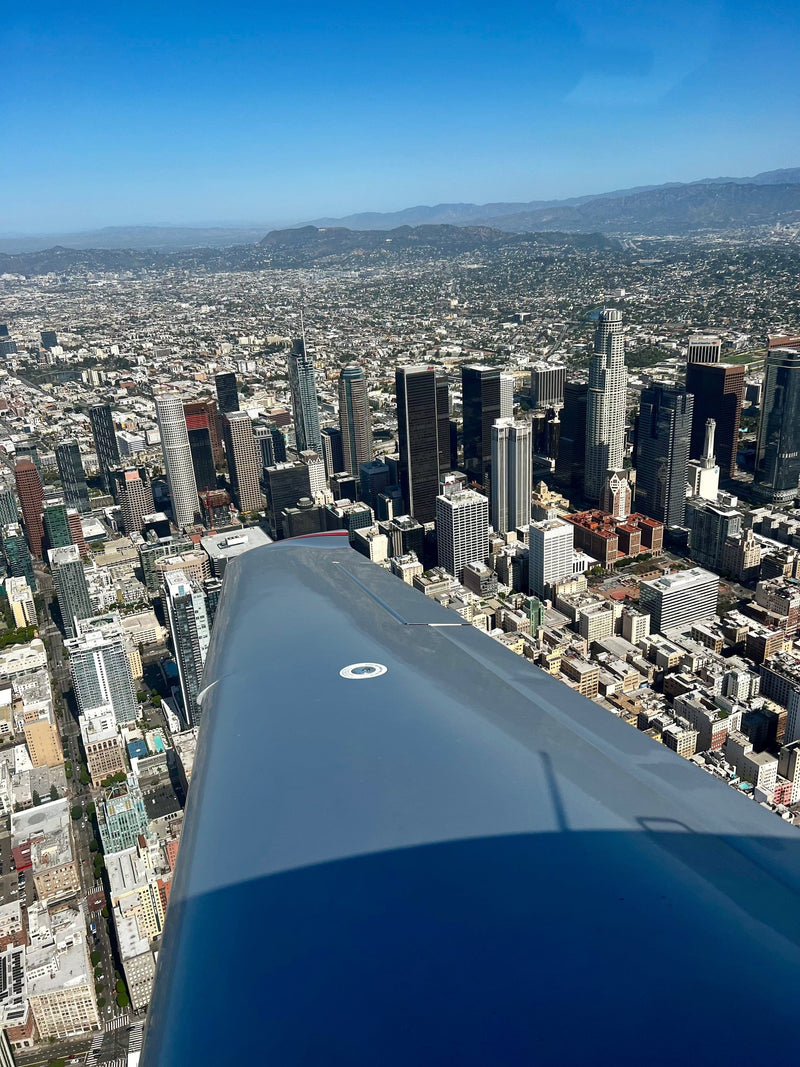
Turn east out of Van Nuys and the run along the foothills gives you all of this in about twelve minutes.
The isolated block of hills between Burbank and Glendale, standing alone with the valley on one side and the Crescenta basin on the other. It is the first real terrain you cross going east.
The restored art deco terminal on the Glendale side, with the old runway still legible as a straight seam through the industrial blocks. Charles Lindbergh flew out of it and the field closed in 1959.
The campus reads as a tight grid of olive courtyards and red tile south of Colorado, the library tower standing clear of everything near it. San Marino's larger lots begin immediately south.
The deep notch cut into the mountain wall above Altadena, with the Angeles Crest Highway threading up the slope beside it. From a few thousand feet the abruptness of the range is startling.
Thirty-five minutes on the 210 and 118 when nothing is wrong, and much the same on the 134 and 101 outside the evening peak. Both finish on Balboa Boulevard. Students from your side of town tend to book mid-morning or the last slot of the evening. Ring us if you are running late.
We fly from Van Nuys Airport and nowhere else. El Monte and Whiteman are both nearer to you and both smaller. Neither has a control tower, parallel runways, seven aircraft types and a full-motion simulator on one field. The extra quarter hour in the car buys a training environment you would end up traveling to anyway once you started an instrument rating.
In our own lot at 7900 Balboa Boulevard, right outside the door. It is free, with no gate arm, no meter and nothing to validate. Come to Suite 108A: the address is a shared hangar site holding several separate aviation businesses, so the suite number gets you to us first time.
The standard course is $10,900. The comprehensive version, which builds in considerably more instruction and simulator time, is $15,900, and the premium course is $22,500. The written exam fee and the examiner's fee sit on top. Your discovery flight is credited in full if you enroll within twenty-four hours.
Six to nine months for most people flying twice a week, and longer if you fly once. Forty hours is the FAA minimum and very few finish there; sixty to seventy is realistic. Frequency matters more than talent, because a lesson every fortnight means paying to relearn what you already had.
Not to begin lessons, but you need one before you solo, so arrange it early. An FAA aviation medical examiner issues it and several practice within reach of Pasadena. If anything in your history might complicate matters, start in your first week; finding a problem at hour fifteen is the frustrating version.
Yes, and it is one of the better reasons to hold a certificate here. Terrain flying is covered properly, including density altitude, ridge crossings and how wind behaves over a range that steep. Afterwards the same aircraft stay open to you, so a morning over the Angeles Crest is a booking rather than an expedition.
You come to Suite 108A, walk the ramp, sit with an instructor and go through the syllabus, a realistic timeline for your schedule and the total cost with nothing left out. No obligation, no pressure. If the sport license at $8,400 suits you better than the full certificate, we will say so.
Ring (818) 290-8249 and take a mid-morning slot, before the 210 has anything to say about your day. We are at 7900 Balboa Blvd, Suite 108A in Van Nuys, open nine to nine every day of the week, with free parking at the door.
The three private pilot packages, what each one includes, the financing options and a realistic timeline built around how often you can actually fly. Sent to you in one email. Nobody will pressure you.
Loved On Google
Every review below is real and shown verbatim, in the reviewer’s own words — written by the people who learned to fly here, not by us.
SAFETY FIRST
Very safety and detail oriented. Pre-flight briefing explained everything there was. To my knowledge, this flight school is exceptional in their ability.
 DISCOVERY FLIGHT
I recently had the chance to take my first-ever discovery flight, and it was nothing short of amazing! From the moment I stepped into the cockpit, the...
 SUNSET CIRRUS
It was a great flight! I did a sunset flight and Alex let us fly an awesome. Website was easy to book, and the plane itself was really fun to fly...
 FLYING LESSON
We had a great flying lesson with Ralph and came away with a much better understanding of both the aircraft and the principles of flight. Ralph is a...
 KIDS LUXURY FLIGHT
I got 2 luxury discovery flights for my kids. I wanted them to have the experience of flying. Our instructor Alex was amazing he made sure they feel...
 HONEYMOON SURPRISE
Last minute booking to surprise my wife on our honeymoon. She had no experience with flying and was scared of flying, but Alex was very easygoing and knew...
 FULL-MOTION SIM
Amazing flight school in van nuys airport. I have been a student here for the past few months and i could not be happier. I started doing a lot of...
 DISCOVERY FOR TWO
I booked a Discovery Flight for Two for my girlfriend's birthday and it was the perfect gift for her. She couldn't have been more excited to get to...
 SIMULATORS
Very professional and great airplanes. I love the flight simulators. The pricing is very fair compared to any other flight school
 TEEN FIRST LESSON
We gifted our teenage son his first flying lesson. He was so excited! Alex greeted us and gave a reassuring brief that made us all feel comfortable and at...
 FIRST-TIME FLYER
Flying is my husband's hobby and I was incredibly anxious and apprehensive about the discovery flight. However, I felt completely safe and at ease once we...
SAFETY FIRST
Very safety and detail oriented. Pre-flight briefing explained everything there was. To my knowledge, this flight school is exceptional in their ability.
DISCOVERY FLIGHT
I recently had the chance to take my first-ever discovery flight, and it was nothing short of amazing! From the moment I stepped into the cockpit, the...
SUNSET CIRRUS
It was a great flight! I did a sunset flight and Alex let us fly an awesome. Website was easy to book, and the plane itself was really fun to fly...
FLYING LESSON
We had a great flying lesson with Ralph and came away with a much better understanding of both the aircraft and the principles of flight. Ralph is a...
KIDS LUXURY FLIGHT
I got 2 luxury discovery flights for my kids. I wanted them to have the experience of flying. Our instructor Alex was amazing he made sure they feel...
HONEYMOON SURPRISE
Last minute booking to surprise my wife on our honeymoon. She had no experience with flying and was scared of flying, but Alex was very easygoing and knew...
FULL-MOTION SIM
Amazing flight school in van nuys airport. I have been a student here for the past few months and i could not be happier. I started doing a lot of...
DISCOVERY FOR TWO
I booked a Discovery Flight for Two for my girlfriend's birthday and it was the perfect gift for her. She couldn't have been more excited to get to...
SIMULATORS
Very professional and great airplanes. I love the flight simulators. The pricing is very fair compared to any other flight school
TEEN FIRST LESSON
We gifted our teenage son his first flying lesson. He was so excited! Alex greeted us and gave a reassuring brief that made us all feel comfortable and at...
FIRST-TIME FLYER
Flying is my husband's hobby and I was incredibly anxious and apprehensive about the discovery flight. However, I felt completely safe and at ease once we...
Reviews shown verbatim, exactly as each reviewer published them.
Aviation News
Notes from the flight line at Van Nuys — weather, regulation changes, checkride questions and the cost of training, written up as they come.
Open 7 days · 9:00 AM – 9:00 PM
Los Angeles Flight School