Private Pilot Training for Pacific Palisades
Van Nuys Airport · KVNY

Private Pilot Training for Pacific Palisades

The Palisades has two roads out and a permanent layer of coastal cloud, which is why the sensible place to learn to fly sits over the ridge on the Valley side. We are at Van Nuys Airport; the Palisades is where you drive from.

Sunset to the 405, 40 minutesFree lot at the doorFlying nine until nine daily
5.0★on Google across 53 reviews
2,000+discovery flights flown safely
$229for a logged first hour
9am–9pmseven days a week
Local

Coastal weather, and why training happens inland

Pacific Palisades sits on a shelf of mesas and canyons with the bay on one side and the Santa Monica Mountains at its back, reached by Sunset Boulevard or the Pacific Coast Highway and almost nothing else. It is a beautiful place to look at aeroplanes from and an awkward one to learn in. The nearest field to you, Santa Monica, is not ours and not a base we would recommend: its runway was cut to 3,500 feet in 2017 and it is due to close under the city's agreement with the FAA after 2028, which makes it a poor thing to build a multi-year plan around.

The bigger factor is the cloud. From late spring into midsummer the marine layer parks itself along this coast most mornings and often does not clear until the afternoon, while the Valley floor twelve miles inland is already blue. For a student pilot that difference is decisive, because progress depends on flying two or three times a week rather than on how much you want to. Training out of Van Nuys means the number of lessons lost to weather in a year is small enough to plan around.

The certificate itself is straightforward to describe. Forty hours is the FAA minimum and sixty is what a working adult usually needs, spread across handling, solo flight, navigation you plan yourself, night flying and basic instrument work, finished with a practical test. The standard programme is $10,900 and takes four to six months at two lessons a week. The premium course at $22,500 exists for people who would rather compress that into a shorter run with priority on the schedule.

What follows is the part worth having. Santa Barbara is well under sixty minutes in the air, San Luis Obispo and Catalina are easy days out, and the coastline you drive along becomes something you look down on from a few thousand feet with the whole bay in the windscreen. The Piper Warrior and the Cirrus SR22 Turbo stay bookable from our ramp at Van Nuys afterwards, so the aircraft remains available without a hangar, a partnership or an annual inspection of your own to worry about.

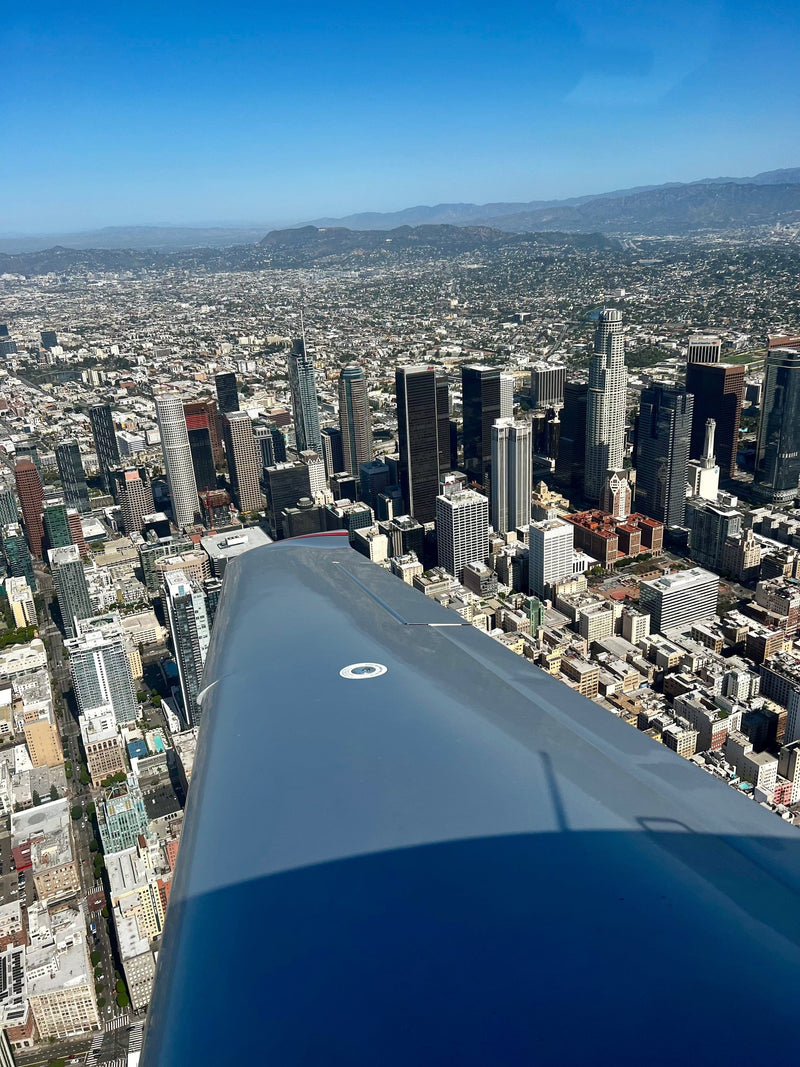
A training aircraft on a flight over the San Fernando Valley
Training packages

Ways in, with the price on each one

Five fixed programme prices, published rather than quoted as an hourly rate that grows.

Solo Certificate

$5,500

Train to your first solo, sport or private track.

Learn more

Sport Pilot License

$8,400

The fastest route to flying legally as pilot in command.

Learn more
Most popular

Standard Private Pilot

$10,900

The full FAA Private Pilot Certificate. Where most students start.

Learn more

Comprehensive Private Pilot

$15,900

More simulator and ground time built into the package.

Learn more

Premium Private Pilot

$22,500

The widest margin of hours for students who want no surprises.

Learn more

Instrument Rating

$11,700

The rating that makes a licence useful in Southern California weather.

Learn more

Multi-Engine Rating

$5,100

A short add-on rating flown in the Piper Seminole.

Learn more

Airline Pilot Program

$89,000

Zero time to airline-ready, financing available.

Learn more

Teen Flight Training

$4,200

Ages 10 to 15, built around the school calendar.

Learn more
Every course above is a package, not an hourly rate — the price covers the aircraft, your instructor, ground school and the simulator time in that package. Financing is available through Stratus Financial and through in-house payment plans, and a discovery flight is credited in full against any package if you enrol within 24 hours. All training is flown from Van Nuys Airport (KVNY), 7900 Balboa Blvd, Suite 108A.
Discovery flights

Try it first — a discovery flight from Van Nuys

You fly the aircraft from the left seat with an instructor beside you. The time is loggable and counts toward a certificate.

Discovery Flight For One

$229/ 60 min

You fly it. 90 min $299, 120 min $399.

Learn more

Discovery Flight For Two

$299/ 60 min

Bring a passenger. 90 min $399, 120 min $499.

Learn more

Luxury Cirrus For Two

$399/ 60 min

The SR22 Turbo, glass cockpit. 90 min $549, 120 min $699.

Learn more

Multi-Engine Discovery

$499/ 60 min

The Piper Seminole twin. 90 min $699, 120 min $899.

Learn more

Redbird Simulator Session

$189/ 1 hr

FAA-approved full-motion MCX, on the field at Van Nuys.

Learn more
Getting here

Sunset and the 405 to 7900 Balboa Blvd

The standard run is Sunset Boulevard east through Brentwood to the 405, then north over the Sepulveda Pass past the Getty. Come down into the Valley, stay on the freeway past Ventura and Burbank, and leave at Victory Boulevard or Sherman Way. Head west two and a half miles to Balboa Boulevard, turn north, and the airport fence appears on your right at the 7900 block. Around twenty-two miles, and thirty-five to fifty minutes depending entirely on how the pass is behaving.

The second route is longer in miles and often better in temper: Pacific Coast Highway north to Topanga Canyon Boulevard, up through the canyon and over the crest into Woodland Hills, then east on Ventura Boulevard or the 101 to the Balboa exit. It is about twenty-five miles of genuinely good driving, it avoids the 405 completely, and on a Friday afternoon it is frequently the faster of the two. Chautauqua and Temescal Canyon both feed Sunset if you are starting from the Highlands.

We are at 7900 Balboa Boulevard, Suite 108A. Parking is free in our own lot immediately outside the door, with no gate, no meter and nothing to validate. The complex is a shared hangar building housing several unrelated aviation businesses, which is completely normal at a field this size, so aim for the suite number rather than only the street address. The phone is (818) 290-8249 and somebody answers it from nine in the morning until nine at night, every day.

The entrance to LA Flight School at 7900 Balboa Blvd, Suite 108A
Why Van Nuys

Why Palisades pilots train over the hill

1

Inland air flies when the coast does not

Low cloud sitting on the shoreline until two in the afternoon is a normal June morning here and a cancelled lesson anywhere on the water. Van Nuys is far enough inland that the marine layer usually burns off early or never arrives, so the training schedule you agree in January is roughly the one you actually fly.

2

The aircraft you would want to own is here

The Cirrus SR22 Turbo sits on our ramp at Van Nuys with a full glass panel and an airframe parachute, and the Luxury Cirrus discovery flight from $399 is the easy way to try it. Plenty of people from this side of the hill are quietly costing out ownership, and flying the type first is the cheapest research available. The twin-engine Seminole is on the same apron.

3

Instructors who are not passing through

Every instructor here is FAA-certified with fifteen years or more behind them, rather than a low-hours pilot waiting for an airline class date. Over a six-month course that continuity is the difference between a training plan and a series of unrelated lessons, and it shows up in the 5.0 rating the school holds across 53 Google reviews.

4

A schedule built for a real commute

We fly from nine in the morning until nine at night, seven days a week, which lets you book late morning or evening and avoid the pass at its worst. Students from here tend to fix two slots a week and keep them. Consistency, not intensity, is what gets somebody to a checkride on time.

The fleet

Trainers, a Cirrus, a twin and a simulator

Most of your course is flown in the Cessna 162 Skycatcher, the Piper Warrior or the Diamond DA20, all of them covered by your package rather than billed separately. The DA20 is a favourite with coastal students because of its bubble canopy: on a clear afternoon heading south-west, the view takes in the whole sweep of the bay from Point Dume round to Palos Verdes with nothing but perspex in the way. They are simple, honest aeroplanes, and simple is exactly what you want while learning to land one properly.

The rest of the ramp gives the course somewhere to lead once you hold the certificate. The Piper Arrow II introduces retractable gear and a constant-speed propeller. The Cirrus SR22 Turbo and the twin-engine Piper Seminole sit alongside it, the Seminole carrying the $5,100 multi-engine rating. Indoors sits the Redbird MCX, a full-motion simulator at $189 for a one-hour session and included in the private pilot packages, where an instrument approach into thick coastal cloud can be flown eight times in a single evening, deliberately badly for a few of those, with nothing at stake but the lesson.

Training aircraft and the Redbird MCX simulator at LA Flight School
From the air

The Palisades from 2,500 feet

Four things that stand out along this stretch of coast on the way back from the bay.

Riviera in its canyon bowl

The golf course lies in a deep natural amphitheatre off Capri Drive, a green floor with steep wooded sides rising all around it. From above it looks carved out, and nothing else on this coast has that shape.

🏛️

The Getty Villa

A Roman villa with formal gardens and colonnades set into the hillside above the coast highway. Its geometry is so deliberate that it reads instantly from the air against the tangle of canyon vegetation around it.

🏞️

Potrero Canyon

The long green cut running from the bluffs down toward the shoreline, now a park threading between the mesas. It marks exactly where the flat ground ends and the drop to the beach begins.

⛰️

The Highlands up Santa Ynez

Housing climbing far back into a canyon that would otherwise be empty chaparral, with the ridge of Topanga State Park closing off the top. It is the deepest that development reaches into these mountains anywhere nearby.

FAQ

Common questions

Around forty minutes for twenty-two miles via Sunset Boulevard and the 405 over the Sepulveda Pass, though the pass can add twenty minutes in the evening peak. The Topanga Canyon route from PCH takes a similar time and is often steadier. Booking late morning or after seven avoids most of the problem.

We are not based there. Santa Monica's runway was shortened to 3,500 feet in 2017 and the airport is due to close after 2028 under the city's agreement with the FAA, which is not a stable base for a course that runs for months. Our ramp is at Van Nuys Airport, which has two parallel runways, a tower, seven aircraft types and a full-motion simulator in one place.

Rarely, and that is the point of training inland. The cloud that sits over the Palisades until early afternoon in May and June usually stops well short of the Valley. If the weather does close in, a session in the Redbird MCX at $189 keeps the syllabus moving instead of losing the slot entirely.

The standard programme is $10,900, comprehensive is $15,900 and premium is $22,500. All three finish with the same FAA certificate; what differs is instructor time, simulator hours and how much contingency is built in. Financing is available through Stratus Financial or our in-house plans, and the first consultation is free.

It is free, ungated and directly outside Suite 108A at 7900 Balboa Boulevard, with no meter and nothing to validate. Several unrelated aviation companies share the same hangar complex, which is standard at Van Nuys, so look for the suite number when you arrive rather than a name on the street.

Yes, and often. Coastal transits are part of learning this airspace, and the run from Point Dume down to the bay is one of the more spectacular training environments in the country. Most manoeuvring practice happens over open ground north-west of the field, where there is room to work without traffic.

No, and most people never do. After the checkride you book from the same ramp at Van Nuys that you trained on, from the Warrior and Skycatcher up to the Cirrus SR22 Turbo. No hangar, no annual inspection, no partnership arguments, and somebody else deals with the maintenance schedule.

You come to Suite 108A at 7900 Balboa Boulevard, meet an instructor, walk out to the aircraft on the ramp and ask whatever you want about hours, medicals, weather, timelines and cost. It takes thirty minutes and costs nothing. If an aircraft and instructor are free, a discovery flight at $229 can often follow the same day.

Talk to us

Come over the pass and see the aircraft

Drive Sunset to the 405 on a clear late morning, or take Topanga over the top if you would rather enjoy the trip, and look at the fleet before deciding anything. Call (818) 290-8249 for a free consultation or a discovery flight from $229.

Discovery Flight For One
$229
60 minutes, hands on the controls, fully loggable
Book a discovery flight or call (818) 290-8249