SAFETY FIRST
★★★★★
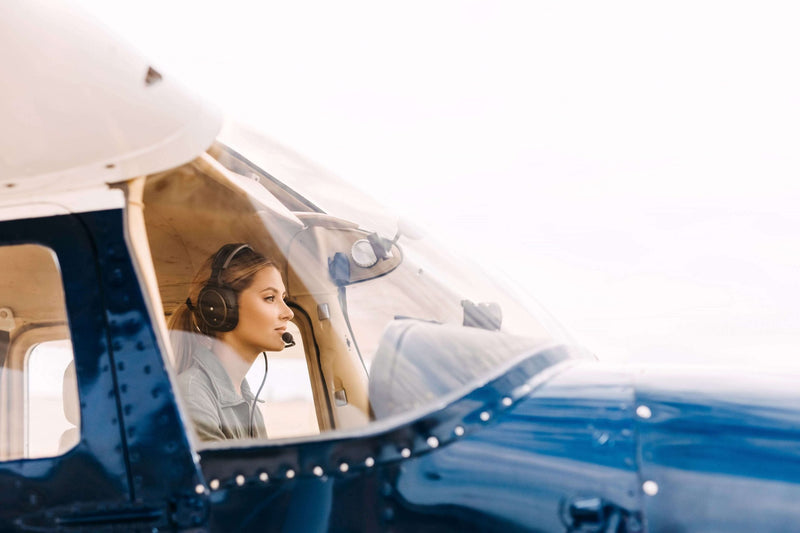
Very safety and detail oriented. Pre-flight briefing explained everything there was. To my knowledge, this flight school is exceptional in their ability.

The FAA certificate that lets you carry passengers, fly at night and take an airplane anywhere in the country, earned at the closest full-service field to Hollywood.
A private pilot certificate is a specific legal document, not a course completion note. The FAA asks for a minimum of forty hours of flight time, of which twenty are with an instructor and ten are solo, including night flying, a long solo cross-country, some instrument work and a written knowledge exam. It ends with a practical test flown with an examiner who can and does fail people. Most adults in Hollywood who hold down a job finish in sixty to seventy hours.
Nowhere south of the Santa Monica Mountains offers a sensible place to do that any more. Santa Monica's runway was shortened years ago and the airport is scheduled to close at the end of 2028, which makes it a poor place to begin a two-year project. Burbank is an airline field. That leaves Van Nuys, over the hill, where two runways, a full-time tower and a fleet running from a two-seat trainer to a twin sit on the same ramp with room for students.
The people who come to us from Melrose, Larchmont, Los Feliz and the streets above Franklin tend to be freelance in some form, which shapes how they pay rather than whether they finish. Income arrives in lumps. So we quote a whole program price rather than run an open meter, and Stratus Financial will lend against it if that suits you better, or we can split it across payment plans in house. The consultation is free.
The airspace is part of the education. Hollywood sits under the outer shelves of the Los Angeles Class B, with Burbank's Class C a few miles northeast and Van Nuys's own tower controlling everything at the field. Flying home over the pass means holding an altitude, knowing whose airspace you are in and asking permission before you enter it. Students who learn this from lesson one arrive at their checkride sounding like pilots rather than tourists.

Courses & Pricing
Course prices are packages, not hourly rates - the aircraft, your instructor, ground school and simulator time are all in the figure. Van Nuys Airport, KVNY. Financing Available Through Stratus & In-House Plans.

Start Here
The First Hour At The Controls. Credited Toward Your Training If You Enroll Within 24 Hours Of Landing.
All Prices In USD. 7900 Balboa Blvd, Suite 108A, Van Nuys, CA 91406 · Open 9 AM–9 PM, Seven Days. Free In-Person Tour Of The School
Book It Or Gift It
Every discovery flight below can be booked for yourself in the next few minutes, or bought as a gift certificate that is emailed within minutes and never expires. Same flight, same price, either way.
 Most Given
 Two Seats
 The Nice One
 Twin Engine
One person, one instructor, and no audience. Hands on the controls from the left seat, briefed before you go and debriefed after you land.
Hands-On Stick TimePre-Flight BriefingLoggable Flight Time
Flight Length
$229Book It Or Gift It
Same Price Either Way
The same flight with a passenger in the back seat, briefed and on the intercom. Couples book it; so do parents who would rather watch than hear about it.
One Passenger SeatPiper Warrior Or ArcherHeadsets For Both
Flight Length
$299Book It Or Gift It
Same Price Either Way
The nicest airplane we put a first-time flyer in. Glass cockpit, air conditioning, leather seats, and a parachute built into the airframe rather than strapped to the person.
Turbocharged Cirrus SR22Air ConditioningWhole-Airframe Parachute
Flight Length
$499Book It Or Gift It
Same Price Either Way
Two engines, and the airplane instrument-rated pilots move into when they start thinking about a career. Flown from the left seat with a multi-engine instructor.
Piper Seminole TwinMulti-Engine DepartureCareer-Track Instructor
Flight Length
$499Book It Or Gift It
Same Price Either Way
Gift It issues a real gift certificate, emailed within minutes, which never expires and credits in full toward training. Flights are limited to 180 lb per person, 370 lb combined. Questions: (818) 290-8249, 9 AM–9 PM, seven days.
The straightforward version: north through the Cahuenga Pass, then west on the 101 through Studio City and Sherman Oaks, off at Balboa Boulevard and north for five miles past Victory, Vanowen and Sherman Way. The airport fence appears on your right at Saticoy. It is a little over twenty miles from Hollywood and Highland and the clock says thirty minutes on a good run, closer to fifty when the Valley side is stacked up. Aim for either side of the peak and it stays a half-hour errand.
There is a version without a car, and Hollywood is one of the few neighborhoods where it works. Take the Metro B Line from Hollywood and Vine to North Hollywood, cross to the G Line and ride west along the Valley to the Balboa stop. From there it is a two-and-a-half mile hop north up Balboa to the field, which is a short rideshare. Several of our students do exactly this and read on the way.
We are at 7900 Balboa Boulevard, Suite 108A, on the west side of the airport. The car park belongs to the building, sits outside our door and costs nothing at all. A number of unrelated aviation businesses share the complex, so use the suite number to find us rather than the street address alone. Doors are open from nine in the morning to nine at night, seven days, on (818) 290-8249. Ring ahead and somebody will meet you at the door.

You will speak to a tower on your first lesson and be sequenced behind business jets by your fiftieth. Pilots who train at quiet airfields eventually have to learn this, usually while already airborne somewhere unfamiliar. Doing it from the beginning removes a whole category of anxiety from the rest of your flying life.
The Santa Monica range sits directly between here and Hollywood, so terrain flying, canyon winds and altitude discipline are part of ordinary lessons rather than a specialist add-on. Add the marine layer, summer heat and Class B shelves overhead and you finish with a broader set of conditions than most new pilots.
The program figures are fixed: $10,900, $15,900 or $22,500 depending on how much instruction is built in. Outside them you pay for a medical examination, the written test and a headset if you want your own. No meter running quietly in the background, and no phone call in month five about extra costs.
Our FAA-certified instructors carry fifteen years or more each, and the useful part of that is judgment. They will tell you when your landings are not checkride standard, when the weather is not worth launching into, and when you are ready before you feel ready. All three conversations save money.
Early lessons happen in the Cessna 162 Skycatcher, the Diamond DA20 or the Piper Warrior. All three are covered by your program price, and this is where most of your forty to seventy hours are actually spent. The DA20 in particular is unforgiving about lazy feet, which sounds unappealing and is exactly what you want in a machine you are learning to fly properly. The Warrior seats four and does the longer cross-country work comfortably. All three aircraft are on the same booking system.
Beyond the certificate the ramp keeps going. The Piper Arrow II adds retractable gear and a constant-speed propeller. The Cirrus SR22 Turbo has a glass cockpit and an airframe parachute, and the Piper Seminole twin is what the $5,100 multi-engine rating is flown in. The Redbird MCX full-motion simulator, $189 for a sixty-minute session, is where instrument approaches and engine failures get rehearsed until they are dull, which is the point of rehearsing them at all. Everything on this list lives on one ramp at Van Nuys Airport and stays available to you once you hold a certificate, after a checkout in an airplane you already know well.

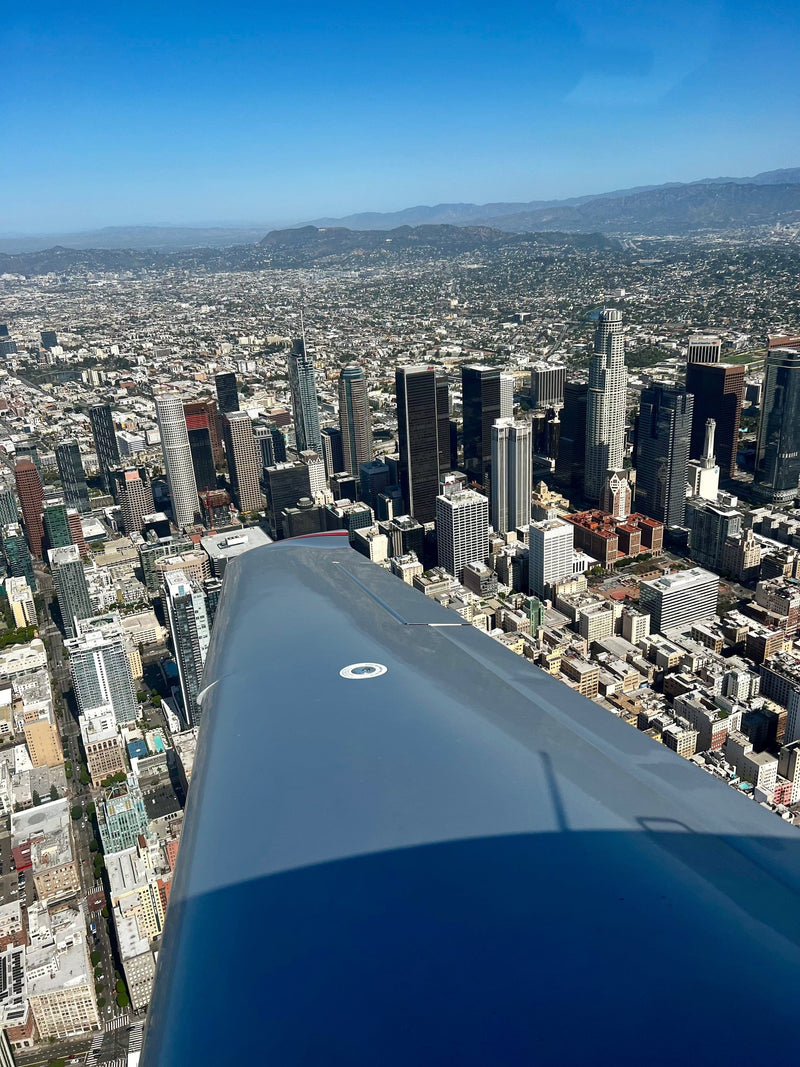
Cross the ridge southbound and the neighborhood arranges itself quickly.
The round white building north of Hollywood and Vine is one of the few structures in the area that is genuinely easier to identify from above than from the pavement. Its circular roof and needle make a reliable visual fix when you are pointing out where you live to a passenger.
The canyon cuts a bare green wedge straight down into the street grid above Franklin, with the switchback trails visible as thin pale lines. From the air it explains the geography of Hollywood better than any map does, because you can see exactly where the flat ground stops.
The isolated knoll above Hollywood Boulevard and Vermont carries the Hollyhock House and a ring of olive trees, standing alone in the middle of East Hollywood. From altitude it reads as a green island in a grid, which you cannot appreciate from below.
The ridge behind the sign carries a cluster of antennas and a service road switchbacking up the back of the mountain. Approaching from the Valley you see the working, industrial half of that hill long before the famous letters appear.
Twenty-odd miles through the Cahuenga Pass and west on the 101, then five miles up Balboa. Thirty minutes when the freeway behaves, fifty when it does not. Mid-morning and evening slots are far easier than anything at five in the afternoon, and our last lessons launch late enough to miss the worst.
Yes. The B Line from Hollywood to North Hollywood connects with the G Line running west across the Valley, and the Balboa stop leaves you two and a half miles from us, which is a short rideshare. It is not faster than driving, but it is genuinely workable, and a few of our Hollywood students use it every week.
Not usefully. Santa Monica's runway has been shortened and the airport is scheduled to close at the end of 2028, so starting a multi-year certificate there makes little sense. Burbank is a commercial airport. Van Nuys is the nearest field with a full training fleet and instructors seven days a week, and it is where we are: 7900 Balboa Blvd, Suite 108A, on the western edge of the airport.
Forty is the legal minimum and almost nobody finishes in forty. Sixty to seventy is normal for an adult flying twice a week around a job. The variable that matters most is frequency: two lessons a week builds on itself, while one a month means spending the first half of each lesson recovering what you lost.
A third-class medical from an FAA-designated aviation medical examiner, required before your first solo rather than your first lesson. Get it early anyway, so nothing awkward surfaces after you have spent real money. Several examiners practice on the Valley side and in central Los Angeles.
An oral examination lasting a couple of hours followed by a flight with a designated examiner, who is not your instructor. You plan a cross-country, explain your decisions, then demonstrate maneuvers, stalls, emergency procedures and landings to published standards. Our instructors will not sign you off until they are confident.
Carry passengers, fly at night, cross the country, and carry on flying our aircraft once an instructor has checked you out. You cannot be paid to fly; that requires a commercial certificate. Most people add an instrument rating at $11,700 within a year or two, because Southern California mornings are frequently overcast past sunrise.
Yes. A discovery flight is $229 and you fly the airplane yourself for most of that hour. Enroll within twenty-four hours and the full amount is credited against your training. Alternatively the $5,500 solo certificate takes you as far as your first solo and counts entirely toward the private certificate.
Come and see the training airplane you would actually be flying before you decide anything. Call (818) 290-8249 and we will find a slot that does not collide with the Cahuenga Pass at six o'clock.
The three private pilot packages, what each one includes, the financing options and a realistic timeline built around how often you can actually fly. Sent to you in one email. Nobody will pressure you.
Loved On Google
Every review below is real and shown verbatim, in the reviewer’s own words — written by the people who learned to fly here, not by us.
SAFETY FIRST
Very safety and detail oriented. Pre-flight briefing explained everything there was. To my knowledge, this flight school is exceptional in their ability.
 DISCOVERY FLIGHT
I recently had the chance to take my first-ever discovery flight, and it was nothing short of amazing! From the moment I stepped into the cockpit, the...
 SUNSET CIRRUS
It was a great flight! I did a sunset flight and Alex let us fly an awesome. Website was easy to book, and the plane itself was really fun to fly...
 FLYING LESSON
We had a great flying lesson with Ralph and came away with a much better understanding of both the aircraft and the principles of flight. Ralph is a...
 KIDS LUXURY FLIGHT
I got 2 luxury discovery flights for my kids. I wanted them to have the experience of flying. Our instructor Alex was amazing he made sure they feel...
 HONEYMOON SURPRISE
Last minute booking to surprise my wife on our honeymoon. She had no experience with flying and was scared of flying, but Alex was very easygoing and knew...
 FULL-MOTION SIM
Amazing flight school in van nuys airport. I have been a student here for the past few months and i could not be happier. I started doing a lot of...
 DISCOVERY FOR TWO
I booked a Discovery Flight for Two for my girlfriend's birthday and it was the perfect gift for her. She couldn't have been more excited to get to...
 SIMULATORS
Very professional and great airplanes. I love the flight simulators. The pricing is very fair compared to any other flight school
 TEEN FIRST LESSON
We gifted our teenage son his first flying lesson. He was so excited! Alex greeted us and gave a reassuring brief that made us all feel comfortable and at...
 FIRST-TIME FLYER
Flying is my husband's hobby and I was incredibly anxious and apprehensive about the discovery flight. However, I felt completely safe and at ease once we...
SAFETY FIRST
Very safety and detail oriented. Pre-flight briefing explained everything there was. To my knowledge, this flight school is exceptional in their ability.
DISCOVERY FLIGHT
I recently had the chance to take my first-ever discovery flight, and it was nothing short of amazing! From the moment I stepped into the cockpit, the...
SUNSET CIRRUS
It was a great flight! I did a sunset flight and Alex let us fly an awesome. Website was easy to book, and the plane itself was really fun to fly...
FLYING LESSON
We had a great flying lesson with Ralph and came away with a much better understanding of both the aircraft and the principles of flight. Ralph is a...
KIDS LUXURY FLIGHT
I got 2 luxury discovery flights for my kids. I wanted them to have the experience of flying. Our instructor Alex was amazing he made sure they feel...
HONEYMOON SURPRISE
Last minute booking to surprise my wife on our honeymoon. She had no experience with flying and was scared of flying, but Alex was very easygoing and knew...
FULL-MOTION SIM
Amazing flight school in van nuys airport. I have been a student here for the past few months and i could not be happier. I started doing a lot of...
DISCOVERY FOR TWO
I booked a Discovery Flight for Two for my girlfriend's birthday and it was the perfect gift for her. She couldn't have been more excited to get to...
SIMULATORS
Very professional and great airplanes. I love the flight simulators. The pricing is very fair compared to any other flight school
TEEN FIRST LESSON
We gifted our teenage son his first flying lesson. He was so excited! Alex greeted us and gave a reassuring brief that made us all feel comfortable and at...
FIRST-TIME FLYER
Flying is my husband's hobby and I was incredibly anxious and apprehensive about the discovery flight. However, I felt completely safe and at ease once we...
Reviews shown verbatim, exactly as each reviewer published them.
Aviation News
Notes from the flight line at Van Nuys — weather, regulation changes, checkride questions and the cost of training, written up as they come.
Open 7 days · 9:00 AM – 9:00 PM
Los Angeles Flight School