SAFETY FIRST
★★★★★
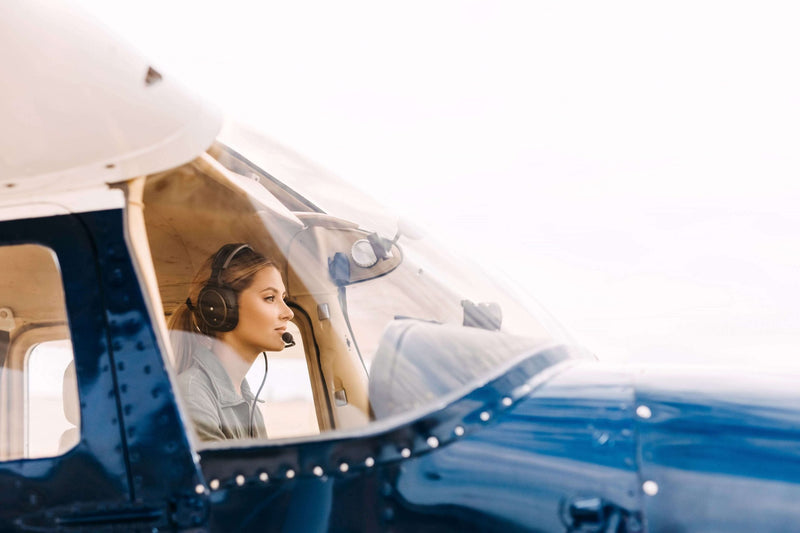
Very safety and detail oriented. Pre-flight briefing explained everything there was. To my knowledge, this flight school is exceptional in their ability.

A full FAA private pilot certificate flown from a tower-controlled field you can see from the top of Sesnon Boulevard, with instruction seven days a week.
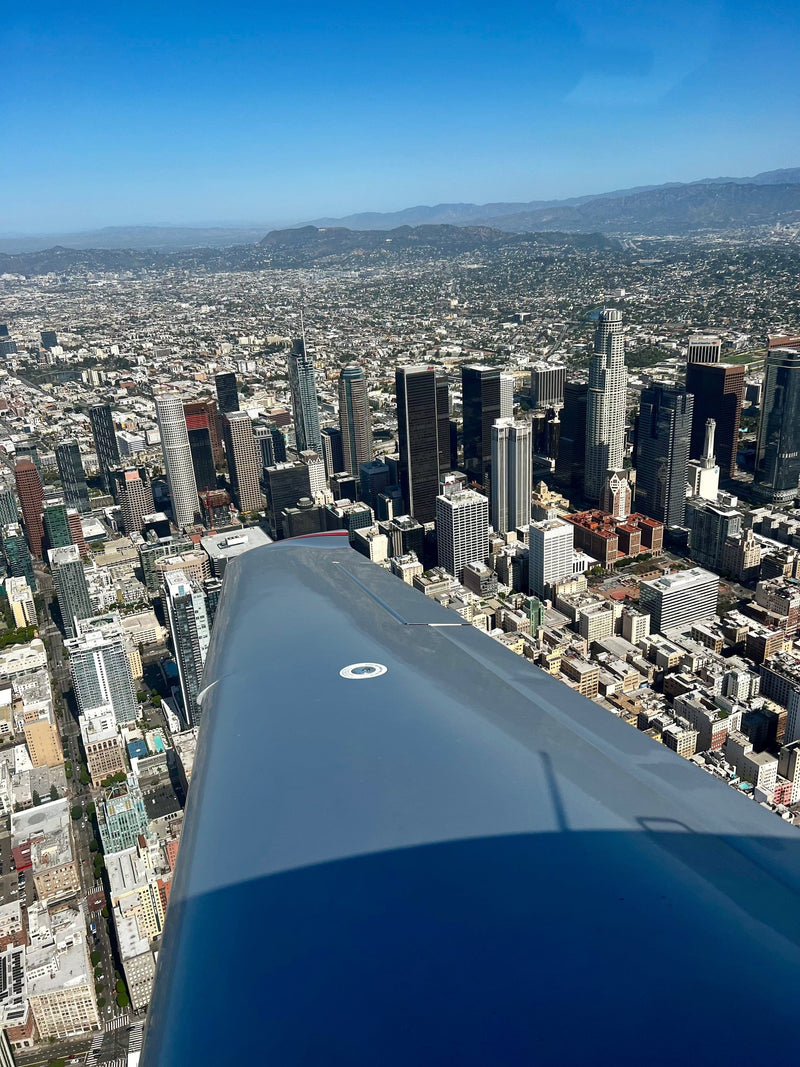
Porter Ranch is the youngest large piece of the San Fernando Valley, laid out in long curving streets across the last shelf of ground before the Santa Susanas. From the upper end of Sesnon Boulevard you can see most of the Valley floor below you and the flight line at Van Nuys Airport sitting in the middle of it. That view is the whole premise of this page: the thing you are looking at is where you would learn.
A private pilot certificate is a specific document with specific contents. The FAA requires at least forty hours of flight time, of which twenty are dual instruction and ten are solo, plus cross-country navigation, three hours at night with ten takeoffs and landings, instrument reference work, a written knowledge exam and a practical test with an examiner. Our standard course is $10,900 and covers all of it. What varies between students is not the syllabus but how often they turn up.
That is where living here helps. Most people in Porter Ranch already spend real time commuting east on the 118 or south on the 405, and they know what a long commute is worth. Getting to the airport costs a fraction of that. Two lessons a week is realistic from these streets, and two lessons a week is the difference between finishing in six months and dragging it out over two years.
What the certificate buys afterwards is ordinary use of an airplane. Day or night, passengers, baggage, any distance. Santa Barbara for lunch is a short hop up the coast, Big Bear is thirty-five minutes, Mammoth becomes a morning rather than a whole day of the 395. None of it needs an airline schedule, because it starts from a ramp eight miles from your driveway. First flights are $229 for one and $299 for two, and the time is logged.

Courses & Pricing
Course prices are packages, not hourly rates - the aircraft, your instructor, ground school and simulator time are all in the figure. Van Nuys Airport, KVNY. Financing Available Through Stratus & In-House Plans.

Start Here
The First Hour At The Controls. Credited Toward Your Training If You Enroll Within 24 Hours Of Landing.
All Prices In USD. 7900 Balboa Blvd, Suite 108A, Van Nuys, CA 91406 · Open 9 AM–9 PM, Seven Days. Free In-Person Tour Of The School
Book It Or Gift It
Every discovery flight below can be booked for yourself in the next few minutes, or bought as a gift certificate that is emailed within minutes and never expires. Same flight, same price, either way.
 Most Given
 Two Seats
 The Nice One
 Twin Engine
One person, one instructor, and no audience. Hands on the controls from the left seat, briefed before you go and debriefed after you land.
Hands-On Stick TimePre-Flight BriefingLoggable Flight Time
Flight Length
$229Book It Or Gift It
Same Price Either Way
The same flight with a passenger in the back seat, briefed and on the intercom. Couples book it; so do parents who would rather watch than hear about it.
One Passenger SeatPiper Warrior Or ArcherHeadsets For Both
Flight Length
$299Book It Or Gift It
Same Price Either Way
The nicest airplane we put a first-time flyer in. Glass cockpit, air conditioning, leather seats, and a parachute built into the airframe rather than strapped to the person.
Turbocharged Cirrus SR22Air ConditioningWhole-Airframe Parachute
Flight Length
$499Book It Or Gift It
Same Price Either Way
Two engines, and the airplane instrument-rated pilots move into when they start thinking about a career. Flown from the left seat with a multi-engine instructor.
Piper Seminole TwinMulti-Engine DepartureCareer-Track Instructor
Flight Length
$499Book It Or Gift It
Same Price Either Way
Gift It issues a real gift certificate, emailed within minutes, which never expires and credits in full toward training. Flights are limited to 180 lb per person, 360 lb combined. Questions: (818) 290-8249, 9 AM–9 PM, seven days.
The most predictable route skips the freeway merge entirely. Come south on Reseda Boulevard from Devonshire, stay on it through Northridge past the Cal State campus to Saticoy, then east four blocks to Balboa Boulevard. Turn north and 7900 is on your right before the fence line ends. Nine miles, nearly all timed signals: slow, but honest. What it takes at eight in the morning is close to what it takes at six at night.
If you prefer the 118, join it eastbound at Porter Ranch Drive or Tampa and come off at Balboa heading south. That version is quicker in the middle of the day and worse at peak, because everything heading for the 405 stacks up in the same lanes you are in. Either way you finish on the same stretch of Balboa. Give yourself twenty minutes and you will almost never be late; give yourself twelve and you occasionally will be.
We are in Suite 108A at 7900 Balboa Boulevard, in the hangar complex along the western boundary of Van Nuys Airport. Parking is our own lot and it is free, with no structure, no ticket machine and no security queue between the car and the aircraft. Arrive about fifteen minutes early, because the briefing is part of the lesson. Bring photo ID the first time; headsets and charts are here.

Porter Ranch has no airfield of its own, and the nearest alternative, Whiteman in Pacoima, is further away, smaller, and without a tower for much of the day. Van Nuys gives you two parallel runways, continuous air traffic control and one of the busiest general aviation operations in the country. That is the environment worth training in.
Students here talk to a controller on their first lesson and every lesson after it. By the checkride, requesting a clearance or accepting a sequence behind a business jet is unremarkable. Pilots trained at quiet uncontrolled strips often avoid busy airports for years afterwards, which quietly shrinks the usefulness of the certificate they worked for.
The Valley clears earlier and more reliably than the coastal fields do. While Santa Monica and Torrance are waiting out a marine layer on a June morning, Van Nuys is usually flying. Over a full course that difference shows up as lessons actually flown rather than lessons rescheduled, and it is the single biggest reason people finish on time.
Instrument at $11,700, multi-engine at $5,100 in the Seminole, and the zero-to-airline program at $89,000 with financing through Stratus Financial. You never have to start again with an unfamiliar fleet and a stranger for an instructor. Whatever you decide two years from now happens in this same building on Balboa.
Primary training happens in the Cessna 162 Skycatcher, the Piper Warrior or the Diamond DA20. You can move between them rather than being locked to one airframe, because the aircraft sits inside the course price rather than being billed alongside it. They were picked for temperament: they tell you clearly what they are doing, they forgive the small mistakes every student makes at twenty hours, and they carry modern navigation equipment so nothing has to be unlearned later. The DA20's canopy gives a downward view that makes ground reference work much easier to judge.
Beyond the certificate there is somewhere to go. The Piper Arrow II has retractable gear and a constant-speed propeller and is the usual step up for complex time. The Cirrus SR22 Turbo brings a full glass panel, turbocharging, air conditioning and a whole-airframe parachute. The Piper Seminole is the twin every $5,100 multi-engine rating here is flown in. Indoors, the Redbird MCX full-motion simulator runs at $189 for a sixty-minute session and is where emergencies, instrument approaches and gusty Santa Ana afternoons turn into useful training rather than a lost slot. All of it is parked at Van Nuys Airport, nine miles from Porter Ranch.

Four things that show up on the short leg home toward Porter Ranch.
A dense block of flat roofs, running track and playing fields on the way up Reseda Boulevard, with the Oviatt Library colonnade catching the light. It is the easiest checkpoint between the airport and the hills.
A wide empty bowl of dry grass in the far north-west corner of the Valley, drained decades ago and never built on. From two thousand feet it is a startling amount of nothing.
Pale sandstone outcrops piled up where the 118 and the old railway squeeze through the ridge into Simi. The rock formations are unmistakable and they mark the western edge of the practice area.
The long retail roofs and their car parks sit right where the curved residential streets stop and the hills begin. Most students spot their own neighborhood off this landmark first.
Fifteen to twenty minutes for about nine miles. Reseda Boulevard south to Saticoy and east to Balboa is the steadiest version and barely changes with the hour. The 118 to Balboa is faster midday and slower at peak, when everything heading for the 405 shares your lanes. Most students settle on one and stop thinking about it.
No. We fly from Van Nuys Airport, not from Whiteman: there are smaller operations at Whiteman in Pacoima, but that field is further from Porter Ranch than we are, and thinner on aircraft. Van Nuys has two parallel runways, continuous air traffic control, seven aircraft types and a full-motion simulator. On both distance and capability the comparison is not close.
The standard course is $10,900 and includes ground school, dual instruction, solo hours, the written exam and the checkride. The comprehensive version with more hours built in is $15,900, and the premium accelerated course is $22,500. A sport pilot license is $8,400 and a solo certificate alone is $5,500. Stratus Financial and in-house payment plans are available.
Forty is the FAA minimum and very few people finish exactly there. Sixty to seventy is a common real number, and how close you land to the minimum depends almost entirely on frequency. Students who fly twice a week from nearby need fewer hours than students who fly twice a month, because less of each lesson goes on recovering what was lost since the last one.
Yes, and we would rather you did. A discovery flight is $229 for one seat or $299 for two, you fly the airplane yourself with an instructor beside you, and the hour goes in a logbook. If you enroll within twenty-four hours the full cost is credited against your course. There is also a free in-person consultation with no flying involved at all.
We do not send students into conditions we would not fly in ourselves, so gusty offshore days get moved. Being fifteen minutes away means that costs you a phone call rather than a wasted afternoon. Many of those slots become Redbird MCX simulator sessions at $189 for sixty minutes, which is where emergency procedures get flown properly anyway.
Yes. There is no minimum age for lessons, first solo is legal at sixteen and the certificate at seventeen. The teen package is $4,200 and is built around a school timetable, using weekday evenings and weekend mornings. Local families often book a $299 flight for two first, so a parent can sit in the back and hear the whole lesson.
Call (818) 290-8249 and either book a discovery flight or come in for the free consultation. We are open nine in the morning to nine at night, seven days a week, at 7900 Balboa Boulevard, Suite 108A. If you hold a medical certificate or have logged hours elsewhere, bring the paperwork and we will work out what still needs doing.
Come down Reseda Boulevard, park in our lot, and spend sixty minutes flying the ridge you look at from your own front window. Call (818) 290-8249 and we will find a slot that fits around the commute.
The three private pilot packages, what each one includes, the financing options and a realistic timeline built around how often you can actually fly. Sent to you in one email. Nobody will pressure you.
Loved On Google
Every review below is real and shown verbatim, in the reviewer’s own words — written by the people who learned to fly here, not by us.
SAFETY FIRST
Very safety and detail oriented. Pre-flight briefing explained everything there was. To my knowledge, this flight school is exceptional in their ability.
 DISCOVERY FLIGHT
I recently had the chance to take my first-ever discovery flight, and it was nothing short of amazing! From the moment I stepped into the cockpit, the...
 SUNSET CIRRUS
It was a great flight! I did a sunset flight and Alex let us fly an awesome. Website was easy to book, and the plane itself was really fun to fly...
 FLYING LESSON
We had a great flying lesson with Ralph and came away with a much better understanding of both the aircraft and the principles of flight. Ralph is a...
 KIDS LUXURY FLIGHT
I got 2 luxury discovery flights for my kids. I wanted them to have the experience of flying. Our instructor Alex was amazing he made sure they feel...
 HONEYMOON SURPRISE
Last minute booking to surprise my wife on our honeymoon. She had no experience with flying and was scared of flying, but Alex was very easygoing and knew...
 FULL-MOTION SIM
Amazing flight school in van nuys airport. I have been a student here for the past few months and i could not be happier. I started doing a lot of...
 DISCOVERY FOR TWO
I booked a Discovery Flight for Two for my girlfriend's birthday and it was the perfect gift for her. She couldn't have been more excited to get to...
 SIMULATORS
Very professional and great airplanes. I love the flight simulators. The pricing is very fair compared to any other flight school
 TEEN FIRST LESSON
We gifted our teenage son his first flying lesson. He was so excited! Alex greeted us and gave a reassuring brief that made us all feel comfortable and at...
 FIRST-TIME FLYER
Flying is my husband's hobby and I was incredibly anxious and apprehensive about the discovery flight. However, I felt completely safe and at ease once we...
SAFETY FIRST
Very safety and detail oriented. Pre-flight briefing explained everything there was. To my knowledge, this flight school is exceptional in their ability.
DISCOVERY FLIGHT
I recently had the chance to take my first-ever discovery flight, and it was nothing short of amazing! From the moment I stepped into the cockpit, the...
SUNSET CIRRUS
It was a great flight! I did a sunset flight and Alex let us fly an awesome. Website was easy to book, and the plane itself was really fun to fly...
FLYING LESSON
We had a great flying lesson with Ralph and came away with a much better understanding of both the aircraft and the principles of flight. Ralph is a...
KIDS LUXURY FLIGHT
I got 2 luxury discovery flights for my kids. I wanted them to have the experience of flying. Our instructor Alex was amazing he made sure they feel...
HONEYMOON SURPRISE
Last minute booking to surprise my wife on our honeymoon. She had no experience with flying and was scared of flying, but Alex was very easygoing and knew...
FULL-MOTION SIM
Amazing flight school in van nuys airport. I have been a student here for the past few months and i could not be happier. I started doing a lot of...
DISCOVERY FOR TWO
I booked a Discovery Flight for Two for my girlfriend's birthday and it was the perfect gift for her. She couldn't have been more excited to get to...
SIMULATORS
Very professional and great airplanes. I love the flight simulators. The pricing is very fair compared to any other flight school
TEEN FIRST LESSON
We gifted our teenage son his first flying lesson. He was so excited! Alex greeted us and gave a reassuring brief that made us all feel comfortable and at...
FIRST-TIME FLYER
Flying is my husband's hobby and I was incredibly anxious and apprehensive about the discovery flight. However, I felt completely safe and at ease once we...
Reviews shown verbatim, exactly as each reviewer published them.
Aviation News
Notes from the flight line at Van Nuys — weather, regulation changes, checkride questions and the cost of training, written up as they come.
Open 7 days · 9:00 AM – 9:00 PM
Los Angeles Flight School