SAFETY FIRST
★★★★★
Very safety and detail oriented. Pre-flight briefing explained everything there was. To my knowledge, this flight school is exceptional in their ability.

Eight miles from the top of Rinaldi to the flight line, with the mountain range behind your house doubling as the terrain classroom you will train in.
Porter Ranch is built up the last slope before the Valley runs out. Behind it the Santa Susanas rise to Oat Mountain at nearly three thousand eight hundred feet; below it the 118 runs east toward the rest of the city. That position gives the neighborhood two things nowhere else in the Valley has quite so plainly: the best weather seat in the county, and the shortest possible introduction to real terrain flying. Van Nuys Airport is eight miles away down the freeway you can see from most of the higher streets.
Anyone who has lived here through an October knows more about wind than they realize. Santa Ana events pour through the passes above Chatsworth and Porter Ranch first, the hillside streets get it before the flats, and the whole neighborhood has opinions about gusts. That knowledge transfers directly. Much of learning to fly out of Van Nuys is learning what those winds do on the lee side of a ridge, how density altitude behaves on a hot afternoon, and when the honest answer is to stay on the ground.
Living close is what lets you act on that. When you are eight miles from the ramp you can take the good window instead of the booked one: fly at nine on a still Saturday morning rather than at two when the hills have started working. Our schedule runs from nine in the morning to nine at night, every day of the week, so slots exist at both ends of the day. The people who finish quickly are almost always the people who can move a lesson without it costing them an afternoon.
The students who come to us from these streets are mostly what the neighborhood is made of: engineers and project managers, people running businesses out of the office parks along Corbin and De Soto, physicians, and families where one parent flies and a teenager quietly decides to as well. First flights are $229 for one and $299 for two, the second seat has a headset and hears everything, and the hour goes into a real logbook.

Courses & Pricing
Course prices are packages, not hourly rates - the aircraft, your instructor, ground school and simulator time are all in the figure. Van Nuys Airport, KVNY. Financing Available Through Stratus & In-House Plans.

Start Here
The First Hour At The Controls. Credited Toward Your Training If You Enroll Within 24 Hours Of Landing.
All Prices In USD. 7900 Balboa Blvd, Suite 108A, Van Nuys, CA 91406 · Open 9 AM–9 PM, Seven Days. Free In-Person Tour Of The School
Book It Or Gift It
Every discovery flight below can be booked for yourself in the next few minutes, or bought as a gift certificate that is emailed within minutes and never expires. Same flight, same price, either way.
 Most Given
 Two Seats
 The Nice One
 Twin Engine
One person, one instructor, and no audience. Hands on the controls from the left seat, briefed before you go and debriefed after you land.
Hands-On Stick TimePre-Flight BriefingLoggable Flight Time
Flight Length
$229Book It Or Gift It
Same Price Either Way
The same flight with a passenger in the back seat, briefed and on the intercom. Couples book it; so do parents who would rather watch than hear about it.
One Passenger SeatPiper Warrior Or ArcherHeadsets For Both
Flight Length
$299Book It Or Gift It
Same Price Either Way
The nicest airplane we put a first-time flyer in. Glass cockpit, air conditioning, leather seats, and a parachute built into the airframe rather than strapped to the person.
Turbocharged Cirrus SR22Air ConditioningWhole-Airframe Parachute
Flight Length
$499Book It Or Gift It
Same Price Either Way
Two engines, and the airplane instrument-rated pilots move into when they start thinking about a career. Flown from the left seat with a multi-engine instructor.
Piper Seminole TwinMulti-Engine DepartureCareer-Track Instructor
Flight Length
$499Book It Or Gift It
Same Price Either Way
Gift It issues a real gift certificate, emailed within minutes, which never expires and credits in full toward training. Flights are limited to 180 lb per person, 370 lb combined. Questions: (818) 290-8249, 9 AM–9 PM, seven days.
The freeway version is the short one. Get on the 118 eastbound at Tampa, Reseda or Balboa, run two or three exits along the base of the hills, and come off at Balboa Boulevard heading south. Four and a half miles through Granada Hills and Northridge brings the airport fence up on your right, and Suite 108A sits on the 7900 block with our own car park in front. Fifteen minutes outside the morning peak, twenty when the eastbound lanes stack for the 405.
Surface streets are the better bet in the evening. Tampa Avenue south from Rinaldi to Sherman Way and then east is steady and reasonably well signalled, and from the Corbin and Winnetka side, Reseda Boulevard south then east on Roscoe does the same job. Neither beats the freeway at eleven in the morning, but both are more predictable at six, and neither puts you into the merge that ruins the 118 whenever something stalls near the Balboa off-ramp.
Arriving here is not like arriving at an airport. Park free in our own lot and walk in; there is no structure, no ticket, no security line and nobody at a barrier. Fifteen minutes ahead of your slot is right, because the briefing is part of the lesson. Bring photo identification the first time and wear shoes with a flat sole for the pedals. Headsets, charts and the airplane itself are all ours to sort out for you.

The Santa Susanas and the ridge behind your house are the practice area. Mountain wind, ridge lift, sink on the lee side and density altitude on a hot day are all things you meet within minutes of departure and learn to handle properly. Pilots who train over flat ground meet all of it for the first time somewhere unfamiliar and alone.
Being close means you fly the calm window rather than the booked hour. On a gusty afternoon we will tell you honestly not to come, and you have lost a phone call rather than a drive. On a still morning you can be airborne forty minutes after deciding to go. Over a year that flexibility is worth real money in aircraft time.
Two parallel runways, continuous air traffic control and everything from trainers to business jets in the pattern. You learn clearances and sequencing as ordinary parts of flying rather than as an advanced topic. It is also why our students arrive comfortably at Santa Barbara, Palm Springs or Long Beach instead of avoiding controlled fields for years.
Instrument at $11,700, multi-engine at $5,100, the full airline track at $89,000 with financing through Stratus Financial. Nobody has to find a second school after the private certificate, learn a new fleet and start again with strangers. The instructor who signs your first solo can still be with you at the multi-engine checkride.
Training starts in one of three light aircraft. The Cessna 162 Skycatcher, the Piper Warrior and the Diamond DA20 all carry modern radios and GPS, and a package covers the aircraft and the instructor together. They were chosen for behavior rather than badge: they respond honestly, they recover easily, and they turn the mistakes of a twenty-hour student into small ones. The DA20's bubble canopy gives an unusually good downward view, a real advantage when you are learning ground reference work over the tract streets you grew up on.
The aircraft above them exist because training does not stop at the private certificate. The Piper Arrow II brings retractable gear and a constant-speed propeller. The Piper Seminole is the twin every multi-engine rating here is flown in, and that rating is a $5,100 package. The Cirrus SR22 Turbo has a glass panel, air conditioning, turbocharging and a parachute for the whole airframe. Indoors, the Redbird MCX full-motion simulator is $189 for a sixty-minute session and is where a windy Porter Ranch afternoon still becomes useful training. All of it is parked at Van Nuys Airport, eight miles from your door, not at Whiteman or Burbank.

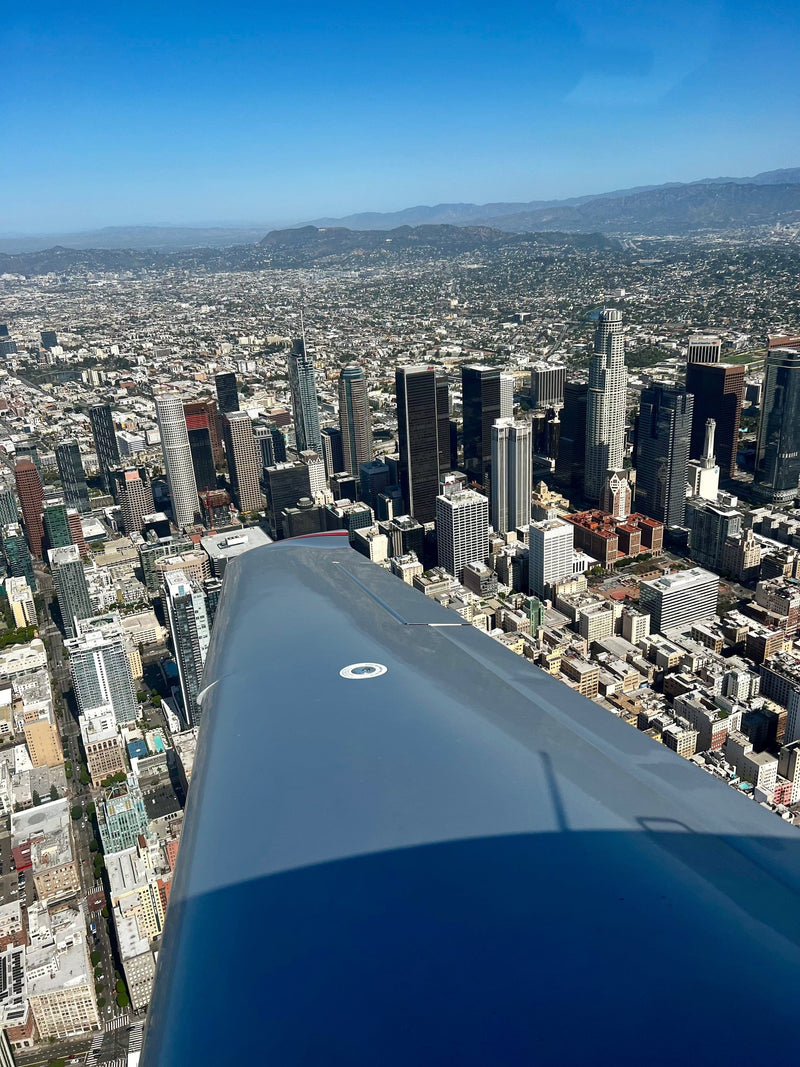
Four things you will see on the climb out toward the north-west corner of the Valley floor.
The highest point in the Santa Susanas, topped with communication masts and a switchbacking service road up the south face. It is the first thing to appear above the haze on the way home.
A narrow green wedge of oak and sycamore driving down through the tract housing from the hills to Rinaldi. From above it looks like something the developers were not allowed to touch, which is roughly what happened.
Porter Ranch's looping cul-de-sacs stop dead at Rinaldi and the old Valley street grid takes over in a hard straight line. It is the clearest boundary between two eras of building anywhere in Los Angeles.
Flat gravel pads and pale switchback roads scattered across the ridge north-east of the houses, marking the gas storage field under the hills. They are unmistakable and they make a useful position check.
About fifteen minutes for eight miles: the 118 eastbound to Balboa Boulevard, then four and a half miles south. Allow twenty in the morning peak when the eastbound lanes are building for the 405. In the evening, Tampa Avenue south to Sherman Way is more predictable than the freeway even though it is no shorter.
No. Whiteman is in Pacoima, about ten miles east of Porter Ranch, so Van Nuys is both nearer and considerably larger. Van Nuys gives you two parallel runways, continuous air traffic control, seven aircraft types and a full-motion simulator. There is no version of this trade-off where the smaller field wins from up here.
We do not fly students in conditions we would not fly ourselves in, so gusty offshore days get moved. Living eight miles away means the cost of that is one phone call. We often shift the lesson into the Redbird MCX simulator, $189 for a sixty-minute session, instead, which is where emergencies and instrument procedures get flown properly anyway.
Yes. There is no minimum age to take lessons, first solo is at sixteen and the private certificate at seventeen. The teen package is $4,200 and works around a school timetable using weekday evenings and weekend slots. Plenty of parents from Porter Ranch book a $299 flight for two first, so they can sit behind and watch the first lesson.
The standard course is $10,900, including ground school, dual instruction, solo hours, the written exam and the checkride. The comprehensive version with extra hours built in is $15,900 and the premium accelerated course is $22,500. A sport pilot license is $8,400 and a solo certificate on its own is $5,500. Financing runs through Stratus Financial.
The instrument rating at $11,700 first, because it is what makes an airplane usable rather than fair-weather. Then the multi-engine rating at $5,100 in the Seminole if you want twins. Both are done here with the same instructors, and both start with a free consultation and a look at your logbook.
Every evening until nine, and night flying is a required element of the private certificate rather than an optional extra. From up here it is the easiest lesson to schedule, since you are home fifteen minutes after shutdown. The Valley grid seen from three thousand feet after dark is the part of training nobody forgets.
In our own free lot on Balboa Boulevard, immediately outside the door of Suite 108A. No terminal, no shuttle, no ticket machine. Arrive about fifteen minutes before the slot so the pre-flight briefing is not rushed, and if the entrance is not obvious, ring (818) 290-8249 and somebody will come out and wave.
Book a discovery flight, drive down the 118, and fly the ridge behind your own house with an FAA instructor beside you and the controls in your hands. Call (818) 290-8249 and we will find a still morning that suits you.
The three private pilot packages, what each one includes, the financing options and a realistic timeline built around how often you can actually fly. Sent to you in one email. Nobody will pressure you.
Loved On Google
Every review below is real and shown verbatim, in the reviewer’s own words — written by the people who learned to fly here, not by us.
SAFETY FIRST
Very safety and detail oriented. Pre-flight briefing explained everything there was. To my knowledge, this flight school is exceptional in their ability.
 DISCOVERY FLIGHT
I recently had the chance to take my first-ever discovery flight, and it was nothing short of amazing! From the moment I stepped into the cockpit, the...
 SUNSET CIRRUS
It was a great flight! I did a sunset flight and Alex let us fly an awesome. Website was easy to book, and the plane itself was really fun to fly...
 FLYING LESSON
We had a great flying lesson with Ralph and came away with a much better understanding of both the aircraft and the principles of flight. Ralph is a...
 KIDS LUXURY FLIGHT
I got 2 luxury discovery flights for my kids. I wanted them to have the experience of flying. Our instructor Alex was amazing he made sure they feel...
 HONEYMOON SURPRISE
Last minute booking to surprise my wife on our honeymoon. She had no experience with flying and was scared of flying, but Alex was very easygoing and knew...
 FULL-MOTION SIM
Amazing flight school in van nuys airport. I have been a student here for the past few months and i could not be happier. I started doing a lot of...
 DISCOVERY FOR TWO
I booked a Discovery Flight for Two for my girlfriend's birthday and it was the perfect gift for her. She couldn't have been more excited to get to...
 SIMULATORS
Very professional and great airplanes. I love the flight simulators. The pricing is very fair compared to any other flight school
 TEEN FIRST LESSON
We gifted our teenage son his first flying lesson. He was so excited! Alex greeted us and gave a reassuring brief that made us all feel comfortable and at...
 FIRST-TIME FLYER
Flying is my husband's hobby and I was incredibly anxious and apprehensive about the discovery flight. However, I felt completely safe and at ease once we...
SAFETY FIRST
Very safety and detail oriented. Pre-flight briefing explained everything there was. To my knowledge, this flight school is exceptional in their ability.
DISCOVERY FLIGHT
I recently had the chance to take my first-ever discovery flight, and it was nothing short of amazing! From the moment I stepped into the cockpit, the...
SUNSET CIRRUS
It was a great flight! I did a sunset flight and Alex let us fly an awesome. Website was easy to book, and the plane itself was really fun to fly...
FLYING LESSON
We had a great flying lesson with Ralph and came away with a much better understanding of both the aircraft and the principles of flight. Ralph is a...
KIDS LUXURY FLIGHT
I got 2 luxury discovery flights for my kids. I wanted them to have the experience of flying. Our instructor Alex was amazing he made sure they feel...
HONEYMOON SURPRISE
Last minute booking to surprise my wife on our honeymoon. She had no experience with flying and was scared of flying, but Alex was very easygoing and knew...
FULL-MOTION SIM
Amazing flight school in van nuys airport. I have been a student here for the past few months and i could not be happier. I started doing a lot of...
DISCOVERY FOR TWO
I booked a Discovery Flight for Two for my girlfriend's birthday and it was the perfect gift for her. She couldn't have been more excited to get to...
SIMULATORS
Very professional and great airplanes. I love the flight simulators. The pricing is very fair compared to any other flight school
TEEN FIRST LESSON
We gifted our teenage son his first flying lesson. He was so excited! Alex greeted us and gave a reassuring brief that made us all feel comfortable and at...
FIRST-TIME FLYER
Flying is my husband's hobby and I was incredibly anxious and apprehensive about the discovery flight. However, I felt completely safe and at ease once we...
Reviews shown verbatim, exactly as each reviewer published them.
Aviation News
Notes from the flight line at Van Nuys — weather, regulation changes, checkride questions and the cost of training, written up as they come.
Open 7 days · 9:00 AM – 9:00 PM
Los Angeles Flight School