The Aircraft We Fly at Van Nuys Airport
Van Nuys Airport · KVNY

The Aircraft We Fly at Van Nuys Airport

Seven airframes and one full-motion simulator, kept on the field at Van Nuys, chosen so a student can start in a trainer and finish in a twin without changing schools.

Discovery flights from $229Redbird MCX full-motion simGlass and steam-gauge panels
5.0★on Google, 53 reviews
7aircraft plus a full-motion simulator
2,000+discovery flights flown safely
15+ yrsexperience behind every instructor
Local

A fleet built for a whole training career

Most flight schools own two or three aircraft of the same type and hope that covers everything. We took the opposite approach. The line at Van Nuys runs from a light sport two-seater up to a turbocharged Cirrus and a twin-engine Piper Seminole, so a student who arrives having never touched a control yoke can reach a multi-engine rating without moving to another school or another field.

The spread matters more than the count. Learning to land is easier in something light and forgiving, so first lessons happen in the Cessna 162 or the Diamond DA20. Cross-country work rewards speed and range, which is where the Piper Warrior earns its place. Commercial work needs retractable gear and a constant-speed propeller, so the Piper Arrow II exists for that. Instrument students want a modern panel and an autopilot, and the Cirrus SR22 Turbo gives them one.

Every aircraft is privately owned rather than leased in from a syndicate, and that shows up in the maintenance calendar more than anywhere else. We schedule inspections on our own timetable, we ground an aircraft for a snag a rental club might defer, and there is no absent owner arguing about a squawk. When you book a slot, the aircraft that appears is the one on the booking, with the avionics working.

The simulator is part of the fleet rather than a wet-weather backup. A Redbird MCX moves on all axes, so unusual attitudes, engine failures and holds feel like something instead of being an academic exercise on a desktop screen. Simulator hours are logged and count toward the instrument rating within the limits the FAA allows, and time in the box costs far less than time in the Cirrus. We use it deliberately, early and often.

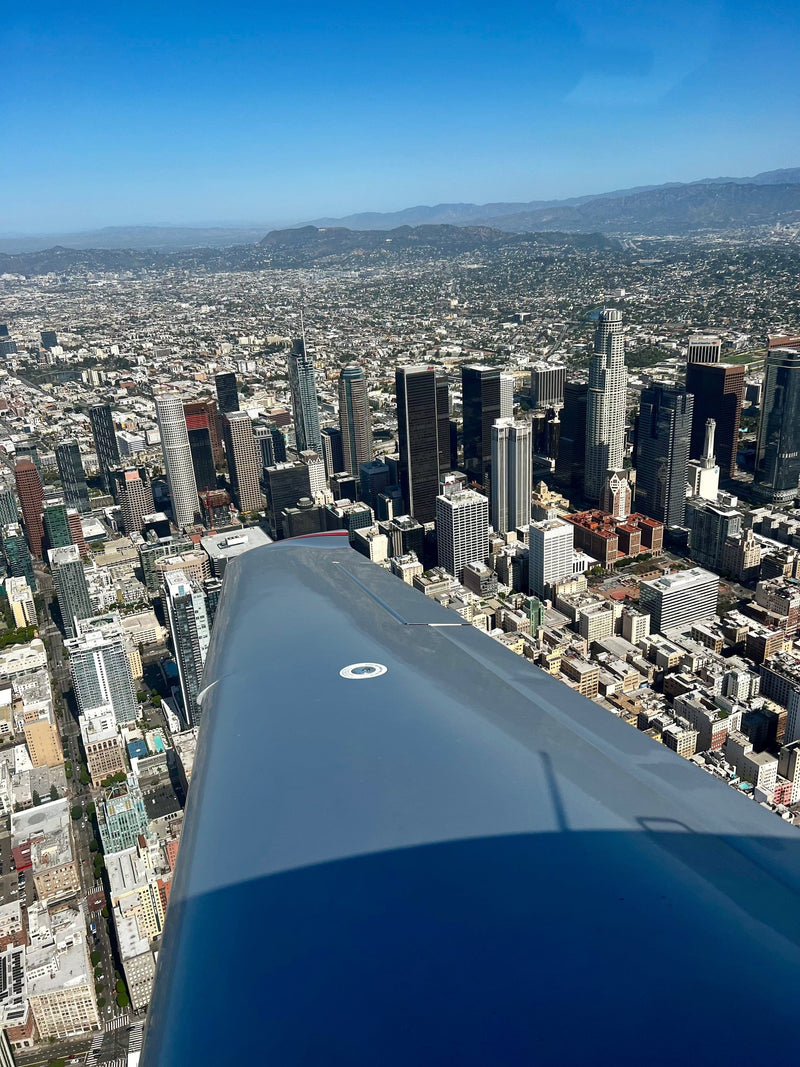
A training aircraft on a flight over the San Fernando Valley
Training packages

Fly the fleet without enrolling first

Every aircraft on the line is available on an introductory flight where you handle the controls yourself.

Solo Certificate

$5,500

Train to your first solo, sport or private track.

Learn more

Sport Pilot License

$8,400

The fastest route to flying legally as pilot in command.

Learn more
Most popular

Standard Private Pilot

$10,900

The full FAA Private Pilot Certificate. Where most students start.

Learn more

Comprehensive Private Pilot

$15,900

More simulator and ground time built into the package.

Learn more

Premium Private Pilot

$22,500

The widest margin of hours for students who want no surprises.

Learn more

Instrument Rating

$11,700

The rating that makes a licence useful in Southern California weather.

Learn more

Multi-Engine Rating

$5,100

A short add-on rating flown in the Piper Seminole.

Learn more

Airline Pilot Program

$89,000

Zero time to airline-ready, financing available.

Learn more

Teen Flight Training

$4,200

Ages 10 to 15, built around the school calendar.

Learn more
Every course above is a package, not an hourly rate — the price covers the aircraft, your instructor, ground school and the simulator time in that package. Financing is available through Stratus Financial and through in-house payment plans, and a discovery flight is credited in full against any package if you enrol within 24 hours. All training is flown from Van Nuys Airport (KVNY), 7900 Balboa Blvd, Suite 108A.
Discovery flights

Try it first — a discovery flight from Van Nuys

You fly the aircraft from the left seat with an instructor beside you. The time is loggable and counts toward a certificate.

Discovery Flight For One

$229/ 60 min

You fly it. 90 min $299, 120 min $399.

Learn more

Discovery Flight For Two

$299/ 60 min

Bring a passenger. 90 min $399, 120 min $499.

Learn more

Luxury Cirrus For Two

$399/ 60 min

The SR22 Turbo, glass cockpit. 90 min $549, 120 min $699.

Learn more

Multi-Engine Discovery

$499/ 60 min

The Piper Seminole twin. 90 min $699, 120 min $899.

Learn more

Redbird Simulator Session

$189/ 1 hr

FAA-approved full-motion MCX, on the field at Van Nuys.

Learn more
Getting here

How a checkout and a booking actually work

If you already hold a certificate and want to rent, start with a phone call rather than an online form. We will ask what you fly now, when you last flew it and what you want the aircraft for, because a pilot who wants the Warrior for local sightseeing and one who wants the Arrow for a trip to Mammoth need different conversations. Bring your certificate, medical or BasicMed paperwork, logbook and photo ID to the first appointment.

The checkout is a ground session followed by one flight, sometimes two. On the ground we go through the specific aircraft: fuel system, weight and balance for that airframe, avionics, and the handful of quirks every individual aeroplane has. In the air we do airwork, a diversion and enough circuits to see steady landings. Complex types take longer, and the Seminole always takes longer than people expect.

Booking runs through the office on (818) 290-8249, between 9 AM and 9 PM, seven days a week. Aircraft go out in blocks rather than to the minute, and we build in turnaround so a late arrival from the previous flight does not eat your slot. Weekend mornings and the last two hours before sunset are busiest, so book those further ahead. Getting here is simple. From the 405, exit at Roscoe Boulevard or Sherman Way and drive west about two miles to Balboa Boulevard, then turn in at 7900 with the airport fence beside you. From the 101, leave at Balboa in Encino and run north. Parking in our own lot at 7900 Balboa Blvd is free and unmetered, and Suite 108A is a numbered door on that lot.

The entrance to LA Flight School at 7900 Balboa Blvd, Suite 108A
Why Van Nuys

Why the fleet is put together this way

1

Ownership, not leaseback

The aircraft belong to the school. That removes the usual argument where an owner wants the aeroplane flying and the school wants it in the hangar. Snags get fixed rather than logged for later, and inspections happen on schedule instead of at the last legal moment.

2

Both panel styles on the field

Some of our aircraft have traditional round instruments and some have full glass. Learning on both makes you a better pilot than learning on either alone. Glass makes navigation easy and scanning lazy; steam gauges make you work but build a scan that survives a screen failure. Being able to swap between them in the same week is the point.

3

One field, one progression

Sport, private, instrument, complex and multi-engine are all flown from the same ramp with the same instructors reading the same logbook. You never explain your history to a new school halfway through, and nobody restarts you from scratch to protect their own syllabus. The progression is continuous, which is the fastest route through it.

4

A simulator that earns its keep

The Redbird MCX is not decoration. Engine failures, approaches in weather we would not launch into, and the same procedure repeated ten times in one session are all things the box does better and cheaper than an aircraft. Used properly it removes hours of expensive fumbling from the aeroplane and puts them somewhere they cost less.

The fleet

Maintenance, avionics and how we look after it

Inspections run to the calendar rather than to the last permitted hour. Aircraft used for instruction and rental fall under the 100-hour inspection requirement, and we add intermediate checks between them because a training aeroplane lives a harder life than a privately flown one. Landing gear on a trainer absorbs a great deal of enthusiasm from student flare technique, so gear, tyres, brakes and shimmy dampers get looked at more often than the regulation demands. Anything that would leave the aircraft merely legal rather than genuinely right gets fixed before it flies.

Avionics are kept current because an out-of-date database is a real limitation, not a cosmetic one. The glass-panel aircraft carry moving-map navigation, traffic and terrain awareness, and the Cirrus has an autopilot that instrument students learn to use properly rather than treat as a magic button. ADS-B is fitted across the fleet, which matters in the airspace around Van Nuys where you share the sky with jets, helicopters, banner tows and other students. Headsets are available at the desk if you have not bought your own.

Training aircraft and the Redbird MCX simulator at LA Flight School
From the air

The seven types, in short

Here is what each aircraft is actually for, and what it feels like from the left seat.

✈️

Cessna 162 Skycatcher

A light sport two-seater with a gross weight of 1,320 lb, an empty weight of 839 lb and a useful load of 490 lb, cruising around 130 mph. Honest, forgiving, and where most sport pilot students spend their first twenty hours. The $8,400 sport pilot package is built around it.

🔹

Diamond DA20 and Piper Warrior

The DA20 has a bubble canopy and superb visibility, which makes it a pleasure for airwork. The Warrior is the four-seat workhorse, cruising above 143 mph with enough weight and fuel for real cross-country navigation exercises.

⚙️

Piper Arrow II

Retractable gear and a constant-speed propeller make the Arrow the complex trainer commercial students need for time on type. It is the least expensive way in the fleet to log complex time, and the gear lever changes how you fly a circuit.

🚀

Cirrus SR22 Turbo and Piper Seminole

The turbocharged SR22 cruises near 240 mph with a full glass panel and the CAPS whole-airframe parachute. The Seminole is the twin, around 186 mph, and every multi-engine rating here is flown in it as a $5,100 package.

FAQ

Common questions

Yes, within reason. Most students start in the Cessna 162 or Diamond DA20 because the handling is forgiving and the workload is manageable, then move to the Warrior for cross-country work. If you have a preference we will accommodate it. Your instructor may push back if the type is fighting your learning rather than helping it.

Not to begin with. We keep headsets at the desk and you are welcome to borrow one for your first several lessons. Most students buy their own within a month or two, partly for hygiene and partly because active noise reduction genuinely reduces fatigue on longer flights.

There is no separate checkout fee. Ring the office and we will quote the checkout as one package covering the aircraft and the instructor together. A checkout in the Cessna 162 or Piper Warrior usually takes one or two flights. Complex and high-performance types take longer, and the Seminole takes longest because engine-out work has to be demonstrated properly.

Yes, within the limits the FAA sets. Time in the Redbird MCX counts toward the instrument rating up to the allowed maximum, logged as ground training or simulated instrument time depending on what was flown. At $189 for a sixty-minute session it costs far less than the aircraft, and for procedures it is more productive because you can pause and repeat.

Ages vary across the fleet, and age matters much less than maintenance history in general aviation. A well-kept Piper Warrior with a fresh engine and current avionics beats a neglected newer type every time. Inspections here run ahead of schedule and squawks are fixed rather than deferred.

Rated pilots who have completed a checkout and fly with us regularly can, subject to a daily minimum and prior arrangement. Tell us the trip, the dates and the alternates when you book. Trips over the Sierra in summer get a longer conversation about density altitude.

The Piper Seminole, every time. It is a conventional light twin with counter-rotating propellers, which makes it a stable and predictable platform for engine-out work, and it is the type most examiners in Southern California expect to see. The rating is $5,100 as an add-on for pilots who already hold a private or commercial certificate.

We call you as early as we can and offer another type or another slot, whichever suits. Because there are seven aircraft on the line rather than two, a substitution is usually possible the same day. If nothing suitable is free we move the booking with no penalty.

Talk to us

Come and look at the aircraft first

You are welcome to walk the line at 7900 Balboa Blvd, Suite 108A before booking anything, and we will open the hangar and answer questions. Call (818) 290-8249 between 9 AM and 9 PM daily.

Discovery Flight For One
$229
60 minutes, hands on the controls, fully loggable
Book a discovery flight or call (818) 290-8249