SAFETY FIRST
★★★★★
Very safety and detail oriented. Pre-flight briefing explained everything there was. To my knowledge, this flight school is exceptional in their ability.

Your discovery flight is booked and your seat is held. Below is what you need for the day: how to find us at Van Nuys Airport, what happens from check-in to landing, and what to bring.
We are on the west edge of Van Nuys Airport at 7900 Balboa Blvd, between Saticoy Street and Roscoe Blvd. From the 405, exit at Roscoe and head west two miles to Balboa, then turn south. From the 101, exit Balboa and drive north through Encino and Lake Balboa, past the Sepulveda Basin and across Victory Blvd and Sherman Way. Turn in, bear right, follow the road to the hangar side.
From the Westside or the South Bay, the 405 north over the Sepulveda Pass is the usual run. Give yourself an extra half hour on weekday mornings, because the pass backs up from Getty Center Drive down to Ventura Blvd. From Pasadena, Glendale and Burbank, take the 134 west onto the 101 north and exit at Balboa. From Santa Clarita, the 405 south to Roscoe Blvd and west is quickest.
The turning is easy to overshoot. Watch for the line of hangars behind the chain-link fence on the east side of Balboa; if you cross Roscoe Blvd you have gone a block too far north, and if you are back at Sherman Way you have gone too far south. Give a rideshare driver the street address rather than the airport name, since Van Nuys has several separate gated entrances along Balboa.
Parking is free. Entering the lot off Balboa Blvd, turn right and follow the road around to the hangar side; Suite 108A is on your right.

Plan on about two hours at the airport for a sixty-minute flight.
Come through the door on the hangar side and give your name at the desk. We confirm the booking, take a driver's license or passport for the record, and sort out the short waiver. If you are on a gift voucher, bring it or the confirmation email. Then you meet the instructor flying with you today.
You sit down with your instructor and go through the flight before going near the aircraft. They cover the controls, how the airplane turns, climbs and descends, what the instruments mean, and where you are going. You see the route on a chart and can ask anything. Most people arrive nervous and leave this table curious.
Every flight starts with a physical inspection, and you do it alongside the instructor rather than watching from the fence. Fuel is drained and checked for water, the oil dipped, control surfaces moved by hand, tires and brakes looked over. It takes fifteen minutes. It is the first thing you would repeat on every flight afterwards.
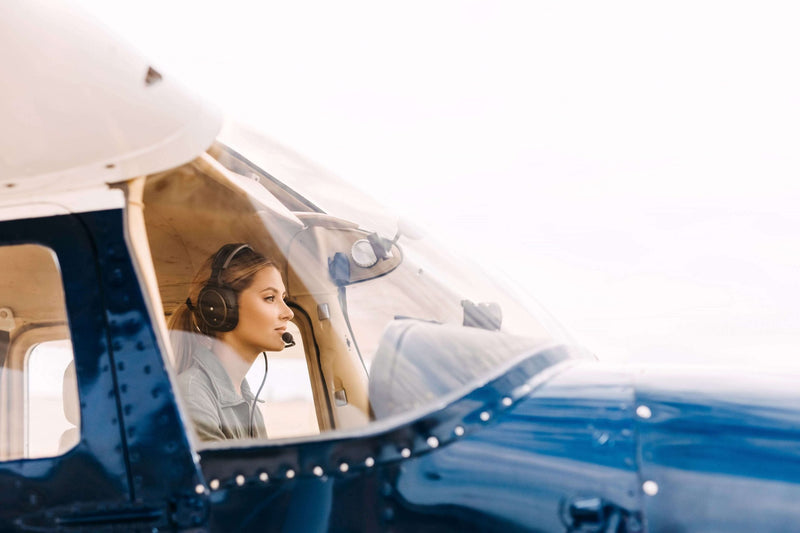
You climb into the left seat, where a pilot sits. Headsets go on, the instructor walks you through the checklist, and the engine starts. You will hear Van Nuys Ground on the radio; your instructor does the talking. Taxiing is steered with your feet, which surprises everybody. Then you hold short and run the engine checks.
The instructor handles the takeoff roll with you following through on the controls. Once clear of the airport they hand the aircraft over and you fly it: straight and level, gentle turns above the Valley, a climb, a descent. They stay on the controls only if you want them. Most of the flight is yours.
The instructor lands and you taxi back to the hangar. Afterwards you sit down for ten minutes and go through what you did, what a second lesson looks like, and anything the flight raised. The time counts, so we make a logbook entry: the first hour of your training record, and it goes home with you.
Courses & Pricing
Course prices are packages, not hourly rates - the aircraft, your instructor, ground school and simulator time are all in the figure. Van Nuys Airport, KVNY. Financing Available Through Stratus & In-House Plans.

Start Here
The First Hour At The Controls. Credited Toward Your Training If You Enroll Within 24 Hours Of Landing.
All Prices In USD. 7900 Balboa Blvd, Suite 108A, Van Nuys, CA 91406 · Open 9 AM–9 PM, Seven Days. Free In-Person Tour Of The School
Book It Or Gift It
Every discovery flight below can be booked for yourself in the next few minutes, or bought as a gift certificate that is emailed within minutes and never expires. Same flight, same price, either way.
 Most Given
 Two Seats
 The Nice One
 Twin Engine
One person, one instructor, and no audience. Hands on the controls from the left seat, briefed before you go and debriefed after you land.
Hands-On Stick TimePre-Flight BriefingLoggable Flight Time
Flight Length
$229Book It Or Gift It
Same Price Either Way
The same flight with a passenger in the back seat, briefed and on the intercom. Couples book it; so do parents who would rather watch than hear about it.
One Passenger SeatPiper Warrior Or ArcherHeadsets For Both
Flight Length
$299Book It Or Gift It
Same Price Either Way
The nicest airplane we put a first-time flyer in. Glass cockpit, air conditioning, leather seats, and a parachute built into the airframe rather than strapped to the person.
Turbocharged Cirrus SR22Air ConditioningWhole-Airframe Parachute
Flight Length
$499Book It Or Gift It
Same Price Either Way
Two engines, and the airplane instrument-rated pilots move into when they start thinking about a career. Flown from the left seat with a multi-engine instructor.
Piper Seminole TwinMulti-Engine DepartureCareer-Track Instructor
Flight Length
$499Book It Or Gift It
Same Price Either Way
Gift It issues a real gift certificate, emailed within minutes, which never expires and credits in full toward training. Flights are limited to 180 lb per person, 370 lb combined. Questions: (818) 290-8249, 9 AM–9 PM, seven days.
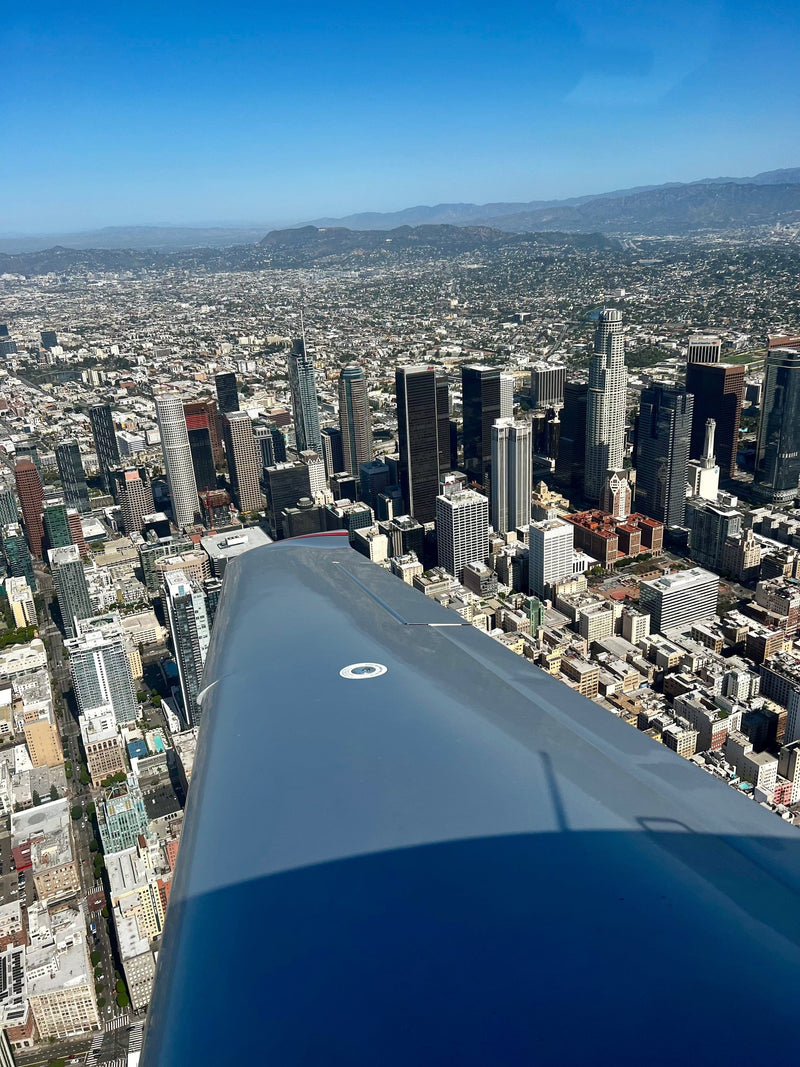
A short climb out of Van Nuys puts one of the most recognizable views in the world under the wing.
Departures from Van Nuys usually turn south or south-east, and the Valley opens up at once. The grid below is Balboa, Sherman Way and Victory Blvd, with the 405 running north to south and the 101 cutting east below the hills. The Sepulveda Basin is the big green rectangle off the nose, lakes, playing fields and golf courses. Past it the Santa Monica Mountains stand between you and the coast.
At 2,500 feet the city stops being a map and becomes one continuous thing. The Verdugo Mountains sit north-east above Burbank and Glendale, the downtown towers stack up on the horizon to the south-east, and on a clear winter afternoon you can pick out Catalina beyond the Santa Monica coastline. Air over the Valley is smoothest in the morning; afternoons bring a sea breeze through the passes and gentle movement.

The green flood-control basin just south of the airport: Lake Balboa, the wildlife reserve, two golf courses. Usually the first thing you see after takeoff.
It sits on the south slope of Mount Lee, above Griffith Park. From the air you look down on it, which catches people out.
White domes on the ridge above Los Feliz, the whole basin behind them. On a clear run it and the downtown skyline sit in one window.
Past the Santa Monica Mountains the land drops away and the Pacific fills the windscreen. The Getty sits on its ridge above the 405 on the way.
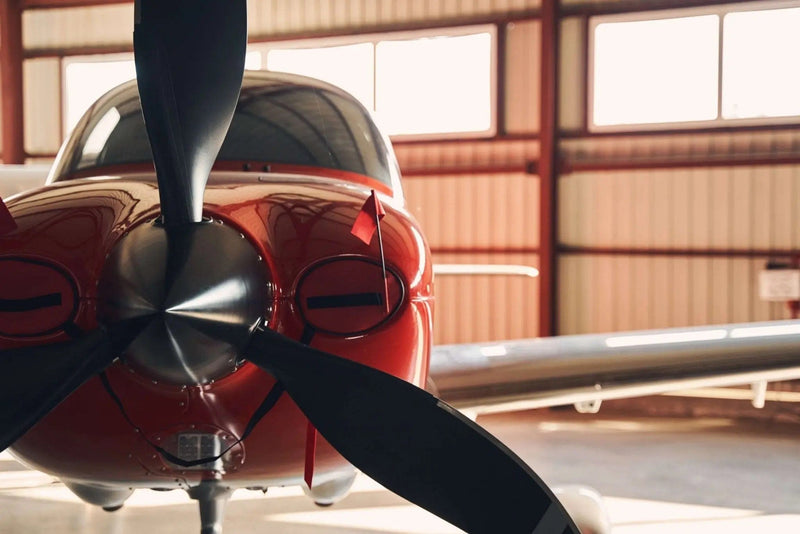
Most discovery flights go out in a Cessna 162 Skycatcher, Diamond DA20 or Piper Warrior. All three are single-engine trainers with dual controls, which is the point: there is a yoke or stick in front of you as well as the instructor's. If you booked the Luxury Cirrus flight you will be in the SR22 Turbo, a glass-cockpit aircraft with a whole-airframe parachute. The Piper Arrow II has retractable gear, and the twin-engine Piper Seminole flies the multi-engine discovery flight.
Flying one for the first time is less dramatic than people expect. Light aircraft are stable; let go and they mostly carry on flying straight. The inputs are gentle, a few pounds of pressure rather than a wrestle, and the airplane answers within a second, so you learn quickly what you just did. Engine noise makes ordinary conversation impossible, so you wear a headset. If you would rather start on the ground, the Redbird MCX full-motion simulator is $189 for a sixty-minute session.

None of this is complicated, but a few things help.
Comfortable clothes and closed-toe shoes with flat soles, since you will be using the rudder pedals. Sunglasses help, because the light at altitude is strong and the cockpit has glass on three sides. Skip a hood or loose brim that fights your headset.
Photo identification, your confirmation email or gift voucher, and a phone or camera if you want pictures. Headsets are supplied, and we will start a logbook for you. Leave loose items at home, because anything unsecured moves around in a light aircraft.
Eat something light beforehand; an empty stomach is worse than a full one. Motion sickness is uncommon on a smooth morning. Tell your instructor if you are prone to it and they will fly gently and keep the horizon in view.
We fly in most conditions, but not all. Low cloud, strong crosswinds or poor visibility mean we call you, usually that morning, and move you to another slot at no cost. Nobody here will push a marginal day on you, because the view matters.
Friends and family are welcome and can wait in the office or watch from outside the hangar. Seats are limited, so a passenger must be booked onto your flight rather than added on the day. Children are fine on the ground with an adult.
The hour you fly is not a demonstration ride. Your instructor logs it as dual instruction received, and every minute counts toward the forty-hour minimum for an FAA Private Pilot Certificate. If you carry on, you carry on from hour one rather than zero. On top of that, if you enroll within twenty-four hours of your discovery flight, one hundred percent of what you paid for it is credited toward your training. That credit applies whichever training package you go on to choose.
The Standard Private Pilot program is $10,900 and is where most people start, with larger and smaller packages either side of it, plus a Solo Certificate at $5,500 if you want a nearer goal first. Financing runs through Stratus Financial or an in-house payment plan. Before committing, book the free in-person consultation: you sit down with an instructor at Suite 108A, look at the syllabus and a realistic calendar, and get a number that reflects how often you can actually fly.

Yes, that is the point of it. Your instructor handles the takeoff and landing; everything between is yours, including turns over the Valley and the run home. They sit beside you with dual controls throughout.
Neither. A discovery flight is an introductory instructional flight with a certificated instructor, so no medical certificate and no license are needed. Most people who book have never flown a small aircraft; bring photo identification and nothing else.
Yes, because light aircraft have real weight and balance limits. The trainers suit most adults up to around 250 pounds, and tall passengers fit because the seats adjust. Call (818) 290-8249 beforehand if you think you may be close.
Budget about two hours for a sixty-minute flight. Thirty minutes covers check-in, the briefing and the walkaround, then your booked time in the air, then ten minutes for the debrief and logbook entry. Longer flights add that time on top.
You can. Discovery Flight For One is $229 for sixty minutes, $299 for ninety, $399 for two hours. Discovery Flight For Two is $299, $399 and $499, and Luxury Cirrus For Two starts at $499.
We call you and move the flight. There is no rescheduling fee; the cancellation simply becomes another date that suits you. The spring marine layer and strong Santa Ana winds are what usually push a slot.
It is. Your instructor signs an entry recording aircraft type, route and time as dual instruction received, and it counts toward the FAA Private Pilot Certificate. If you carry on, it is page one of your record.
Call (818) 290-8249 as early as you can and we will find another slot. We are open 9 AM to 9 PM, seven days a week. Give reasonable notice, because an instructor and an aircraft are held for you.
Call (818) 290-8249 any day between 9 AM and 9 PM and you will reach an instructor, not a call center. We hold a 5.0 rating on Google across 100+ reviews and have flown more than 2,000 discovery flights.
The three private pilot packages, what each one includes, the financing options and a realistic timeline built around how often you can actually fly. Sent to you in one email. Nobody will pressure you.
Loved On Google
Every review below is real and shown verbatim, in the reviewer’s own words — written by the people who learned to fly here, not by us.
SAFETY FIRST
Very safety and detail oriented. Pre-flight briefing explained everything there was. To my knowledge, this flight school is exceptional in their ability.
 DISCOVERY FLIGHT
I recently had the chance to take my first-ever discovery flight, and it was nothing short of amazing! From the moment I stepped into the cockpit, the...
 SUNSET CIRRUS
It was a great flight! I did a sunset flight and Alex let us fly an awesome. Website was easy to book, and the plane itself was really fun to fly...
 FLYING LESSON
We had a great flying lesson with Ralph and came away with a much better understanding of both the aircraft and the principles of flight. Ralph is a...
 KIDS LUXURY FLIGHT
I got 2 luxury discovery flights for my kids. I wanted them to have the experience of flying. Our instructor Alex was amazing he made sure they feel...
 HONEYMOON SURPRISE
Last minute booking to surprise my wife on our honeymoon. She had no experience with flying and was scared of flying, but Alex was very easygoing and knew...
 FULL-MOTION SIM
Amazing flight school in van nuys airport. I have been a student here for the past few months and i could not be happier. I started doing a lot of...
 DISCOVERY FOR TWO
I booked a Discovery Flight for Two for my girlfriend's birthday and it was the perfect gift for her. She couldn't have been more excited to get to...
 SIMULATORS
Very professional and great airplanes. I love the flight simulators. The pricing is very fair compared to any other flight school
 TEEN FIRST LESSON
We gifted our teenage son his first flying lesson. He was so excited! Alex greeted us and gave a reassuring brief that made us all feel comfortable and at...
 FIRST-TIME FLYER
Flying is my husband's hobby and I was incredibly anxious and apprehensive about the discovery flight. However, I felt completely safe and at ease once we...
SAFETY FIRST
Very safety and detail oriented. Pre-flight briefing explained everything there was. To my knowledge, this flight school is exceptional in their ability.
DISCOVERY FLIGHT
I recently had the chance to take my first-ever discovery flight, and it was nothing short of amazing! From the moment I stepped into the cockpit, the...
SUNSET CIRRUS
It was a great flight! I did a sunset flight and Alex let us fly an awesome. Website was easy to book, and the plane itself was really fun to fly...
FLYING LESSON
We had a great flying lesson with Ralph and came away with a much better understanding of both the aircraft and the principles of flight. Ralph is a...
KIDS LUXURY FLIGHT
I got 2 luxury discovery flights for my kids. I wanted them to have the experience of flying. Our instructor Alex was amazing he made sure they feel...
HONEYMOON SURPRISE
Last minute booking to surprise my wife on our honeymoon. She had no experience with flying and was scared of flying, but Alex was very easygoing and knew...
FULL-MOTION SIM
Amazing flight school in van nuys airport. I have been a student here for the past few months and i could not be happier. I started doing a lot of...
DISCOVERY FOR TWO
I booked a Discovery Flight for Two for my girlfriend's birthday and it was the perfect gift for her. She couldn't have been more excited to get to...
SIMULATORS
Very professional and great airplanes. I love the flight simulators. The pricing is very fair compared to any other flight school
TEEN FIRST LESSON
We gifted our teenage son his first flying lesson. He was so excited! Alex greeted us and gave a reassuring brief that made us all feel comfortable and at...
FIRST-TIME FLYER
Flying is my husband's hobby and I was incredibly anxious and apprehensive about the discovery flight. However, I felt completely safe and at ease once we...
Reviews shown verbatim, exactly as each reviewer published them.
Aviation News
Notes from the flight line at Van Nuys — weather, regulation changes, checkride questions and the cost of training, written up as they come.
Open 7 days · 9:00 AM – 9:00 PM
Los Angeles Flight School