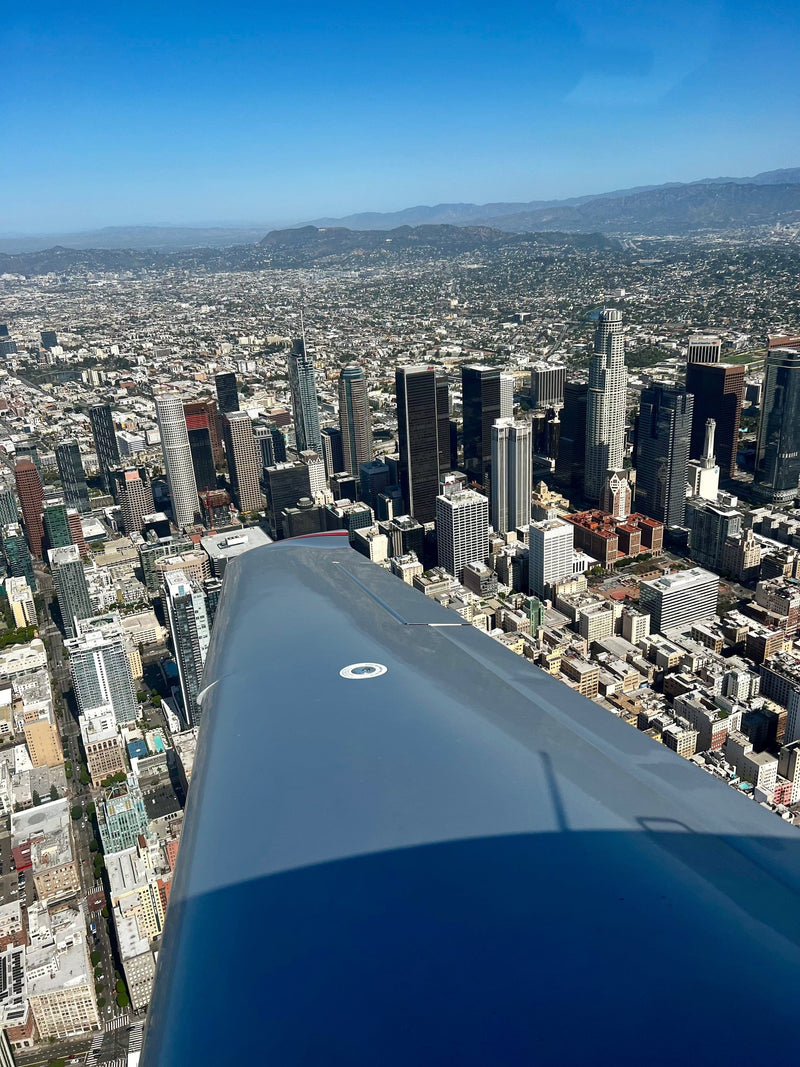
Los Angeles from the air, departing Van Nuys Airport
Free consultation booked

Your Free In-Person Consultation Is Confirmed

Your free consultation is booked and an instructor will sit down with you at Suite 108A. Below is what the meeting covers, how to find us at Van Nuys Airport, what to bring, and what the training costs.

Email confirmation on its wayText reminder before your visitFree visitor parking
Suite 108A7900 Balboa Blvd, Van Nuys
5.0★on Google, 53 reviews
2,000+discovery flights flown
9 AM – 9 PMseven days a week
Meeting location

Finding Suite 108A at 7900 Balboa Blvd

7900 Balboa Blvd runs along the western edge of Van Nuys Airport, between Sherman Way and Roscoe Blvd. From the 405, take the Victory Blvd exit and head west to Balboa, then turn north; you cross Vanowen Street and Sherman Way before the hangars appear on your right. From the 101, the Balboa exit gives you a straight run north through Encino and Lake Balboa. Either way, the last mile is Balboa itself.

From Simi Valley, Chatsworth and Northridge, the 118 east to Balboa and then south is the clean route, and it stays quiet outside the school run. From Woodland Hills, Tarzana and Calabasas, Victory Blvd or Vanowen Street heading east beats doubling back to a freeway. From Downtown, Silver Lake and Hollywood, the 101 north through the Cahuenga Pass is about forty minutes off-peak and closer to seventy at five in the afternoon.

Balboa has several separate airport gates, so give a rideshare driver the street address rather than the airport name; the wrong gate means a walk around the perimeter fence. As you turn in off Balboa, make a right immediately, because that road leads to the visitor spaces and our entrance. Suite 108A is a numbered door on the hangar side rather than a shopfront. If you reach Roscoe Blvd you have gone a block too far north.

Parking is free and there is no gate code. Turn right as you come into the lot off Balboa Blvd, follow it round to the visitor spaces, and Suite 108A is the numbered door on your right.

Arrive about ten minutes early so we can start on time.(818) 290-8249
The entrance to LA Flight School at 7900 Balboa Blvd, Suite 108A, Van Nuys
What happens next

What happens at the consultation

Plan on about sixty minutes at Suite 108A.

1

Before you arrive

A confirmation email is on its way and a text reminder follows before your appointment. Nothing needs signing in advance and there is no deposit attached to a consultation. If the time stops working, call and move it; we would rather see you on an unhurried day. Evening slots exist because we are open until 9 PM.

2

Check-in at the desk

Come through the door on the hangar side and give your name. There is no paperwork at this stage, no clipboard and no waiver, because you are not flying today. You meet the instructor sitting with you, and an aircraft turning outside is audible through the wall. Then we sit down at a table in the office.

3

Your goal, in your own words

The first question is what you actually want, and the answers vary a lot. Some people want to fly friends up to Santa Barbara at weekends. Some want a career and a first officer seat. Some want to know whether they will enjoy it. The advice that follows only makes sense once we know which you are.

4

The syllabus on the table

We go through the real sequence: ground instruction, the early handling lessons, first solo, cross-country work, the FAA written knowledge test, then the practical test with an examiner. You see the minimum hours and, more usefully, the realistic hours for somebody flying as often as you can. Nothing here is a secret or dressed up.

5

An honest number

Then the money. We put the package prices in front of you, explain what sits inside them and what does not, and talk through Stratus Financial and our in-house payment plans. The biggest factor in what a licence costs is how often you fly, because long gaps mean re-learning. Better to hear that now than in month eight.

6

The ramp, and what you take home

If there is time you can walk out to the trainers, sit in one on the ground, and see the Redbird MCX simulator. You leave with a written plan: which programme fits, roughly what it costs, and what the first month looks like on a calendar. Nobody asks you to sign anything on the day.

Training packages

Course packages and what they cost

Solo Certificate

$5,500

Train to your first solo, sport or private track.

Learn more

Sport Pilot License

$8,400

The fastest route to flying legally as pilot in command.

Learn more
Most popular

Standard Private Pilot

$10,900

The full FAA Private Pilot Certificate. Where most students start.

Learn more

Comprehensive Private Pilot

$15,900

More simulator and ground time built into the package.

Learn more

Premium Private Pilot

$22,500

The widest margin of hours for students who want no surprises.

Learn more

Instrument Rating

$11,700

The rating that makes a licence useful in Southern California weather.

Learn more

Multi-Engine Rating

$5,100

A short add-on rating flown in the Piper Seminole.

Learn more

Airline Pilot Program

$89,000

Zero time to airline-ready, financing available.

Learn more

Teen Flight Training

$4,200

Ages 10 to 15, built around the school calendar.

Learn more
Every course above is a package, not an hourly rate — the price covers the aircraft, your instructor, ground school and the simulator time in that package. Financing is available through Stratus Financial and through in-house payment plans, and a discovery flight is credited in full against any package if you enrol within 24 hours. All training is flown from Van Nuys Airport (KVNY), 7900 Balboa Blvd, Suite 108A.
Discovery flights

Try it first — a discovery flight from Van Nuys

You fly the aircraft from the left seat with an instructor beside you.

Discovery Flight For One

$229/ 60 min

You fly it. 90 min $299, 120 min $399.

Learn more

Discovery Flight For Two

$299/ 60 min

Bring a passenger. 90 min $399, 120 min $499.

Learn more

Luxury Cirrus For Two

$399/ 60 min

The SR22 Turbo, glass cockpit. 90 min $549, 120 min $699.

Learn more

Multi-Engine Discovery

$499/ 60 min

The Piper Seminole twin. 90 min $699, 120 min $899.

Learn more

Redbird Simulator Session

$189/ 1 hr

FAA-approved full-motion MCX, on the field at Van Nuys.

Learn more
Van Nuys

Where you would actually be flying

Part of the consultation is putting a chart on the table.

Van Nuys sits in a bowl with high ground on three sides, which makes it a good place to learn, because the geography does some of the navigating for you. Early lessons stay in a training area a few minutes north-west of the field, over open ground toward the Santa Susana Mountains, where there is room to practise stalls, slow flight and steep turns without crowding anybody. You are back on the ground inside about fifty minutes.

The other reason this is useful ground is the traffic. Van Nuys is a busy towered airport with parallel runways and a tower that talks to student pilots all day, so radio work becomes ordinary rather than frightening. Twenty minutes in any direction there are quieter fields for landing practice, and Class B airspace over Los Angeles to learn the rules around. A licence earned here travels well to anywhere else.

The Los Angeles basin seen from the left seat
From the air

What you fly over

🛫

Van Nuys Airport

Two parallel runways with hangars down both sides. From the traffic pattern you look straight down on the field you just left.

⛰️

The Santa Susana Mountains

The brown ridge closing the north-west end of the Valley above Chatsworth. The open ground beyond it is where early handling practice happens.

🏞️

Hansen Dam

A wide flood basin with a lake and a golf course above Lake View Terrace, visible from far off. A useful reference on the north-east side.

🛩️

Whiteman Airport

A small uncontrolled field a few miles north-east in Pacoima. Students use airports like it to practise landings away from the busier pattern.

The fleet

The aircraft we will talk about

Primary training happens in the Cessna 162 Skycatcher, the Diamond DA20 and the Piper Warrior: simple, forgiving and cheap to run, which is a large part of why a whole package can be priced the way ours is. Later there is the Piper Arrow II with retractable gear, the glass-cockpit Cirrus SR22 Turbo, and the twin-engine Piper Seminole for multi-engine work. All of them live on the ramp at Van Nuys, a short walk from the door of Suite 108A, and every one of them comes with the instructor included in the programme you choose.

The other machine worth seeing is the Redbird MCX, a full-motion simulator with dual controls, weather you can set to whatever you need and visuals good enough to fly instrument approaches in. It is not a substitute for the aeroplane, but at $189 a session it is the cheapest place to make your first mistakes, and a great deal of instrument training gets done there. Ask to see it while you are here; it only takes about five minutes of your time.

The Redbird MCX full-motion simulator at LA Flight School
Before you come

Getting the most out of the hour

A little preparation turns a general chat into a plan.

1

Bring your calendar

The most useful thing you can tell us is how many days a week you can realistically fly. Two lessons a week finishes a private certificate in months; one a fortnight can stretch past a year and cost more. Look at your diary first.

2

Decide a budget range

You do not need an exact figure, but a range helps. It is the difference between us pointing you at the Solo Certificate as a first milestone or at a full programme. We will say plainly if something is out of reach.

3

Write your questions down

People forget half of what they meant to ask, especially the awkward ones about money, medicals and age. Put them in your phone. If a question feels too basic, it is usually the one an instructor most wants to answer.

4

Think about the medical

Most training paths need an FAA medical certificate from an aviation medical examiner before you fly solo. If you have any history worth mentioning, raise it at the table rather than discovering a problem later. Sorting it early is our commonest advice.

5

Bring whoever else is involved

If a partner is nervous about safety, or a parent is paying, bring them along. It is a much shorter conversation in person, and questions about training standards and maintenance are better answered by an instructor than by you. Bring them.

Your options

Programmes and prices we will go through

Most people start with the Standard Private Pilot programme at $10,900, with the Comprehensive at $15,900 and the Premium at $22,500 above it, and the Sport Pilot License at $8,400 below. If you want a nearer target, the Solo Certificate is $5,500 and takes you to the point of flying the aircraft alone, which is the milestone people tend to remember for the rest of their lives. Teenagers have a package of their own at $4,200. Every one of them ends in the same FAA certificate.

Looking further ahead, the Instrument Rating is $11,700, the Multi-Engine Rating adds on at $5,100, and the Airline Pilot Program, which runs from no experience through to airline-ready, is $89,000. Financing goes through Stratus Financial or an in-house payment plan, and we work through both at the table rather than sending you away to figure it out. If you would rather test the water first, a discovery flight starts at $229 and is credited in full toward training if you enrol within twenty-four hours.

An instructor briefing a student beside the aircraft at Van Nuys
FAQ

Common questions

Yes. There is no charge, no deposit and no obligation. We do it because one honest conversation prevents most of the misunderstandings that make people quit training later.

Budget about sixty minutes. That covers your goals, the syllabus, a realistic schedule and the cost conversation. If you want to walk out to the ramp and see the Redbird MCX simulator, allow another twenty minutes on top.

No. You will be talking to an instructor rather than a salesperson, and instructors tend to be poor at pressure and good at detail. If your budget or schedule does not support training now, we will say so.

Please do, particularly if they are paying or worried. Safety, maintenance and training standards are easier to explain face to face than through you afterwards. There is room at the table.

Usually. It depends what is out flying at the time, but there is normally a trainer on the ramp you can sit in. Wear flat, closed-toe shoes and mention it when you book.

Photo identification and proof of citizenship, which for a US citizen usually means a passport, or a birth certificate with a government photo ID. You will also need an FAA medical certificate before flying solo. We go through the full list at the consultation.

We can talk anything through on the phone at (818) 290-8249, and plenty of people start that way. In person is better, because you see the aircraft, the simulator and the ground school room.

Call (818) 290-8249 and we will find another slot. We are open 9 AM to 9 PM, seven days a week, so evening and Sunday appointments are normal. There is no fee for rescheduling.

Talk to us

Questions before you come in

Call (818) 290-8249 any day between 9 AM and 9 PM and an instructor will pick up. We hold a 5.0 rating on Google across 53 reviews, and our instructors are FAA-certified with more than fifteen years of experience.

Standard Private Pilot
$10,900
A discovery flight is credited in full if you enrol within 24 hours
See the private pilot course or call (818) 290-8249